At Melbourne Film Blog, Paul Martin presents an objective eye toward Australian cinema, as well as beyond. Not only is Paul able to take in the wonderful programming of the Melbourne Cinematheque, but he also serves on the theater's committee -- a position that led him to the world of film criticism. Paul's inaugural review -- of his favorite movie, Lost Highway -- was distributed among the audience for a twin bill of Lost Highway and Eraserhead. Paul's Lost Highway review is a must-read for any Lynch fan, as it's a movie that often falls through the cracks when talking about the director's best. Paul also tackles a lot of Australian films (and no Adam, neither Mad Max or Picnic At Hanging Rock are among his favorites, but you had to ask, didn't you?), and some -- like Em 4 Jay (his favorite 2006 movie) -- are rarely distributed outside the country.
WE'VE MET BEFORE, HAVEN'T WE?: 'There are about fifty that would compete for second place, but only one that is a clear favourite – Lost Highway. No film has ever affected me like this one, and I don’t know if any film could ever do it again. Pure mind-bending magic!'
HOW DID YOU GET INSIDE MY HOUSE?: 'The first film to really overwhelm me with a desire to discuss it with others was Lost Highway. I pestered my significant other that night, and the following two days discovered the power of the internet by researching it online. This was also the first film that I wrote a significant review on, which was only relatively recently.'
IT'S BIG, IT'S FAT AND IT'S CHEESY!: Fat Pizza (2003), One of Paul's guilty pleasures.
I WANT IT ALL: 'I see just about every contemporary film that comes out that I want to see.'
ALL ABOUT ALMODOVAR: 'I’ve seen every Almodóvar film since All About My Mother, and none of them have particularly overwhelmed me. When I saw Volver, I started to understand what it is that I don’t like about his films. I’ve since taken up watching all his films starting with his first, Pepi, Luci, Bom (1980) and am currently up to High Heels (1990). I’ve never felt so compelled to like someone’s films that have so many things about them that I don’t like. I can’t explain it. But I still think his films are not particularly good.'
WATCH THIS: Takashi Miike's Audition -- Paul's go-to horror movie.
FILM CAFFEINE: 'It doesn’t matter how tired I am, a good film will wake me up.'
Contact DVD Panache if you are interested in contributing to Friday Screen Tests.
Friday, February 23, 2007
FRIDAY SCREEN TEST: Paul Martin

Tuesday, February 20, 2007
Bicycle Thieves: The Criterion Collection
My first viewing of Bicycle Thieves remains one of the most memorable for me. I saw it, like many it seems, in a college class -- and the film didn't immediately shake me, but as I walked back to my dorm it was all I could think about. Gradually I started to take in the story, characters and themes as a whole, and was able to penetrate it more easily. Finally, as I explained Bicycle Thieves to my future wife I simply broke down in tears when I got to its famous, heart-wrenching climax. The emotions in Bicycle Thieves may catch you off guard because you are not watching acting, and it doesn't feel like a documentary -- it is the definition of neorealism and everything that genre strove for.
The Criterion Collection version of Bicycle Thieves arrived on shelves last Tuesday, giving it the elite treatment it so well deserves. In what is likely the best DVD of the young year, Criterion serves up a new transfer, three documentaries and an assortment of essential essays. But the biggest change of all is made up of two words: Bicycle Thieves. Until this DVD, the film was known in North America as The Bicycle Thief, whose singularity is factually incorrect when relating to the movie. Each title will give first-time viewers a different prejudice of the film, with the singular acting as somewhat of a spoiler since it must be referring to the main character (Damian at Windmills of My Mind has a great post devoted to this topic).
The extras appear on the surface to be light by Criterion's standards (no commentaries or galleries), but the biggest gems of the lot are housed in the companion booklet. Included is an essay written by Bicycle Thieves screenwriter Cesare Zavattini during the height of neorealism. In describing the challenges posed to neorealist filmmakers, Zavattini remarks that in an American film there might be a two minute scene depicting a woman buying a pair of new shoes -- whereas in neorealism that would be a two hour movie.  Zavattini isn't bluffing either, he maps out just how he would go about making this shoe purchase movie, and it explains the brilliance of Bicycle Thieves beautifully: taken on its own, the plot is nothing. French film critic Andre Bazin expounds on this idea in his essay: 'the whole story would not deserve two lines in a stray dog column.' This is why Bicycle Thieves has endured through generations and remains just as relevant in any culture today. We have all lived this movie -- a seemingly simple pratfall which cannot truly be explained to someone who has not lived it.
It's too easy to compare neorealism to today's reality television.  Neorealists used non-actors and worked exclusively on location, but they also crafted stories that were neither fantastical, spectacular or exploitive. With Bicycle Thieves, the story is a crime that means nothing to the thousands of other poor Italians walking Rome's streets, but it is a journey the viewer takes with Antonio and Bruno that feels coldly realistic because of the absence of film canons. There are no motives that can be questioned or reactions that can be doubted.
Contrary to the film's style, the making of Bicycle Thieves seems all Hollywood. Director Vittorio De Sica held large auditions to find the perfect any-persons for his roles, yet found none of the main cast by this method: Enzo Staiola (Bruno) was a 'clown-faced' boy trying to catch a glimpse of the production, Lianella Carell (Maria) was a journalist trying to get an interview from De Sica and Lamberto Maggiorani had brought his son to audition for the role of Bruno. In all these cases, it is reported that De Sica instantly knew he had found his characters, and this is how the genius of a neorealist works. In Maggiorani, he saw a beaten but hopeful man who had been through the wild highs and lows that his character experiences. Staiola's clownish face and awkward build made him perfect for the young boy whose childhood never existed. Maria looked capable of projecting the pain of an Italian wife and the love of an Italian mother. All of these 'actors' would not be asked to act, but simply live their parts as they would live their own life. De Sica was renowned for his ability to work with children, and this is best apparent with Bruno -- perhaps the film's most memorable character. We see Bruno as a man, not a boy, who provides for his family just as his father does. When Antonio brings home the bicycle that ensures him a job, Bruno is fast at work mending and polishing the bike, and even makes jabs at his father for not noticing a dent. Bruno -- probably six years old -- has some kind of job on the street, and he barely glances toward his father when he hops off the bike and gets right to work. Bruno lives in a world where he is not allowed to be a child, and he takes great pains to not act like one. Bicycle Thieves reaches new heights when Bruno's adult facade starts to wear away and begins to naturally act his age -- his response to 'how about a pizza?' is too natural to be called acting and is possibly the film's greatest moment.
Antonio is a man who understands the weight of this terrible day, when reclaiming his bicycle will make him the father and husband he strives to be, while coming home empty-handed takes him back to the despairs he felt only one day prior as a penny-less provider. The more dead ends Antonio finds, the more driven he becomes in his quest, and the more he realizes that there is no way out of his existence. The circle Antonio finds himself in starts with the police who can't try to care about his problem and ends with the thief community that vigorously supports their own and makes their members nearly invincible by providing infinite alibis. Antonio finds himself retreating to the one place where he is allowed to exist -- his home -- before trying in vain to get in a desperation punch to the world that robbed him, and failing just the same.
********
The new transfer of Bicycle Thieves is a richer, crisper image than previous incarnations, easily handling the chaotic rain sequence and showing the movie's deep focus well. The mono soundtrack is about as good as it can be, and an English dub is now available.
The extras on Disc 2 include 'Working with De Sica,' an assortment of recent interviews with surviving Bicycle Thieves collaborators, presented in anamorphic widescreen. Included in this bunch is none other than Staiola, who recounts the shock of being selected by De Sica, and screenwriter Suso Cecchi d'Amico, who talks vividly about how the ending was her original idea. 'Life as It Is: The Neorealist Movement in Italy' works as a near-lecture from genre scholar Mark Shiel, who gives rich insights on the history of the art, and how it affected the world cinema. While this feature is interesting, it is also somewhat disappointing to have Shiel being the only participant. 'Cesare Zavattini' is the most impressive of the DVD extras, it is a 2003 Italian-made documentary on the life of the Bicycle Thieves screenwriter. Many of the heavyweights of Italian (including Bernardo Bertolucci) weigh in on Zavattini, and we learn about his life from beginning to end. As a whole, the three digital supplements are impressive not only for their individual insights, but also in the fact that their information almost never overlaps.
The accompanying booklet (lavishly bound and printed) is a fascinating collection of contemporary analysis, period theory and remembrances from cast and crew. Zavattini's writings on neorealism provides a look at the genre from an individual who was driving it, and Bazin's exploration contains a wealth of keen talking points, including this knockout: 'It is our intelligence that discerns and shapes it, not the film. De Sica wins every play on the board without ever having made a bet.' The final entry is a collection of memories from those involved in the film, ranging from De Sica himself to none other than Sergio Leone -- who at age 16 (!) played one of the German priests in the rain scenes and also helped behind the camera. All of the collected memories were originally published in the 1997 Italian book Bicycle Thieves.
All in all this is another home run from Criterion, which continues to raise its high standards and gives this treatment to a monumental and timeless film.

Friday, February 16, 2007
FRIDAY SCREEN TEST: Edward Copeland
Good will can be hard to find on the Internet these days, but I can safely describe Edward Copeland as a blogger philanthropist. How else to put in words his epic Oscar surveys? For the benefit of everyone, Copeland began last year with a wide-reaching survey for the best and worst of the Best Picture winners, presented wonderfully with his own editorial combined with the surveyed's (survees?) comments. Copeland followed that up this year with a best and worst poll for Best Actress. These two projects have left readers of Edward Copeland on Film with but one question: can 2008 hurry up and get here already so we can have our best and worst Best Actors survey already?? But there is more to Copeland than the Oscars, as he writes on a wide variety of topics cinematic and entertainment -- even taking us back in time occasionally (his 1989 review of a show called Baywatch is fun, and his 1993 River Phoenix eulogy is a somber reminder).
WAKING LIFE: 'There are certain films that if they are on, and nothing else is worth watching, they can soothe me even if I doze or wake up, such as Die Hard, Groundhog Day and Jaws.'
SPELLBOUND: 'I've always had great fondness for Julien Temple's Absolute Beginners, so much so that I've been afraid to ever revisit it for fear it might break the spell. As for the opposite, I'm not dumbfounded as to why I dislike them as much as I am as to why others like them (say, Dr. Zhivago or The Thin Red Line).'
IN GOOD COMPANY: 'The insane praise that Babel has received has frustrated me, though at least I know there are plenty who agree with me about it.'
10 AND (BARELY) HOLDING: 'I can only narrow [the best] down to 10: Casablanca, Citizen Kane, Dr. Strangelove, Goodfellas, Nashville, Network, The Purple Rose of Cairo, Rear Window, The Rules of the Game and Sunset Blvd.'
FILM BLOGGERS DO IT EVERY DAY: 'About 1 a day, maybe more on weekends. Also depends on the time of year. Right now, it's the busy season.'
STILL KICKING: The Dead Girl -- the movie that most recently surprised Edward.
WHAT'S THE PROBLEM, BUUUDDDDY?: Guaranteed to scare -- 'the scene in Bio-Dome when Stephen Baldwin chews off Pauly Shore's toenails.'
ADMIT ONE: 'I would have loved to have been able to have seen Psycho in a theater before everyone knew its secrets so the shower scene would have been a surprise.'
Contact DVD Panache if you are interested in contributing to Friday Screen Tests.
Tuesday, February 13, 2007
Peckinpah's Valentine

Note: This post is part of the Lovesick Blog-a-thon at 100 Films.
I had read many descriptions of Straw Dogs prior to seeing it, and all of them played it up as 'Dustin Hoffman goes mad, ruthlessly kills his enemies, Bloody Sam Peckinpah at his bloody best!' (which is admittedly an attractive plot), but none of them spoke of the complex study of marriage and love contained in it. Like many of Sam Peckinpah's films, the intriguing story was ignored by the public in favor of the bloodshed and violence contained in it. And while Straw Dogs is indeed violent and graphic, it uses these elements to convey a message of the sacrifices that must be made in a marriage and what becomes of love once that is the only thing two people have in common. Peckinpah shows that marriage can full of unrealized violence, that to co-exist for most of a lifetime, two people must sometimes treat each other like enemies.
Dustin Hoffman and Susan George (perhaps never more beautiful) are David and Amy Sumner, who are in the early stages of settling in Amy's hometown -- a decaying, ruthless rural English community. It could be interpreted that the couple left Vietnam War-embroiled America for a place where their pacifist views could be more widely accepted, but it also makes sense that Amy wanted to live in an environment where she could become the dominant figure in their marriage. David explains that they are living in the town so that he can finish some kind of grant-sponsored math study.
Right off the bat we can see inside the character of Amy -- as she is proudly walking through the streets in a thin sweater with no bra.  The town is exactly how it was when she left, complete with a population of drunk and immature men, at least one of which has a sexual history with her (and he is not shy about reminding her of that fact). It is clear that the Sumners are now on Amy's turf -- a strange place where she knows the rules of the land, and knows that she is the object of affection for every male eye.
David is uncomfortable in this new place and perhaps regrets their decision to move. He soon finds out that life in the town is simply a series of tests of will between the men, and he witnesses one inside the bar -- with the lone constable seemingly rolling his eyes and the long-beaten characters (the barkeep) offering not even a thought of resistance. David is a pacifist at heart, who keeps to himself and simply wants a little peace and quiet while he slaves at his blackboard with equations. Since he is passive, David gets his way with Amy by exerting his intelligence on her and treating his wife like a child. Amy reacts like a child because her defense mechanism is her sexuality -- which is mostly useless against David who is always buried in studies. We see that though the Sumners exude an air of sophistication, their hearts have much growing to do and they live in a dysfunctional marriage.
David and Amy are only able to express their passion when they let down their guard and act like children -- such as the early bedroom scene that devolves from a lesson in chess (an attempt by Amy to appeal to David's intelligence) to an under the sheets whirlwind of junior high giggling. During this scene, the Sumners are spied on through the window by a few townsfolk who see this act as novelty, since it is so different than their buttoned down way of life where emotions are seldom seen or welcomed.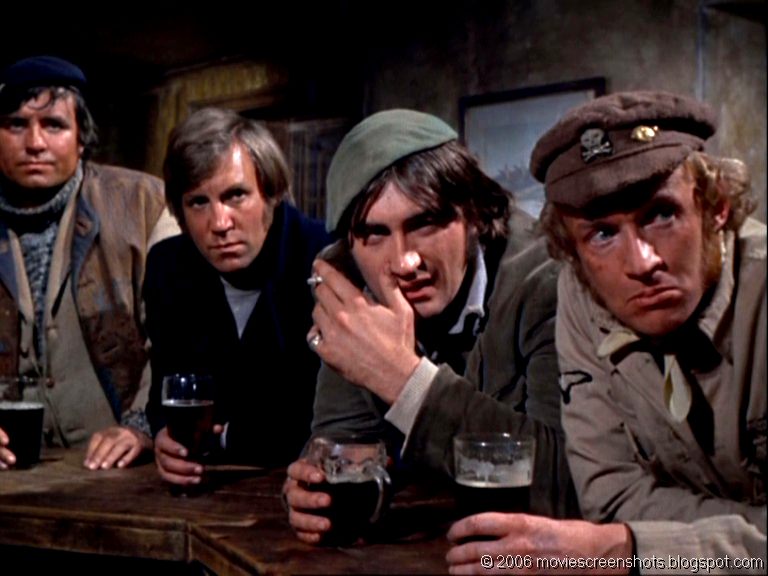 The Sumners' fragile relationship begins to slowly fray because of outside forces -- starting with Amy's old chums who are now employed to finish a roof on their garage. They eagerly watch as Amy gets out of her car in a dress, and accidentally flashes her panties. Amy is clearly disturbed by this event and their reactions, but it is also a discovery of where she can find the emotions so clearly lacking at home. She takes this a step further by walking near a window topless, explicitly letting them see her body. While Amy delights in the attention being paid her body, she is also unknowingly opening a door to the violent sexual hunger of the men, who see her act as an invitation.
As Amy is unwisely stoking the men's libido, David is being slowly ground down by the goons -- who use his pacifist tactics against him -- demonstrating that they can get into his house by stealing Amy's panties and leaving their dead cat hanging in the closet. The men trap David into one of the town's violent rituals of testing his tolerance, setting a precedent by seeing how far they can go before he snaps. A similar act is happening in the Sumners' home, as Amy is basically daring David to do something about the dead cat -- knowing full well that he is incapable of any retaliation. By calling her husband's non-shot, Amy has gained the upper hand in their marriage that she so desired. In her native land, she has the advantage over David, and is damn well going to use it.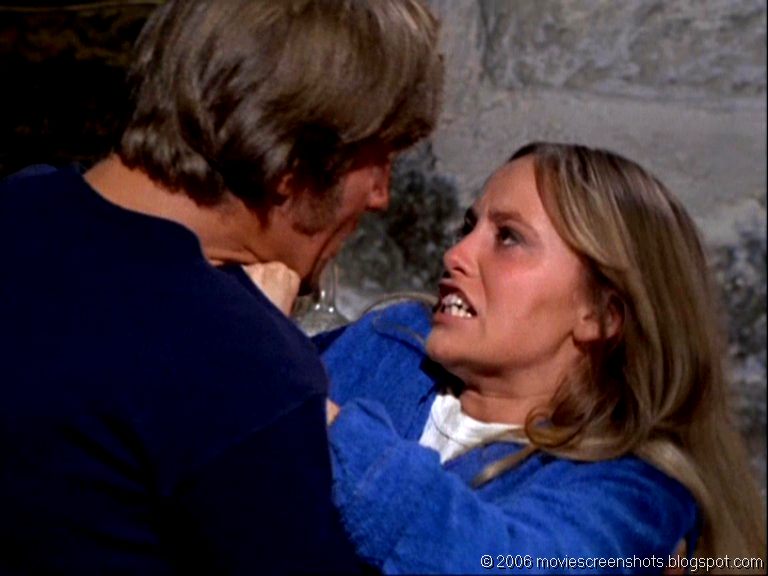 David tries to win over his wife by agreeing to go hunting with the men, but in doing so only enables the final part of their plan: leaving Amy home alone. Amy's old flame Charlie sneaks away from the hunting group and tries to make like old times inside her house. Amy resists his advances, but is powerless against his brute strength and is conflicted because she probably realizes how in this environment it is actually her fault because she was asking for it by exposing herself to Charlie and his friends. Equally conflicting to Amy is that she is finally receiving the lust and physical passion she has been begging for since she and David moved to England. For a moment we see Amy semi-enjoy Charlie having his way with her, and then it is gone as she tries to process the emotions and feelings she is experiencing.
The American in Amy wants to tell David about the rape, but her upbringing tells her to forget it -- since it was partially her fault. Meanwhile, shooting a shotgun during the hunt seems to have energized David, who fires Charlie's men for abandoning him on the hunt. Things come to a boil when David tries to harbor the village black sheep Henry (David Warner), who accidentally suffocated the young granddaughter of the town's drunken patriarch. The young girl probably mirrors Amy of years ago, as she struts around in skimpy clothing through the streets of an environment not made for her. After trying to find attention from the town's men, she goes after Henry -- who is mildly retarded and serving a lifetime of penance for a previous advance on a young girl.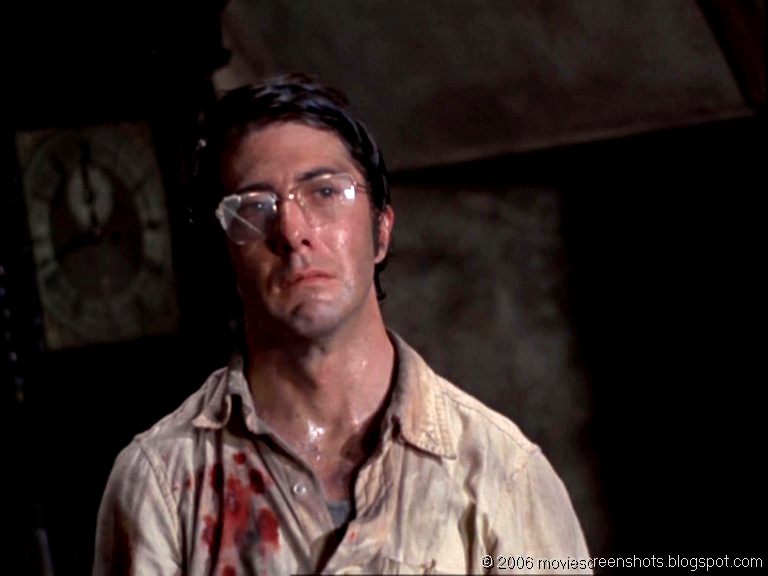 David knows the mob will kill Henry, and keeps him safe while plotting a plan to exact his revenge on all of them -- and in effect his wife, by showing her what he is capable of. During this process, David and Amy enjoy a fleeting moment of shared passion as Amy begins to see her husband as the kind of man her town produces, and is obviously turned on by it. In the end, David's pacifist ways come to an end, but so does his marriage, as in 'winning' the war within he and Amy's relationship -- he has only found the door to escape.
Thanks to Movie Screenshot blog for the excellent screenshots.
Friday, February 09, 2007
FRIDAY SCREEN TEST: DVD Guy
DVD Guy has been writing movie reviews on the Internet longer than most of us have been ... um, watching reality shows? A founding member of the Online Film Critics Society, DVD Guy has penned content for a variety of sites, but now focuses most of his attention on his blog The Watercooler, where in addition to film reviews you'll find the fruits of his intensive You Tube surfing and many other pop culture tidbits that you'll rarely find anywhere else. The Watercooler has a vast reserve of content that goes far beyond movies, including remarkably candid accounts of his career stops -- including a fascinating read about his time at a failed HD television network.
THE GHOST AND MR. DVD GUY: 'I thought the Blair Witch Project was sufficiently creepy, with creepy vibes given off that would last for quite some time after the initial viewing.'
SEE YA, PSYCHLO: 'Battlefield Earth made me quit Scientology.'
THE 10 CENT CONCESSIONS AREN'T BAD EITHER: 'I'd love to experience the 50s and 60s sci-fi/horror movies in a theater with that era's crowd.'
ROCK OF AGES: 'I recently watched The Family Stone over the holidays with family. I fully expected to hate the thing but it wound up being the best film I'd seen all year.'
THE LOST WEEKENDS: '[I watch] one or two films during the week. 3-5 on weekends. Sometimes more during the summer or outside of football season.'
LISTEN HERE, YOUNG WHIPPER SNAPPER: '12 Angry Men, The Ox-Bow Incident or Ruggles of Red Gap' -- movies DVD Guy would show to someone who hates anything not in color.
AQUA LUNG! Anchorman never fails to rise DVD Guy's spirits.
BE NICE: 'Road House' . . . 'awesome cheese.'
WELL, ALLOW ME TO RETORT: Pulp Fiction is DVD Guy's easy answer for all-time favorite film.
Contact DVD Panache if you would like to contribute to Friday Screen Test.
Monday, February 05, 2007
Cut to The Chase

One of the first posts I imagined myself writing when I started this blog was an expansive essay on Vertigo. After picturing the myriad of messages, images and oddities my complete Vertigo essay would need -- not to mention sections on composer Bernard Herrman and his themes -- I became a little intimidated by my own expectations and backed off. Recently I compromised on a post that would try to list all the things I loved about the movie, but as that list evolved it became clear that one entry would be enough for one whole post, which I present today.
Vertigo enters my mind more frequently than any other movie. There's so much to like that I often find myself humming Herrman's Love Theme or just imagining the cemetery scene. It all comes back to The Chase, as I think of it: beginning with Scottie's first encounter with Madeleine at Ernie's and ending with the McKittrick Hotel scene. The chase sequence epitomizes what a cinematic experience Vertigo is and the decisions Hitchcock could make to brand his films so otherworldly and so uniquely his. The sound, the images, the story -- I'm in heaven when I watch it, and I'm going to try and explain everything that's perfect about it:
Ernie's
The Chase begins at the restaurant Ernie's, where Scottie is supposed to meet his mark, Madeleine. Ernie's is a great example to how committed Hitchcock was to making a complete environment in the Vertigo world: the restaurant set doesn't have much screen time and is not central to the plot at all, yet it becomes one of the most beautiful scenes in the most gorgeous movie of all time. The swanky Ernie's is covered rich crimson walls (looks almost like velvet) and filled with well-to-do San Franciscans. Ernie's is crowded, and yet when the camera pans into the dining room our eyes can't help but be drawn to the woman in the corner wearing a dark green dress. Her back is to the camera, but we all know it's Madeleine. She isn't even centered or focused on, yet because of the contrast in colors, it's apparent who we're supposed to be looking at.
Start your engines
No small detail is left to chance in Vertigo, including the cars of choice for Scottie and Madeleine. Scottie is driving a white DeSoto Firedome, while Madeleine is behind the wheel of a sea green Jaguar Mark VII. Watching Hitchcock, it's clear he was a car guy, as the automobiles in his movies are characters of their own (as I observed in The Birds, which features one of the rarest cars of its era). The Jaguar is a Union Jack touch in a movie that otherwise celebrates America, and also serves to set Madeleine apart while on the road, since almost all the other cars seen have nowhere close the elegance of her Mark VII. Scottie's DeSoto suits him similarly, as he's driving an obscure brand that would be dissolved only three years after Vertigo was released.
The early driving scenes lead us to a hallmark sequence of the film, as Madeleine turns off into an alley. The decision to have Madeleine enter from a backdoor in the alley not only serves to convey that she has done this quite a few times, but also enables Hitchcock to present a surprising reveal: Scottie opening the door from the dark alley to see a vibrant flower shop. This short scene of Scottie watching Madeleine purchase a corsage gives us two inventive techniques. First, the new DVD transfer of Vertigo allows us to better appreciate a subtle, yet brilliant bit of cinematography: there's such a contrast between the foreground characters and the floor, as well as from the foreground to the multiple planes of focus in the background, it's almost like a cinematic Where's Waldo. If you fix your eyes on the floor of the flower shop, it appears that it is the principle focus of the camera -- it appears sharper than anything else in the frame. This effect adds to the dreamy nature of The Chase, and is enhanced by the multiple planes of background that are still slightly in focus enough for us to observe their details. The other bit of brilliance in this brief scene is when we see Madeleine turn towards our (Scottie's) viewpoint -- we think she's spotted her pursuer, yet as the angle changes we see that she's actually admiring herself in a mirror. In this angle we see both characters looking at each other, even making eye contact, without Madeleine knowing he was there (or did she?).
See you in church
Throughout The Chase, Bernard Herrman's epic score has been pulling us through a variety of themes -- similar to how a silent movie score would, in that its many variances serve to further the story. As Scottie follows Madeleine into a church, we get a sort of Herrman/Hitchcock 'wink' through the score. When Scottie enters the church, the score suddenly switches to an organ playing a slow hymn -- the first reaction is that church is in session and the organist is playing, yet a split second later we see that save for our characters the church is dark and empty. What was originally presented as music in the story is revealed to be more of Herrman's atmospheric score -- a hymn whose ending note is played just as Scottie exits. I believe this maneuver to be a nod toward classic silent cinema, when the music would mirror where the movie was taking place (i.e. a maritime tune for a boat scene, a youthful jingle for children).
Scottie's exit of the dark church becomes another bold transition, as he finds himself in the adjoining cemetery, with blaring colors and gravestones that seem to glow in the light. Hitchcock uses the many flowers in the cemetery to play with perspective -- one such example is when Scottie is hiding behind a wall, when he begins walking again the camera pans with him and suddenly a rose branch comes into the frame right in front of the camera, and perfectly in focus. The Chase is so mysterious and suspenseful, Hitchcock's playful 'gotcha' jabs adds to its atmosphere.
Things only get more mysterious at the museum, where Scottie sees the resemblance between Madeleine and Carlotta. One aspect I recently noticed is how not only Madeleine mimics the painting, but also Scottie. Watch as Scottie turns to find the museum worker, at one point his face and eyes are in the exact same pose as Carlotta in the painting.
The lady vanishes
The Chase concludes at the McKittrick Hotel, home to the most vexing scene in the movie. The hotel itself fits right in with the rest of Vertigo's locations, as its dark gothic appearance looks out of place in the glowing streets of San Francisco. Madeleine's ghost-like exit is enhanced during Scottie's last glimpse of her in this scene, as he sees her raise the curtain in her room -- brightening up the grim exterior, resulting in a glow-like appearance for her. Hitchcock plays with perspective again here, as when Scottie is on the ground floor with the manager, the hotel interior seems small and narrow -- yet when he goes upstairs it suddenly looks grand and expansive, perhaps another minor jab at Scottie's fear of heights. We find Madeleine's room locked and undisturbed, despite the fact that we had just seen her open that curtain. It's a strange scene that doesn't really make sense even after later events occur, but it's a fitting conclusion to one of the most fascinating sequences ever seen.
Friday, February 02, 2007
FRIDAY SCREEN TEST: Piper
At Lazy Eye Theatre, Piper gives readers his own unique programming. The posts often come fast and furious, with Tuesdays reserved for original Top 5 lists (Top 5 Pantiless anyone? How about Top 5 Missing Digits?). Piper recently published a generously-detailed ranking of his favorite montages (some may cry foul over The Karate Kid's low rating), and his clever Plot Farm posts are worth revisiting. If you're still not sold, try reading about what movies changed Piper's DNA -- to see what he's really made of.
WHEN CAN YOU START? 'Get Shorty ,Goodfellas and The Godfather all make me want to be in the mob. High Fidelity makes me want to own a record store. La Femme Nikita makes me want to be a professional assassin' ... 'All those films and many more make me want to be a film-maker. But the truth is, I love my career right now.'
IF YOU'RE GONNA SHOOT, SHOOT -- DON'T TALK: 'I sat downwith a friend and spoke for hours about Mulholland Drive. And I mean HOURS. I saw A Clockwork Orange way before I was old enough to and I think I talked with my buddies about that all night. Probably more about the sex and violence than what a good film it was. I rarely sit down and write about a
film. I'm not the best reviewer. I'm a much better talker.
TIME ENOUGH AT LAST: 'I am a husband and father of two so I don't get away to the theatres as much as I want. I probably watch 2 to 3 movies a week. And not always new movies as I am an avid re-watcher of my favorites.'
IN THE END, THERE CAN BE ONLY FIVE: 'I love so many different movies for different reasons. If I pick one over the other, it's like I'm picking one kid over the other. I can give you my top 5. The Royal Tennenbaums, Out of Sight, Fight Club, High Fidelity and Goodfellas. And now I feel guilty because I've left out so much.'
THE KID'S ALRIGHT: 'Seven Samurai is a bit long, but you watch it and see how so many current movies have borrowed from it. Even my eight year old loved it.'
THE FRIGHTENERS: 'Watch Halloween and The Thing and Hell Night and more recently, Malevolence. If [you] weren't scared by those, [you] are not living. Going to movies is about having fun. It's not a dare or a chore. You have to want to be scared. It's no fun otherwise.'
PLEASE VENTURE TO SHUT UP: 'I bought the first season of Venture Brothers on DVD and I can't quit talking about that show. Everybody hates me because I always talk about it and how funny it is and subtle and brilliant.'
HUGHES IT OR LOSE IT: 'Last year my mother was diagnosed with lung cancer (she is cancer free now). Those first few days were some of the darkest I have faced and all I wanted to do was watch John Hughes movies. Ferris Buellers Day Off, Sixteen Candles, Weird Science. Movies that made me feel young again when I didn't have to worry about all the shit I do now.'
AWFULLY GOOD TASTE: 'There are some who probably think Re-Animator is awful, but I love it for everything that it is. Or Phantom of the Paradise. Or Roadhouse, which I might argue might be one of the best action movies out there and I know a lot of people who think I'm crazy for saying that.'
Contact DVD Panache if you are interested in contributing to Friday Screen Tests.
Tuesday, January 30, 2007
The case for Alien 3

There was no way Alien 3 could win. Not only was it the long-time-coming sequel to one of the most popular and revered movies of its genre, but it fed fans an early peak at a potential dream storyline, only to jerk them the other way with a more familiar, financially prudent one. Despite being an Alien/Aliens fanboy, I resisted seeing 3 for years -- and when I did I kind of enjoyed it. This feeling was enhanced recently when I watched the 2005 re-cut of the film, which puts it closer to director David Fincher's original vision before Fox stepped in. While 3 certainly is not in the same league as its predecessors (and miles away from the coloring book bird shit of Resurrection), it's also a movie that when set on its own and regarded individually is actually very enjoyable. But the movie, even in the new cut, does have some problems -- which I'll get to, but first a look back at the impossible expectations facing 3.
In the years leading up to 3, the Alien fan fervor was continually stoked by the high quality comic book and novel series by Dark Horse that took up the franchise and offered inventive stories and sometimes stunning illustrations. My experience was with Book 2 and Earth War, both of which had their own unique graphic style and followed similar storylines of large scale alien wars on Earth and beyond, with tons of action, lots of blood and new twists to the Alien universe. The overriding theme with all of the Alien comic books and novels was a lot of aliens, and possibly a conflict on Earth.
So you can imagine the response from the original teaser trailer, which was little more than a voice-over of 'They say in space no one can hear you scream -- on Earth, everyone can hear you scream.' Fantastic, Aliens on Earth! This trailer must have been made at the earliest of stages of 3's production, because even before the reported 30 drafts of the script -- the original never included Earth (Wikipedia's Alien 3 entry speaks of an early script where Hicks and Bishop are the main characters, and another where Ripley lands on a wooded planet inhabited by farmers). Further complicating the promised 'on Earth' premise is that the movie's title in that teaser was still 'Alien 3,' not 'Aliens 3' or 'More Aliens' -- indicating a singular nature of the enemy that ended up in the finished product. It seems unlikely that there would have ever been a concept centered around just one alien on Earth -- because the whole point of 'Alien' and 'Alien 3' was the lack of weapons (maybe it would have taken place in a mine? on a boat?).
3's critical and commercial meltdown upon release was exacerbated by a 'what could have been?' sentiment started by that original teaser. Instead of Ripley fighting through hordes of Aliens as she made her way up the Statue of Liberty to be picked up by Bishop at the torch (why not?), we have a movie where the title villain doesn't really make an appearance until it's halfway over. Worse yet, Ripley was dead, realistically ending any hopes for a make-good sequel.
Over the years, the stories from behind the scenes of 3 have made it a sort of modern day Mr. Arcadin or Pat Garrett and Billy the Kid in terms of studio interference. After seeing the theatrical cut, Fincher essentially disowned the movie -- a gutsy statement for a first-time director -- and refused to participate in any of the DVD extras for Alien Quadrilogy (though he reportedly did do interviews for the DVD, where he blasted Fox -- and they were subsequently cut out by the studio). Despite Fincher's non-participation, the lavish set does include an extended cut of the film, which makes it more enjoyable but does not erase all of its problems.
Watching the new cut, I couldn't help but imagine how interesting 3 would have been if it wasn't part of the Alien universe. So much of the first half is dependent on the prison colony not knowing who Ripley is or what her secrets are -- if this was a standalone movie and the viewers were getting filled in along with the prisoners, it wouldn't make the first half feel so slow. The slow first half gets the best treatment in the new cut: the alien emerges from a cow instead of a dog (much more realistic -- in the original cut the dog pretty much explodes, leaving an alien in its place), there's a great little shot of a prisoner finding a dead face-hugger (presumably one that impregnates the host with a queen alien) and a few scenes enhance the character development (the best is a frightening attempt at raping Ripley by a group of prisoners, showing that they're just as dangerous as the alien).
Not until the plot development of The Company coming to retrieve the alien and Ripley, and the prisoners banding together to kill the alien do things really start to pick up and develop into a nice thriller. Lacking even the flamethrowers of Alien, the characters have to get creative to survive, and I would put these scenes among the best of the series. Perhaps the greatest (and most overlooked) strength of 3 is the acting by the first-rate cast. Charles Dutton hasn't gotten too many quality roles, and you could argue that this is his best -- possibly channeling his own prison experience. Charles Dance, Paul McGann and the great Pete Postlethwaite are all great character actors who are allowed to work without much of a leash. And of course the photography and production design we've since come to expect from Fincher is always on display in 3, presenting a dark labrynth of despair and disrepair.
The biggest problem with 3 is the alien itself -- both in how it is presented and what its role is. I used to enjoy the creature effects in 3, but that was when I saw it on VHS and it seems like the new DVD transfer really exposes the effects' problems. For the first time we really get a good look at the full alien (this was impossible with the predecessors since puppets were used), but it just never looks real. More troublesome is the creature's role in the film -- it never really gains that aura of menace and evil like the lone beast in Alien. Despite the theat of The Company's arrival, there just never seems to be a serious urgency in killing the alien -- maybe because Ripley is the only character we really care about, and she's going to die anyway from what's inside her.
The 2005 cut enhances 3, which remains an interesting scifi sequel, and an entertaining study in the studio process. I have to also mention perhaps the single-biggest change of the new cut: when Ripley dies, we don't see a fully-mature queen alien bursting out of her chest -- this always struck me as odd, since it went against everything in the previous films and helped end the movie on a frustrating note.
Friday, January 26, 2007
FRIDAY SCREEN TEST: Andy Horbal
[A note about this series: As a child, The Oregonian's entertainment magazine A&E was something I looked forward to every week, not only for movie reviews by Shawn Levy, but for their weekly Film Freak. Each week, the paper would profile someone on their movie tastes -- it was usually someone in the local entertainment field, but sometimes it was a baker, or city official or a nobody. I was always praying that the Film Freak would somehow pluck me out of Madeleine Elementary for a quick interview. Little things like that were cherished in the pre-Internet age. I'm hoping Friday Screen Tests will inspire similar enthusiasm -- each week, a new blogger or critic. I've been planning this for awhile and have a good corps of my favorite writers onboard with me. Enjoy.]
I first found Andy Horbal's No More Marriages! via his supremely overwhelming and thought provoking Film Criticism Blog-a-thon -- which ended up being so wonderfully vast, that it probably deserves a disclaimer at the top warning readers what they're getting into. Andy's posts have a way of stirring conversation that only adds to his editorial (this poll generated 277 comments), and it doesn't hurt that he usually uses a series of excellent screen grabs to illustrate his points. Andy also keeps a handy running post of monthly links, pointing readers toward the furthest reaches of pop culture and beyond.
NO MORE MARRIAGES?: The unique title of Andy's blog is perhaps a reference to the movie that inspired its creation a year ago this month: Brokeback Mountain.
THAT'S A WRAP!: 'I saw The Mummy in high school and I left the theater saying to my friends, "Bloody hell! I could make a better film than that!" I think I started looking at film schools the next day...'
ONE AND DONE: The phrase 'what is your favorite movie?' rankles some of us in its bitter singularity: how can you choose just one? Andy's final answer is at the ready: Playtime. It's a good time to be a fan of the Tati classic, as it recently received the treatment by Criterion.
SEVEN DAYS WITHOUT A MOVIE MAKES ONE WEAK!: 'I get all itchy if a day goes by without a movie...'
NO SUMMERTIME BLUES: 'I disliked the first Spider-Man a great deal and I had no reason to believe the sequel would be much better, but I quickly realized that I was watching perhaps the single best summer special effects spectacular ever. A movie like this is a mixed blessing: every summer since I've found myself ponying up $8 for movies like The Island and Superman Returns just in case...'
SOMETIMES THEY COME BACK AGAIN: 'LSD + Night of the Living Dead = A lifetime of looking over your shoulder...'
ONE CRITIC'S GARBAGE: 'My negative responses to film are as interesting to me as my positive responses, so I end up spending as much time re-watching and thinking about "bad" movies as I do "good" ones. Because, the thing is, if I'm watching the film, then someone liked it enough to spend money on it. Someone expected other people to like it. So where's the discrepancy, right? Is there something wrong with me? I'll give you a representative selection of a "bad" movie that fascinates me: Rocky IV. I disagree with just about every decision made in the making of that film, but I love it. That movie is America...'
STRIKE UP THE FLUX CAPACITOR: Seeing The Passion of Joan of Arc during its original theatrical run must have been a lot like being struck by lightning...
LIFE AS HE KNOWS IT: '"Wake up woodchuck chuckers, it's... Groundhog Day!" The most life-affirming movie ever made. Ever.'
Contact DVD Panache if you are interested in contributing to Friday Screen Test.
Monday, January 22, 2007
Three forgotten femme fatales

My recent viewings have given me three of my favorite femme fatale characters and actresses that rarely get the notoriety they deserve. The first has long been a favorite of mine, while the other two have only recently perked my interest
Billie Jean (Helen Slater in The Legend of Billie Jean)
When the best teen movies of the 80s are spoken of, the works of Hughes, Spielberg, The Cories, as well as the usual suspects of The Goonies, Adventures in Babysitting and maybe a few good slashers are frequently the topic. My top five in this category will include some combination of the previous, but also a largely forgotten gem that is not even on DVD: The Legend of Billie Jean.
Released in 1985 as a vehicle for Helen Slater, a Pat Benetar single, some kid named Christian Slater and as much teen angst and injustice you can serve up in 96 minutes, Billie Jean is pure entertainment for anyone seeking to relive those seemingly carefree years. Filling the movie's one-sheet and most of its scenes is Slater, whose unique beauty was perhaps never put to better use as a striking young girl who walks the line between innocence and heartbreaker. Alongside Slater is the blond (!) and barely recognizable Christian Slater (no relation), as well as Dean Stockwell and an early role by Yeardley Smith (who was 21 at the time but looks no older than 11). Behind this respectable 80s talent is Benatar's "Invincible," which must have been viewed by the studio as the movie's trump card (chords from it are played throughout, and the song itself is played at length no less than twice).
One of the more endearing qualities of Billie Jean is that the central prop is a top of the line Honda scooter (God those were cool), belonging to the Billie's brother Binx (Slater). After a milkshake skirmish at a local Sonic with spoiled ruffians, said bullies steal and trash the scooter, leading Billie to seek reparations from Head Bully's bully dad. Predictably, Bully Dad wants more than Billie's gratitude in exchange for the repair money. Confusion and youthful stupidity in Bully Dad's store lead to our gang being framed for armed robbery -- and they go on the run. Worse yet, no scooter repair money!
Though on the run from the law, Billie becomes a sort of folk hero for teens across the country. Getting inspiration from a Joan of Arc movie, Billie sheds her golden locks and continues to stick it to the grown man -- eventually growing into a Pied Piper-like figure with the nation's youth. Did I mention that every character speaks with exaggerated south Texas accents? That Yeardley Smith is the comic relief? That there's a getaway scene involving marbles? That Peter Coyote has a significant role!?!
It's all here, and so much more. The action really picks up when Billie uses her newfound media celebrity to save a child from his abusive father and ultimately get sweet revenge on Bully Dad and adults everywhere in a scene that must have sold millions of "Invincible" singles. It's a little sad to realize that of all the actors in the movie, Christian Slater had the best career, while Helen Slater's presence and looks couldn't help her get another meaningful onscreen role again -- perhaps unfairly blamed for the dreadful failure of Supergirl, when she played the title role.
Annie Laurie Starr (Peggy Cummins in Gun Crazy)
Oh how I love the alternate title for this movie: Deadly is the Female. Goddamn that rocks, and really seems to fit better in regards to the story and the movie's message. As the sex bomb with the six shooters Annie Laurie Starr, Peggy Cummins has one of the most memorable and jaw-dropping sexy entrances in all of cinema. After being introduced by her carnie manager, Starr struts out firing a pair of revolvers, wearing skin tight pants with holsters resting on her hips. As she goes about her trick shooting act (which includes shooting targets through her legs), she treats the men in the audience (as well as the viewers) to a view of her behind that must have been considered scandalous in 1950. You have to understand: Cummins is absolutely poured into these pants and with the look on her face throughout the shooting exhibition is simply the definition of a vamp.
Gun Crazy has more to offer than just Cummins, giving us the story of reformed bad boy Bart Tare, fresh off a tour in the military and committed to a straight life after once being a delinquent youth obsessed with guns. Those good intentions go astray with the sight of Starr one night at a carnival. Tare is invited onstage to best Starr's crack eye and the result is a ferocious display of sexuality in the form of dueling pistols and wills. Starr's display consumes Tare, and two quickly are a pair. But a carnie salary does not satisfy Starr, and she soon convinces Tare to rob a bank with her. The bank heist is presented in a breathtaking one-shot scene filmed from the back seat of their getaway car, and the deadly pair are soon on their way across the country picking up loot wherever they can. Yes, deadly is the female who can put such an honest boy up to no good.
Gun Crazy was a fun surprise, packaged in Warner's Film Noir Classic Collection -- though I would hesitate to classify it as film noir. Yes, the subject of a woman turning a man to crime smells somewhat of noir, but outside of that it looks and plays a lot like the better crime movies of the era (think White Heat or The Public Enemy). Still, DVD Savant provides a commentary track (credited as a film noir expert), and I'll defer to his knowledge.
Marnie Edgar ('Tippi' Hedren in Marnie)
Though she's not commonly mentioned as one of film's timeless beauties, something about Tippi Hedren is intoxicating to me. She has such a flawless -- possibly girlish -- face, and that rare way of barely moving her lips (hardly ever smiling) that I've also noticed with Scarlett Johanson. I can see why she was a Hitchcock girl, her odd but beautiful qualities are similar to Kim Novak's -- who has a somewhat masculine face, and also uses stone emotions. When paired with Sean Connery in Marnie, it's all eye candy.
In The Birds, Hedren isn't given too much to do save for screaming -- but as the mysterious, venomous Marnie, she is clearly in her element. Panned upon its release, Marnie holds up well as an absolutely gorgeous movie with sexual themes similar to what Hitchcock presented in Notorious. It's a wordy movie and I'll try to describe the plot with few of them: Marnie has many aliases and has left many trusting men poor in her stealing wake, until she meets Mark (Connery) who catches on to her game. Mark forces Marnie to marry him, lest he reveal her crimes -- but he is not so much concerned with having a comely wife as he is aroused by her cunning nature and obsessed with figuring her out.
In Notorious, power-wielding Carey Grant grappled with being a pseudo cuckold while gives us Connery playing a man who has created a pleasant domination-submission scenario with a woman who is used to having the upper hand. In both movies, the men are in unchartered sexual territory and struggle with how far they want to take it. But with Marnie, it's tough to find much sympathy for either character, unlike Notorious. The characters are unlikable and seem to have little consequences for their actions. Still, it's a gorgeous movie with a great Herrman score (his last for Hitchcock).
Tuesday, January 09, 2007
"Does Anybody Remember Laughter?"

The bar has been lowered. Not only for Hollywood and the moviegoing public, but the general creative direction of comedies. If you know what I speak of, you have no doubt seen the trailer for Epic Movie, which appears to take the obscenely unoriginal attempts at satire of the Scary Movie saga into unseen levels of unfunny.
What the HELL is this thing?
Before we get into the real horror of the matter, let's look at what it's following. I steered as far away from Scary Movie 4 after seeing its predecessor, which was the biggest bomb attempt at comedy I had seen since Saving Silverman. Not only did Scary Movie 3 look like a straight-to-Comedy Central production, it just wasn't funny. At all. The only mildly funny gag in the whole movie wasn't even an attempt at satire, it was the somewhat-clever 'rats vs. mice' bit. The only reason I gave '3' a try is that I actually liked the second one, which I felt was even superior to the original. The problem with '3' was that in the process of handing the directing reins from Keenan Ivory Wayans to David Zucker, the movies dropped their clever gags and writing and somehow discovered that it's funny simply to pop in references from recent movies and pop culture. The problem with this is that when seen even a year after its release (if not during its theatrical run), the movie feels achingly dated -- which makes the unfunny jokes even more painful.
So here we are at 'Epic Movie,' which drops the theme of skewering horror movies and goes after any recent blockbusters. Let's see, that will mean we'll get a homosexual Superman, an excuse for a bunch of drug jokes in Narnia, maybe some homosexual Pirates of the Caribbean and . . . some drug jokes from 'Willie Wonka'? Is that it? Oh wait, seems we also get some poignant skewering of 'Davinci Code' in the form of an albino character (albino humor!) and also some Mexican/homosexual humor care of Nacho Libre. Brilliant.
The sad thing is, this movie will make money (if you don't believe me, 'Night at the Museum' is already long past the $150 million mark) and this tragic trend of hit non-comedies will continue. If you really want to ruin your day, take a look at some of the comments on the movie's MySpace page, here's a few snippets of agony:
'yo, i can't w8 4 dis movie 2 com out, i'm gonna go c it on da day it does'
'cant wait to c this movie ... "omg a talking beaver*girl kicks beaver*" ... lol'
'this movie will trully kick ass'
'EPIC MOVIE OPENS IN 17 DAYS!!! This movie is going to kick serious *bleep*!!! Word to the CRAACKEN!!!'
It's just depressing that these kind of movies represent the state of satire filmmaking today. Zucker cut his teeth with some of the best of the genre in 'Airplane!' 'Top Secret!' and the like, but those movies were based around well-executed goofball comedy inside a shell of takeoffs on recent subjects (and even then, they were generalizations of genres, not the exact characters). If the misguided youth of today is this excited for 'Epic Movie,' will they ever know what it is like to laugh at something that is actually funny? If a girl kicking a beaver makes them laugh, what then when they see This is Spinal Tap or The Big Lebowski?
Most confusing is that a couple members of Christopher Guest's Comedy Troupe (Jennifer Coolidge, Fred Willard) -- talented actors who know what comedy should be -- are apparently willing to grit their teeth through a few days on set in exchange for another month at Atlantis.
I can't remember ever wanting a movie to fail as much as I do with 'Epic Movie.' It represents laziness and a collective disinterest in quality filmmaking.
Note: Extra large kudos to readers who know which 1970s concert movie this post's title is taken from.
Friday, January 05, 2007
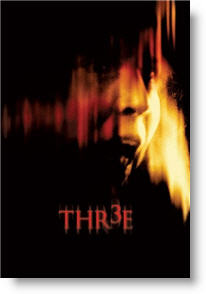
'Thr3e' is a z3ro
You may have seen previews for the mystery/thriller Thr3e on the Sci-Fi channel recently, and perhaps were slightly surprised that you were watching a trailer for a theatrical movie and not a straight-to-video release. But after seeing 'Thr3e' (opening toda in select markets) via a screener disc recently, what jumped out to me is that the previews do not tout its one selling point: as being a Christian mystery thriller.
Based on the popular Ted Dekker novel of the same name, 'Thr3e' is distributed by Fox Faith -- a new Christian wing of Twentieth Century Fox -- and on paper would appear to be a viable attempt at getting a mostly clean Hey-People-This-Isn't-7th Heaven! Christian movie into the mainstream. Why? The book (which I have not read) has a plot that's pretty much ready-to-film, even though it borrows heavily from many other better movies ('Saw,' 'Se7en'). Wait Adam -- you're saying a Christian movie could resemble 'Saw' or 'Se7en'? That's exactly its problem, in trying to cater to more mainstream movie fans, 'Thr3e' is ultimately a failure as both a straight-up thriller and a Christian movie.
The story follows Kevin Parsons -- a young seminary student who is very good at looking sullen -- who suddenly finds himself tormented by a villain who uses a voice-altering device and a bunch of vintage mini reel-to-reel players to ensnare his victims in easily-escapable traps and puzzles. The villain desperately wants Kevin to confess his sin (as we are frequently told), lest his bland bomb-laden puzzles continue to unspectacularly explode 'round the city. Luckily Kevin has childhood friend Samantha at his side -- who took an interest in his emotion-free existence at an early age -- and a female detective who was once a target of a similar villain.
The Christian hook outside of Kevin being a seminary student is that there are cursory biblical references in the villain's puzzles -- and a desperate attempt to develop a theme of good vs. evil within man. If you're looking to take your family to a Christian movie, the preceding is really all you get -- oh wait, there is a priest character at the end who issues a weightless proclamation that we must put our trust in God, but you've probably heard that line before. Like the trailers airing, 'Thr3e' contains no Christian message, unless you count the fact that it's a 'Se7en' clone made without gore or harsh language.
So people looking for a Christian movie will be disappointed, but so will the handful of folks who get lured in via the non-Christian Sci-Fi Channel trailers. This is your by-the-numbers thriller where people dash from one dark corner of a city to another, featuring haggard-looking cops in trench coats and manufactured suspense under the constant drone of the villain's digitally-altered voice through a cell phone. The puzzle-killer aspect of the movie would seem to be a chance for success, but one dreadfully dull sequence illustrates how this device fails: a friend of Kevin is found with a bomb strapped to him and the words 'wages of sin' written on his fore head -- in a frantic race against time, Kevin remembers where in the bible these words are spoken, and uses the verse and chapter numbers to stop the bomb. Why would a killer go to that much trouble when he's up against a seminary student? What's more, there's never any sense of danger because the bombs left by the killer never really do any harm because of how poor the movie's pyrotechnics are. Example: characters run away from a refrigerator right as it explodes in a fireball, but when they return to it five seconds later, the blast has only mildly scalded the inside of the appliance.
The answer to many of the movie's confounding lack of excitement can be found in the 'twist' ending taken straight from the book. Looking back, it would seem that a twist of this sort could be an ace-in-the-pocket of 'Thr3e' -- like 'Signs' or 'The Village' -- but it ends up being terribly unsatisfying and almost completely unblievable. What starts out with the intentions of a theme on confession and good vs. evil ends up being an ancient plot device that relies on a stereotypical view of the mentally ill that I thought Hollywood buried for good in the 1970s. Any 'Amen' you may say at the end for its alleged Christian message will only be for the sight of the closing credits.
Tuesday, January 02, 2007
List Me Deadly
We find ourselves in a new year, and yet I still have not posted a year end list of sorts. Well since I'm late to the party, I think I'll go in a different direction. My new release viewing this year was dreadfully low, so this post will focus on my favorite DVDs of 2006.
Best Box Set
1. The John Ford-John Wayne Film Collection
This was one set that made me jump out of my chair after reading about the early specs, and I still consider it one of my best purchases of the year and a very cherished cornerstone of my collection. What sets this set apart from others is the sheer value of it: for a little more than the price of buying the new editions of 'The Searchers' and 'Stagecoach' (included) you also get SIX OTHER MOVIES. And these are no throwaway titles (though it's admittedly hard for me to get excited about The Long Voyage Home), they're some of the best ever produced by this duo.
2. Superman: Ultimate Collector's Edition
From the You Wanted the Best You Got the Best shelf comes this gargantuan chunk of superfan bliss. The 'Superman' collection is similar to the above set in value, but gets knocked down a peg due to the famously questionable quality of (at least, depending on who you ask) two of the including movies. Even the most hard core Superman fans would admit that they could live without III and IV, but neither are without their merits (e.g. Brick Vision and Robot Hag). In addition to generously upgraded DVDs of all five movies, you also get the new Donner Version of II, the theatrical version of The Movie, old Superman cartoons, a huge documentary and even a chance to send away for 27x40 posters of each movie (I could do without five Superman posters, but have always had a spot in my heart for the 'Quest for Peace' poster).
3. Preston Sturges: The Filmmaker Collection
This is the rare set that lets you explore the given works of a genre or director nearly completely. From the brilliant comedic director's golden era (1941-44) we get everything but The Miracle of Morgan's Creek, all packaged in a pretty attractive price. I'm sure there's plenty of fans out there like me who have heard all the praises of Sturges, but have yet to really penetrate his work (in my case, Sullivan's Travels is my lone voyage), and this set solves that problem nicely.
4. Controversial Classics Collection
A somewhat steep price is the only knock on this set, which has a nice blend of well-known classics and forgotten wonders. The beauty of this collection is that all of the movies contained were all genuinely controversial in their own way: Bad Day at Black Rock (see it!) was the first film to touch on post-WWII American-Asian hostilities, The Blackboard Jungle's violence and tension is still shocking today in some respects (not the least of which is Glen Ford's explosive performance), while A Face in the Crowd was an early examination of the power and influence wielded by the media.
5. Bogie & Bacall -- The Signature Collection
A great example of how a box set can bat 1.000 without being huge or luxurious. For a low price you simply get four genuinely excellent movies including at least two (for me it's The Big Sleep and Key Largo) that can be considered among the best ever made. This set does not offer heaps of extras, but it also has exactly zero fat on it and is a great value (gotta love the name, too).
Best Re-Issues
1. The Maltese Falcon
Like many of Bogart's movies (*cough* 'Casablanca' *cough*), this classic was in serious need of a re-issue, as it does not deserve bare-bones treatment. The resulting treatment was more than anyone could have expected, which was highlighted by the inclusion of two previous film versions of the story and also three radio adaptations. The other extras -- a new transfer, feature-length documentary, commentary and even a blooper reel -- combined to make this DVD one of the rare instances when a major studio's release is on par with what Criterion would have done.
2. The Searchers
Available on its own or in the aforementioned Ford-Wayne set, Warner Bros. celebrated this timeless movie's 50th anniversary in style. The handsome packaging foreshadowed the lavish treatment of the film inside: a stunning transfer, three wonderful featurettes, an informative commentary by the always entertaining Peter Bogdanovich (his track on 'Citizen Kane' is another good one) and an introduction by Patrick Wayne are just starters, as you also get a large assortment of lobby cards, on-set correspondance and even a 1956 comic book adaptation of the movie. The latter is a treat for 'Searchers' fans, as it was printed in the early days of the comic book code era, and as such there were significant liberties taken with the movie's storyline to omit graphic content.
3. Forbidden Planet
Another 50th anniversary edition, the classic sci-fi triumph's rich colors and amazing special effects can finally be seen as they should. Highlighting the generous extras is a spinoff movie starring Robby the Robot and the mildly disappointing but well-meaning TCM documentary 'Watch the Skies.' I was lucky enough to receive the Ultimate Collector's Edition of this for Christmas, which comes in a large tin and includes lobby cards and a Robby the Robot figurine, and let me tell you: if you're expecting to open up the tin and find a like-sized robot, you'll be disappointed (its size is even misrepresented on the official picture of the set, but at least you get a nice-sized tin). Read DVD Savant's take on the movie for his typically-engrossing analysis.
4. Brazil: The Criterion Collection
Another in Criterion's applauded effort of re-upgrading movies. In Brazil's case, it was one of the first movies to be overflowing with extras, first on laserdisc and later as one of the first huge efforts on DVD. This new version gives the movie a much needed anamorphic upgrade, and also adds a single-disc incarnation for those who don't need multiple cuts of the movie or want to pay twice as much. The extras are still eye popping, with the short 'Love Conquers All' cut dropped on America and the proper 146-minute Gilliam edit. DVD Journal regards the previous version as the best DVD ever made, and this only makes it better.
5. Seven Samurai: The Criterion Collection
Perhaps a more impressive Criterion re-issue was their new three-disc 'Seven Samurai.' The Kurosawa classic put Criterion on the mainstream map for unmatched DVD quality and was their top-seller for a long time. Not only does the new version one-up the original's lauded transfer, but also adds two more discs full of extras including exhaustive documentaries (such as a two hour Kurosawa conversation produced by the Director's Guild of Japan) as well as a booklet packed with essays.
Best of the Best
Saturday Night Live: The Complete First Season
In another huge DVD year, this release probably made the most waves just for what it represented. Definitely no stranger to DVD, Lorne Michaels and company upped the ante by committing to what they have been dared by fans to do from the beginning: give us everything. And it's all here: every uncut episode and even the musical guests. To me, the biggest whopper of this idea is imagining down the road when we have thirty-some seasons for sale, and the inevitable BOX SET TO END ALL BOX SETS featuring EVERY season with somewhere in the neighborhood of 200+ discs! What this also signals is the strength of the DVD format, because I doubt that NBC would release six or so SNL seasons on DVD, then commit to Blue Ray or HD-DVD and leave DVD in the cold. If this is a true commitment, it's one that will span years.
Dazed and Confused: The Criterion Collection
This was a personal slam dunk, that feeling you get when Criterion chooses one of 'your' movies that you never thought would have gotten the treatment, and boy did it get it: appropriately outrageous cover art, a Linklater commentary, documentaries and a booklet full of high-quality essays. This is just a loving tribute to a great movie that means a lot to plenty of people, and has even managed to increase my love for it (best example: Linklater clues us in on the scene with Carl's mom pulling the shotgun being his tribute to the similar scene in 'Night of the Hunter').
Essential Art House - Fifty Years of Janus Films
I'm not exactly recommending this one -- I'm not sure I would even want it if I had the means -- but it's reassuring to know that something like this exists (sort of how the Pagani Zonda deserves to be worshipped, even if it really has no place in the world). I think of this as the Galactus of DVD -- Criterion saying 'you call that a knife, this is a knife' and promptly pulling out a MOAB bomb. For the low low MSRP of $850, you get a 50 disc phonebook of a set includes 50 films and a 200 page book that will provide equal wonder and horror for anyone in your home.
Best Trends
1. Movies within movies
I noticed this one last year when the Wizard of Oz three disc set included long-forgotten silent treatments of the classic story, and you're seeing it more often now, as evidenced by a few of the above. I love seeing extras like this that break from the mold.
2. Slim-line box sets
It seems that the days of box sets the size of a phone book are coming to an end, as studios are starting to catch on to the idea of using slim-line (or slim-pack, whatever you call the very thin packages) holders inside sets to reduce their girth. Not only does it look better, but it makes everything much easier to handle without wear and tear.
3. More economical 'discing'
Like the above, the days of DVDs having two discs just for the hell of it seem to be dead too. The worst example of this for me was the old double-disc version of 'Big Trouble in Little China,' which put the full screen version on one disc and the widescreen on the other, despite the fact that there were few extras to take up space. It seems that since prices of DVDs are getting lower and lower, manufacturers are more apt to keep them low by keeping everything on one disc.
Best of 2007?
Bicycle Thieves: The Criterion Collection
Another Criterion that will hit home with me, Bicycle Thieves is one of the best movies you will ever see and is very deserving of some world class DVD treatment. Though it's set in post WWII Italy, this is simply a timeless movie about life that has indescribable highs and lows of genuine emotion. Haven't heard any specs on this one yet, but I'm sure it will be top notch.
Long-rumored Eyes Wide Shut special edition
There have been rumors practically since its theatrical release about a definitive director's cut of 'Eyes Wide Shut,' and there's some 'truthy' information about its future being bounced around lately. Initially this focused on the controversial decision to digitally mask some of the more graphic elements of the orgy scene, but now the most anticipated feature of the DVD would be an anamorphic widescreen transfer. Kubrick's more recent movies are presented in open matte full screen at his famous request, reportedly believing that full screen looked better on televisions -- and he obviously did not live to see the day of widescreen TVs. The most recent 'Eyes Wide Shut' DVD is presented in the actual aspect ratio it was filmed in (it was matted on the top and bottom for its theatrical run), but it's frustrating to watch on a widescreen TV and the picture itself could use a remastering.
Tom Goes to the Mayor: The Complete Series
It's a small triumph that this short-lived, much-loved [adult swim] series is coming to DVD, but it's a minor miracle that it's all going to be on one three disc collection. If you missed Tom's original run, it was a strangely animated and even stranger written show, that was always bizarre and hilarious. Its crude underground origins are similar to South Park's, and I hope it enjoys more popularity on DVD.
Night of the Comet/Solarbabies
Just announced from MGM, a pair of 80s scifi movies that had long languished in the Night of the Creeps/Monster Squad level of digital non-existance. I'm very familiar with Solarbabies, one of those movies that you could always count on HBO to show way too many times in the late 80s. Combining a little of a Mad Max-like apocalypse future with teen angst and some roller skates -- 'Solarbabies' is pure magic. I've seen bits and pieces of 'Night of the Comet' -- a tale of valley girls trying to save the world after a large scale disaster, and it'll be tough to keep me away from this one.
Criterion's Eclipse series
A very exciting announcement from Criterion has been their decision to start a new line devoted to forgotten/cult films, which will be offered at an affordable (around $15) price. The only movies on the Eclipse line so far is a collection of Ingmar Bergman's earliest efforts, but you know there's going to be an announcement or two down the road that will really blow your socks off.