Showing posts with label Theatrical reviews. Show all posts

Wednesday, February 06, 2008

Burmese Promises: Rambo's back


By Mark A. Curci

Was the it the Philosophers' film of the Decade?
Of course not.
No more than Cash was a poet laureate.
BUT. Was it a good movie? Absolutely.
To examine...The first, damn near inherent, argument...Does America (and, by that. most Americans mean "the World" NEED another Rambo film?
Weren't all those points made? Well, I suspect Stallone's perspective would indicate, "Clearly not."
We start with First Blood, a truly introspective film most people haven't seen, based on the VERY advanced novel by the Canadian writer David Morell.
The thesis? Humans enter into wars with the Abraham convention that sacrifice has a divine dignity to it- which it might...BUT; without respect and understanding of the true implications OF that sacrifice; and WHO and HOW those sacrifices unfold-without THAT understanding... how dare we?
I think ALL the films, at surely varying degrees of complexity, present the thesis that we’ve always been to quick to send out our sacrifices like we’d order in a pizza during a blizzard or hurricane. With calm, detached, simple removal.
The sequels... testosterone infused zen answers to questions we have yet to fully articulate; about how the soldier breaks; fails society, and how an already innately broken society has always failed to answer the riddle of the soldiers we broke.
Well...so DOES the world need another Rambo?
I guess that depends on whether or not you feel that that question has been answered yet.
In MY opinion, given the movements of the world, and us within it...No. We still ask the same questions with the same bullets.
On the other hand, director/co-writer Stallone takes a keenly hard-lined approach at those who would answer those questions with home-grown, absentee-faith-based naiveté. His answer to that is equally grisly.
My appreciation for the film is that it ultimately offers no immediate answer. It merely paints a portrait of war that, one critic, bafflingly in a pejorative sentiment, said that the film, "depicts violence so graphically that it transcends cartoonishness."
Well, duh. That's the point.Violence transcends cartoonishness.
And, even in the parts where one roots for the "good" guy... the shots are devastating. They are laborious. They are disgusting... and, further, they make ourselves disgusted with ourselves for having ever rooted for the John Wayne simplifications-cowboys-and-indians answers we were handed before.
Seeing a person come apart isn't supposed to be simple, and it certainly isn't supposed to be pretty. It's a disgusting, revolting act, meant to be just that. And, here, it is.
In this film… it is NOT. The theme of the original is how long of a road home life is, in the context of the horrors we face.Attach your own philosophy to what "home" is; but in this film... I feel Stallone presents a very sober, if not subjective, answer.
Something of a..."Enough is FUCKING-ENOUGH!!!"...Maybe home IS worth the trip.
And, in his way, a big "Fuck-you" to Hollywood to boot. Ironically, Hollywood hasn't gotten it yet, and is actually marketing it. But I think I get it.
Anyway, again, all subjective. But I give it a thumbs up.
Again, by NO means the best film of whatever *insert arbitrary time frame* BUT...a work of artistic and competent merit, for sure....my friend who accompanied me, a world-traveled anthropology major, she thanked me, saying she felt the film had merit, that she appreciated it AND... that, of course, she'd never have seen it if I hadn't asked her to accompany me.
There you go. Like all Zen...sometimes the best way to think is by not over-thinking. In that, Stallone has always been our masculine-monk-master... forever under-appreciated in the plainest of sight.…the point is made through what I observed while smoking on my deck after the film.
Six cars, on an obviously iced up road zoomed past. Each times, within seconds, a long and loud screech wailed down the road. Americans just don’t get what’s obvious. They must be slapped, then lulled. We don’t wish nor require sense. We need to be tricked, into Stewart, or Stallone- wisdom masqued as Pop, to get the Point.
The point is the ridiculousness of us, our excess our vanity and our willingness to go the distance.
St. Aquinas painted proof of God’s existence in the world as evidenced through five naturalized proofs. We, on the other hand, have bleached everything natural from our periphery and wonder why we never see God in the white noise punctuating our commercial channel surfing. We’re fools. But, the fools we are- ignorant to so much of the Art in this world… we’d do worse than a three-billion-dollar, one-eyed King like Stallone finally coming full-circle....But enough of that... read the book ya'selves!

-------------------
Mark A. Curci is a writer and poet based in Ashland, Ore. He once rode a Greyhound bus from Oregon to New Orleans and back.

Sunday, January 27, 2008

Strategy guide for 'Cloverfield' (XBOX 360)


About the game: Cloverfield is a first-person adventure game where the player takes on the role of HUD (an obvious play on "Heads Up Display"), an everyday guy who gets caught up in a monster attack on Manhattan. The game begins at a going away party for one of HUD's friends, and progresses as HUD and his friends try to escape to safety, while also trying to unlock the secret of the monster's origin and possibly defeat it.

Weapons: There are only three weapons in the gme: digital camera, pipe and fusion cannon. The digital camera has unlimited recording capacity, and when pointed at someone allows you to talk to them and gain information. The pipe is available at certain locations in the game and is effective at swatting away Gnat Spiders and possibly killing them. The fusion cannon is only available if you decide not to save Beth at her apartment building and is located in a secret location (see the LEVEL 6 section for more information.

Gameplay: Most of the game is spent running through the streets of New York City, with occasional jumping challenges and attacks from Gnat Spiders. Occasionally, you will be attacked by the monster and will need to dodge its legs. Also, several areas will require you to talk to people on the streets to gain information for the next level.

Level walkthrough
Level 1: The Party
This is a fairly simple level designed to teach you the controls. At your friend Rob's going away party, you're tasked with getting seven video testimonials from guests. Aim the cursor at a guest's head to solicit a testimonial, and be sure to have your digital camera recording. You'll find that most of the guests won't be interested in giving a testimonial, the easy way to find the right guests is to look for those who are holding a martini glass. A few guests will offer you a drink -- if you accept, your movement will become slower, but it will also add to your Drunk Bonus at the end. After you record the seventh testimonial, follow Rob to the roof to see the monster cut scene.

'Cloverfield' gives the gamer first-person monster action!

Level 2: Streets of Manhattan
The hardest part of this level is right at the beginning when the Statue of Liberty's head comes flying through the street. The best strategy is to wait two seconds after the crowd starts screaming before jumping backwards. Too early and you'll land where wreckage from the building will crush you, too late and the head will squash you. After the head lands, talk to a few people and you'll eventually meet a crowd heading for Brooklyn. Before you leave, make sure to find the convenience store and stock up on your Slusho supply for later.

Level 3: Brooklyn Bridge
This is one of the hardest levels in the game, as you'll have to keep track of Rob and your other friends, or risk getting caught where the bridge will collapse. After a few minutes of walking, the bridge will start collapsing -- instead of running with the crowd, stay with your group of friends and jump to safety. There are a few tricky jumps so it might take you a few tries to get through. To get through the level, talk to a few people at the end to find which route to take to the subway.

Level 4: Monster Battle
After following Rob through the streets, you'll soon hear the monster coming. Dodging its giant footsteps is fairly easy, as you'll see the shadow indicating where they'll land. The monster will stomp six times before the army intervenes. Duck as soon as you hear gunshots (Y button) and stay down until you hear the tank approaching. Roll to the right (Y + R buttons) and watch the army battle the monster. If you rolled to the right, the entrance to the subway should be around the next corner. Find the pipe next to the subway entrance, you'll need it for the next level.

Level 5: Subway
By far the hardest level in the game, if only for how hard it is to see the Gnat Spiders. At first they will come one by one, but by the end of the level there will be packs of them. At first you'll be able to kill them by dealing a few blows by the pipe, but when more and more gang up on you, just give each of them one hit to slow their attacks. Remember, if any of your friends die the game is over so keep the Gnat Spiders away from Rob and Marlena. When you hear Marlena yell "This way!" that means the exit is up ahead, hit it with the pipe and the door should open and the level will end. Try to save your Slusho health power-ups because you'll get to recuperate in the next level.

Medical center crossroads
After Level 5 you'll get a chance to refill your health from the military doctors and also need to decide which path to take to the end of the game. If you choose to go to Beth's apartment building, you can save Beth and upgrade your Friends Bonus at the end of the game. I recommend taking the Central Park path, where you can find the Fusion Cannon and destroy the monster.

Level 6: Central Park
During this level you'll be dodging the monster's footsteps until you find the Fusion Cannon and blow up the bug. The Fusion Cannon is located on top of the J.J. Abrams statue at the center of the park, and the only way to get to it is to push the hot dog cart at the beginning of the level and jump from the top of it. Once you have the Fusion Cannon, there's just one shot to kill the monster or the game is over. The best way to connect with the Fusion Cannon is wait until the F-22s distracts the monster, then aim for its head. Bonus: before you head to the evacuation helicopter and finish the game, go to the electronics store across the street and click the cursor on one of the televisions, the news report on the TV will explain the monster's origin.

Sunday, November 25, 2007

Walk Silently and Carry a Big Whatever-the-Hell-That-Thing-is


No Country for Old Men is the most quietly ferocious movie you'll ever see. I can't stop thinking about the brilliant sound design choices by Joel and Ethan Coen that lift the movie from a simple genre exercise into another level of terror and excitement. In the same way Ennio Morricone fashioned a theme out of creaks, drips and cracks for the opening of Once Upon a Time in the West, here we have an entire "score" made out of footsteps, desert wind, breezes through an open window, distant passing trains and simply the sound a man makes when he's contemplating what his next action will be that won't result in his death. All these sounds are heightened because no note (whether dialog or effects) goes wasted, wrapping the viewer in silence and putting us in the same mindset as the characters, where fate seems to be waiting behind the corner.

The sequence that best exemplifies this method is when Llewelyn checks into the second hotel, and tries to assess his possibly fatal situation inside his room. He hears something strange from the front desk, then tries to phone the manager -- with no answer. The next two minutes are nearly silent, save for a couple remote footsteps and Llewelyn's fear of what might be outside his door. There's no dialog, but it's one of the most exciting moments of the movie, as we wait for the action to shift toward Llewelyn or Chigurh at any moment. The masterful sequence one-ups itself as the action shifts outside, with Llewelyn commandeering a man's truck as bullets from Chigurh's suppressed pistol attack the vehicle like hellfire from some unearthly beast. The sound design on the gunfire is unlike anything else I've ever heard -- you can almost hear the bullets zipping through the air, and it's never clear where they're coming from. The exhilarating battle continues on the deserted street (with the adversaries still never seeing one another) much like it began, with both men waiting for the other to make a move.

No Country For Old Men is essentially about a satchel full of MacGuffin, the quest of two men to extend their lives for one more day, and an aging sheriff dealing with the fear of where his road may end. Like many Coen Bros. characters, the three men are very precise in what they say and do. These are the kind of resourceful men who use items such as tent poles, cotton balls, wire hangers and their confidence to extraordinary effect. And of course there's the little matter of a high-powered captive bolt pistol. This kind of device could only be utilized so efficiently by a man such as Chigurh, whose drive requires only the most clean, horrifying and consistent methods. When we first see him use the weapon, he appears almost giddy at introducing another person to its quiet terror, confident that his victim won't struggle because he doesn't know what the hell it is. Has there been a weapon so befitting a movie villain since Leatherface started up his chainsaw?

As to be expected from the Coen Bros, the characters are charmingly foolish, but with more than enough wits to make you believe in them. Llewelyn is not a smart man, but he's definitely cut from a different cloth than other Texan trailerpark folk. He brings trouble on himself more than once, but he never flinches when searching for the next rabbit hole that will lead him to daylight. Chigurh is a psychopath, but he's also a self-aware psychopath, and his confidence can often betray him (such as when he's squaring off against a bull-headed trailer park manager). Sheriff Bell always wears the face of the law, but he's obviously terrified of what he's up against. And you can always count on the Coen Bros. to pepper their films with odd, one-off characters who wouldn't show up in any other movie (Llewelyn's encounter with the teenagers on the bridge? Fantastic!), and they're always able to remind you never to try and take some world-encompassing message from what you're seeing.

After the second act, I knew the movie would produce an abrupt and divisive ending ala Miller's Crossing or Barton Fink, since it seemed the Coens were giving us another story that had no intentions of wrapping up nicely. I wasn't quite sure of it right after I left the theater, but it made more sense once I realized that Bell never saw Chigurh, but knew without a doubt he was still at large. To know that an invisible terror was capable of re-entering your life at any time is truly the stuff of nightmares, particularly the one Bell describes in the final shot.

Wednesday, July 11, 2007

A Date with Loneliness


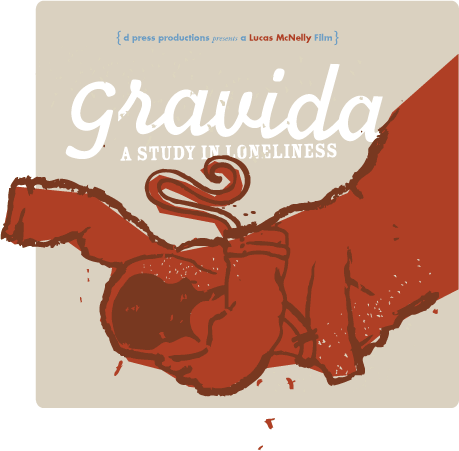
Many of you know Lucas McNelly from his excellent blog 100 Films, on which he frequently shines the spotlight on uber-indie filmmakers who make their art mostly on their own dime and definitely their own vision. Lucas champions these artists in part because he is one himself. His d press Productions is responsible for projects such as L'Attente and Guard Duty, and the latest is his most ambitious -- Gravida.

Gravida premieres July 12 at the Hollywood Theatre in Pittsburgh, and I was more than happy to post an advance review (these are the kind of perks you can expect as a Friday Screen Test alum).

Billed as 'a study in loneliness,' Gravida is equally about hope and identity. With a running time of 24 minutes, the film is tight with real conflict and emotion, taking great advantage of its short duration. The film is simple, but its themes and resolution is anything but -- and any further exposition or story lines would only detract from the end product. As the credits open we wake up wearily with Kristin, who only has a few more months of living alone (she's pregnant). The other character is Guy, a courier who frequently stops by Kristin's office and is a bit shocked at her forward invitation to dinner at her house. The evening seems to be going well, but there's always the lingering element of Kristin's pregnancy, and how she's not being forward about it with Guy. This issue is brought to a head in the film's final minutes, where Gravida reaches its touching apex.

Gravida deals with a delicate subject matter, and could have lost the audience's interest and trust without a careful hand, but Lucas is certainly up to the task. Lucas' camera is never obtrusive, acting more as an invisible observer even when the story's emotions peak. Actors Rachel Shaw and Adam Kukic find their stride as the story builds and are able to sell the idea that their characters are facing troubling, adult decisions.

Since the characters are obviously lonely subjects, much of their intimate moments are spent reconnoitering whatever line has been drawn between them. Because of this there is little dialog, but the film slowly gains momentum as the tension builds between Kristin and Guy as they must decide the fate of their night. This isn't a sob story. Gravida is honest and sweetly brutal in how it deals with its subject matter, and leaves you wondering how you would react in the same situation.

Saturday, June 30, 2007

Die, Hard Drive!


While watching Live Free or Die Hard, two questions kept going through my head: Does the world still need John McClain? and Does the world still need Die Hard movies? After exiting, I'm pretty sure that the answers are "no" and "yes."

I'll explain the former answer first: Live Free or Die Hard does pretty well without McClain, it has a great story and might have been a better movie without the Die Hard label and the constraints that come with it. If it had been made in the style of The 39 Steps or North by Northwest where a pair of truly ordinary people solved the crisis, there would be more opportunities for greatness. As an action movie, Live Free is very good. As a Die Hard movie, it's pretty average.

Live Free's greatest asset is its source material, a 1997 Wired article entitled A Farewell to Arms, which describes how the U.S. could be vulnerable to a digital attack. Consider these cryptic quotes from the article's opening:

From former National Security Agency director John McConnell: "We're more vulnerable than any other nation on earth." Or former CIA deputy director William Studeman: "Massive networking makes the US the world's most vulnerable target" ("and the most inviting," he might have added). Or former US Deputy Attorney General Jaime Gorelick: "We will have a cyber equivalent of Pearl Harbor at some point, and we do not want to wait for that wake-up call."

And the Pentagon brass? They commissioned their old RAND think-tank friends, who combed through the Day After results and concluded, "The more time one spent on this subject, the more one saw tough problems lacking concrete solutions and, in some cases, lacking even good ideas about where to start."

Live Free is different from your average action movie because it can establish genuine fear. When hackers start manipulating traffic signals to cripple Washington, D.C.'s transportation system, you wonder why it hasn't happened yet -- same goes for their activity surrounding the Eastern Power Hub in West Virginia (this aspect may actually be fictional, as there is no city of 'Middleton' in West Virginia, and I haven't been able to find anything on Google relating to a central power hub for the East Coast). Like the Wired article said, there appears to be no real answers to what the hackers are able to do in Live Free, and you start to wonder just how McClain figures into the solution. Many of the scenes find McClain twiddling his thumbs while Matt Farrell (Justin Long) hammers away on his roll-up keyboard. McClain conceivably supplies the muscle in their relationship, but most of his action scenes seem forced, as without the Die Hard label they probably wouldn't have been in the movie.

But the world needs Die Hard? I say yes. It had been too long since we have experienced the kind of characters only Die Hard can bring us: the Female Villain Who is Not as Defenseless as She Looks (but cannot hear a 50-year old man sprinting toward her from behind in a closed room), the Villain Whose Skill Becomes His Undoing (Jungle Boy in the ventilation room) or the shot of Bruce Willis Grinning While Dripping Blood and Reloading His Gun. In this resurgence of comic book, horror and CGI movies these kind of standbys often get left in the cold, but you can always count on a Die Hard to remind us of them.

This was usually a good thing, but it seems like the comic book movies may have affected the Die Hard franchise like John McTiernan slipping on Green Lantern's Power Ring. This manifests itself in the form of the aforementioned FVWNDSL slipping in and out of She-Hulk mode, especially the time she gets hit head-on by a truck going at least 40 mph without even coughing. The hacker villains' abilities sometimes rival that of Galactus, able to shut down power to vast expanses of cities but still retaining the ability to power up an individual elevator in the blacked out area at their whim. The hackers' god-like powers hurt much of the credibility established by Live Free's great story: at one point they gain control of a webcam in a character's house and make it point in their desired direction (I didn't realize webcams had the kind of motor mechanisms that would enable such a move -- and should I be worried about a hacker gaining control of my refrigerator and directing it to run me over?).

Die Hard movies have never really gone for realism, but the aforementioned trips into fantasyland seem to amend the movie's rule book as it goes along. The biggest damage the digital terrorism does to McClain is that he's not fighting something tangible -- the viewers have to imagine like he does that trillions of pieces of code are infiltrating the U.S. and crippling it. There's no central horde of villains carrying out the evil deed, it's a bunch of programs designed by hackers hundreds of miles away. In this sense, I wish the Wired article had been adapted for a non-Die Hard storyline. We still need Die Hard movies, but we also need McClain to be working in his native habitat.

Wednesday, May 09, 2007

Outside the Gates of 'INLAND EMPIRE'


There's a moment in David Lynch's INLAND EMPIRE where it seems like the director is sympathizing with his mostly confused audience: one of Laura Dern's characters is telling her story to a silent therapist and says 'I don't know what happened first, and it's kind of laid a mindfuck on me.' This line works on many levels: not only does it describe what the audience is experiencing at this point of the movie, but it also references an oft-quoted description of Lynch's movies: mindfuck. INLAND EMPIRE is so often frustrating and inaccessible that indeed my own mind may have been a victim of a Lynchian fucking -- I could have sworn this Dern line included a remark about not knowing about the future, but a Google search only contained quotes of what I printed above. It doesn't surprise me, as there's so little structure and narrative to INLAND EMPIRE that it's hard to recall the movie as a whole, only individual moments.

While Dern's character experienced a mindfuck, and many of Lynch's movies so enjoyably fuck with the viewer's mind, I can only describe my experience with INLAND EMPIRE as a mind-assgrab: it's only mildly offensive and rarely arousing, and the grabber gains only minimal enjoyment from it. David Lynch said during the making of this film that even he wasn't sure what it was going to be about, but rather 'I have this feeling that because all things are unified, this idea over here in that room will somehow relate to that idea over there in the pink room.' This is rather disconcerting for the viewer, because many movies require deep thinking and multiple viewings -- but if you're not sure there's actually something there, what's the point? In some ways, knowing that Laura Dern wasn't quite sure about the movie's meaning made feel better about not understanding it myself; but it also made me question just why it was made and/or released. Dern's apparent ignorance about the movie also speaks greatly about the actress' ability an d Lynch's talents, because her performance is the highlight of INLAND EMPIRE (and maybe her career).

INLAND EMPIRE is a claustrophobic experience for a viewer, because you have no clue where you are, and no sense of where you're going. I knew going in that it had a 170-minute running time, but I found it difficult to keep track of time during the movie because the scenes jump between delicately slow and maddeningly quick. If there was a redeeming aspect of
INLAND EMPIRE, it's that it physically puts you into a dream-like state -- constantly questioning where you are and what you're seeing. Lots of movies feel like dreams, but this is the only one I can think of that actually feels like a dream (do I have you in la-la land yet?). There are moments where beauty emerges out of bewilderment: a roomful of stunning hookers who transform from gleeful bullshitting to synchronized dance in an instant, an eerie scene on a movie set that hints at a temporal causality loop and the infamous family of rabbits that look somewhat like donkeys. In between these scenes are moments that draw you in because they hint at an actual narrative or plot, and you start to think about where it's going next.

I waited quite awhile before writing this because I wanted to think about the positive opinions I had read. Chris Stangl called it his favorite movie of 2006 and the always-keen Ed Gonzales gave it four stars -- what was I missing? I wanted to chalk it up to the fact that although I enjoy Lynch movies, I have also not seen them all, and some reviews hinted at belonging to a broader narrative that Lynch's movies have been building to. I also usually find myself defending the so-called 'confusing' movies such as Eyes Wide Shut and Syriana, which can sometimes be attributed to viewers not willing to give the effort needed to understand them. With INLAND EMPIRE, I never got the sense that there was something waiting to be discovered, and some of that may be due to the quotes from Lynch and Dern.

Exacerbating this sense is the fact that INLAND EMPIRE is not all that fun to look at. Beyond its digital video medium (which I kind of liked), the main problem is that the film is filled with jarring close-ups and angles which puts you right inside the life of someone you don't really want to meet (a seemingly useless late scene focusing on a grotesque conversation between homeless people is a chief offender of this). The next time Lynch makes a movie, I hope he knows what it's going to be.

Sunday, April 08, 2007

Giving Thanks


I set my expectations for Grindhouse at a usually impossible level. I couldn't believe a movie like this was going to be made, and upon reading the initial specs I had these instant thoughts: Danny Trejo must be involved in one way or another; Good God what is Rodriguez going to cook up? How will this be marketed? Good God what will Tarantino cook up? And the fake trailers will surely be one of my favorite cinema experiences of the year. While I had high hopes for Grindhouse, my expectations for the trailers were set at 'hungover Simon Cowell level' ... and were promptly exceeded. My Grindhouse experience was so wonderfully fun, that thanks need to be given out to many parties -- with the first to Eli Roth for putting me in a thanksgiving mood.

... to Eli Roth: Wow, where to begin? Your fake Thanksgiving trailer was a marvel of perfectly timed grotesque comedy that seemed to rev up the audience for Death Proof. Before the Zuckers (or whoever is passing themselves off as the Zuckers) try to release another 'satire' movie, maybe they should take a look at this trailer -- which shows that when done right, modern satire can be viciously funny and entertaining. It helps Roth that he knows the satire subject inside (ahem) and out, and that he is using a medium that affords him great strings of beats, one playing off the other with nothing in between. The much-rumored 'main course' of the trailer probably came the closest of anything since my first viewing of The Big Lebowski to ejecting me from my theater seat -- on paper this imagery would sound vile to the point of criminal charges in some countries (or states), but in the context and timing of the trailer it becomes one of the funniest things I've ever seen. Same goes for the infamous 'bounce kill' that the MPAA winced at -- it's the kind of thing you can't even explain to someone without making them back away slowly, but the way it's handled (the barely interested rat-faced boyfriend, the girl's strange enthusiasm, how the payoff comes about with no warning) is perfect. Sanity test: with this aforementioned scene, did anyone else see it as a cruel wink to the similar scene in the wretched 80s Brad Pitt slasher Cutting Class? Can anyone else admit to seeing Cutting Class? One more note: I'd like to believe that the cruel 80s trailer of Boarding House was one of Roth's main inspirations for Thanksgiving (not on YouTube, but found on many VHS copies of exploitation flicks -- see Necromancy, The Cheerleaders).

. . .to Rob Zombie: For informing me that we have the same sense of humor. I'm one of the few who liked his Werewolf Women of the SS trailer, sure it's bizarre and a little bit out of place, but how can you not love his shot of the zombie officer firing the machine gun while flanked by beautiful Nazi women? Or the fact that his trailer uses this exact same shot no less than three times? Whereas the other trailers have a Saturday Night Live feel, Werewolf Women seems like it was rejected from The Kids in the Hall. I loved how Zombie used his cameo actors, referring to them by name, but giving us just a quick (barely in focus) shot of them -- save for the biggie at the end.

. . .to the cast of Planet Terror: Part of the brilliance of Grindhouse is the contrast between the two features, and one aspect of this is that Planet Terror could probably stand on its own as a regular release, whereas Death Proof in all fairness would never have been made outside of this medium (in no way a slight on QT's movie, much more on this later). What makes Planet Terror the exception and places it a realm outside normal zombie fare is the high level of talent and sheer number of quality characters packed into an 85 minute horror movie. This element gives Planet Terror a frantic undertone that exacerbates the onscreen mayhem. The camera never lingers on one character long enough for them to get stale, but Lord knows we could have used even a little more Josh Brolin -- what a great character for the actor who started out as the asshole older brother in The Goonies!

. . .to Rose McGowan: For finally finding a role and putting in a performance that shows us just what she's capable of. As much as Rodriguez is lauded as a technical director, you have to give him credit for coaxing the stripper Cherry out of McGowan. For most of her career, McGowan has drawn on her base as a true vamp to pump out seething bitchiness and cold stares, but in Grindhouse she actually comes off as sweet and down-on-her-luck, maybe the first 'girl next door' that Rodriguez has ever cast. This quality allows her comedic beats to come on more naturally which in turn brings out more of the pouty vamp quality that Jennifer Tilly perfected long ago. I remember first seeing McGowan in Scream, where she had a small role and a smaller sweater -- which is probably what I remember more. Since then she's done quite a few duds, and her involvement in Charmed put her on hiatus from films for a few years. Hopefully Planet Terror will give her the opportunities her fans have been clamoring for.

. . . to Kurt Russell: For being Kurt Russell. Watching him as Stunt Man Mike in Death Proof makes you thank the movie gods that there is a Kurt Russell -- Tarantino lets him go to work. He has that familiar half-John Wayne accent combined with the 80s hair do that still looks good on him and probably four other men on the planet -- he's Kurt again. There are at least a couple generations of moviegoers who adore Kurt no matter what (look at what he gave us in the 70s and 80s), but Stunt Man Mike proves that his ageless quality goes more than skindeep -- he can still pull off the characters that utilize his brand of being a working man's action hero.

. . . to Zoe Bell: I wasn't a style="font-style: italic;">Kill Bill fan, nor have I ever watched Xena: Warrior Princess, so forgive me if I had never heard of Zoe Bell or even realized she was playing herself in Death Proof. This girl is something else: she's at once a modern day Karen Allen and the one girl on the college softball team you knew. She draws your attention in all her scenes, but does not look like a Hollywood actress. Bell is part of the reason Grindhouse will have a lasting legacy, because she will never have a better role in her career. Bell plays herself, and as such brings a breath of fresh blood to the screen, unburdened by any cliches or a conventional script, and promptly steals the show in the final act and ends the movie with a kick that leaves the audience cheering.

. . .to Quentin Tarantino: For proving us wrong. So much of the talk leading up to Grindhouse was that QT was a true aficionado of the genre, who worshiped exploitation flicks and had owned hundreds of prints of obscure blood and tit fests. With that in mind, it's amazing to see QT's restraint in Death Proof, the slow burn that he lets simmer for half the movie, with no exploitative sex or shocks to be found. To those wondering if Death Proof belonged in a feature called Grindhouse, check out some of the calendar he programmed for the Grindhouse Film Festival at the New Beverly Theater in Los Angeles: Rolling Thunder, The Town that Feared Sundown and Return to Macon County. Tarantino obviously knows the 'grindhouse' concept better than most, and he knows that not all of the films that typified that age were bizarre, blood-soaked flicks. Many of them were like Death Proof, a movie that appealed to a certain demographic and didn't have the support of a big studio behind it. While I didn't appreciate the tomes of dialog that QT threw at us in some scenes, you can't help but marvel as Death Proof turns into a monster of an adventure -- building and building until a fantastic climax that just happens to coincide with 'The End' being sprayed across the screen. It's quite a trip.

But . . . I can't give all thanks to Grindhouse, it's not a perfect film -- but who expected it to be? My criticisms are probably similar to others': Tarantino's cameos were unneeded and only damaged the mood of the scenes; the long spouts of dialog in Planet Terror are neither interesting or entertaining; and Planet Terror too often wanders into a silly world that his movies at some point or another inhabit, a trend he will someday outgrow I hope. I only have one gripe with an issue that many have brought up: the near complete lack of nudity and sex, a staple of the genre. I wasn't disappointed by this because one early scene tipped me off to it: after the opening credits we follow Cherry into the changing room of her strip club, and the most we see is a pair of pasty-covered silicone bags. If there's no nudity in that scene, why would there be at any other point? But this puzzles me -- why not have some accurate level of boobage in that kind of setting, seeing as Rodriguez tries for most of the running time to shock our senses and test our limits? I wasn't expecting anything sexual in Death Proof, because Tarantino's movies almost always sidestep this, with his characters usually choosing to express their sexuality with weapons or cars.

***********
You may have noticed the row of pictures on the right, it's my latest attempt to take more advantage of my sidebars. I chose this route because I often find myself staring at bizarrely fascinating and befuddling pictures on the Net, and why not share them? I'm addicted to a variety of random image generators, so you'll soon be seeing a better variety than what's there now (this is just a dry-run).

Tuesday, March 20, 2007

They Died With Their Codpieces On


I'll admit it: I liked 300. It's strange in that it's hard not to like, but equally difficult to isolate any particular moments of enjoyment. While I watched it, there was always a sense that something was missing, and later that night I arrived at just what that was: more violence.

Yes, violence. 300 appears to have this trait in spades, but it's never the kind of carnage or gore that makes you wince or appreciatively chuckle. Like the movie itself, the violence and gore is there, but it really isn't. This heavy digital style didn't stop me from enjoying the hell out of Sin City, but with 300 the violence and gore are two of the main characters. A full CGI experience works with lush backgrounds and special effects, but when it comes to a sword ripping through Persian after Persian, for some reason it doesn't translate with CGI.

Brutal large-scale battle movies like Braveheart, Zulu and Spartacus are effective because the characters have genuine fear of their enemies, and would plainly like to avoid being skewered or shot. The carnage in those movies was painful, brutal and most of all -- exciting. In 300 the blood is digital, as are the wounds and stampeding hordes. The disconnected emotions I felt during the grandest of the battle scenes was similar to what I experienced after a nice game of Halo in which maybe 200 aliens met their spectacular demise. In both cases I saw the deaths and was convinced the characters were dead, but didn't feel it at all because it was clearly just some combination of digital bits. I'm more likely to be motivated to pick up the flag of PETA after a game of Duck Hunt than to feel the weight of mass human loss from 300.

That said, 300 does have a lot going for it. The decision to film a comic book adaptation of a historical event dumps a helmet full of potential on the page before a single word of the script has been written. I've read Frank Miller's 300 (hell, it's only like 50 pages) and loved Miller's approach of illustrating an epic event as it would be imagined by a young person. Miller took great creative liberties in his story, but it's nothing that a young imagination wouldn't dream up while hearing about it in history class. In the hands of Zack Snyder, Miller's imagery is brought to life with loving care. The source material is never dumbed down, and the warriors on both sides are lifted up to a level just beyond reality.

After enduring his odd voice in Phantom of the Opera, I could never imagine liking Gerard Butler, but 300 would be nothing without his strong Leonidas. It might help his cause that he's carrying with him into battle one of the greatest beards the world has ever seen. Xerxes is magnificent, better than I had imagined while reading the book. He looks and acts like some obscure X-Men villain, and his scenes are the movie's strongest. It's this aspect where I yearned a little for 1962's The 300 Spartans, which features Xerxes and his camp much more prominently -- and also has a better overall story. In that movie we get much closer to Xerxes, portrayed in a far less interesting (though no more historically accurate) manner, and the give and take between the two sides becomes more developed. I would have loved to see more of Xerxes' horrifying camp -- his 'human guillotine' was perhaps my favorite part of the whole movie, what a spectacularly wretched creation

I will say this about digital combat: it is a proud age we live in for cinematic decapitations. Until this movie I had never seen a full-on believable beheading (guillotine scenes notwithstanding), but Snyder perfects it with his technology. I hope from this moment forward we never get another awkward jump-cut shot to a dummy with a foam rubber head tumbling off.

Saturday, March 03, 2007

Black Snake Groans


In his coming-out movie, Hustle and Flow, writer/director Craig Brewer provided one of the year's best scenes. The bare-bones creation of music -- starting with the lyrics, gradually getting a beat, then a melody, until finally a song was born. I think I watched that scene three times in a row, and each time I was amazed at how Brewer was able to give the sequence a natural progression, showing that when creative minds are put to good use, new art can be born in a matter of minutes. I look at Black Snake Moan as a similar exercise, but this time it's a tribute to blues music -- a genre Brewer shows needs much more than simply lyrics and a melody, but for the artist to use their emotional extremes as an instrument of its own.

When it all comes together, in a crumbling but still lively blues hall somewhere in Tennessee, Lazarus (Samuel L. Jackson) lights up the place with a hard, menacing number that contains all the strange amounts of anger, strength and salvation he had felt in the past week. It's a scene that almost makes you want to get up and dance in the theater aisle, or at least yell the profane lyrics along with Lazarus. Black Snake Moan shows hints of the sex/race exploitation movie that commercials and promos make it out to be, but it's ultimately about redemption through a microphone -- not a chain locked to a radiator and a delicate waist.

Those last three elements are what get the most face-time in the previews, but they take a backseat to Lazarus and his guitar. Lazarus is a stubborn Tennessee farmer, whose favorite line is 'ain't no way you're gonna move me!' The key word in that quote is 'you,' because Lazarus is intent on solving problems on his own, or through the Bible. Yet there aren't many words in the Bible to explain what to do with a beat-up, sex-starved, half-naked floozie who is dropped near Lazarus' house as if from above. What Lazarus does know is that according to the Bible, there's no reason why Rae (Christina Ricci) should hunger for sex like a hummingbird for nectar. His controversial solution is to put Rae on a rehab program with no Britney Spears-walk-out clause: chain, radiator.

It's in this device that Black Snake Moan will win or lose with the audience. To me, it seems to function more for visual means than anything within the story, while others might see it as Lazarus' way of making Rae experience a normal sex drive. The chain scenes weighted the movie down too much for me, and I had to strain to find anything engaging Rae's plight after the first few minutes. Ricci, looking nothing like the curvy sprite of her early career, does a fine job as Rae -- but it's hard to find too much to like about her. Lazarus sees her as a soul capable of salvation, but do we? Rae kissed her boyfriend Ronnie (Justin Timberlake) goodbye to Iraq in the film's early moments, but it's never apparent what their love is, besides satisfying Rae's appetite (Ronnie is seldom onscreen, and given little to do besides furrow his brow).

It's Lazarus that's easy to root for, as he was once a blues showman in this desolate place, and shows an occasional flare of being the town's troubled hero. Unfortunately, possibly for Brewer's need to 'pulp-up' his movie, Lazarus is given baffling moments such as telling us about losing his virginity to an overweight second cousin, and moments of cruelty that seem out of place with his character. Black Snake Moan's finest moments are when we see Lazarus as a bluesman, such as playing Rae a tune while lightning crashes outside and the power goes in and out, or the aforementioned club scene.

When Lazarus belts out that last song and is on top of his game again, it's easy to chant along with him, but it's hard to feel the sense of his journey because Rae is still largely the same person. Even more troubling is the fact that Lazarus brutally imprisoned Rae, but after the first few hours she appears resigned to the situation and becomes the Harold to Lazarus' Maude rather rotely and unremarkably. Brewer tries to juice up Rae by dropping in a cold subplot about her mother and possibly explain her sickly condition, but it ends up feeling forced mainly due to the lack of script space devoted to it (Rae's confrontation with her mother ends cheaply with nothing resolved). Lazarus' performance is the highlight of the movie, but we arrive there by slogging through an album of songs whose choruses never seem to end. In a movie powered by music, Black Snake Moan only has a single to show for its efforts.

Note: This review is also published at TalkingMoviezzz.com

Friday, January 05, 2007

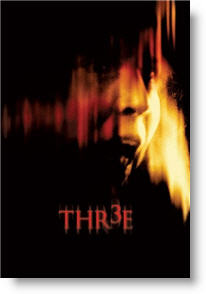
'Thr3e' is a z3ro


You may have seen previews for the mystery/thriller Thr3e on the Sci-Fi channel recently, and perhaps were slightly surprised that you were watching a trailer for a theatrical movie and not a straight-to-video release. But after seeing 'Thr3e' (opening toda in select markets) via a screener disc recently, what jumped out to me is that the previews do not tout its one selling point: as being a Christian mystery thriller.

Based on the popular Ted Dekker novel of the same name, 'Thr3e' is distributed by Fox Faith -- a new Christian wing of Twentieth Century Fox -- and on paper would appear to be a viable attempt at getting a mostly clean Hey-People-This-Isn't-7th Heaven! Christian movie into the mainstream. Why? The book (which I have not read) has a plot that's pretty much ready-to-film, even though it borrows heavily from many other better movies ('Saw,' 'Se7en'). Wait Adam -- you're saying a Christian movie could resemble 'Saw' or 'Se7en'? That's exactly its problem, in trying to cater to more mainstream movie fans, 'Thr3e' is ultimately a failure as both a straight-up thriller and a Christian movie.

The story follows Kevin Parsons -- a young seminary student who is very good at looking sullen -- who suddenly finds himself tormented by a villain who uses a voice-altering device and a bunch of vintage mini reel-to-reel players to ensnare his victims in easily-escapable traps and puzzles. The villain desperately wants Kevin to confess his sin (as we are frequently told), lest his bland bomb-laden puzzles continue to unspectacularly explode 'round the city. Luckily Kevin has childhood friend Samantha at his side -- who took an interest in his emotion-free existence at an early age -- and a female detective who was once a target of a similar villain.

The Christian hook outside of Kevin being a seminary student is that there are cursory biblical references in the villain's puzzles -- and a desperate attempt to develop a theme of good vs. evil within man. If you're looking to take your family to a Christian movie, the preceding is really all you get -- oh wait, there is a priest character at the end who issues a weightless proclamation that we must put our trust in God, but you've probably heard that line before. Like the trailers airing, 'Thr3e' contains no Christian message, unless you count the fact that it's a 'Se7en' clone made without gore or harsh language.

So people looking for a Christian movie will be disappointed, but so will the handful of folks who get lured in via the non-Christian Sci-Fi Channel trailers. This is your by-the-numbers thriller where people dash from one dark corner of a city to another, featuring haggard-looking cops in trench coats and manufactured suspense under the constant drone of the villain's digitally-altered voice through a cell phone. The puzzle-killer aspect of the movie would seem to be a chance for success, but one dreadfully dull sequence illustrates how this device fails: a friend of Kevin is found with a bomb strapped to him and the words 'wages of sin' written on his fore head -- in a frantic race against time, Kevin remembers where in the bible these words are spoken, and uses the verse and chapter numbers to stop the bomb. Why would a killer go to that much trouble when he's up against a seminary student? What's more, there's never any sense of danger because the bombs left by the killer never really do any harm because of how poor the movie's pyrotechnics are. Example: characters run away from a refrigerator right as it explodes in a fireball, but when they return to it five seconds later, the blast has only mildly scalded the inside of the appliance.

The answer to many of the movie's confounding lack of excitement can be found in the 'twist' ending taken straight from the book. Looking back, it would seem that a twist of this sort could be an ace-in-the-pocket of 'Thr3e' -- like 'Signs' or 'The Village' -- but it ends up being terribly unsatisfying and almost completely unblievable. What starts out with the intentions of a theme on confession and good vs. evil ends up being an ancient plot device that relies on a stereotypical view of the mentally ill that I thought Hollywood buried for good in the 1970s. Any 'Amen' you may say at the end for its alleged Christian message will only be for the sight of the closing credits.

Tuesday, December 12, 2006

Jaguars and Sacrifices and Mayans - Oh Mel!


A few years ago I had East Indian neighbors, who were very passionate about their Bollywood movies. I would try and watch some of them (on Indian channel so no subtitles), but could never really get into them. I always meant to show them an American movie that didn't need subtitles, a movie where you could enjoy it without knowing what the characters were saying. At that time I thought of 'Hoosiers' as a choice, but never had the opportunity to show it to them. I'm telling you this because one of the reasons I enjoyed 'Apocalypto' so much was thinking how it could be enjoyed by any culture.

Yes, there are subtitles, but I would argue that it would be an even more entertaining movie without them simply because 95 percent of what the characters say could be deciphered from director Mel Gibson's visuals. Everything in 'Apocalypto' is visual, every single detail adds to the experience, because there is a sense from the very first frame that you're in an entirely alien world.

You think you know about the Mayan Empire, but you don't. I thought I was pretty brushed up on their culture from high school and college, yet nothing prepared me for the female aristocrats and their startling hair, jewelry and piercings. This is due perhaps to the fact that there really are no Mayan movies prior to this one -- the basis of most of our interpretations of their civilization is based on paintings and drawings. We have all seen photographs of Mayan ruins and perhaps drawings of what the civilization might have looked like, but to see it on a big screen just blows all those memories away.

At its core, 'Apocalypto' is an action movie set against the backdrop of the Mayan Empire. It is thankfully not an attempt to give a complete account of the downfall of their society. Gibson goes to great lengths to make it a story that is a snapshot of one person's experience in the Mayan world -- there is no 'stand at the top of a hill transition into overhead shot of the Mayan city,' nor are there any political scenes. In this respect it is similar to 'Full Metal Jacket,' showing a soldier from his conception and giving us the war through his unique experience. The furthest 'Apocalypto' gets from this strategy is the ending -- which is amusing, but also predictable and somewhat unnecessary.

We are introduced early to Jaguar Paw, a nimble Mayan family man, who sees his village burned to the ground by a brutal war party. He manages to lead his very pregnant wife and small son to 'safety' (a deep hole/cave), and the rest of his tale is his relentless pursuit to come back and save them no matter what his predicament. Jaguar Paw faces certain death many times (sacrifice, various large drops and bigger cats) and seems to emerge stronger after each escape.

'Apocalytpo' is raw, unmerciful and sometimes creative in its unrelenting violence, but never cruel or menacing. During the extended raid scene early in the movie, I braced myself for a gruesome shock as the prisoners were being tortured -- but it never came. Largely off-camera, there is obvious brutality happening against women, but the worst we see is pretty harmless. When the violence and gore does shock, it's (mostly) believable, what we see is horrific, but it's also part of their culture. Only in the third act, when the action is ratcheted up a few notches do we get any kind of cartoony violence.

It's in this final act that 'Apocalypto' changes from a historical survival tale into a spin on the Ten Little Indians-style of one-by-one elimination seen in so many horror movies, as the hunted becomes the hunter. I couldn't help but chuckle as this final sequence reminded me of the last scenes of 'Predator,' and it may be the most excitement you find in a theater this year.

If you're looking for a hidden message in 'Apocalypto,' they're here, but it's nothing overwhelming or anything that hasn't been said before. References to contemporary war and corruption are relavent, but to me it was saying that they're relavent to every civilization -- they all had problems, and there wasn't television or the media to blame. There's also the constant theme of survival, of how even the most astronomic odds can be overcome by sheer will -- again nothing earth shattering.

Though the violence will turn a lot of people off (my wife counted among them), it's hard not to appreciate what Gibson has made. He has a cast of apparent non-actors (no Wes Studis or Lou Diamond Phillipses to be found here), he had a tempting opportunity to give us a sprawing, CGI Mayan city (we get only glimpses from atop the pyramid, this is no 'Gladiator') and he resisted all chances to input at least a shred of contemporary issues or pop culture (no, George Lucas, none of the Mayans give Tarzan calls in the jungle). It's a huge production, but also feels bare-bones. I'm ready for Gibson to not receive much credit for his direction, but I'm having a hard time believing anyone else could have done something more impressive or entertaining.

Friday, July 14, 2006

'This is a world getting progressively worse, can we not agree on that?'


Even though I have not read it, I'm sure it's been said that A Scanner Darkly is an unfilmable book, much like Heart of Darkness once was. But in the hands of the impossibly-talented Richard Linklater, 'Darkly' becomes believable enough to terrify and comes across you at so many different levels that -- like many of Linklater's projects -- you need multiple viewings to appreciate all of them.

To try and write a synopsis of 'Darkly' is an exercise in futility, partly because I'm not sure I understood it entirely, but also because it largely takes a backseat to Linklater's themes of addiction and big government. It's set in the future, but the only advancements we see are the new technologies being used by the government (the scanners) to record seemingly everyone's daily life. A drug called Substance D is taking over the country, but its makers are using the strict drug laws to their advantage. One agency may have found a way to the top of the chain, but only a flawed, illegal plan will allow them a glimpse.

Throughout most of the film, you struggle to understand just where 'Darkly' is going, and only until the last 15 minutes do you really start to grasp what it's all about. But that doesn't detract from the film's enjoyment, because Linklater (as usual) is able to pack his frame with memorable characters and scenarios. There's one sequence in particular which lasts about 20 minutes and ultimately has nothing to do with the main plot, but is a riot nonetheless as the three main characters dissolve into a wreck of mad paranoia.

Although Keanu Reeves is the main character, it's Robert Downey Jr.'s Barris that often carries the film. He manages to constantly come across as both genius and nuts, with some scenes acting as nearly a one man show for his character.

Much has been made about Linklater's use of rotoscoping (or whatever new word he's given it), the exhausting process of layering filmed material with animation pushed the film's release date back over six months, but the result cannot be argued. The technique allows Linklater to manipulate the visuals so they're just beyond reality, and the tricks he uses to illustrate the effects of drug use are something a conventional film could not approach. At the same time it's not distracting, but draws you in even more, never once doubting that you're watching actors performing.

With that said, 'Darkly' never stands on its visuals alone, instead it has a dense, quotable script which keeps the action moving through (at times lengthy) conversation. Despite having almost zero action elements, 'Darkly' remains an entertaining scifi trip because it's packed with ideas and leaves it to the viewers to interpret many of them. Like most of Linklater's projects, 'Darkly' isn't so much a straightforward narrative, as it is a series of connected scenes which could easily stand on their own. We're dropped into the middle of their world as many of the important plot points have already happened, but since the chronology is constantly foggy and we sometimes drift into flashbacks, it's tough to decide just what -- if any -- of the story is reality.

After seeing 'Darkly,' it's hard to imagine how Linklater could take on projects such as Bad News Bears or even School of Rock, but it may be his way of punching a ticket for complete creative freedom on movies that will likely make a studio no money. As much as everyone loves Wes Anderson, he's never produced a box office hit, maybe one day we'll see his name attached to 'Aquaman.'

Sunday, July 09, 2006

Pack a cutless, and a lunch


By now you've no doubt heard the critical wails regarding the running time of Pirates of the Caribbean: Dead Man's Chest
(more on that later, unfortunately), and while that certainly detracts from enjoying this swashbuckler, this is still a movie you need to see in theaters. Even if you didn't like or see the first one, you must give 'Dead Man's Chest' a chance just for the opportunity to see the new benchmark of digital effects. The achievements on display here are of the caliber which will cause George Lucas to cough and leave the theater early. Literally amazing, and you don't find yourself saying that very often in this CGI world we live in.

The effects are so good that casual viewers will not even realize they're looking at something which took hundreds of silicon hours to create. Director Gore Verbinski has so much confidence in his effects that he fills scenes with extreme close-ups of his digital creations, just so geeks like me can scrutinize every gill, looking for a pixel, and finding none. You have to wonder what the early stages of this film was like, explaining to production designers that the main adversaries were men resembling sharks, mollusks and other invertebrae, and that said characters would be played straight, with no camp value.

Although Verbinski's story-telling techniques need to be questioned, his creative efforts cannot. Davy Jones' ship just drips with eye candy in every corner. The idea of this supernatural pirate is that he offers drowning and near-death sailors a chance: die or pledge 100 years of service to this octopus-faced monstrosity. In exchange for cheating death, Jones and his crew start to meld with the sea, gradually becoming more amphibian than man. There's a great scene where we meet a Jones partner who has actually become a part of the vessel, acting as some kind of candle-holding gargoyle, and it's just magical when he painfully tries to interact with Orlando Bloom. What excites me most about Davy Jones and Co. is that this is just the tip of the iceberg, in regards to the sequel. We never really see what kinds of powers he and his crew have, and we get glimpses of some really messed up crewmembers, such as one guy who appeared to be about 80% shrimp.

Unfortunately, Davey Jones can't save this movie. I've always felt that an action movie shouldn't feel long unless it's adhering to respected source material (i.e. Lord of the Rings), and that's on display here. What we have is a simple story (everyone wants the chest) trying to be much more significant than it is. As a result, 'Dead Man's Chest' is insanely talky and in turn suffers from 'Phantom Menace syndrome,' whereby there's so much exposition to get through that by necessity there are a series of 'meeting' scenes which weigh down the movie. What's worse, all of the characters play these scenes like it's a critical part in a bad 'ER' episode, so the music and their voices are all screaming 'YOU BETTER LISTEN!!'

One of the problems I had with the first one was that the characters were given one note of emotion they had to adhere to. Bloom's character is 100% steadfast, Depp is Depp (but it strangely seems to work even better than the original) and Keira Knightly seemed to get her motivation from this creature, she never thinks to stop shouting at the camera or take that sneer off her face.

It's undoubtedly flawed, but sometimes enjoyable in its vices. Much has been said about the needless cannibal escape scene, but I see it as necessary, since so much of the film is people talking on a ship, you need a good land action scene early, even if it does add another half hour.

One thing to watch for: there's a great device in the first Toratuga (sp?) scene which is directly lifted from the Disneyland ride. Even though I haven't ridden it since 1989 (it was down for repairs last time I was there, goddammit), I instantly recognized it. See if you can catch it.

Thursday, June 29, 2006

Unbreakable


Reverent. That's the word I kept thinking while seeing Superman Returns. The reverence Bryan Singer and Co. had toward everything Superman is apparent in every element of this film, and it's that kind of thinking which has helped produced the best comic book movies, and the exact feeling which was missing in the last X-Men movie. Whereas X-Men was a slow-moving parade from one special effects sequence to another who-cares plot point, 'Superman Returns' exudes a charm that it is the best possible incarnation of a worshipped cultural icon.

The best decision Singer made with this movie was placing it somewhere in Richard Donner's Superman universe. As a pseudo sequel to Superman II, Singer didn't need to spend an hour with Supes' origin. This was the right decision not only story telling-wise, but also because it allows the first two entries in the series to be appreciated as they should be, while also enabling fans to further forget the last two Superman movies. I think this was an early stumbling block by fans, as the thinking was 'Superman' didn't need to be remade, as Donner's 1978 will always be a landmark achievement for all comic and blockbuster films.

And like Donner's film, 'Superman Returns' feels like two movies. I've always felt that the first third of 'Superman' is the high-water mark for any superhero movie, which is why some feel disappointed with the movie as a whole, because the rest is almost a letdown. 'Superman Returns' is the reverse of this, with the movie kicking into high gear after the first hour. Where 'Superman Returns' will pale in comparison to the 'Spiderman' franchise to non-comic fans is that first hour, where you'll feel kind of lost if this is the first Superman movie you've seen. But it's impossible not to smile once you see how right Brandon Routhh looks in the suit (which in my opinion, does NOT need to be fire engine red and sky blue, the straight-up colors looked hokey even in '78 and would come off worse on today's screens, I like the new pallette), how much fun Kevin Spacey is obviously having as Lex Luthor (despite what Ebert says, more on that later) and even though flying sequences are old hats nowadays, Singer manages to conceive something effortlessly startling in many scenes. This is most apparent at the end of the much-talked about airline rescue scene, I won't spoil it but when you see the notes Singer ended it on, you'll get a feeling for how much creative energy was really put into this film, I know I did.

I re-watched Superman: The Movie with my nephew the day before seeing the new one, and I recommend doing the same, just to get a handle at how connected the two are. Sure, Gene Hackman's Luthor was fun as hell and Spacey's is more evil than gregarious, but then how would expect Hackman's Luthor to act after spending five humiliating years in prison? I knew Singer was headed in the right direction when I heard he was re-using some of Brando's footage, and it turned out to be a revelation. Brando IS Jor-El, using a new actor would be all wrong, and I think my favorite scene of the new movie is at the end when Superman recites my favorite Jor-El line. But this wasn't from Jor-El talking to him through the crystals, this came right before he left Krypton, as if the father HAS become the son and vice versa. I wasn't expecting it and was just blown away when I heard it.

'Superman Returns' is nearly flawless, but there are still some parts of it that bother me. Chief among them is the decision to have a Superman Jr. in this. I can understand putting this device in a sequel, but now they HAVE to put lil Supes in the sequel, and they didn't really get much mileage out of him in this movie. Do we really want to see a coming-of-age Superman learning his powers in the next movie? I'm sure they will make it work when we see Superman again in 2011 or so, but it just seemed like an odd decision which didn't prove too fruitful. Another is that while Singer weaves the Superman world masterfully, we never really get the feel how happy Earth is to see Superman again after a five year absence. Seeing the miracles he works, don't you think the populace would really miss him, and if he came back, shouldn't there be some sort of global emotion? You see it at the end, but never really get the impression when he first arrives. Also, some minor fan boy quibbles: if this is a sequel, why does the Kryptonite Lex steals from the museum still say 'Abbas Addiba' on it? Lex already stole this piece of Kryptonite in the original and presumably used it, did someone recover it and put it back in a museum? We're never really convinced why Superman would want to return to Krypton, I mean if a planet explodes, it explodes, meaning even if there were some chunks left floating around, there wouldn't be anyone hanging out on it Little Prince style. One last note: there were a few scenes where my wife and I both thought Routhh's unusually perfect features were digitally enhanced. I know it was filmed in digital and we were seeing it at a digial theater, but watch for a few shots where Routhh comes off looking more like a Ken doll than human.

Finally, I have to say how much I disagree with Ebert's two star review. I've been reading Ebert for at least 10 years and don't think I've ever thought he was ever so wrong. The ho-hum action sequences he describes sure don't sound like the ones I watched, same goes for Spacey, who seemed to relish playing someone genuinely devil-ish. I thought Ebert would appreciate the creativity which went into 'Superman Returns,' as well as the story, which was miles ahead of X-Men 3, for which he gave a positive review.

Late review: A Prairie Home Companion
As much as I enjoyed 'Superman Returns,' my favorite movie of the year is still A Prairie Home Companion, which is the rare kind of movie that leaves you with some sort of baptismal feeling exiting the theater. Everything works. Everything. As good as the casting looked on paper, it becomes near perfection when you see Woody Harrelson and John C. Reilly in the prototypical Harrelson and Reilly roles. This is especially true for Kevin Klein, who would get an Oscar nom for this if he hadn't played this same role a few times before. It's a movie full of Best Supporting Actor nominations, but if I could pick actor who will actually get this nomination, it's actually Virginia Madsen, who's in the role of her career and literally sparkles throughout. Throw in the wonderful-as-usual Garrison Keillor writing, and you have a movie that you have to be kind of an asshole not to like.

Tuesday, May 30, 2006

Your basic X-Men rant


We all know the problems X-Men: The Last Stand faced even before anyone saw it: rushed production schedule, underfunded (for a summer special effects behemoth), questionable story (Dark Phoenix as Plot B?) and leagues of fans ready to pounce on it for any irregularities between comic pages and film. After seeing that, all of the above helped contribute to a sub-par movie, but I'm not ready to jump on the bandwagon saying it could have been a great movie.

Some potential existed, but I'm convinced more than ever that a 'Spiderman'-caliber X-Men movie cannot be made. The biggest challenge is that the X-Men universe has become so bloated over the decades -- with a ridiculous infusion of characters, villains, philosophies, etc. -- that it is near impossible to make a quality, focused film. What makes movies based on the likes of Superman, Spiderman and Batman so epic is that the formula is fairly cut and dry because their origins are a part of pop culture and the villains and dynamics are pretty well-known. In the case of X-Men, there is no great origin and the problems that face a superhero team are much different (and you could say less interesting) than those which confront an individual.

My great hope from the beginning for the X-Men franchise was that it would eventually adopt one of the epic storylines for a movie. I've always felt that the Days of Future Past saga was made for Hollywood (kind of a Terminator-meets-12 Monkeys story), sure it would have been a daunting production, but it would have been the kind of plot that would appeal to a large mass beyond the comic fans. Of course the other most well-known X-Men storyline is the sprawling Dark Phoenix saga, which was alluded to in X2 but then pushed away as a side story in X3, solidifying its stature as a rush job with little creative energy.

Making Dark Phoenix the primary plot would have no doubt increased the budget quite a bit, and it seems 20th Century Fox was unwilling to break the bank with X3. To deal with this, it seems the filmmakers decided to give viewers as many X-Men characters as possible, increasing the 'Hey!' ratio but lowering the overall product with flimsy special effects and a who-cares story. But even with the inclusion of a horde of X-Men past and present (who the hell was the antler guy?), there were many questionable no-shows. Chief among these was Gambit, who -- along with Wolverine -- seemed like the most obvious choice for an X-Men movie character from the beginning: he's a sarcastic charmer with a screen-friendly power, and has built-in connections to Rogue.

On the villain side, there was the strange choice to make Pyro (a perennial non-descript background character) as Magneto's No. 2. In order to set up a predictable battle with Iceman, they changed his character to an apparently young American (he's always been an adult Australian). To the surprise as no one, the Iceman-Pyro fight was a dud.

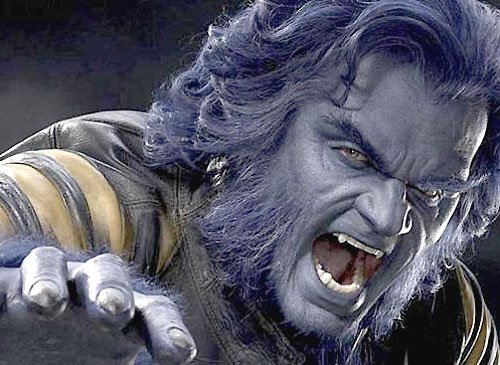
But there were some nice surprises in X3, I don't think anyone ever expected Juggernaut and Beast to be portrayed so accurately on screen as they were. I wasn't expecting Juggernaut's near-invincibility to be translate well, but it was one of the few successful effects in the movie (Super-Annoying Comic Geek Swipe: One scene that irked me was how Juggernaut was eventually overcome at the end, with his 'mutant' powers temporarily removed -- actually Juggernaut is one of the few X-Men characters who is not a mutant, his powers come from a magical gem inside his armor, which is why he is virtually unstoppable. And even if he was a mutant, wouldn't his mutant ability -- being unstoppable and invincible -- be something the government would want to harness or at least research?). Beast seemed like a character who would never look good on screen, but putting him in a suit and playing up his intelligence and diplomacy was perfect -- as was his graceful fighting at the end.

Unfortunately the excellent treatment of Beast and Juggernaut was overshadowed by several mis-steps, most notably -- and surprisingly -- with Wolverine. Whereas the first two films sometimes came close to showing Wolvie's true nature, X3 portrayed him as a mild-mannered uncle-figure, constantly trying to offer advice and generally just walking around the mansion playing it cool. What has made the real Wolverine one of Marvel's most popular characters is that he is a near-unlikable ferocious fiend who can rarely contain his anger. What happened to him? There have been rumblings of a Wolverine movie which will hopefully show us the true side of him.

Final swipe: The low budget of X3 was at times embarrassingly obvious, with the low mark coming at the beginning. Wolverine and Co. are battling a Sentinel (yes!) -- offscreen (no!!!) and all we see of this fantastic, towering character are a pair of glowing eyes and its head after Wolvie cuts it off. If there was ever a stage production of X-Men, this is how it would be done. Truly pitiful.

Thursday, March 23, 2006

Requiem for a lazy blogger


Yup, I'm still yet to be cured of this slacker blogging syndrome. I was trying to pin down the reason this week and thought that it might be the fact that I've seen way too many disappointments this month, films that aren't exactly inspiring me to write. That doesn't mean I haven't seen some good ones, but the stud:dud ratio was clearly at an all-time low in February-March, so come with me as I take you on a tour of the hits and misses I've seen lately.

Biggest Dud: 'Creepshow 2'
My God this one was bad, and I actually had some modest expectations for it. I remember seeing the previews for it as a kid and always was intrigued by the potential of the vignette The Raft, which is the main reason I finally watched it. Based on three of Stephen King's short stories, Creepshow 2 also included George A. Romero as director. So there's definitely some potential here, which is subsequently ruined by the curious directing decision to play the whole movie slightly sarcastically, with a half-smirk to inject some element of comedy into all three stories. While it might have looked good on paper, the laughs are never there and subsequently, neither is the horror.

Making matters worse is the awful animated segments that preclude each of the stories. We begin as some sort of Cryptkeeper dude drops of the latest issue of Creepshow at a comic book store, where it is picked up by some slimey kid. Through the magic of animation that reaches previously unheard of lows, we see the kid's adventures with the comic in between readings and are introduced to the Cryptkeeper's generic castle as he introduces each story. Before the previously mentioned Raft story, we get a worthless vignette called 'Chief Wood'nhead' about a wooden indian who sits in front of George Kennedy's store, until one night when some hoods rob the place and he goes on a killing spree. It is devoid of any fright, comedy or entertainment value. Luckily after it was finally over I got to see the reason I even popped in this atrocity (which regularly sells for $5, wonder why): The Raft.

The story is vintage King: three teens on a raft haunted by a strange creature in the water that slowly kills them. The thing in the lake resembles a floating oil spot and can reach up through the cracks in the raft and kill them. This is a good premise, but the whole segment is ruined by more awful direction. When the first teen is sucked in and horribly killed, her friends react more like she dropped a glass of milk. It could have been played out like Cujo, which has a similar plot, but instead plays out like a bad Amazing Stories episode. In the end, 'Creepshow 2' was so disappointing I couldn't even bear to watch the final vignette (some trash about a woman and a zombie hitch hiker).

Biggest Hit: 'Elephant'
After watching Gus Van Sant's masterful Elephant, I couldn't believe there isn't more hype about it. 'Elephant' is one of the most original and unique movies I've ever seen. Most will dismiss it when they hear it's about a Columbine-style high school massacre, but it's more of an experimental film about life than anything. Using a voyeuristic lens and toying with the chronology of a day at a generic high school, Van Sant leads us through characters we get to know deeply, while never succumbing to overly expository dialogue. One of the characters, Carrie, has extensive screen time, but maybe two lines. Finally, she is given a quick and emotionless death just like the others, showing what little concern the teen killers had for their victims as they probably knew her just as we did: a face in the hallway.

Van Sant uses extremely long shots from a lens that routinely drifts away from characters and into other conversations like it was some ghost wandering through the school. The chronology Van Sant uses is creative, as in one scene we see three characters pass by each other in the hall and eventually see through each of their paths how they got to that intersection. At no point until that deja vu shot was it apparent that we were watching a flashback. The killers themselves are not portrayed as hell-bent Satanic kids, but as a couple of punks who anyone would know. Both know they are going to die and that they will kill many of their classmates, but never seem overly excited about their prospects. The only real emotion any of them show is when one is walking the halls and is frustrated that most of the students have already fled the building.

Van Sant makes it a point to show that he has no answers, just like anyone else, for the ghastly phenomenon of high school shootings. Using a controversial and unsexy topic, Van Sant created a very simple movie that creates a powerful message by being just that.

Biggest surprise: 'High Anxiety'
I was surprised by Mel Brooks' tribute to Alfred Hitchcock not in how much I liked it, but just as how it is not your typical Brooks comedy. He's at his always-zany, but it's not exactly overflowing with jokes like Blazing Saddles or Young Frankenstein or as daring as Silent Movie. And most of all, it's not really a parody, but as the opening prologue says: a tribute. If you're not familiar with Hitchcock, this might not be for you, as you won't catch the note-perfect takes on his scenes, or jokes like Brooks' character checking into a hotel as Mr. McGuffin. It's not the funniest Brooks comedy, but it just feels so right, such as the setup for the best joke in the movie: Brooks repeatedly asks for a newspaper from a bellhop, who finally enters Brooks' room while he's taking a shower and 'stabs' him with the newspaper, leading to the exact shot from 'Psycho' where we see black ink (the same color the blood in Hitchcock's black and white movie was) swirling down the drain.

Other misses:
Rio Grande
As the closing movie in John Ford's 'Cavalry Trilogy,' I really wanted to like Rio Grande, but it never seemed to capture the lively spirit that Fort Apache and She Wore a Yellow Ribbon did so well. Sure, John Wayne and Maureen O'Hara are in it and Victor McClaglen plays Victor McClaglen again, but the pieces never seem to come together as well as they did in the other two. Hurting its cause is that Lt. Col. Yorke isn't the best kind of character for Wayne. It's essentially the same character Henry Fonda played so well in 'Fort Apache,' whereas Wayne was always at his best when playing men with a slightly lighter and synical side, not a stone cold disciplinarian as Yorke is.

The Devil's Rejects
This wasn't so much a disappointment, as it was entertaining, but it seemed like it should have been better. The sequel to Rob Zombie's tremendous House of 1000 Corpses (which will be even better when a director's cut is finally released), The Devil's Rejects seems more like made-for-TV spinoff of a once-popular series. We get the best characters from 'House' back and go with them on more of their adventures, but it always seems like it's a 109-minute movie made with a 45-minute story. There are subplots and inflated scenes everywhere that seemingly do nothing to better the movie than to up the running time. And in that running time we never really get that good a glimpse at Captain Spaulding & Co. We're with them the whole time but never get the sense that we know them, or find out much more about them than we did in the original.

The Haunting (1963)
Again, a good movie but it never once lived up to its hype as a genuinely scary film. I watched it at night and never found it even remotely creepy. I wouldn't sayI'm immune to scares, as I am quick to give a movie credit for having genuine chills, but it may be a case of simply becoming desensitized to the 'what's that sound' kind of scare that this movie apparently makes its living on. That's not to say 'The Haunting' is not entertaining, as its use of brilliant setpieces (the towering spiral staircase -- wow!) and lighting make for plenty of eye candy, but the lack of scares makes this movie truly drag at times.