Note: This post is part of the Lovesick Blog-a-thon at 100 Films.
I had read many descriptions of Straw Dogs prior to seeing it, and all of them played it up as 'Dustin Hoffman goes mad, ruthlessly kills his enemies, Bloody Sam Peckinpah at his bloody best!' (which is admittedly an attractive plot), but none of them spoke of the complex study of marriage and love contained in it. Like many of Sam Peckinpah's films, the intriguing story was ignored by the public in favor of the bloodshed and violence contained in it. And while Straw Dogs is indeed violent and graphic, it uses these elements to convey a message of the sacrifices that must be made in a marriage and what becomes of love once that is the only thing two people have in common. Peckinpah shows that marriage can full of unrealized violence, that to co-exist for most of a lifetime, two people must sometimes treat each other like enemies.
Dustin Hoffman and Susan George (perhaps never more beautiful) are David and Amy Sumner, who are in the early stages of settling in Amy's hometown -- a decaying, ruthless rural English community. It could be interpreted that the couple left Vietnam War-embroiled America for a place where their pacifist views could be more widely accepted, but it also makes sense that Amy wanted to live in an environment where she could become the dominant figure in their marriage. David explains that they are living in the town so that he can finish some kind of grant-sponsored math study.
Right off the bat we can see inside the character of Amy -- as she is proudly walking through the streets in a thin sweater with no bra.  The town is exactly how it was when she left, complete with a population of drunk and immature men, at least one of which has a sexual history with her (and he is not shy about reminding her of that fact). It is clear that the Sumners are now on Amy's turf -- a strange place where she knows the rules of the land, and knows that she is the object of affection for every male eye.
David is uncomfortable in this new place and perhaps regrets their decision to move. He soon finds out that life in the town is simply a series of tests of will between the men, and he witnesses one inside the bar -- with the lone constable seemingly rolling his eyes and the long-beaten characters (the barkeep) offering not even a thought of resistance. David is a pacifist at heart, who keeps to himself and simply wants a little peace and quiet while he slaves at his blackboard with equations. Since he is passive, David gets his way with Amy by exerting his intelligence on her and treating his wife like a child. Amy reacts like a child because her defense mechanism is her sexuality -- which is mostly useless against David who is always buried in studies. We see that though the Sumners exude an air of sophistication, their hearts have much growing to do and they live in a dysfunctional marriage.
David and Amy are only able to express their passion when they let down their guard and act like children -- such as the early bedroom scene that devolves from a lesson in chess (an attempt by Amy to appeal to David's intelligence) to an under the sheets whirlwind of junior high giggling. During this scene, the Sumners are spied on through the window by a few townsfolk who see this act as novelty, since it is so different than their buttoned down way of life where emotions are seldom seen or welcomed.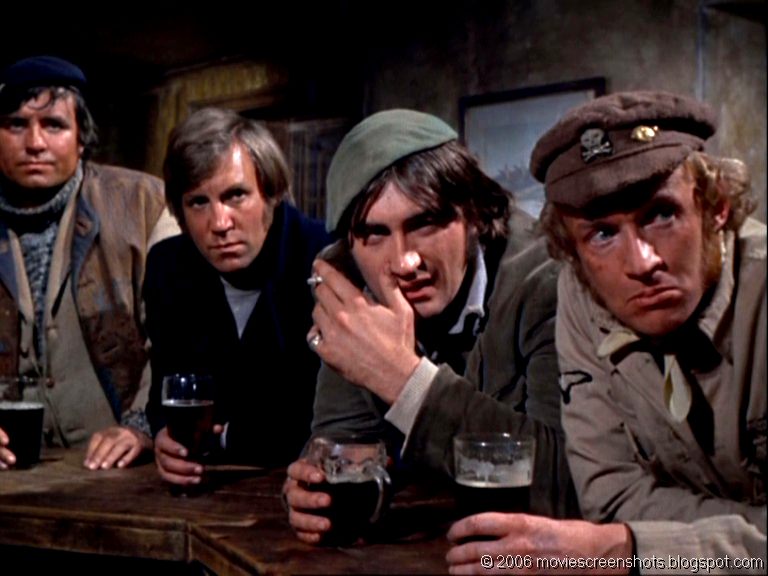 The Sumners' fragile relationship begins to slowly fray because of outside forces -- starting with Amy's old chums who are now employed to finish a roof on their garage. They eagerly watch as Amy gets out of her car in a dress, and accidentally flashes her panties. Amy is clearly disturbed by this event and their reactions, but it is also a discovery of where she can find the emotions so clearly lacking at home. She takes this a step further by walking near a window topless, explicitly letting them see her body. While Amy delights in the attention being paid her body, she is also unknowingly opening a door to the violent sexual hunger of the men, who see her act as an invitation.
As Amy is unwisely stoking the men's libido, David is being slowly ground down by the goons -- who use his pacifist tactics against him -- demonstrating that they can get into his house by stealing Amy's panties and leaving their dead cat hanging in the closet. The men trap David into one of the town's violent rituals of testing his tolerance, setting a precedent by seeing how far they can go before he snaps. A similar act is happening in the Sumners' home, as Amy is basically daring David to do something about the dead cat -- knowing full well that he is incapable of any retaliation. By calling her husband's non-shot, Amy has gained the upper hand in their marriage that she so desired. In her native land, she has the advantage over David, and is damn well going to use it.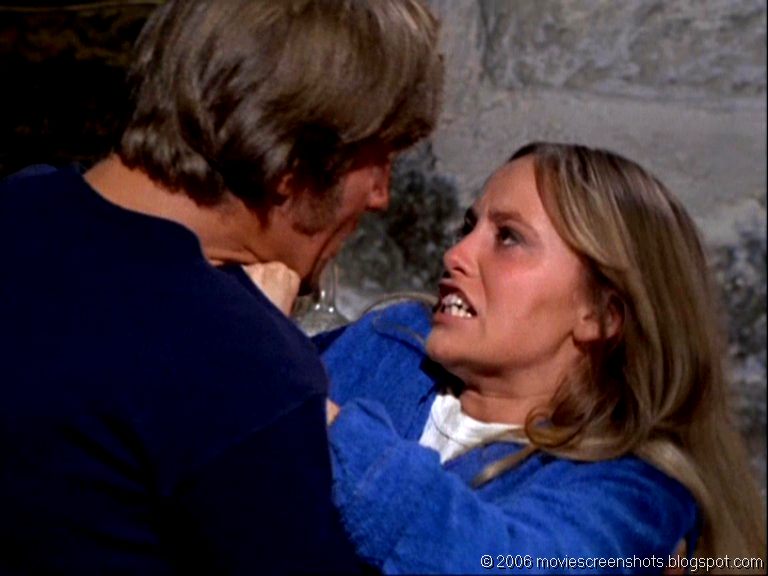 David tries to win over his wife by agreeing to go hunting with the men, but in doing so only enables the final part of their plan: leaving Amy home alone. Amy's old flame Charlie sneaks away from the hunting group and tries to make like old times inside her house. Amy resists his advances, but is powerless against his brute strength and is conflicted because she probably realizes how in this environment it is actually her fault because she was asking for it by exposing herself to Charlie and his friends. Equally conflicting to Amy is that she is finally receiving the lust and physical passion she has been begging for since she and David moved to England. For a moment we see Amy semi-enjoy Charlie having his way with her, and then it is gone as she tries to process the emotions and feelings she is experiencing.
The American in Amy wants to tell David about the rape, but her upbringing tells her to forget it -- since it was partially her fault. Meanwhile, shooting a shotgun during the hunt seems to have energized David, who fires Charlie's men for abandoning him on the hunt. Things come to a boil when David tries to harbor the village black sheep Henry (David Warner), who accidentally suffocated the young granddaughter of the town's drunken patriarch. The young girl probably mirrors Amy of years ago, as she struts around in skimpy clothing through the streets of an environment not made for her. After trying to find attention from the town's men, she goes after Henry -- who is mildly retarded and serving a lifetime of penance for a previous advance on a young girl.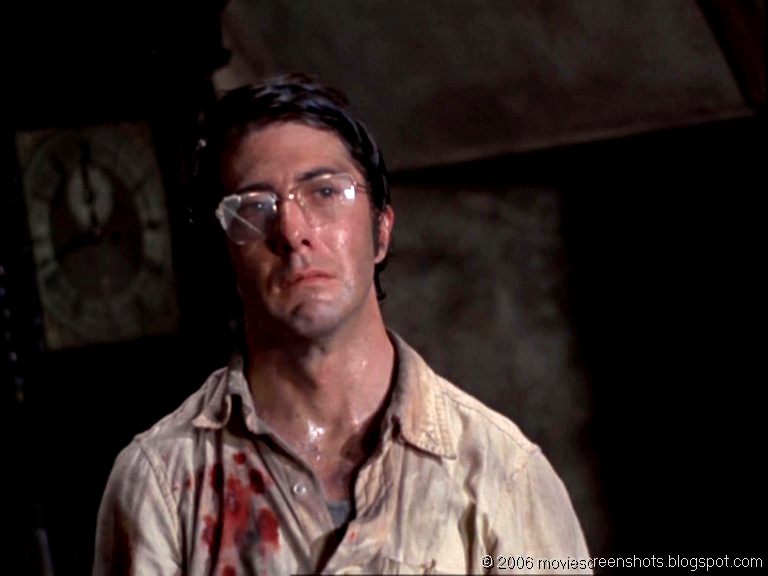 David knows the mob will kill Henry, and keeps him safe while plotting a plan to exact his revenge on all of them -- and in effect his wife, by showing her what he is capable of. During this process, David and Amy enjoy a fleeting moment of shared passion as Amy begins to see her husband as the kind of man her town produces, and is obviously turned on by it. In the end, David's pacifist ways come to an end, but so does his marriage, as in 'winning' the war within he and Amy's relationship -- he has only found the door to escape.
Thanks to Movie Screenshot blog for the excellent screenshots.
Tuesday, February 13, 2007
Peckinpah's Valentine

Thursday, February 02, 2006
Seven Days of Sam Peckinpah, Part 2
'Am I still gonna get paid?'
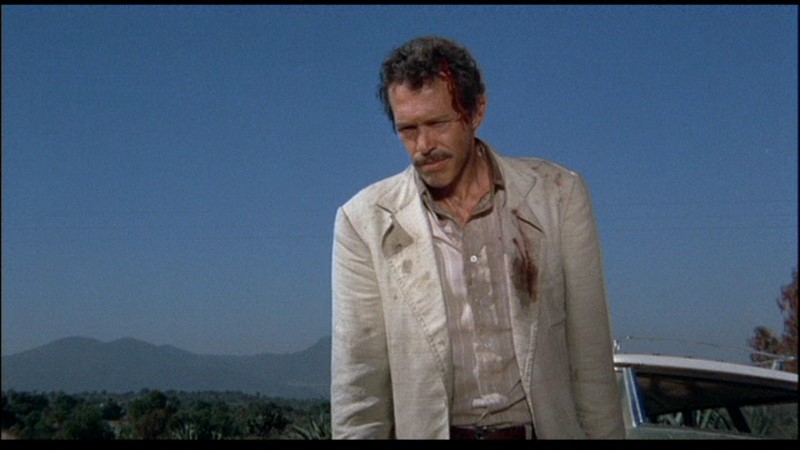
Day 4: 'Bring Me the Head of Alfredo Garcia'
This movie is often described as Peckinpah's most personal film, so it comes as no surprise that Bring Me the Head of Alfredo Garcia is a grating, unforgettable trip through the deepest depths of desperation and false hope. 'Alfredo Garcia' was the lone 'controversial' film by Peckinpah that had no studio interference, and it was also the director's last great film. After 'Alfredo Garcia' he would essentially become a director-for-hire, taking on projects such as Convoy and The Osterman Weekend before his death in 1984.
So as the last great Peckinpah film, it is so fitting that 'Alfredo Garcia' is also the first starring role for Warren Oates, who made a career out of small, but entertaining roles, primarily in Westerns. Oates was a perfect cast, because his character of Bennie is a person who was always in the background, but who has one chance (however minute) to pull himself out of a lifetime rut. Bennie, an American banished to Mexico, is spending another night as a worthless piano player in a bar where no one bats an eye when a hooker is punched to the floor. But on this fateful night, he hears news that a Mexican general is offering a sizeable bounty for the head of one Alfredo Garcia. Bennie takes interest in this because he knows Garcia is already dead.
To get the bounty, Bennie will have to enlist the help of his hooker girlfriend (who was once involved with Garcia) and journey into the darkest locations of Mexico before digging up a corpse and coming away with its head. It is a risky and unsettling proposition, but also one Bennie knows he can't turn down, because this is his one chance to come out on top. Oates is marvelous playing a character who will reach the pinnacle of hope and experience love for the first time in his life, before jarringly plunging into the lowest possible depth and emerging with nothing save for a craving for his own death.
With 'Alfredo Garcia,' Peckinpah gives us an emotional punch to the gut. The movie turns so unexpectedly from an underdog story into a what-could-possibly-come-next descent into the absolute worst of ourselves. The characters are so perfectly established, that when Bennie wakes up next to Garcia's grave to find out the only thing in the world he cared about more than that awful head was taken away from him, the anger and grief feels almost too real.
Peckinpah again uses his familiar technique of demoralizing male characters by showing their companion taken by another man. But in 'Alfredo Garcia' it is used in the most heartbreaking fashion, when the biker played by Kris Kristofferson essentially says he's going to rape Bennie's girlfriend, our hero tries to intervene only to be told to go away because she's 'been here before.' This leads to Bennie killing both bikers, as he begins to realize the violence he is capable of and what he is willing to do to reach his goal.
By the end, the prize is in sight for Bennie, but he has lost everything else and knows it does not matter a bit. When he looks into the eyes of the person who started this backbreaking fall for him, Bennie realizes he has fallen so far that the only way out is through the barrel of a gun, which is the last visual before the credits rise.
Best scene: Bennie gets a little help from his friends (and their machine gun) when the going gets iffy on the road.
Best line: 'I've been no place I wanna go back to, that's for sure' --Bennie
Best Peckinpah moment: El Jefe's daughter telling Bennie to kill him.
'It feels like ... times have changed'
Day 5: 'Pat Garrett & Billy the Kid'
With Pat Garrett & Billy the Kid, Peckinpah was presented for the first time in his career with material that had been done before. Hollywood had produced numerous tales of the former lawless friends who were now at odds with each other, and many of them focused on the infamous Billy the Kid. If Peckinpah was going to make a film on a familiar story, then you know he was going to do it different, and his way. Peckinpah's vision of the old Western tale is told more from the angle of Garrett, and is ultimately light on story but heavy on all the elements that make his movies great.
As the movie opens, we are introduced to Billy and Garrett and quickly learn that they are old friends. Garrett informs Billy that he has short time to get out of town, since Garrett will soon be the area's sheriff. Weeks later, after arresting his friend, Billy escapes from jail and leads Garrett on a long chase through Mexico that takes up the rest of the movie. Where this movie loses most viewers is after Billy escapes from jail, as there is little narrative as Billy eludes his friend. Garrett doesn't seem all that rushed to capture his fugitive and Billy doesn't seem to be trying to hard to escape the law. The plot is weak compared to other Peckinpah greats, but it is still an entertaining show, as it is helped by one of the greatest casts for any Western.
What keeps 'Billy' going is the casting of Kris Kristofferson and James Coburn in the title roles. Peckinpah portrays Billy as an anti-authority free spirit capable of harsh violence, Kristofferson fits this role perfectly, looking the part of a 19th century hippy. Coburn is able to be his hard-ass self in the role of Garrett, who at heart is still every bit the bandit as Billy. Both actors have two of the most memorable voices in cinema, and their rare conversations create some sort of testosterone-twanged harmony. The casting of Bob Dylan is questionable, but he does well with what little material he has and of course contributed the outstanding soundtrack.
Dylan's music is the driving force behind one of the movie's best scenes. As Garrett hunts down some of Billy's comrades with a newly deputized old friend and his wife, the opening chords of 'Knocking on Heaven's Door' begins playing softly. This happens just as Baker, the lawman accompanying Garrett, is shot in the gut and realizes he's about to die. Baker slowly starts walking toward a river when his wife notices and runs after him. Just as his wife sees his wound, Dylan sings the iconic first line of the song, 'Mama take this badge from me . . .' A scene earlier, Baker asked 'Mama' for his badge so they could help Garrett. It's a small, but heartbreaking and just plain perfect scene.
The new DVD of 'Billy' offers two versions, the 'preview version' which is the longer cut, and a new cut of the film from 2005 done by those who worked with Peckinpah and were familiar with what he wanted. The new version is tighter and moves a couple of scenes around as well as other differences (i.e. in the preview version, we never hear Dylan's lyrics in the above scene). That the newer version is able to present a more fluid movie by rearranging scenes illustrates the frustration many have with this movie. It has little structure and we appear to follow the title characters from one isolated scene to another. As the film progresses, its pretension increases, climaxing with an unfulfililng ending that tries to be overly relevant. 'Billy' is an entertaining Western spectacle, but lacks the deeper meaning of Peckinpah's other greats.
Best scene: Billy's jail escape is raw, brutal and wild fun.
Best line: 'Won't some of you people get him up off the ground and into it?' --Garrett
Best Peckinpah moment: Billy convinces his friend during a shootout that since he already has mortal wounds, why not help us out and go out shooting?
'If you have trouble [spelling] "Cable," wait until you get to "Hogue"'
Day 6: 'The Ballad of Cable Hogue'
The Ballad of Cable Hogue is unlike any other Peckinpah movie, which pretty much makes it unlike any other movie, period. This does not mean it is a truly great film, but it is wonderfully quirky and unique, with a typically excellent Peckinpah cast. 'Cable Hogue' is a simple revenge tale sprinkled in with romance and some occasional goofball comedy. Most of this movie has aged very poorly, as you will likely groan when scenes have characters running away in double time, Benny Hill-style.
A soft-hearted drifter double-crossed and left for dead by his 'friends,' Cable is in the desert with no horse, water and presumably -- hope. That's until his unlikely discovery of a spring not too far from the road. With the help of a girl-crazy preacher who comes along the road, Hogue fixes up a glorified roadhouse that serves the occasional passerby. While in town securing the few acres he needs, Hogue takes a fancy to a prostitute named Hildy, but doesn't bother to pay for her services. Before being chased out of town, Hogue convinces a stage company to take a chance on him and give him funds for his roadhouse. Soon, Hogue is a fairly reputable businessman, and it's not too long before Hildy starts to warm up to him again.
What keeps 'Cable Hogue' going is the electric performance from Jason Robards as the title character. In keeping with Peckinpah's usual themes, Hogue is a good guy nearing the end of his life before realizing what he is capable of. While he softens up a bit as he succeeds as a businessman, Hogue knows that someday his former friends will be coming along that road and he has some payback for them.
There is little violence, and the comedy rarely works, so what makes this a good movie? Like all Peckinpah films, the characters are believable and rarely fail to entertain. The interaction between Hogue, Hildy and their preacher friend Josh is where the film is at its best. 'Cable Hogue' starts going downhill at the end, when Peckinpah tries to cram more meaning into the movie than it really needs. His familiar theme of the end of the West comes out at the end, and it seems unneeded. 'Cable Hogue' is still a fun movie, but has less relevance and has aged worse than any of Peckinpah's other Westerns.
Best scene: Hogue scares the wits out of his enemies by baiting them into a hole where they find snakes thrown on them.
Best line: 'Since I cannot rouse Heaven, I intend to raise Hell' -- Josh
Best Peckinpah moment: Hogue sharing a bottle of whiskey with the drivers of the stagecoach, ala 'The Wild Bunch.'
'The day of the 49er is gone'
Day 7: 'Ride the High Country'
I conclude this Peckinpah marathon with his first real movie, which showed Hollywood what he could do even with the most modest of budgets and expectations. Shot in only 26 days and with two of the genres foremost stalwarts, Ride the High Country is a timeless tale of morals, friendship and aging, which would go on to be popular themes in all of Peckinpah's greats.
Longtime friends Steve Judd and Gil Westrum find themselves on opposite ends of the tracks now. Gil is an entertainer, masquerading as a sharp shooter named 'The Oregon Kid,' while Steve was once a U.S. Marshal, but is now trying to prove he can still cut as a lawman even as he grows old. Together, they take on a job of transporting a gold shipment through dangerous territory. Gil brings with him his young protege Heck and they even pick up a young woman who is going their way to be married.
'Ride the High Country' was greenlighted as another simple Western, but Peckinpah made it something much more, and it is still regarded as one of the genre's best. All of Peckinpah's Westerns show the end of the cowboy days, and this is the most literal use of that theme, as stars Joel McCrea and Randolph Scott were both veteran Western actors looking to end their acting days on a high note.
On their way to the gold town, Gil and Steve prove to their young companions that they can more than handle their own on the dangerous trail. And when it is clear that Elsa is in over her head with her marriage, the two take it upon themselves to set things right. Little did Elsa know that by marrying one of the infamous Hammond brothers, she was in essence marrying the whole gang. Essentially raped on her wedding night, Gil and Steve take things into their own hands, even though they don't have to.
Before they get back home, they will take on the Hammond brothers gang and Gil will be forced to make a choice of going forward with his plan (stealing the gold for himself and Heck) or being loyal to his friend. By the end, we are left with one of the most touching death scenes of all time and a glimpse into the early successes of a filmmaker who would use this film as his jumping-off point. The values touched on in 'Ride the High Country' are summed up in the best line of the film, and perhaps any Peckinpah movie:
Heck: My father says there's only right and wrong - good and evil. Nothing in between. It isn't that simple, is it?
Steve: No, it isn't. It should be, but it isn't
Best scene: The raucus gold community celebrates Elsa's wedding the only way they can
Best line: See above
Best Peckinpah moment: In a shootout with the Hammond brothers, Gil and Steve show they haven't missed a beat.
Closing thoughts: The idea for this marathon came from the new Peckinpah box set, and it does not disappoint. All four movies (as well as other Peckinpah DVDs, such as 'Straw Dogs,' 'Alfredo Garcia' and 'Junior Bonner') have excellent commentaries from four men who knew the director best. The new version of 'Pat Garrett & Billy the Kid' actually improves on the original movie and 'The Wild Bunch' is loaded with extras (not that I would know, my second disc is defective and I'll have to send the whole set back to get a replacement disc). What got me excited to write these two posts is that Peckinpah is not only one of my favorite directors but also one of the most interesting persons in all of cinema. He was a tortured soul and was able to make several great movies before his death. Even though a few of the films touched on here ('Major Dundee,' 'The Ballad of Cable Hogue') do not measure up to the others, they are still entertaining and worthy of seeing.
Wednesday, January 25, 2006
Seven Days of Sam Peckinpah, Part 1

Well I now know it's true because I got the box set in the mail last week, along with Peckinpah necessities Bring Me the Head of Alfredo Garcia and Junior Bonner. This coincided with me finally getting the new extended version of Major Dundee from Blockbuster Online, thus setting the stage for Seven Days of Sam Peckinpah: a one week, two post event wherein I would finally get around to reviewing some of my all-time favorites.
'If they move ... kill 'em'
Day 1: The Wild Bunch
It's rare that you find a movie whose opening scene has so much tension or sheer 'you are in for one hell of a movie' bravado as 'The Wild Bunch.' The opening is just perfect, from Peckinpah's trademark freezeframe credits to the uneasy calm before the robbery turns into a bloodbath. It's a fitting introduction to a film which goes so outside the boundary of what a typical Western was and packs so much plot, characters and thrilling violence into its running time.
It's easy to see how 'The Wild Bunch' still has an influence over today's films. It was one of the first movies to use slow-motion photography in action scenes, as well as one of the first to utilize the more liberal censors of that era by painting each shootout with gratuitous amounts of blood. It would also set the stage for many more movies where pretty much all the characters are criminals, leading to calls that Hollywood is glorifying crime and violence.
But the gunfire and gore isn't what made 'The Wild Bunch' such a classic, this is a movie with a multi-layered plot and many well-developed characters. For me, 'Wild Bunch' starts to hit its groove when we see the first Pike Bishop-Deac Thornton flashback. We learn so much about both men in that short flashback, Bishop's quiet regrets of leaving Thornton in the lurch and Thornton's searing revenge for getting arrested while Bishop continued living the life of a criminal. The idea of former friends now on opposite sides of the law is one of the many themes repeated in Peckinpah's movies, as it was featured prominently in 'Ride the High Country,' 'Major Dundee' and of course 'Pat Garrett and Billy the Kid.'
All of Peckinpah's films feature the theme of growing old, but staying smart and strong. 'The Wild Bunch' is perhaps the most famous example of this, and I would say his best use of it, since all of the characters carry an air of desperation with them, as they know their time is running out. 'The Wild Bunch' was the first Peckinpah film to use a cuckold element as a device to show power. Angel is absolutely destroyed by watching his former flame ignore him and throw herself at Gen. Mapache, seemingly reveling in his feelings of shock and betrayal. Peckinpah would use scenes of women openly cheating on their partners later in 'Pat Garrett and Billy the Kid' and most prominently in The Getaway.
What helped undoubtedly helped 'The Wild Bunch' become such an undisputed classic was the underrated score by Jerry Fielding. The bristling, varied themes composed by Fielding pop up at just the right time and add extra punch and tension to scenes such as those preceding the final shootout
Best scene: Has to be the opening shootout, its controlled chaos rivals that of the movie's climax.
Best line: 'What I like and what I need are two different things!' -Thornton
Best Peckinpah moment: Thornton constantly abusing the thugs that are supposed to assist him. He's out of prison, but trying to catch Bishop and Co. is almost as bad when he's stuck with these 'gutter trash, chicken-stealing sons of bitches.'
'Tell him Junior sent ya'
Day 2: Junior Bonner
If your nickname is 'Bloody,' you can shed that image as a filmmaker real quick by making a rodeo movie. Yes, it is a rodeo movie set in modern times, but Peckinpah makes sure no one mistakes it for anything but a Western. 'Junior Bonner' doesn't have any shootouts and has few tense moments, but still manages to be a very entertaining film.
Like most of his films, Peckinpah surrounds his star (Steve McQueen) with his own troupe of well-known Western mainstays (though in this case, the Peckinpah Troupe is sparsely represented, with only Dub Taylor and Ben Johnson on hand). 'Junior Bonner' has a small, but well-rounded cast, and that seems to help the movie, since you know who everybody is. One thing that has always amused me is how McQueen is pretty much upstaged in the movie by Johnson, who plays his affable and flamboyant father.
Ace Bonner is a key figure in the movie, since Junior is as much awed by him as he is scared, because he can see himself becoming the mirror-image of him. At one point in time, the elder Bonner was a self-described rodeo celebrity, but is now barely known in his own town (which is quickly becoming unrecognizable, thanks to his other son, Curley). This sense of becoming forgotten is illustrated beautifully in two short moments (at Curley's new development and outside the rodeo) when Junior asks if someone has seen his father and both times he is answered with 'who?'
Junior doesn't much care about being a celebrity, but he does want to show his hometown what he can do at the rodeo before traveling to another small town who-cares competition. The most important thing in Junior's life is doing things his way, whether it's right (getting a second chance at the bull who beat him before) or wrong (punching out his brother in front of his family). Junior comes back to Preston, Ariz. finding his family's old house being razed to make way for a mobile home park built by his brother, his dad's in the hospital after driving drunk, his mom is happy to see him, but she (like everyone) want him to settle down and do something practical with his life.
The ending is predictable, but along the way we get amazing scenes, such as father and son riding off on the same horse in the middle of a beautiful parade to share a bottle of booze, the chaotic milk-a-cow competition and of course the barfight scene, which I wrote about before. In the end, 'Junior Bonner' has simplest of all Peckinpah stories, and you get the sense he wanted it that way, so as to avoid the studio meddling that plagued most of his efforts.
Best scene: Junior tricks an old friend into starting a bar fight so he can escape for a few minutes with his trophy girlfriend.
Best line: 'I'm working on my first million, you're still working on 8 seconds' -Curley
Best Peckinpah moment: Children watching in awe as Junior and other rodeo guys get pummeled in the dirt (violence amusing the young is seen in almost every Peckinpah film).
One last thing: Scarecrow Video, the biggest and best video store on the planet, put out an excellent book two years ago, at least I thought it was excellent until I read their synopsis of 'Junior Bonner:' 'His old friends welcome him immediately and press him to ride in the upcoming rodeo. His children are slower to accept him, and after dogged perseverance by Bonner, his wife comes around.'
Uh, what? First of all, the first thing he does when he gets into Preston is join the rodeo, no one had to convince him. But Junior definitely has no children or wife, at least not in the movie I saw. The only explanation I can think of is Scarecrow must have confused his two nephews and sister-in-law Ruth as his children and wife.
'Until the Apache is taken or destroyed'
Day 3: Major Dundee
All that I knew about 'Major Dundee' prior to this week were from reading DVD Savant's extremely indepth article regarding the trials Peckinpah faced in filming it. The story of how 'Major Dundee' was made is perhaps more famous than the movie itself, here's a quick synopsis: In 1964, Peckinpah's only major experience directing a mainstream studio film was 'Ride the High Country,' but he was nonetheless recruited for 'Major Dundee,' which Columbia had eyed as a historic, patriotic movie. Peckinpah had grander plans of a 160-minute epic, which Columbia did not want but Peckinpah went ahead with it, blowing his budget on filming in exotic Mexican locales. This led to Peckinpah being banned from the Columbia lot, where his movie was chopped down to under 2 hours. No one has ever seen the full version Peckinpah intended, until this year when an extended edition DVD was released with 12 additional minutes and re-cut scenes. It also had an entirely new score, replacing the amateurish, abrasive original music.
As a result of being chopped down so much, 'Major Dundee' was released in 1965 as a movie with a grand story and an all-star cast, but also a film that was very hard to follow . . . or enjoy. As such, it often gets the studio interference 'free pass' that other mangled epics such as Welles' The Magnificent Ambersons is afforded (you will note that 'Ambersons' is rated an '8' by IMDB users, a rating I think is about three points too high, but that's for another post).
Savant noted that Peckinpah's overly grand plans for 'Major Dundee' were probably due to his inexperience with dealing with studios and his desire to put himself on the same level as filmmakers such as David Lean and Howard Hawks, whose resumes were filled with such epics. What 'Major Dundee' ultimately became was a movie filled with the small details and memorable characters that made Peckinpah such a popular director, but these characters were caught in an abbreviated story with nothing all that interesting or significant to do.
'Major Dundee' is the story of the title character (Charlton Heston), a civil war union general relegated to overseeing a jail full of confederates. But when a band of Apaches slaughter troops and kidnap children, he takes their vengeance upon himself, even if he has to lead an army composed of mostly of confederate prisoners. It's a wonderful beginning, but the movie never really takes off, and there are only a couple of memorable scenes that stick out (the best being the climax, in which the remains of Dundee's army square off with a large French contingent in the Rio Grande, turning the river red with blood). One curious aspect that really bogs down 'Major Dundee' is that many of the key scenes are filmed (poorly) at night, leading to squinted eyes and the hopes that one of these troops brought a lantern or two.
It's interesting to imagine what 'Major Dundee' could have been in its full form, but it already seems too long at the restored 139 minutes. Another way to look at it its significance is how it changed Peckinpah as a director, would we have gotten 'The Wild Bunch' or 'Bring Me the Head of Alfredo Garcia' without 'Major Dundee'?
Best scene: The aforementioned Rio Grande scene, which allegedly was even more drawn out and action packed in the full version.
Best line: 'I am *not* your uncle, you redneck peckerwood. And if you say one more word, you'll spend the rest of this campaign in chains.' -Dundee
Best Peckinpah moment: Capt. Tyreen (Richard Harris) shoots Hadley in the back before the Yanks can put him before a firing squad.
Stay tuned for Seven Days of Sam Peckinpah, Part 2!