Note: This post is part of the Blog, James Blog-a-thon at Lazy Eye Theatre.
I had hoped to write an all-Timothy Dalton post for the James Blog-a-thon, but it turns out there's nothing nice I can say about License to Kill, other than its ultra-smooth title cut from Gladys Knight. So all-Timothy Dalton turned in to all-Living Daylights, which is fine by me. I've never hesitated to declare The Living Daylights as one of my favorite Bond movies (same for A View to a Kill), despite having a decidedly lower pedigree than its peers. There's not a single memorable villain in the movie, the plot seems like a lost A-Team episode, and the most critical piece of gadgetry James uses is an exploding key chain. And yet, it's still fun as hell.
What The Living Daylights has going for it is strong source material, a short story by Ian Fleming that was the last of the author's books to be adapted into a big-screen 007 before Casino Royale. Fleming's short story The Living Daylights presents the concept of Bond's conflict of killing a beautiful woman sniper, who he earlier had eyes for. The movie recreates this short story nearly line for line in the opening sequence, even ending with the same words, "I must have scared the living daylights out of her." The short story ends there, and from that scene the movie goes on to a mostly uninteresting series of double-crosses about the KGB and an arms dealer portrayed by Joe Don Baker. The plot never really comes to life after that opening scene, especially since the worst that can happen is the KGB getting to buy some weapons from Joe Don Baker. But the opening sniper sequence gives us the one element that will hold everything together: the chemistry between Bond and Kara (Maryam d'Abo). Unlike many of the perfunctory 007 relationships, these two seem to really share something, and dammit if they don't look good together. Kara is a good complement to Bond, as we see early on she's a capable sniper and later proves to be a nearly-competent pilot.
 The pair figure in to the movie's two best moments: a flawless Aston Martin gadget escape turned cello sled ride, and a still amazing airborn fight on a barely-tethered opium cargo. The latter leads to the movie's best line ("he got the boot!"), and one of the franchise's best-executed stunts, with Bond and Kara escaping the doomed cargo plane in a Jeep on some sort of parachute sled. They make it look easy, but I've always loved Dalton's fearless look when he pulls the parachute and jumps back in the Jeep ("I know a great restaurant in Karachi!").
 These charms may not be appear to be in the caliber of Bond's more popular fare, but there's something about the overall film that's kept me coming back. It may be due to the fact that it was made in 1987, and as such its DNA contains elements of 80s action movies (random happenings in Afghanistan, exploding cargo planes, Joe Don Baker, etc.). It's also hard to deny that this is the last of the old school 007 movies -- the last of Fleming's original material, and also the last one to be scored by John Barry. The score and accompanying songs are excellent, with Barry adding some late-80s sensibilities to the traditional 007 score, and a-Ha turning in a surprisingly memorable title song (Barry himself remixed the song for the movie, adding in the snappy strings intro).
And then there's Dalton. While he may never rise above the bottom of the Bond depth chart among fans, he has nothing to be ashamed of in The Living Daylights. Dalton's Bond is closer to Sean Connery than Roger Moore, with little of the former's sarcasm. He plays Bond pretty straight, but always appears capable of doing his part in keeping the Majesty's Crown safe. License to Kill sunk the franchise to unseen depths, and Dalton's legacy was taken down with it, but The Living Daylights has aged well.
Wednesday, November 12, 2008
From Russia with a cello

Saturday, November 08, 2008
My ignorance knows no alphabetical bounds

Fletch at Blog Cabins is battling illiteracy with his new meme, The Alphabet Meme. I've heard that for every child that learns to read through this meme, Fletch will receive a golden apple, and I think that's great (the golden apple part, I don't care about the kids). I was roped into this one via Piper, and the rules are fairly simple, go through the alphabet and name a film for every letter. And since I never want to be accused of being simplistic, I've altered the rules for my post a little bit: I've never seen any of the movies listed below. I wanted to have some kind of over-arching theme for my alphabet, and some of the entries here may surprise you as to what I haven't seen:
Altered States (1980)
Born on the Fourth of July (1989)
Can't Stop the Music (1980)
Day of the Dead (1985)
Emmanuelle (1974)
Force 10 from Navarone (1978)
Get Carter (1971)
Hell is a City (1960)
Indiana Jones and the Kingdom of the Crystal Skull (2008)
Jezebel (1938)
Kiru (1968)
Le Samourai (1967)
Mikey (1992)
Never So Few (1959)
Oscar (1991)
Patton (1970)
Quo Vadis (1951)
Richard III (1995)
Spellbound (1945)
Twelve O'Clock High (1949)
Under the Volcano (1984)
Viridania (1961)
Warlock (1989)
X: The Man With the X-Ray Eyes (1959)
Yentl (1983)
Zulu Dawn (1979)
Tuesday, September 02, 2008
12 must (somehow) sees...

Niceguy Joseph Campanella of Cinema Fist was nice enough to tag me with the latest 12 Movies meme, and I'm hear to spread the love even further. A spinoff of Piper's 12 Movies Meme, the Holy Grail List is different in that you're selecting 12 hard-to-find movies you haven't seen (full rules at the meme's birthpalce, The Dancing Image). I like this idea, and I only had to cheat a little bit to come up with my 12:
- Frog Dreaming (1986, aka The Quest) -- The only movie on this list I've actually seen. This Australian kids adventure flick used to be on regular HBO rotation in the late 80s under the U.S. title The Quest. Nowhere to be found on DVD (even in Australia, apparently), this is a creepy little movie about a nerd in a small town who investigates the local myth about a lake-dwelling monster. After a little poking around, it's actually on YouTube in multiple parts, beginning here.
- Night of the Creeps (1986) -- Heard a lot about this Fred Dekker effort, starring Tom Atkins and Dick Miller, and riffing on horror and B-movies in general with an Invasion of the Body Snatches-ish plot. Not available on DVD, but if Monster Squad can make it, why not this?
- Bad Ronald (1974) -- TV movie about a disturbed kid who accidentally kills a classmate, and rather than go to jail, mommy hides him in the basement. Things get interesting when ma dies and a new family tries to move in. This one sounds right up my alley, and with TV movies starting to appear on DVD, maybe there's new hope for this one.
- Summer of Fear (1978) -- Another TV movie, this one brought to my attention by the good guys at Kindertrauma. Summer of Fear is about the one fear we all share: that weird country cousin is actually a witch.
- Phantasm II (1988) -- As a big fan of the original, I've been wanting to track down this one for a long time, unfortunately it's not available on Region 1 DVD (part of the legendary Region 2 "ball set").
- Great White (1980) -- Enzo Castellari's shark movie resembles Jaws, in the illegal way. Universal successfully sued and was able to get it pulled from theaters shortly after its release, and it's never gotten (and likely never will) get a legal release on video. I'm just curious what it looks like, since there are many movies that resemble Jaws: does it feature Sheriff Crody? Mr. Squint? I want to know.
- Santa Sangre (1989) -- Alejandro Jodorowsky's last real movie was made in the tradition of his great surreal masterpieces like The Holy Mountain and El Topo. Not available on DVD.
- Dune (1984, David Lynch cut) -- Universal has supposedly tried to get Lynch to sign off on a director's cut of the film, but his hard feelings from the project have not softened. I enjoy the theatrical cut, but it's clear that most of the movie is edited as basically a montage of a much longer cut. But in its current form, very little of Lynch's version remains -- even the opening credits don't look like something Lynch would do.
- The Movie Orgy (???) -- Dennis Cozzalio had a beautiful writeup of experiencing Joe Dante's wondrous Movie Orgy, an endless string of movie, TV and commercial clips spliced together. Impossible to release on any home video format, I'll have to catch a rare screening someday.
- Fitzcarraldo (1980, early version) -- As chronicled in the epic documentary The Burden of Dreams, this Werner Herzog classic began with Jason Robards in the title role and Mick Jagger (!) as his assistant, Wilbur. Nearly half the movie was shot in this configuration, but Robards became intensely ill and doctors orders kept him out of the Amazon. Jagger's schedule wasn't able to accommodate the delay, and we were still given a great movie with Klaus Kinski picking up the title role. I'm curious what Robards would have done with the role, and what Jagger's character was like.
- Noon Wine (1966) -- After the epic failure and disastrous production of Major Dundee, Sam Peckinpah went back to television and crafted this adaptation of Katherine Anne Porter's short novel, starring Jason Robards and Olivia de Havilland. Just an hour in length for ABC's Studio 67, Noon Wine is an interesting examination of social justices and prejudices, with many saying it's Peckinpah's most intimate work. The piece's critical reception led to Warner Bros. approaching Peckinpah for what eventually became The Wild Bunch. Amazingly, it's only viewable through the Library of Congress and the Museum of Broadcasting.
- Looking for Mr. Goodbar (1977) -- I've been interested in this movie ever since Kim Morgan posted her thoughts on it (las I am with just about every movie Kim likes). Diane Keaton stars as a woman whose search for the perfect man goes downhill and very dark.
Joseph B at itsamadmadblog2
Jeremy Richey at Moon in the Gutter
Moviezzz at The Moviezzz Blog
weepingsam at The Listening Ear
Piper at Lazy Eye Theatre
Friday, July 25, 2008
Once, twice, twelve times a New Beverly

Piper has quite a meme incubation program over at Lazy Eye Theatre, and his new one just hatched. Of course, now it's gonna multiply like tribbles with a premise like this:
1) Choose 12 Films to be featured. They could be random selections or part of a greater theme. Whatever you want.
2) Explain why you chose the films.
3) Link back to Lazy Eye Theatre so I can have hundreds of links and I can take those links and spread them all out on the bed and then roll around in them.
4) The people selected then have to turn around and select 5 more people.
My double bill picks are all related somehow, and I've provided links to past posts of mine about the movies. Note: only a theater like the one pictured would allow me to choose their programming.
Monday
The Terror/Targets
(as I say in the linked post, The Terror plays a big role in Targets, and seeing it beforehand will only add to the enjoyment of the second movie).
Tuesday
Point Blank/Beetlejuice
(Both movies deal with the supernatural and the physical overlapping. Chris Stangl has an excellent essay on these themes in Beetlejuice).
Wednesday
Bicycle Thieves/Legend of Billie Jean
(A two-wheeled means of transport is stolen, no justice to be found. What can be done? Lamberto Maggiorani and Helen Slater have a few ideas).
Thursday
Night of the Hunter/Halloween
(The first directly influenced the latter, by being one of the first modern slasher movies. The visuals of Jack and Pearl barely escaping Rev. Powell would be repeated again and again in the 70s and 80s).
Friday
The Burbs/Rio Bravo
(I've said a couple times that these two would make good companions, they complement each other nicely).
Saturday
Petulia/Superman III
(As suggested by Mr. Peel).
OK, now I'm calling ya'll out:
The afrorementioned Mr. Peel
Becca at No Smoking in the Skull Cave
Damian at Windmills of My Mind
James at his Mad Grasp for Relevancy
Jonathan "Smooth as Vermont Maple Syrup" Lapper at Cinema Styles
Wednesday, July 09, 2008
Between Nightmare and Terror

Note: This post is a contribution to the Self-Involvement Blog-a-thon at Culture Snob.
Dreams and nightmares have long been valuable plot devices for films, able to suddenly jolt us into reality, or make us wonder at the conclusion that all we were seeing was one big dream. The line between dream and reality in movies is often very thin, with the image of a character leaping out of bed after waking from a nightmare being a burned-in cliche. It's no accident that dreams figure so heavily into film, since it's the medium best suited to representing our nocturnal visions, and replaying that half asleep/awake feeling where you question the validity of what you just remembered experiencing.
I know from personal experience that it's possible to grab hold of your nightmare and bring it into the physical world. And no, I'm not talking about the plot of Freddie's Dead: The Final Nightmare, but a strange event in my life that I've been trying to explain ever since. The incident I will explain has given me the rare understanding of what it's like to run like your life depends on it, that any hesitation will result in your body being consumed by unimaginable terror. It's the same emotion we've seen displayed by numerous characters in horror movies (some more realistic than others), and I'm here to say that until you've tried it in real life, you really have no idea what it's all about:
Our story begins in 2001 in Gig Harbor, Wash. The location is important because anyone familiar with western Washington knows that at night the temperatures plummet, no matter the season. I was spending the weekend with family, who had graciously allowed me the use of one of their bedrooms. They lived in a large house at the top of a long, steep and winding driveway, about a quarter mile in length, surrounded by dense forest. Before I went to sleep the night was uneventful, and little did I know when I laid my head down that my nighttime adventures would take me far beyond my bed.
I can clearly remember everything that happened late that night, except for what motivated the events: the terror that lurked in my nightmare. In my nightmare, I was in the same house, I was sleeping in the same bed, and something woke me. I got out of bed and walked to another room in the house where the sound originated from. When I opened the door, I saw something so terrifying that my brain knew I would have to keep running if I was to survive. Now here's where things start to get interesting: in this nightmare, I run back to the room I was staying in, and get back into bed.
Then I wake up. Actually, I don't wake up -- but explode out of bed and run out of the house with the urgency of a person on fire. There is no hesitation as I fling my relatives' front door open and start running down their driveway. Some may brush these actions off as extreme sleepwalking, but this is not true, as I remember every second of them -- I was fully conscious. I remember how the asphalt driveway was ice cold and my feet gradually numbed. I remember how there wasn't a sound to be heard except the impact of my feet to the ground, and my heavy breathing. Most of all, I remember never questioning why I was running, and never having the urge to look behind me at my pursuer.
I was so completely scared for my life that I ran all the way from my bed to the bottom of the driveway without pause, until I came to the first house I saw. I tried the door -- locked. I tried the doorbell -- no answer. So I went for the next logical action: the large flower pot on the porch. I picked up the flower pot, ready to heave it through the house's window so I could seek refuge from the terror behind me. But as I drew ready to power the flower pot, I stopped. I finally questioned what I was doing -- what was I doing at 2 a.m. standing outside a strange house ready to throw a flower pot through their window? Looking around, I realized no one else was near me, and thinking back, I had no idea what could actually be chasing me. After calming down a bit, I began the slow, humiliating climb back up the icy driveway and to the house, where I proceeded to write down everything I could remember from what had just happened.
And what did happen? As I thought about it, my diagnosis was that since I climbed back into bed in my nightmare, and then immediately woke up, there was no barrier to keep me from completely believing what I had just imagined. If I had dreamt of being chased by zombies in a graveyard, then waking up to a dark bedroom would have jolted me back to reality, but in this case what I woke up to was just a continuation of the nightmare. In the resulting escape attempt, I probably moved faster and with more reckless abandon than I ever have in my life, at full sprint in bare feet down a steep driveway. At no point did I stop to question the need to run for my life, as I was still reeling from whatever evil I had witnessed in my nightmare. I don't have to say that I was a little lucky to snap out of my spell before I threw a flower pot through the neighbors' window -- that would have been a little awkward the next morning ("Oh, sorry about that -- our nephew Adam was having a bad dream.").
The result of this event is that I have a different response to similar situations in movies. When someone is running for their life from certain death, I can sympathize with a good performance, and can also tell when they're not in the game. Another movie connection: I never could recall just what scared me so much in that nightmare, reminiscent of one of the urban legends in Candyman (where a man's hair turns white after seeing a ghost) and The Peanut Butter Solution (where an unknown terror the character can't recall causes him to lose his hair). My hair remains intact, like the flower pot.
Monday, June 23, 2008
25 years of 'Bizarro III'

Note: This is not part of the Bizarro Blog-a-Thon at Attentive Ear Theater.
Has it really been 25 years since the third (and best) entry in the Bizarro saga? Audiences didn't expect much in 1983 upon its release -- the previous two efforts, directed by Richard Lester, had all been duds -- but Bizarro III would redefine what movie-goers expected from superhero movies. While Bizarro: The Movie and Bizarro II had been sci-fi adventures, the third installment (helmed by funnyman Richard Donner) would be a gut-busting comedy in the tradition of Ryan's Daughter and Silkwood.
Donner's first order of business was to have his movie feature a first-class super villain, but who? Fan favorites such as Zod and Otis had already starred in the previous movies, but Donner went with a less popular adversary who first appeared in Bizarro #302 ("The Hat of Fear"): his name was Superman. Since he was the exact opposite of Bizarro, Superman was an easy villain to hate. Superman possessed none of Bizarro's trademark ugly features, or impractical super powers. Instead of Bizarro's charming flame breath or x-ray hearing, Superman possessed the ability to see through almost anything (as opposed to just lead) and could concentrate his heat vision to accurately destroy objects (instead of randomly burning anyone within a 50-foot radius of him).
Actor Christopher Reeve was an easy casting choice for Superman, although some believed the villainous role could slow the momentum of his prestigious career. Once thought to be dropping out of the series, William Atherton signed up again for the title role -- ready to don the trademark gray makeup for one more go-around. Early dispatches from the set confirmed everyone's hopes, that Bizarro III would be perhaps the best American comedy since Nashville. Since Superman was obviously a thin character, Donner paired him with clever original creations Gus Gorman (Richard Pryor) and Ross Webster (comedy kingpin Robert Vaughn). Donner struck gold with these choices, as a spinoff movie franchise with Gorman outlasted even the Bizarro series, and the Webster character would become a Saturday morning cartoon fixture.
The hilarious plot also broke away from the norm, focusing on computers and coffee (yes, you read that correctly!) with a streak of screwball gags (did someone say skiing down a skyscraper?). After principal photography ended, Donner reportedly lit a cigar and pronounced himself the luckiest man in the world, saying to Atherton "Billy, they better start tearing out those Hollywood Stars, because they'll need 50 of them just for you!" Audiences echoed Donner's sentiments, eating up the movie at the box office and clamoring for more of Bizarro. Movie-goers saved their biggest applause for the dramatic climax, when Bizarro tricks the ne'er-do-well baddie into giving up his powers before pushing him into an ornery super computer that transforms him into a bumbling robot.
The unmatched success of Bizarro III set a precedent for superhero movies: no longer would they be tied to the snoozer genre of action/adventure, but audiences would expect to leave the theater in tears of laughter. Future comic book adaptations would hitch their ride to this star: John Sayles' laugh-a-minute The Penguin, Francis Ford Coppola's hysterical Plastic Man and Robert DeNiro's infamous farce Johnny Quest Meets the Harlem Globetrotters. For the Bizarro franchise, the gang reunited for one last installment (without Superman, of course), 1989's Bizarro IV: The Last Picture Show. While not as universally loved as its predecessor, No. 4 gave America's favorite superhero a proper send-off -- with Bizarro tripping over his shoelaces on the way to the altar to wed longtime sweetheart Lana Lang.
Sunday, June 15, 2008
Blood on the basketball
 Note: This post is part of the Dads in Media Blog-a-Thon at Strange Culture.
Its name is Hoop Dreams, but very little of it is about basketball. The most memorable scene in the movie is a basketball game, but not once during the scene do you feel like you're watching a basketball game. Still with me? One of the main reasons Hoop Dreams made such an impact in 1994 and continues to be relevant is the fact that the documentary's primary themes and subjects persist. The documentary chronicles two rising basketball players through high school, but what gets in the way of their visions of swishing baskets is what keeps you glued to the screen for 171 minutes. The cameras of Steve James capture many unintended moments of crushing drama, and the most powerful is a father and son relationship that effectively ends with the drop of a sweet 12-foot jump shot.
We meet Arthur "Bo" Agee as he's eagerly discussing his son Arthur's prospects as a basketball player, which have led him to a scholarship from the prestigious St. Joseph High School outside Chicago. Bo speaks in glowing terms, but it's obvious that while he's excited about his son's success, he's also giddy about what it may mean to he and his family. Arthur idolizes NBA superstar Isaiah Thomas, and since basketball scouts have compared his son to the Pistons point guard, perhaps a future NBA career isn't out of the question. Hoop Dreams paints a portrait of Chicago's Cabrini-Green neighborhood as a place where escape is only possible through unlikely feats like a pro sports career, and the local playground is full of kids like Arthur preparing for just such a leap.
Hoop Dreams hits you with its first dramatic punch when we abruptly learn that Bo has left his family and fallen into drugs again. Bo's disastrous behavior coincides with his son facing the reality at St. Joseph that there are plenty of rising basketball stars in the city, and he's just one of them. With only Arthur's mother, Sheila, to support the family, the boy's scholarship at St. Joseph comes into question and he is forced to withdraw and enroll at a public school.
Arthur never speaks about his father's transgressions, but there are several times when his silence tells us everything. When the power is shut off in their apartment, Arthur walks silently through the house with a candle and into his room, knowing the darkness is caused by his cowardly father. And in one of the most heartbreaking moments in the movie, Bo abruptly shows up at the playground while Arthur is shooting hoops. After trying (and failing) to dunk, Bo walks down to the edge of the playground where we see him flash some dollars to a small group of men. James' camera catches this perfectly as we see it through the silent eyes of Arthur, knowing exactly what is transpiring.
The silence grows when Bo returns to the family after some sort of spiritual awakening, escorting the family to church on his first weekend back. Bo's face is full of optimism, but his son appears to see through this act, perhaps curious how it coincided with his improving basketball success at high school. And when Arthur leads his school on an unlikely deep trip into the state playoffs, Bo is right there alongside him with the same fire in his eyes we saw in the beginning. Throughout the playoff run, Bo has the look of a fan and never has the courage to offer his son any real advice or encouragement before the games.
So it's little wonder that Arthur and his mom Sheila give a half laugh in disbelief as Bo tries to give some objective parental opinion as his son weighs a scholarship offer. It's not from Indiana or Illinois, but rather a downtrodden junior college in rural Missouri. Arthur and his mom know it's probably his best (and only) chance at a college career, while Bo is visibly disappointed that his son's late-blooming high school career didn't result in more interest from recruiters. After signing the scholarship offer, James immediately turns our attention to Bo and Arthur on the playground court, surrounded by well-wishing onlookers.
What starts as Bo playing around showing the ball skills he still has, devolves into a heated one-on-one between father and son. Arthur's motivation in the game is clear: showing his father what he achieved in his absence, and how he will never sink to the depths of his elder. Bo's intentions are a little foggier -- by trying his hardest to win, he may be attempting to show Arthur how there's no way out of Cabrini-Green, and that inevitably he'll end up just like his old man. As the game goes on and Arthur continues to get the best of his old man, things get chippier with Bo starting to get more physical and even shove his son as he puts in a lay-up. When Bo disputes the score, Arthur lets his emotions and memories spill out.
"Ain't no con game going on anymore, Dad," he says. "I'm older now."
He's not falling for his father's tricks like he might have at a younger age, he's settling this on the court with one more shot. With Arthur at the top of the key, Bo lays off his son to guard against a drive to the hoop, and like the cold-blooded scorer he is, Arthur takes this challenge by launching a jumper that goes right through. Game over. Arthur lets his game do the talking and leaves the court, while Bo mutters some frustration-filled excuses.
Bo Agee was murdered in 2004.
Wednesday, May 21, 2008
'Raiders of the Lost Ark' popular among box historians
 Note: This post is part of the Indiana Jones Blog-a-Thon at Cerebral Mastication.
DENTON, Texas -- Citing "iconic imagery of the industry," the Society for Historical and Informative Teachings of Boxes (or SHIT Box) honored the 1981 film "Raiders of the Lost Ark" with its prestigious Gold Box award. Awarded semi-annually, or whenever they get enough money, the Gold Box recognizes works of art that promote "positive box themes and ideology."
"'Raiders of the Lost Ark' is the rare movie that advanced the public's perception of boxes, and what they are capable of," said SHIT Box President-elect Wesley Cratchman. "How many times has someone entered a crowded supplies closet and said, 'hey it's just like in that one movie'?"
Though very little of the movie concerns boxes, "Raiders" closes with a famous shot of a box containing the Ark of the Covenant being filed away in a warehouse filled with countless other such boxes.
"To tell you the truth, I didn't care much for the rest of the movie," said Muss Wheeler, 91, a self-described "SHIT head" who has spent 50+ years researching boxes and crates. "But when I saw that T-502 being packed away at the end, my eyes lit up."
The life's work of Herman "T" Titmole, the T-502 was the first wooden box to be made in a square shape, as opposed to the triangle and star-shaped boxes of the 19th century. When it premiered at the 1944 Worlds Fair in Tokyo, skeptical box critics decried the design as "lurid," but its inclusion in many Hollywood productions forced the public to take notice. T-502 boxes were soon a staple prop in movies and on television.
But when "Raiders" was released, the T-502 had long since fallen out of public favor, overshadowed by cheaper and less durable cardboard boxes. The whimsical warehouse scene in the movie sparked a brief resurgence in sales of retro wooden boxes.
"We had customers in the Midwest who wanted to turn their barn into an Indiana Jones warehouse, and for awhile it was one of the most popular costumes for shut-ins," said Tuffy Wipple, a former SHIT Box treasurer and box opportunist. "For a few months, it was like the golden age of boxes."
That fleeting feeling of box hysteria was credited to "Raiders," and the fact that a T-502 was chosen to protect a precious religious artifact seemed to invigorate the industry. Cratchman noted that producers could have easily written in a trunk or sack to house the Ark of the Covenant, but clearly saw the aesthetic power of a wooden box.
Accepting the Gold Box, which is actually made of copper, was actor Barrie Holland who played the famous box pusher in the heralded scene. Since his role was uncredited, Holland's pay was a plate of breakfast sausages (a longstanding policy of Steven Spielberg), but the actor says the legacy of his performance has been priceless.
"I can't tell you how many warehouse jobs I've landed because of that role," said Holland, standing at the podium in the prestigious Chaparral Room of the Denton Clarion Inn. "This gold box should look good on the dashboard of my car."
Tuesday, May 20, 2008
In praise of Mr. Round

Note: This is part of the Indiana Jones Blog-a-thon at Cerebral Mastication.
My childhood years following my introduction to Indiana Jones and the Temple of Doom were spent primarily on two activities: watching the movie repeatedly, and encouraging others to do the same. The latter became easier once I started school, since my parents (and even my younger brother) had long become disinterested in re-enacting the final bridge scene with me on any elevated structure (i.e. park bridges, couches, tables). Temple was well regarded with my Catholic school mates, even though only a few of them were allowed to see it. Almost all of them were familiar with the first half of the title, but it was from another movie, which they called Raiders of the Lost Ark. One of them even claimed Temple was a sequel of sorts.
But that's impossible, I thought, because it's called Indiana Jones and the Temple of Doom, not Indiana Jones and the Temple of Doom II: Heartburn. This other movie didn't even have Indiana Jones in the title. Nor, I would find, did it have an opening dance number, a raft plunging out of a plane and through the snow, a gross-out dinner, gruesome rituals, a mine cart chase OR A BRIDGE FINALE THAT COULD BE RE-ENACTED ON FURNITURE! So what did it have? The most common answer I would get to this question was "a part where everyone melts." This sounded fun enough but ... no bridge? When I finally saw Raiders a couple of years later, the omission that disappointed me the most was the lack of any characters near my age.
While the aforementioned scenes were my favorite parts of Temple, it was through Short Round that I experienced them. Short Round allowed me to imagine that a kid could do more than go to school. In fact, there existed the possibility of me driving a car, jumping out of a plane, riding elephants, rescuing hundreds of fellow children and beating up some brat with a doll and a jewel hat. At the same time, Temple didn't feel like a kids movie -- so much so that my parents barely let me watch it. These two elements, a heroic kid in the midst of nightmarish evil, combined to make Temple a source of worship for my young mind for years.
So let's take a look at this under-appreciated boy, and some of his finer moments. At first you think, "Hey, they let kids drive cars in Shanghai?" But no, this ain't no ordinary young Chinese driver. He's friends with Indy, and he may just help him escape danger.
 This line is followed by the first appearance of John Williams' wonderfully spirited Short Round theme.
 Damn I love this kid, not only is he the sidekick to Indiana Jones, but he has license to sass anyone else.
 Just one of multiple Short Round lines that are fun to use while playing poker.
 Best part about this scene is how Short Round is paralyzed by fear through it, just standing and watching Indy dispatch this henchman in thrilling fashion.
 Amazingly, this line works because of what we've seen before it about Indy and Short Round's relationship.
 Short Round may not be as strong as these slave drivers, but dammit if he can climb a ladder faster than them.
 This line is great to use on someone suffering from a hangover, or possibly being awakened from a coma.
Monday, May 12, 2008
You got skills?

Esquire recently listed the 75 Skills Every Man Should Master, and like the magazine itself the list is written for either the prosperous single man, the prosperous man who wishes he was single, the single man who wishes he was prosperous, or the old guy who's seen enough to know better. It's an entertaining list no doubt designed to elicit equal amounts of "yesss", "okayyy" and "what the?!" -- but where's the skill relating to movies? The list touches on music, literature and even poetry, but shouldn't a man who knows how to deliver a eulogy and place at least three different bets on a craps table also have some valuable skill relating to movie knowledge?
I've seen the need for such a skill firsthand: I once knew a guy close to my age who appeared to have a seven figure fortune, with good looks that lit up a room and the ability to charm the pants off said room. He was able to dispense financial advice like someone who was paid for such consultation, and he was enough of an athlete to make a fool of you in just about anything. But in one short conversation his weakness was revealed: I heard him mention how much he liked Van Helsing and invited him to expand on that subject. "Oh I just love the cinematography in it!" I could have said a lot of things to him, but managed to bite my tongue. I don't have to tell you that he was recently indicted on 16 counts of securities fraud (true story).
So what movie-related skill should be added to this list? The music skill is to know one band inside and out, so why not the same for a director? Actually, a better one might be on the theme of the book skill -- "Name a book that matters. The Catcher in the Rye does not matter. Not really. You gotta read."
And as a follow-up question, what's your movie skill? I'd like to believe that my most dependable movie skill is being able to recommend a Sam Peckinpah movie to almost anyone. There are many Wild Bunch people out there, plenty who would respond to Bring Me the Head of Alfredo Garcia, and fewer who would appreciate Junior Bonner or The Ballad of Cable Hogue. When in doubt, I go with The Getaway, and I rarely miscalculate.
Sunday, February 03, 2008
Deeply Superficial Darko
Note: This post is a contribution to the Deeply Superficial Blog-a-Thon at South Dakota Dark.
Orson Welles and Richard Kelly were both 26 when their breakout films were made, but only one of those works was made with the care and creativity beyond their years. Donnie Darko is youthfully flawed, but that's also part of its charm -- and perhaps the main reason it enjoys a cult-like following with young people. The story may seem impenetrable to some, but part of that is due to needlessly complex narrative elements, which often leads the viewer down the garden path but also out the gate and onto a busy highway.
But its youthful enthusiasm also results in a few truly special moments, that an older filmmaker might not have attempted. An opening credits introduction set to Echo and The Bunnymen's The Killing Moon feels like the beginning to a television drama (more memorably on the Director's Cut, when the song is replaced by INXS' Never Tear Us Apart), and Donnie and his sister Elizabeth (Jake and Maggie Gyllenhall) often exist on screen in luke-warm sexual tension. Even if the movie never quite comes together for you, it's hard to argue that the centerpiece comes in a wildly attractive scene at Donnie's high school where characters and plot elements are teased to us like a steakhouse menu. Kelly's camera swims through the school like a wandering freshman, and the whole affair is backed by a selective edit of Tears for Fears' Head Over Heels. I've only watched the movie itself all the way through a couple times, but it's easy to flip this sequence on every now and then to enjoy it on a deeply superficial level:


 The first nod to an upcoming storyline, with a quick look at Patrick Swayze's coif, and the teacher who holds his "Attitudinal Beliefs" so dear.
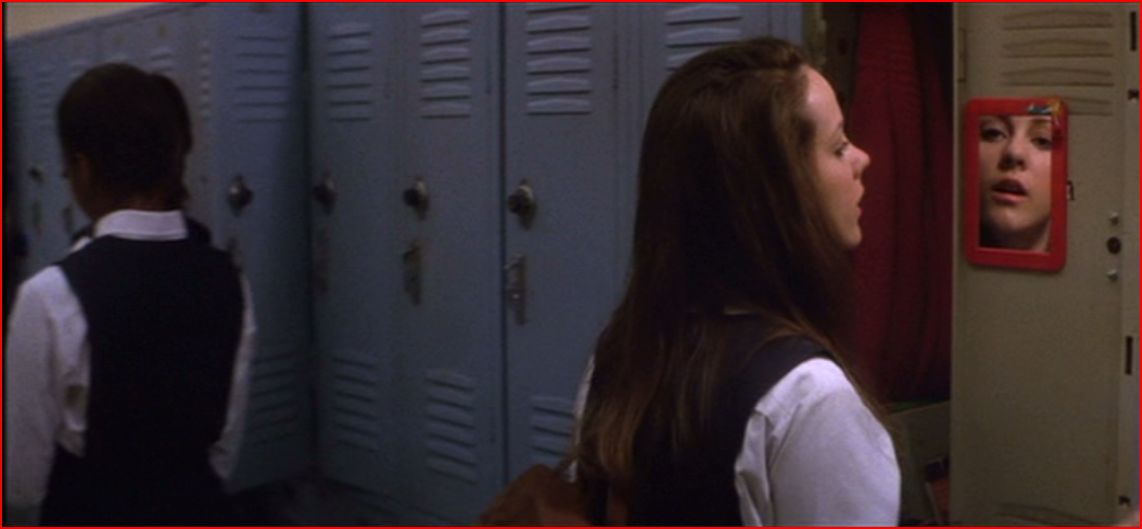 My favorite shot of the sequence, as high school newcomer Gretchen (Jena Malone) briefly catches the eye of Kelly's lens through her locker mirror.
 A clever, well-timed shot, as we see Seth take a quick snort of coke before the principal comes into view to take a naive look down the hall.
 The school's grotesque mascot that will be mentioned later in the film
 Jim Cunningham (Swayze) arrives on campus, "Attitudinal Beliefs" in tow.
 Ms. Pomeroy and Mr. Monnitoff (Drew Barrymore and Noah Wylie) meet Jim, with the clearly disapproving Susie Bates in the background.
 WTF?
WTF? Samantha Darko (Daveigh Chase) and her dance team, a key plot catalyst.
Thursday, November 08, 2007
Next stop: Spiritualism?

Note: This post is a contribution to the Film + Faith Blog-a-Thon at Strange Culture
In The Darjeeling Limited, Owen Wilson's character Francis proclaims he and his brothers are on a "spiritual journey" through India, like it was a package arranged by an online travel agency. In Wes Anderson's previous films, religion was almost never touched on -- save for The Life Aquatic with Steve Zissou's imagery of an undersea world of obvious intelligent design. With his latest film, Anderson often looks at how religion is viewed from the outside, by those who are in it as tourists.
Wilson's performance and his odd character are the driving forces of The Darjeeling Limited, and it's telling that Francis never really expounds on what spiritualism means to him, even though he goes out of his way to trumpet how "spiritual" upcoming locations are and to involve his brothers in complex spiritual rites. To Francis, "spiritual" is merely an adjective. It represents the unknown of what he may find at a temple of a religion completely foreign to him or what a strange ceremony involving peacock feathers may produce.
Francis clearly wants something big to happen between he and his brothers on their journey, but it's unclear why he chose India other than the land's spiritual qualities that baffle him. Perhaps the most spiritual moment of the trip is when the brothers find themselves at a young boy's funeral, inside a small village. Anderson focuses on the the villagers' rituals of burning the body, an image that no doubt shocked the clean cut brothers. Since they had recently attended their father's funeral, the brothers now find themselves at a more emotional event for a person they didn't know, but the effects of the native rituals are probably more profound than anything at the American ceremony.
There is a seismic rift between Francis, Peter and Jack, and Francis may know that it will take a higher power to heal it. Though he praises the spiritual qualities of the land they're traveling through, Francis doesn't appear to be very spiritual himself. But Francis seems convinced that a spiritual ceremony with peacock feathers will help the brothers find common ground -- but it only further illustrates their disconnect since Peter and Jack were unclear on their roles. The ceremony shows Francis' misunderstanding of spiritualism and faith, and how they connect.
The peacock ceremony is empty without the necessary faith, and only when the three brothers have faith in themselves and their family, at the end, does the "ritual" work for them and serves as a uniting force.
Monday, October 22, 2007
DOUBLE BILL: 'The Terror' of 'Targets'

Note: This post is a contribution to the Double Bill Blog-a-Thon at Broken Projector.
Targets is a movie about a seemingly ordinary, well-behaved man who suddenly goes on a killing rampage in Southern California. So it's a bit odd that it starts out with Dick Miller and Boris Karloff in a castle shouting about something, with water quickly filling up the room. Credits fill up the screen, and we learn that Karloff is indeed in the movie -- but where are the guns? And why do we keep seeing that raven? And who's that ghostly woman we see before "The End" pops up on screen. Peter Bogdanovich's first major film, Targets is a unique experience for the viewer in part because it makes great use of another film, Roger Corman's The Terror, released five years earlier in 1963. For this Double Bill, we're going to screen The Terror first.
The Terror (1963)
A French cavalry guard riding on the beach. An attractive woman who may be a ghost. A castle inhabited by the strange Baron von Leppe and his assistant Stefan. A raven. These are the main characters in Corman's The Terror, and there are well-known names behind almost all of them (I don't know the name of the raven): Jack Nicholson, Dick Miller, Boris Karloff and Sandra Knight. Behind the camera at one point or another during the piecemeal production were Francis Ford Coppola, Monte Hellman, Jack Hill and even Nicholson. And the actors and collaborators aren't the only familiar pieces of the film -- Von Leppe's castle interior is also seen in the Corman pictures Tomb of Ligeia, The Haunted Palace and The Raven.
Shot in the dream-like Pathe color, The Terror is titled as horror, but is more mystery or detective story than anything. Nicholson's Lt. Andre Duvalier has been separated from his military unit, and seeks shelter in Von Leppe's castle, as well as an explanation for the beautiful woman he saw on the beach who disappeared. Von Leppe is hesitant to do either, and the fidgety Stefan seems to be hiding something. Oh, and the raven is outside cawing. A coherent story is not always on the screen, as it seems most of the movie is comprised of Duvalier following Von Leppe around the castle asking questions. Eventually, the mysterious woman appears (and disappears) again, and some elements of Von Leppe's past are revealed. The raven makes many more appearances (often cawing), there's lots of shouting at the end, Stefan and the bird get in a fight on a cliff, and the raven wins.
There's never a point in The Terror where it doesn't feel like a legendarily cheapo Corman production, and it's really not one of his better cheapos. But considering it was filmed in many fragments by several directors, it comes together pretty well, and has a fun gothic atmosphere. But these aspects combined to make The Terror a great choice for a second life in Bogdanovich's Targets -- as a run-of-the-mill drive-in movie. Bogdanovic made the movie at Corman's urging, with the conditions being that he use portions of The Terror and also utilize Karloff, who owed the producer two days of shooting from another production.
Intermission
Please enjoy this episode of Batfink
Targets (1968)
Since we're now familiar with The Terror, it's a little strange to see it on the screen again, this time with credits imposed over the film's climax. We once again see Von Leppe's discovery in the tomb, with good old raven flying next to "The End." The next shot shows us the origin of what we were watching: a studio screening for producers, director Sammy Michaels (Bogdanovich) and star Byron Orlock (Karloff). Orlock is an aging horror star who is ready for retirement, studio contract or not, and is also hesitant to participate in a hokey premiere of The Terror at a local drive-in. The next shot of Orlock is a masterful introduction to the film's other main character, Bobby, who has Orlock in his crosshairs from a gun shop across the street. Bobby has a lot of guns, and he's about to buy some more. Leaving the gun shop, Bobby opens the trunk of his Mustang to reveal a startling weapons cache. For the rest of the film, we follow Bobby and Orlock's paths until they meet in a near-perfect climax.
Bobby appears to be a young man cut right out of the My Two Sons mold, and he's more than eager to speak to his parents in "Yes, sir!" "Great!" and "Delicious" tones. But besides his gun collection, there are a few other odd aspects about Bobby: during an outing at the shooting range, he puts his father in his crosshairs briefly, and when his wife comes home from work that night, she finds him sitting in the dark smoking a cigarette. The next morning, Bobby mechanically kills everyone in the house, leaving a confession note and a warning of many more killings that day. Orlock, meanwhile, is spending the day in high spirits, content that his often disappointing career is coming to a close. He will make an appearance at the drive-in tonight, and that will be that.
Bobby's killing path will take him to a water tower overlooking a freeway, where he will pick off several cars with remarkable ease -- while eating a sandwich and drinking a Dr. Pepper. While eluding the police later in the day, Bobby finds the perfect hiding place for more mayhem: behind the screen at the drive-in. It is here where The Terror again becomes a character, with the images of Von Leppe, Duvalier and the raven filling the screen. Bogdanovich films the drive-in scenes perfectly, with dialog barely audible through the collective drone of the tiny car-mounted speakers. Bogdanovich makes great use of The Terror's B-movie quality, showing us fragments of it that make it appear even less comprehensible than in full form. Orlock arrives just as Bobby's terror begins, and as people drive out of the lot in horror, he takes it as their reaction to his movie.
The Terror and Targets come full circle as Orlock gets out of his car to find the source of all this murderous mayhem. Bobby looks up at the screen to see Von Leppe walking down a castle corridor, and then looks to his left to see Orlock walking toward him. The converging characters -- fiction and reality in one -- is too much for Bobby, as he surrenders with his hands over his eyes.
Tuesday, October 09, 2007
Horror by numbers
Another in a series of recent film survey lists, Ed Hardy Jr. is hosting the 31 Flicks That Give You the Willies, with readers asked to submit 31 nominees. I love this idea because it's asking not for the best or favorite, but simply the movies that scare you the most. I can do this -- because a lot of movies scare me.
I tend to write a good amount about horror movies (and that will continue this month), and that's partially due to the fact that for a few years now I've been in horror-catch-up mode, making up for all the years when I avoided horror movies. For the longest time, they weren't me, and there were quite a few I was actually afraid of seeing. Somewhere in college this changed, and I've been going through the genre at a steady pace ever since.
Some of you may not classify all of these as horror, but they all fall into the same category for me: scary.

- The Night of the Hunter (1955) -- One of my top 5 favorite movies of all time, and one that will always frighten me. On a personal level, it reminds me of a nightmare I had when I was three years old that I have never forgotten: my parents had left my brother and I with a babysitter who happened to be a witch, but they didn't believe me. Night of the Hunter follows this mode of terror, by putting you inside the mind of a child who can't trust adults. Being helpless is a terrible feeling, and it permeates this movie. It also helps that Rev. Harry Powell (Robert Mitchum) is one of the scariest characters ever put on film.
- The Leopard Man (1943) -- I've said before, this is an imperfect movie filled with terrifying scares. It's the Don Larsen of horror movies. When we see the leopard's eyes, then look back and see only darkness -- chills.
- The Innocents (1961) -- Hands down the scariest ghost movie ever made. Why is it that ghosts doing nothing but sitting by a pond are scarier than ghosts who jump out of shadows?
- Sisters (1973) -- The best case for never entering a hospital again. Or even hinting that you're mentally ill. Or having a twin sister.
- Halloween (1978) -- As I hope to say in a post later this month, it's the quiet scenes in this movie that do the most for me. Somehow, John Carpenter manages to make every hedge and tree limb scary.
- Invaders from Mars (1953) -- If only for the superb ending, a startling revelation that your worst nightmare is indeed a reality.
- The Descent (2005) -- No more hospitals. No more caves.
- The Thing (1981) -- The scares start right as we learn that the creature sitting on the operating table isn't dead yet.
- Invasion of the Body Snatchers (1956) -- No remake will ever measure up to this one.
- Ringu (1998) -- Don't even know where to start with this one.
- Twin Peaks: Fire Walk with Me (1992) -- I know this isn't a horror movie, but the scene where Laura Palmer enters her room and finds the man behind her dresser scared the hell out of me.
- Friday the 13th (1980) -- Another one in the running for scariest ending ever.
- Demons (1985) -- Delicious concept of being terrorized while watching a horror movie at a theater. Love it.
- Phantasm (1979) -- "You think you go to heaven when you die? You come to us!"
- The Evil Dead (1981) -- A story (and budget) stretched to the absolute extreme.
- Jeepers Creepers (2001) -- The first half was the only time I considered leaving a theater because of how scared I was.
- Candyman (1992) -- Anyone who went to a Catholic school knew the myth of Bloody Mary, and this one hit a little too close to home.
- The Other (1972) -- Kids do the darndest things. I mean they really do some goddamn awful things!
- Village of the Damned (1960) -- It's the eyes.
- Bride of Frankenstein (1935) -- Dr. Pretorious' miniature creations. So creepy.
- Gremlins (1984) -- The image of seeing Santa Claus terrorized while cops looked on haunted me for years.
- Cat People (1942) -- Amid a bunch of high-class scares, the best may be the subtle opening scene where Irena suddenly looks possessed after that brief encounter with another woman in the restaurant.
- The Birds (1963) -- It's basically Hitchcock saying "you wanna see something really scary?"
- Don't Look Now (1973) -- Those dark alleys. That photograph. That thing at the end.
- Freaks (1932) -- Utterly masterful ending, and chilling as hell.
- Return of the Living Dead Part III (1993) -- So much twisted mayhem, it's beautiful.
- The Fog (1980) -- The very beginning and ending get the most scares.
- Prince of Darkness (1987) -- Wait, the fate of the world is resting on a bunch of college nerds in an urban church? And Alice Cooper plays some sort of hobo witch king? And all they have for weapons are 2x4's? Did you say Victor Wong is in it?
- When a Stranger Calls (1979) -- Even scarier than the opening phone conversation is the bar scene where Tony Beckley apparently falls for that absolute hag.
- The Haunting (1963) -- I think it's overrated as far as scary movies go, but the final line gave me goosebumps.
- Hellraiser (1987) -- Love the mythology that exists in this film.
Monday, August 27, 2007
French officials address explosive violence
Note: This post is part of the Bizarro Blog-a-Thon at Lazy Eye Theatre.
By Eve Roth
The Associated Press
PARIS (AP) -- Police officials from Paris, Nice and Arles gathered in the nation's capital city today to address mounting criticism stemming from a recent hurricane of violence that swept through the three cities. In its wake was untold levels of property damage, at least seven civilian deaths, countless smashed cars and the dramatic murder of figure skater Natacha Kirilova. Yet the most damning element of the whole affair was the number zero. As in the number of arrests made by police, and the number of leads about who was responsible.
"We have reason to believe that some of them are still alive, and that one could be an American," Paris Police Chief Raul Beauvais said while trying to look tough, possibly in a poor impression of John Wayne.
French media outlets have been unanimous in condemning local authorities, who they say are contributing to their nation's stereotype as a leaf in the wind when it comes to violent conflict.
"This band of thugs essentially played a game of 'Grand Theft Auto' in our country, and all we have to go on is that a few of them may have had dark hair," blasted crime columnist Frederic St. Videau of the Paris Plain Dealer. "Unless we're targeting stylish criminals as an untapped consumer, then we need to find a new police force."
The carnage began two weeks ago in Paris, when a wild shootout erupted over an apparent arms deal gone bad. After the surviving party predictably escaped, police found four dead Parisian mobsters. It may have seemed like just another Saturday night in Paris, but it was just the start of a maniacal spree of mayhem over the next week.
In Nice two days later, a fantastic barrage of shootings and explosions left residents of the sleepy tourist town stunned.
"I'm fine with guns, but do they really need grenade launchers and bazookas?" echoed longtime village sage Luc Devereaux while lazily filling his tobacco pipe. "And seriously, why do they need to target fruit stands?"
The Nice fruit stand was where the eruption started, with two gentlemen in a Mercedes opening fire on a motorcade of five sedans, with one employing a grenade launcher to great effect. After dispatching two of the cars in spectacular fashion, the party in the Mercedes chased after a Citroen, which met its fiery end through the crosshairs of a well-aimed bazooka.
"You could tell he knew how to handle that little firecracker," observed known vagrant "Sticks," while clutching a sack of carrot stems. "It blew up, then kept sliding down the road. Almost like a badger on election day."
But that was just the opening act of the day's horrible festivities. The cars continued chase, weaving in and out of Nice alleys and even forest roads, smashing into a fish market before destroying a quaint restaurant patio with an outburst of gunfire. Despite a flurry of spilled blood and innocent death, it was here that authorities nearly had their moment of triumph. The Nice SWAT team arrived, however it was only in time to witness the last of the awful visitors speed off in a huff. "You bet our guys were there, with guns drawn and brows furrowed," grinned Nice Police spokesman Guy Garnier-Fulke, leaning precariously close to the press corps. "But then they drove off, what were our men supposed to do -- run after them?"
The one saving grace of the Nice tragedy was that further casualties were eliminated through the help of the city's "No Afternoon Drives" program, where no one is permitted in their cars past 2 p.m. Because of this, the awesome race-car driving skill of our troublers were left unimpeded -- for better or worse.
One day later, the two men seen involved in the Nice disturbance (both possibly with dark hair) arrived in the historic burg of Arles. Whether this was a tourist stop for the criminals or not, it still resulted in the deaths of two sight-seers by gunshot. Like the Nice authorities, Arles Police came close to apprehending the conspirators, only to watch them car-jack a poor soul and escape.
"We didn't plan on them having a reverse gear," lamented recently-axed Arles Police Chief Carl Peterson, who announced after the press conference that he would retire to his native land of Baraboo, Wisc.
With the knowledge of a crime spree terrorizing the country, Paris Police still decided on the questionable action of an early weekend -- leaving but three constables to patrol the whole city for a span of 96 hours. The timing couldn't have been worse, as the "Gruesome Twosome" -- as the Lichtensteinian press has dubbed them -- made their way into the French capital for a riotous chase. Clips of this two-car chase have been among the most popular on the Belgian file sharing Web site ClipTubMan, and those who witnessed it will never forget its awesome spectacle.
"Oh my God, it was like Ayrton Senna had come back from the grave to show us mortals how real driving is done!" recalled noted Formula 1 enthusiast, and current NASCAR driver Kasey Kahne, who spied the chase from the confines of a Paris lingerie shop.
The infamous chase resulted in the wreckage of 25 cars, killed at least one driver, and shocked untold onlookers as the black BMW and blue Peugeot weaved through oncoming traffic. French Transportation Minister praised Parisian drivers on this black day, noting that many of them were not exceeding 20 kph during the chase, despite driving in a 60 kph zone.
Because of Paris' limited police force on that day, the closest authorities got to the chase was a base-pay constable who gave chase in a tunnel, only to flip his car after driving over a small traffic divider. Adding to the agency's black eye was the fact that the lead car in the chase (the black BMW) crashed over an incomplete freeway segment and even blew up -- yet no one was taken into custody.
"Even if we had our full complement of officers, how many would we have had patrolling at the base of a freeway construction site?" Beauvais asked half-sincerely while pouring the last of the press conference's complimentary wine case.
Tragically, the crime spree ended at the site of esteemed skater Kirilova's death during her famous "Go-Go-Whip" routine. The sniper in the case was never identified, nor were the "dark-haired dastardlies" -- as the Basque press has taken to calling them.
Though no crimes have been committed in days, authorities still believe the two headliners of the spree are at large, with only a disappointing description and an eerie thought by Beauvais in the police department's favor.
"If you ask me, the (suspects) kind of resemble those old disgraced samurai whose masters had died -- what'd they call them, Ronin ... Ronan ... Ronjun?" Beauvais muttered as he exited.
Associated Press reporters John Cocktoasten and John "Stumpy" Pepys also contributed to this report.