What ever happened to the good old days when it seemed every time you turned around there was a guy wearing a goat's head sacrificing a nude virgin? Well maybe it never got that bad (in most areas), but it's comforting to know that there was a time when the threat of Satanic cults was a great distress to this nation. Case in point the Satanic cult craze in Hollywood and television through the 70s and early 80s. Rosemary's Baby probably jump started the film industry's fascination, and The Exorcist did nothing to slow it down.
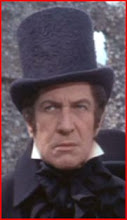
So the Satanic cult/Satan genre had a few good movies, but we also got a bunch of low-grade/high-fun crazy crap such as Necromancy (also known as A Life for a Life, Rosemary's Disciples, The Toy Factory and The Witching), starring a brow-furrowed Orson Welles as the devilish owner of a bad toy factory (never seen) and the leader of a Satanic cult (very much seen). But as far as Satanic cults go, it doesn't get much more fun than 1975's Race With the Devil.
Starring Peter Fonda and Warren Oates (strangely looking much older and fatter than he did in Bring Me the Head of Alfredo Garcia, made only a year earlier), Race With the Devil combines the familiar Satanic cult paranoia of Rosemary's Baby with the sensibilities of a Winnebago road trip. What starts off as a pleasant Texas to Colorado ski vacation via a new RV turns bad when Roger (Fonda) and Frank (Oates) find a secluded camping area for the men and their girlfriends, and accidentally spy an apparent Satanic sacrifice across the river. Somehow the men are spotted, and eventually high-tail their asses out of there, but not before a suspenseful river crossing (this is before people knew RVs were not off-road vehicles) and fighting off a few stowaway cult members.
Of course, the local law is little to no help (despite the usually God-fearing R.G. Armstrong playing the sheriff), but our foursome is able to steal a book on Satanism from the library. So they're in the clear, right? Unfortunately, this is not your everyday Satanic cult. The brand of cult in Race With the Devil is the kind that will fill your RV with snakes, the kind that will stare at you while you're in a swimming pool, and the kind that will take you out to dinner at a country western bar with one hand and sacrifice your little dog with the other.
Our gang soon finds out what most of us had already suspected: the entire state of Texas is one giant Satanic cult. This leads to a Winnebago death chase that may have inspired some of the delicious madness that ends The Road Warrior. There are some absolutely smashing stunts to be had in the climactic chase scene, and if you're hoping for the gang to outrun the Satanists, well -- you just don't know how Texas cults work, do ya? They always get their man.
Race With the Devil is all kinds of fun, and it's helped by the fact that the nameless Satanic cult is played as an outright MacGuffin. We never learn what their intentions are, what they plan to do with our gang, or even who it was they were sacrificing that one night. And who cares? As long as it results in a cross country chase with a Winnebago, I'm satisfied.
Note: While googling Race With the Devil, I ran into this Black Oak Arkansas album of the same name. Niiiiiice.
Saturday, September 29, 2007
Evil Dead RV

Monday, September 24, 2007
Wes Anderson: It's in the Details (Part II)

As I said in Part I, what I love most about Wes Anderson's movies is his attentiveness to the details. Often they don't have anything to do with the plot, or you only catch them the second time through, but they're what make Anderson's movies his. In The Life Aquatic with Steve Zissou, these details are less explicit than they were in The Royal Tenenbaums (such as a richly detailed quick flashback of Ethelline's former suitors or the infamous paintings in Eli's house). The details here are less bombastic and usually low-key, fitting in with the overall mood and story of the film.
- Steve Zissou's office, like that of Raleigh St. Claire in The Royal Tenenbaums, features an outrageous rotary telephone.
- Anne-Marie is topless when she's introduced, silently inferring that she's foreign, but she has an American accent in her later scenes.
- All the crew members of the Belafonte have multiple titles, except Pele, who is merely the "safety expert."
- Zissou's interns are from the University of North Alaska.
- The packed theater in the beginning is made up of French and English speakers, as half the audience starts laughing at Zissou's reply before the translator starts talking.
- The over-attentive assistant at the theater brings Zissou and the host an ornate crystal pitcher of water without prompt.
- Zissou and Alistair Hennessey (Jeff Goldblum) are both wearing a number of apparently nautical decorations on their suits at the gala, but Hennessey has more, including some sort of medal in place of a tie.
- Zissou's entire crew, and also Hennessey, wear a small green pin on their lapel.
- At the after party on the Belafonte, Zissou gives Eleanor some her game of solitaire just before the power goes out.
- The bar tender at the after party is one of Zissou's interns, wearing a shirt with "INTERN" boldly printed on it.
- The Air Kentucky uniform that Ned Plimpton (Owen Wilson) wears includes a string tie in the style of Col. Sanders.
- The kitchen in the Belafonte includes many racks of wine.
- Among the books in The Steve Zissou Companion Series: Tragedy of the Red Octopus, Arctic Night Lights and Trawlers, Junks and Dinghies (Zissou later reads the latter, trying to identify the pirates' ship).
- The painting of Hennessey at the Explorers' Club features him sitting on a couch on the deck of a boat, like he does later in the movie.
- After Zissou berates the Explorers' Club waiter for trying to give wine to Ned -- who "doesn't know anything about wine" -- he throws it down like a shot.
- One of the artifacts at the Explorers' Club is an old space suit from a foreign country.
- After landing on his island with Plimpton, Zissou takes a bottle of liquor and a shot glass out of his suit jacket.
- Continuing the theme of pay phones from earlier Anderson movies, the Belafonte contains a strange, foreign edition with many slots for coins. Unlike the pay phones in The Royal Tenenbaums, it is not rotary.
- Plimpton's official correspondence stationary describes him as "Kingsley (Ned) Zissou."
- Co-writer Noah Baumbach plays Oseary Drakoulias' assistant in a brief scene in his office.
- Zissou uses the term "teamsmanship."
- The studio inside the Belafonte contains a pristine electric guitar, similar to a Fender Jaguar model.
- Among the stunts listed on the bulletin board are: Skydiving into the Volcano (crossed out by Eleanor), bottle shooting, Zodiac speed jump over rocks and cliff jumping.
- Klaus makes himself a cappuccino during the raid on Hennessey's compound.
- Hennessey has a framed picture of Lord Mandrake on his boat, just as Zissou does.
- A rum cannonball (which Zissou remembers fondly from the Hotel Citroen) contains rum, gin, orange juice, strawberry soda, lemon-lime soda and pineapple juice.
Wednesday, September 19, 2007
Where no season set has gone before
I knew I was forgetting something in my last post when I talked about how busy this Christmas season would be for big DVD releases, and here it is:
If you haven't heard, to help celebrate the 40th anniversary of Star Trek, all of the original episodes have been mastered in HD, gotten enhanced special effects and are now being syndicated across the country (here's a list of air dates on local affiliates). The results have been outstanding (see old vs. new) while only occasionally inching into George Lucas touch-up territory. While the episodes are available for broadcast in HD, most areas have them on analog stations (including mine). And unless you have an XBox 360, where they are available for download in HD, you'll never be able to see William Shatner's nipples through his enterprise uniform. Which brings us to the new DVD set.
The moment I heard about the new episode treatment, I couldn't help but feel sorry for all those Star Trek fans who had plunked down $90 for the three season sets released a couple of years ago. Knowing companies are still in the business of making money, they would eventually get around to releasing these hot-rodded seasons on DVD, at an even more astronomical price. But I would have never predicted that the new seasons would arrive in an HD-DVD/DVD combo format! This news is exciting and disappointing at the same time. Exciting because you'll have the episodes in HD even if you haven't decided to upgrade your hardware yet, and disappointing because this has increased the price even more ($200 MSRP).
Still, this is a big milestone for television on DVD and a huge piece of news for the HD-DVD fight. The Star Trek seasons will be the first showcase of what the next-gen formats can do for television, specifically older television. Like many series, Star Trek was filmed on 35mm, which means there is a ton of resolution built into the master prints of it -- a picture quality no television in the 1970s, much less an ordinary DVD can replicate. So this isn't just bumping up to 720p on your upconversion player, these sets will present the genuine article with radically improved picture quality. The DVDs will also have new special features that take advantage of the new format, including the ability to completely navigate through the enterprise with your remote (watch a handy video of the feature here).
In fact, one of the reasons new special effects had to be added was that they didn't hold up in HD. With amazing clarity, the decades-old effects wouldn't be able to blend in like they could on our old Zenith set. Still, there's the price -- and from reading the comments on the Amazon page it looks like that will be a huge stumbling block even for huge Trek fans. I see it as just another reason why the consumer is winning in a big way with the HD-DVD vs. BluRay battle.

Saturday, September 15, 2007
Start saving up for Oct. 23!
October 23 is shaping up to be one of the deepest DVD release dates in some time. There's quite a few to cover, so let's start right at the top with the most anticipated release:
Warner Director's Series: Stanley Kubrick
A long time coming, Kubrick fans will finally get souped-up widescreen transfers of 2001: A Space Odyssey, A Clockwork Orange, Full Metal Jacket, The Shining and Eyes Wide Shut. The set also includes a disc containing the documentary "Stanley Kubrick: A Life in Pictures." This will be the third Kubrick box set from Warner Bros., but by far the best -- and coming in at only $55! As has been long discussed, Kubrick specified that his movies only be released in full screen and mono sound for home video, allegedly because he didn't like how letterbox effects looked. This was fairly easy to do, as almost all of his movies were shot in full frame and then cropped for theatrical distribution. Kubrick died before widescreen televisions became popular, and now we will finally have all of his movies available in their theatrical aspect ratio.
This will also be the first time American audiences will see the uncut version of Eyes Wide Shut, without the digitally-added shadowy figures in the orgy scene. All of the releases will have extra material (a first for each movie included), including commentary tracks. In addition to the box set, each included film will be available in new standalone two-disc editions, and new versions of Lolita and Barry Lyndon will go on sale that date as well (no information as of yet for those last two). Other Kubrick classics, such as Dr. Strangelove and Spartacus, are not available to Warner Bros., but have received quality DVD releases in the past. For a good explanation on Kubrick's full frame compositions and what to expect with the new widescreen cropping, check out this very informative DVD Talk thread.
The Mario Bava Collection, Volume 2
Now that Tim Lucas' long-awaited tome on the director has been released, Bava fans have more reason to celebrate with another affordable collection of his films. $35 gets you 8 Bava movies, including Bay of Blood, Lisa and the Devil and 5 Dolls for the August Moon. Volume 1 of the Bava collection contains six of the director's works, and was available on Amazon this summer for $20. My experience with Bava is admittedly meager, but I've been itching to put an end to that, and this new set may be just the cure.
The Adventures of Young Indiana Jones, Volume 1
I don't remember this series as fondly as others, but fans have been clamoring for a DVD release of it for a long time. From my perspective, only the real hard core fans will pony up $90 for this, as it only contains seven episodes (plus 38 companion documentaries) across 12 discs. The second and third volumes are expected in December and Spring 2008. Paramount was smart to give this similar packaging to the Indiana Jones Trilogy box.
The Criterion Collection: Days of Heaven, Breathless and Under the Volcano
A very solid month's offerings from Criterion. For many, Days of Heaven is the highlight as Malick films typically have very poor representation on DVD (possibly due to the director). I'm looking forward to Under the Volcano, as I had never heard of it until Criterion's announcement, and it sounds very good.
Hellraiser: 20th Anniversary Edition
Hopefully Anchor Bay will give this the same first class treatment it gave Phantasm earlier this year. I believe this will be the first time Hellraiser will be available in anamorphic widescreen.
Cutting Class (Unrated Version)
Yes, that's right Moviezzz! For the first time on DVD comes the horror movie Brad Pitt would like us to forget -- and that's not going to happen with the young actor dominating the cover art. A strangely entertaining slasher flick that seemed to inspire the most infamous shot in Eli Roth's Thanksgiving (see Moviezzz link for more explanation), Cutting Class has been rarely seen, some say due to Pitt's efforts to keep it out of the public eye (I've only seen an edited version on late-night cable). No word on extras, or what the new cut is like.
Battleship Potemkin (The Ultimate Edition)
The historic treasure gets a serious upgrade, featuring newly-translated intertitles as well as the original Russian intertitles. The highlight of this two-disc set looks to be a newly-recorded score, care of the Deutsches Filmorchestra, presented in 5.1 sound.
***************
What a week! And just a week later, we'll have the Twin Peaks: Gold Box. It's also going to be quite a Christmas season, with the Blade Runner extravaganza coming out in December.

Tuesday, September 11, 2007
Wes Anderson: It's in the Details (Part I)

Wes Anderson's career technically started with the marvelous Bottle Rocket, but the career he is currently living out began with Rushmore. It was with Rushmore that Anderson introduced a comedic style that not only featured traditional jokes, but a variety of "static" jokes disguised as background objects, names and seemingly trivial details. The montage of Max Fischer's heavy involvement in scholastic clubs was a perfect introduction to this style, as it took up little screen time but obviously contained a wealth of comedy that would be revealed further on repeat viewings. This style of Anderson's would be applied in his two subsequent films, The Royal Tenenbaums and The Life Aquatic with Steve Zissou. Even though his upcoming The Darjeeling Ltd. looks to be less zany than those last two (obligatory: "why does it have to be zany?"), I'm infinitely thrilled to see it if only for seeing what details he serves up this time.
To me, this kind of comedy reminds me of the best moments of The Simpsons, where static jokes are treated like royalty by writers. But Anderson has quietly made this technique his own, and for me it doesn't get any better than in The Royal Tenenbaums. Here, I have listed (in all the not-so-obvious details, names and background objects I have noticed after many viewings. I intend to do this for the other two Anderson movies I mentioned as well.
- Pagoda serves Royal Tenenbaum a martini on a silver tray, after he informed his children of their parents' divorce.
- The cover of Etheline Tenenbaum's A Family of Geniuses seems to be a photograph taken at the book's very release junket, possibly indicating that we are seeing a later edition of the book.
- The Tenenbaum family flag, an elongated pink triangle with a simple "T" crest at its base, flies on a spire at the family's Archer Avenue house as well as their summer home on Eagle's Island. This same shade of pink is frequently worn by Royal and Pagoda during the movie.

- In a flashback to Royal addressing Margot as his adopted daughter, they are at a party and flanked by high-ranking military members apparently from Russia, Western Europe and the Middle East, as well as an old man in an outrageous houndstooth suit.
- At young Eli Cash's house, in the background there is a key holder bearing Sharpie inscriptions of "Eli's Keys" and "Aunt's Keys" with respective arrows. Young Eli is later seen wearing a key on a necklace.
- Royal wears the same outfit in all the childhood scenes: a tan coat with sunglasses and a lit cigarette.
- As he is getting dressed for a press event for his new book, Old Custer, Eli is assisted by three men -- one of which holds up a platter of finger sandwiches. Eli takes one bite.
- When we are introduced to Henry Sherman, he is apparently inside an apartment building he owns. Behind him are plaques with reminders of when garbage is picked up and other items. Below the text is "H. Sherman. Landlord."
- After Royal is informed that he must leave The Lindburgh Palace Hotel, we see his masseuse packing his bags while he looks out the window and smokes.

- The name of the reggae band Margot got involved with is Desmond Winston Manchester XI (the name of the album is illegible on my TV, anyone?)
- The names of Margot's plays we see on posters in her room include and Nakedness Tonight and Erotic Transference.
- Raleigh St. Claire's office is filled with various outdated technology, including a bizarre multiline rotary phone and random vacuum tube switchboards.
- The three former suitors of Etheline are: Neville Smythe (a British Arctic explorer), Yasuo Oshima (an Asian architect) and Franklin Benedict (a John Huston-like director with an eye patch, cigarette and a set filled with an Indiana Jones lookalike, a pair of amphibious people, a space man and an obscured production chair, of which we can see the word "Galaxion").
- While meeting with Pagoda, Royal calls Henry a "two-bit chartered accountant."
- The Tenenbaum's neighborhood varies radically with each side of the house: one side is in an upscale area next door to the Thai embassy, another is in a downtrodden area and a third side is on a wooded street with a bus stop.
- Margot's closet still contains her leopard costume used in the play performed on her birthday.

- Eli is seen smoking a peace pipe.
- Eli's apartment features the spectacular "Aggressively Mediocre/Mentally Challenged/Fantasy Island (circle one)" paintings by Miguel Calderon.
- Richie is seen reading Three Plays by Margot Tenenbaum. The book can't be any longer than 150 pages, and though the names of the plays listed on the cover are illegible, none of them look to be the previously mentioned titles.
- Henry Sherman's desk has an urn on it, presumably containing the remains of his wife who died of stomach cancer.
- In addition to the previously mentioned former suitors, Henry and Etheline recall Gen. Doug Cartwright in conversation.
- Rotary payphones are frequently featured in shots, often in strange locations such as near the water of a public swimming pool and on the roof of a rec center.
- A gravestone observed by Royal and Richie reads "drowned in the Caspian Sea."
- During the broadcast of Richie's infamous tennis meltdown, the play-by-play man is voiced by Wes Anderson. His color analyst is named Tex Hayworth.
- Eli's apartment has a large table saw and a mounted bull's head with a lasso around the horns.

- Richie is often seen drinking a Bloody Mary.
- The magazine sent from Eli to Etheline has a note that reads "Dear Mrs. Tenenbaum, just in case you missed it. --Eli."
- Eli's cover story is titled "Where the Wild Things Are" and has a deck that reads "New work reopens genre. Adam Scher talks with the James Joyce of the West."
- Eli's previous novel was titled Wildcat.
- Royal tells a cabbie to take him to the "375th St. Y" and their destination bears that literal title.
- The novel The Royal Tenenbaums that the movie supposedly follows is very poorly written. When chapter headings introduce scenes, they begin with lines like "Royal is wearing his wool hat" or "they pull up in front of a building that looks like a huge castle."
- When Chas is chasing Eli through the house during the wedding, Pagoda stops Eli with some sort of food and says "hey man, try this it's very tasty." Eli eats it.
- Margot's play we see near the end, Levinsons in the Trees, appears to be based on the miniature set we see her playing with in the beginning.


Sunday, September 09, 2007
The Mind and the Metallurgy
It was 20 years ago this summer that RoboCop was released, and the occasion is celebrated by finally delivering a proper DVD of it to consumers (more on that later). I first saw RoboCop the following summer, when my mom amazingly rented it for me and my friends to watch during my seventh birthday party. It was quite a coup, since we had all spent most of the year imagining what the movie could have been like -- and wondering how many years it would be before our parents would let us see it. I think the title fooled my mom -- it sounds innocent enough -- and I'll never forget the look on my friend Ben Maddox's face when I told him what movie we would be watching that evening (he gripped my shoulders and asked me to repeat, like he had just been told his parents had been eaten by wolves). Somehow we made it through the whole movie without my parents really catching on to what we were watching. Our minds were appropriately blown, and Paul Verhoeven's trademark shock value was a frequent topic of conversation that summer.
Many might shake their fist at DVD Savant when he says in his review that RoboCop is "both the best and the most important Science Fiction film of the 1980s." It doesn't appeal to everyone, but the movie is supremely important in the realm of Sci-Fi -- using the genre as a means to explore issues in our culture to a depth that a more traditional movie could not achieve. It's also important in how RoboCop represents the decade, using landmark "analog" effects to create a world not post-apocalyptic, but one that has clearly reached its peak and is slowly crumbling.
The movie opens with a futuristic Detroit where criminals no longer fear the police, and local badge is nearing strike after a recent massacre of their own. Compounding their fears is the decision of the city to turn over police operations to a private company, OCP -- with deep pockets and radical ideas of how to eliminate crime. The OCP way is not prevention, but annihilation with the frightening E.D. 209 concept -- a monstrous, armored robot that can mow down rows of criminals without thinking twice. But E.D. 209 famously malfunctions in the boardroom, emptying a few drums of bullets into a lacky suit, shifting the company's focus to another project, the RoboCop. Needing only a "volunteer," OCP finds one in Officer Alex Murphy, who in his first day after transferring to the dangerous downtown precinct is viciously executed by a gang of criminals.
We learn almost nothing about Murphy prior to his death, only that he has a family. In one of the movie's greatest sequences, we see the mechanical transformation of Murphy through his eyes, gradually gaining consciousness as his new identity is forged. This climaxes with an epic reveal, as the ordinary police officers in the precinct hear the thunderous footsteps of their new partner, then come face to face with the eye-less machine. Beyond saying that Murphy's memory was erased as part of the RoboCop program, we're given scant details as to how human he still is -- whether his brain is still somewhat intact, or whether his face was simply transplanted onto steel. However many human elements remain, Robo slowly starts to realize there is more to him than circuits, starting with memories of a home and a family who have since moved on after his death.
RoboCop's creators hail the project as something that will "eliminate crime" in Detroit within a decade, but Verhoeven explicitly shows that the only upgrade Robo offers over regular cops is his efficiency at killing. OCP believes that with enough RoboCops or E.D. 209's, the populace will be too afraid to commit crimes, a strategy that will produce more contracts with other cities. But Verhoeven also shows the business side of crime, with crooks bemoaning their notch on the ladder ("we steal this money but we never get to spend any of it!"), and drug kingpins running their rackets like blue collar business owners.
RoboCop would not have worked without the success of its titular character, and watching the new documentaries on the DVD, it's clear a lot of credit has to go to actor Peter Weller. Working for eight months with a mime expert from Juliard, Weller developed the mechanical body movements that convinced audiences they were seeing a well-polished machine. It's Weller's movements that help keep RoboCop a serious film, with his character never veering into Tin Man territory (the sequels had that area covered). Other aspects of the production design keep it another plane of Sci-Fi as well, starting with the still-amazing look of E.D. 209. Bearing no human aspects, the machine is still full of life and terror thanks to some of the best-applied stop-motion animation ever seen and a look of menace that separated it from other giant screen robots (interviews with the designers confirmed my suspicions that its "face" was inspired by a killer whale).
While other effects-heavy films of decades ago look dated, the concept of Future Detroit still succeeds. It is a future with modest technological gains, but a multitude of new problems. The scant remaining aspects of the past are soon to be paved over for a literally new city where the failings of municipal government will be replaced by privatization. Today, Murphy's loss of identity within his cyberclothes is an easy allusion to the bevy of techno-accessories that regularly weigh us down.
The DVD: After so many incomplete editions, it was refreshing to know a definitive RoboCop DVD was in the pipeline, and here it is. The most elusive extra has always been the uncut version of the film, which was contained in the early (and long out of print) Criterion edition. A later release by MGM contained a handful of documentaries, but you had to spring for the Trilogy box set to see the full cut (with the potential for that awkward explanation to your house guest of why you own RoboCop 3). Generously, both cuts are included in this edition, with each getting a cleaned up transfer and a DTS sound mix. So how is the unrated cut? After waiting years to see it, I have to admit that there's really not much difference. The main thing you'll notice is much more blood and bullets with the E.D. 209 boardroom scene, but other than that nothing really jumped out at me.
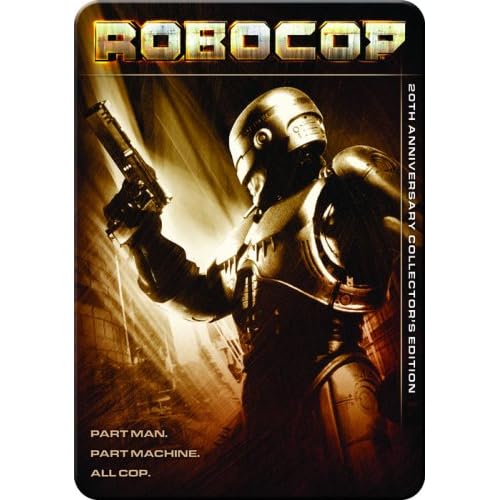
One of many new MGM releases to be housed in attractive "steelbook" packaging, RoboCop: 20th Anniversary Collector's Edition puts each version of the movie on its own disc. The first disc also contains the holdover extras from the last release (including Verhoeven's commentary), while the second disc has all new extra material. The new documentaries are quite good, with "Villains of Detroit" looking at the baddies with actors Ronny Cox, Kurtwood Smith and Ray Wise. Smith points out how his character (Clarence Boddicker) was crafted to be atypical, wearing glasses and a thin frame -- with his smarts being his most sinister weapon. "Special Effects: Then and Now" is the highpoint of the disc, with the film's creative talents providing informative insights into their processes and just how it was done. Much of this is spent on the creation of E.D. 209, including the exhaustive process of making the full-scale replica. A nice touch on this documentary is talking with the artists about today's special effects industry, particularly since their talents (matte painting, stop-motion animation) are pretty much extinct. The last documentary is "RoboCop: Creating a Legend," a nice look at everything RoboCop, such as his suit, the actor in it and even the gun (amazingly, they used an actual Beretta model which really did shoot three-round bursts).
Thursday, August 30, 2007
Saying goodbye to an old friend
In my years on the Internet, I can say that there have been probably three Web sites I have visited regularly, without interruption: ESPN.com, Amazon.com and DVDJournal.com. As of today, one of them is ceasing publication, and I think you can guess which.
Monday and Tuesday mornings have been very similar for me for the past eight years: read the Disc of the Week and see what new reviews are posted (Monday) and read about the latest DVD news (Tuesday). For its entire 9-year run, DVD Journal has kept the same basic look and adhered to the above schedule. There have been almost no changes to the excellent Web site in nearly a decade, and no one was never calling for them -- because it was that good. With a corps of about 10 West Coast-based writers, DVD Journal was impeccable at shining the spotlight on the important releases, keeping you up-to-date on the industry and never letting you down. Since it was based in my hometown of Portland, I had always felt kind of a personal connection to the site, especially since some of the writers (Dawn Taylor, D.K. Holm, Kim Morgan) were connected to other Rose City media. They were all great, but collectively they had a similar style: speaking as wordsmith film fans, but never veering from a high standard of professionalism.
Of course, there were exceptions to this rule, namely the inimitable and mysterious Alexandra DuPont. I think in my early days of reading DVD Journal, DuPont was the first film writer on the Internet I noticed who had an anti-print style to her writing -- the Internet was the only medium where it could exist. Often written in exhaustive length (and appearing sporadically on the site), DuPont's expansive reviews of The Indiana Jones Collection and The Lord of the Rings remain favorites, and her early early theatrical review of Star Wars: The Phantom Menace is that of Internet fan boy legend. Her bibliography was one of the first links I added to this blog.
DVD Journal proved that there's a place on the Net for simplicity. As stated in its About section, it's "typeset in a simple word processing program because we can't find any HTML software that doesn't piss us off." In light of this, there were never any flashy graphics, frames or even much in the way of advertising. This last bit was something that fascinated some of us: just how was it able to exist? With a great stable of writers and remarkable consistency, DVD Journal obviously wasn't out there to be a cash cow. Even though many Web sites of this ilk aren't raking in the profits, they at least try.
Great reviews are one thing, but DVD Journal was able to attract a loyal following because it payed close attention to that first word in its title. In addition to being one of the best places to find news of upcoming DVDs, the site offered an always updated Editor's Top 25, an expansive list of DVD MIA movies, a history of DIVX and even a handy guide to all those DVD terms you may not understand. With big DVD releases, the Journal always had detailed reviews of not just the movie, but also the extras (even breaking down multiple commentary tracks).
So why am I telling you all this just when DVD Journal is calling it quits? Well, it's not going to stay online forever, so go check out some of their 4,000 reviews and find out what you were missing.
Selected favorites from the DVD Journal archives:
Alien Quadrilogy by Clarence Beaks
Heavy Metal by Gregory P. Dorr
Mulholland Dr. by Damon Houx
The Searchers by D.K. Holm
Star Trek: The Motion Picture by Mark Bourne (Mark's reviews of the entire series are all exceptional)
THX 1138 by Alexandra DuPont
The Wild Bunch by Dawn Taylor
Ed Wood by Mark Bourne

Monday, August 27, 2007
French officials address explosive violence
Note: This post is part of the Bizarro Blog-a-Thon at Lazy Eye Theatre.
By Eve Roth
The Associated Press
PARIS (AP) -- Police officials from Paris, Nice and Arles gathered in the nation's capital city today to address mounting criticism stemming from a recent hurricane of violence that swept through the three cities. In its wake was untold levels of property damage, at least seven civilian deaths, countless smashed cars and the dramatic murder of figure skater Natacha Kirilova. Yet the most damning element of the whole affair was the number zero. As in the number of arrests made by police, and the number of leads about who was responsible.
"We have reason to believe that some of them are still alive, and that one could be an American," Paris Police Chief Raul Beauvais said while trying to look tough, possibly in a poor impression of John Wayne.
French media outlets have been unanimous in condemning local authorities, who they say are contributing to their nation's stereotype as a leaf in the wind when it comes to violent conflict.
"This band of thugs essentially played a game of 'Grand Theft Auto' in our country, and all we have to go on is that a few of them may have had dark hair," blasted crime columnist Frederic St. Videau of the Paris Plain Dealer. "Unless we're targeting stylish criminals as an untapped consumer, then we need to find a new police force."
The carnage began two weeks ago in Paris, when a wild shootout erupted over an apparent arms deal gone bad. After the surviving party predictably escaped, police found four dead Parisian mobsters. It may have seemed like just another Saturday night in Paris, but it was just the start of a maniacal spree of mayhem over the next week.
In Nice two days later, a fantastic barrage of shootings and explosions left residents of the sleepy tourist town stunned.
"I'm fine with guns, but do they really need grenade launchers and bazookas?" echoed longtime village sage Luc Devereaux while lazily filling his tobacco pipe. "And seriously, why do they need to target fruit stands?"
The Nice fruit stand was where the eruption started, with two gentlemen in a Mercedes opening fire on a motorcade of five sedans, with one employing a grenade launcher to great effect. After dispatching two of the cars in spectacular fashion, the party in the Mercedes chased after a Citroen, which met its fiery end through the crosshairs of a well-aimed bazooka.
"You could tell he knew how to handle that little firecracker," observed known vagrant "Sticks," while clutching a sack of carrot stems. "It blew up, then kept sliding down the road. Almost like a badger on election day."
But that was just the opening act of the day's horrible festivities. The cars continued chase, weaving in and out of Nice alleys and even forest roads, smashing into a fish market before destroying a quaint restaurant patio with an outburst of gunfire. Despite a flurry of spilled blood and innocent death, it was here that authorities nearly had their moment of triumph. The Nice SWAT team arrived, however it was only in time to witness the last of the awful visitors speed off in a huff. "You bet our guys were there, with guns drawn and brows furrowed," grinned Nice Police spokesman Guy Garnier-Fulke, leaning precariously close to the press corps. "But then they drove off, what were our men supposed to do -- run after them?"
The one saving grace of the Nice tragedy was that further casualties were eliminated through the help of the city's "No Afternoon Drives" program, where no one is permitted in their cars past 2 p.m. Because of this, the awesome race-car driving skill of our troublers were left unimpeded -- for better or worse.
One day later, the two men seen involved in the Nice disturbance (both possibly with dark hair) arrived in the historic burg of Arles. Whether this was a tourist stop for the criminals or not, it still resulted in the deaths of two sight-seers by gunshot. Like the Nice authorities, Arles Police came close to apprehending the conspirators, only to watch them car-jack a poor soul and escape.
"We didn't plan on them having a reverse gear," lamented recently-axed Arles Police Chief Carl Peterson, who announced after the press conference that he would retire to his native land of Baraboo, Wisc.
With the knowledge of a crime spree terrorizing the country, Paris Police still decided on the questionable action of an early weekend -- leaving but three constables to patrol the whole city for a span of 96 hours. The timing couldn't have been worse, as the "Gruesome Twosome" -- as the Lichtensteinian press has dubbed them -- made their way into the French capital for a riotous chase. Clips of this two-car chase have been among the most popular on the Belgian file sharing Web site ClipTubMan, and those who witnessed it will never forget its awesome spectacle.
"Oh my God, it was like Ayrton Senna had come back from the grave to show us mortals how real driving is done!" recalled noted Formula 1 enthusiast, and current NASCAR driver Kasey Kahne, who spied the chase from the confines of a Paris lingerie shop.
The infamous chase resulted in the wreckage of 25 cars, killed at least one driver, and shocked untold onlookers as the black BMW and blue Peugeot weaved through oncoming traffic. French Transportation Minister praised Parisian drivers on this black day, noting that many of them were not exceeding 20 kph during the chase, despite driving in a 60 kph zone.
Because of Paris' limited police force on that day, the closest authorities got to the chase was a base-pay constable who gave chase in a tunnel, only to flip his car after driving over a small traffic divider. Adding to the agency's black eye was the fact that the lead car in the chase (the black BMW) crashed over an incomplete freeway segment and even blew up -- yet no one was taken into custody.
"Even if we had our full complement of officers, how many would we have had patrolling at the base of a freeway construction site?" Beauvais asked half-sincerely while pouring the last of the press conference's complimentary wine case.
Tragically, the crime spree ended at the site of esteemed skater Kirilova's death during her famous "Go-Go-Whip" routine. The sniper in the case was never identified, nor were the "dark-haired dastardlies" -- as the Basque press has taken to calling them.
Though no crimes have been committed in days, authorities still believe the two headliners of the spree are at large, with only a disappointing description and an eerie thought by Beauvais in the police department's favor.
"If you ask me, the (suspects) kind of resemble those old disgraced samurai whose masters had died -- what'd they call them, Ronin ... Ronan ... Ronjun?" Beauvais muttered as he exited.
Associated Press reporters John Cocktoasten and John "Stumpy" Pepys also contributed to this report.


Friday, August 24, 2007
FRIDAY SCREEN TEST: Season 1 Wrap-up

Sometime in early January (while in the shower), I came up with an idea that I hoped would catch on for DVD Panache. A take-off on a long-time feature in The Oregonian's entertainment magazine, I envisioned Friday Screen Test as a way to publicize fellow film bloggers while also adding my own personal touch. Most of all, I knew that my fellow bloggers could deliver the goods, with interesting answers that would keep people coming back week after week.
Last week was the 30th Friday Screen Test, and a good signing-off point for the first season of the series. To let me maximize my efforts on other projects here at DVD Panache, and to also set the stage for a re-tooled "2.0" version of Friday Screen Test, the series is being put on hiatus. I want to give huge thanks to everyone who participated, as well as those who enjoyed the series enough to read it regularly. I already have a few good names in the hat for Friday Screen Test's next go-around, and if you have a blog and some unique opinions, don't hesitate to drop me an email to let me know you're interested.
For the season wrap-up of Friday Screen Test, I've chosen a favorite or interesting line out of each week's entry. Here they are presented chronologically, starting with the very first one (the links take you to that person's Screen Test). Enjoy, and thanks for reading!
ANDY HORBAL: 'LSD + Night of the Living Dead = A lifetime of looking over your shoulder...'
PIPER: 'I bought the first season of Venture Brothers on DVD and I can't quit talking about that show. Everybody hates me because I always talk about it and how funny it is and subtle and brilliant.'
DVD GUY: 'Battlefield Earth made me quit Scientology.'
EDWARD COPELAND: 'I've always had great fondness for Julien Temple's Absolute Beginners, so much so that I've been afraid to ever revisit it for fear it might break the spell. As for the opposite, I'm not dumbfounded as to why I dislike them as much as I am as to why others like them (say, Dr. Zhivago or The Thin Red Line).'
PAUL MARTIN: 'The first film to really overwhelm me with a desire to discuss it with others was Lost Highway. I pestered my significant other that night, and the following two days discovered the power of the internet by researching it online. This was also the first film that I wrote a significant review on, which was only relatively recently.'
DAVID LOWERY: 'I've been in a myopic pursuit of the same career since I was seven years old. Of course, it was a movie that set me on that path, so I suppose the question could be rephrased as "Has there ever been a movie that made every other possible career seem entirely unappealing?" And the answer, as it would be for so many others in this line of work, would be Star Wars.'
JOSEPH B.: 'I've had a major affinity for director Tony Scott for years now, and I can't figure out why. I once wrote a 3000 word essay analyzing and dissecting his films (in the late 90's I believe, sadly lost 2 computers ago and a message board now floating in cyber space). So, when films like Domino, Enemy of the State or Deja Vu creep up on my favorites lists, it always baffles some people. And I have a hard time justifying that these films are more than popcorn action flicks.'
ALAN LOPUSZYNSKI: 'My brother spoiled the ending of The Empire Strikes Back for me, and after I watched it I wouldn't have minded having a group discussion with him and my fists and his breadbasket . . . that movie probably was one of my earliest subjects of film discussion with friends. All of us had cut our teeth on Star Wars and this rather soundly rocked our worlds.'
LUCAS MCNELLY: 'On the worst days, the recipe is something like this: pizza, several good beers, and Smokey and the Bandit (1977). Sequel as needed. Alternately, substitute in good wine and some Woody Allen.'
STACIE PONDER: 'Shark Attack 3: Megalodon is THE greatest bad movie in the history of ever. It's really an awful movie in virtually every respect, but it's also a SUCH joy to watch that it's become one of my favorite movies, period. The effects must simply be seen to be believed there's green screens and stock footage galore. I was literally on the floor at times, howling with laughter. The longer it goes on, the better it gets. I want to buy everybody in the whole world a copy; I want to introduce as many people to it as I possibly can; I want to make out with Shark Attack 3.'
DAMIAN ARLYN: 'I don't really believe in not finishing a movie once I've started it. The only time I've ever walked out of a film halfway through it was when I was forced to do so by the people I went to see it with (my family). The movie was Super Mario Bros. I didn't particularly like it up until that point but I didn't hate it either. Years later I actually finished it. We didn't miss anything.'
TUWA: 'I've probably adopted more [dialogue] of Seinfeld and The Simpsons, though for awhile I was fond of "just put that anywhere"; and "he's a good man, and thorough."
TED PIGEON: 'Andy Horbal recently wrote that he considers film study less and less a relexation or hobby, but more like a job. That's essentially how I feel. I keep a log of everything I see and hold a list of films I'd like to see in the future. I try to keep a rigiorous schedule but I don't always stick to it. Right now, I'd guess I see on average about three movies a week. I do, however, see movies in pieces more now, which has been a really interesting way of seeing films. I try never to watch a movie in pieces the first time I see it, but I think it is essential to see movies you're familiar with broken down. It's a great way of getting into the mechanics of the film and to understand how it's doing what it's doing.'
DENNIS COZZALIO: 'It wasn’t central to my decision to pursue a career as a teacher (a career path upon which I am just now embarking), but seeing Nicholas Philibert’s �tre et avoir (To Be and to Have) a couple of years ago helped to rekindle a dormant interest I had in teaching that has now fully reawakened. I want to see this movie again very soon.'
CHRIS STANGL: 'Summer evening 1957, drive-in theater, black & white ’55 Bel Air convertible, girl in tight sweater in passenger seat, Attack of the Crab Monsters double-billed with Not of This Earth. This is where you go when you die. I would willingly chop off a finger to go back in time and experience this.'
THOM RYAN: 'As a teenager I once sneaked a bottle of beer into a small theater showing a midnight movie. I was just trying to impress my friends ("stupid is as...etc."). I had the bottle hidden in my coat and it slipped out. The screening room had a bare concrete floor so there was a crash, and glass and beer everywhere. The worst part was that they hadn't brought the house lights down yet so everyone in the place (including the management who were not amused) knew I did it. I was invited to find the nearest exit. Embarrassing but true.'
STEVE CARLSON: 'I'd do a whole month of Midnight Kink -- midnight showings of movies with oddball sexuality. I'd try not to leave anything out, either. From S&M (Maitresse and Sick) to transvestiteism (Glen or Glenda?) to transexualism (Let Me Die a Woman) all the way to necrophilia (Nekromantik) and bestiality (The Wedding Trough), plus a few catch-alls (Visitor Q, The Telephone Book, a '70s porno roughie or two)... I'd try and represent all I could. Just seeing the crowds that showed up would be entertaining enough.'
SQUISH LESSARD: 'Before I received a tome called 1001 Movies You Must See Before You Die for Christmas 2005, I was more a contemporary modern day film fan. Since that time I've delved into, pretty exclusively, classic films and having discovered so many silent era titles that moved me so much, I'm a changed man forever.'
JOHANNA CUSTER: 'I have this thing for About Schmidt and pretty much every movie that has a male everyman character who is just this total slob of a man, lost and unable to connect with anything around him. when I'm bummed and I feel like looking for something that's on my emotional level at the moment I pop in a movie like that. Bill Murray movies tend to be good for that too, as do Wes Anderson flicks. When I was younger and channeled my emotions more physically, I think I would have responded with something sillier, like Buffy the Vampire Slayer or Life of Brian or Army of Darkness.'
NEIL SARVER: 'I see Hollywood like as an abusive spouse. I'm hopelessly in love with it. I know what it's capable of, and on it's best days, it makes me so deliriously happy that I want to forgive it on the days that it neglects and abuses me. The most basic crime it commits, and has since its very beginnings, is thinking that audiences as a whole fail to respond to anything beyond the surface. If Jaws is successful, perhaps it's not because they are hungering for movies about killer sharks, but for the well-realized characters and greatly crafted thrills in a general way. If the Lord of the Rings movies are successful, maybe there's something more to their success than wizards and dragons.'
PETER NELLHAUS: 'I have had several. The best were at Telluride. Of those, my favorite moments were a brief meeting with Julie Christie in 1974, and interviewing Henry King by a creek, an appropriately pastoral setting ... I had a nice chat with Jonathan Demme about mutual acquintances that I knew from NYU. Part of my neighborhood in Miami Beach was used for second unit filming of Transporter 2. My wife looked longingly at Jason Statham's stunt double ... There was also the time I worked at the Greenwich Theater in NYC, and saw how James Coco kept his weight up.'
EVAN WATERS: 'Historical epics often lose me -- they get a weird buttoned-down solemnity at their worst, which has a distancing effect. Even though major historical details may be changed, you still feel like the filmmakers felt they had a responsibility to Take Things Seriously. The best films of this genre are either so brilliantly executed that the solemnity is appropriate (Das Boot, Schindler's List, etc.) or cast off that feeling completely and work as entertainment (The Aviator, 300). I also tend to be disengaged by that kind of horror movie where you know there's no point getting involved with any character except the designated survivor because everyone else is just there to pad the body count.'
PEET GELDERBLOM: 'I’m a sucker for lyrical tragedy. As far as that’s concerned, nothing beats the ending of Brian De Palma’s Blow Out. It’s a movie so ripe with drama and metaphor that it becomes part of your metabolism. When Jack kneels down to hold Sally’s lifeless body in his arms and the fireworks go off in the background, he’s really holding America’s lost innocence. A profound moment; tragic, beautiful and blackly humorous at the same time.'
TUCKER TEAGUE: 'Sometimes I wonder if watching movies is something I dreamed I used to do. Life has been so crazybusy the past couple+ years that the frequency of my film viewing has been erratic and sporadic at best. If I am lucky I see a couple a week, if not I see one every two weeks (which appalls me, frankly). I used to watch many a films a week, often one a day in college, and several each weekend. But there is a bright spot; I have been introducing the cinematic art to my daughter (7 years old!) and that has given me the chance to see a few more films. Part of the reason has to do with the fact that many of the films I like she shouldn't watch until she’s older. I would like to stay up and watch them, but alas, I go to bed early so I can get up early to do homework before real work. So it makes sense to pick films she can watch too. Lately we have seen several Hitchcock films, among others.'
JEFF IGNATIUS: 'I can't think of any particular prompt, but at some point in the mid-1990s, for a period I wrote an essay about every movie I saw, and the one that sticks in my faulty memory is Atom Egoyan's Calendar. Steve Buscemi's Trees Lounge and Hitchcock's Vertigo were also important movies for me at that time, and what I wrote about them helped me better understand how movies work and my relationship with them. Writing about film turned me from a passive viewer to an active participant.'
ROSS RUEDIGER: 'What the hell has happened to independent film? When was the last time a true indie made some waves? Open Water? There was supposed to be this huge revolution with the technology that’s now available, but it doesn’t seem that anybody’s using it properly or we’d be seeing more breakout hits. Simply put: Digital cameras do not write great scripts. At least Hollywood still has the ability to get behind a handful of great scripts every year and they may even be one of the last hopes for decent, English-speaking film.'
ANDRE GOWER: 'Doing a guest spot on The A-Team was great. I mean, how many kids have ever chopped down a tree with Mr. T?! I might be the only one. They were great to work with, very fun, yet professional set.'
EMMA: 'At the best of times, I’m just an angry teen, ready to drill holes in the wall, and watching comedy films really do cheer me up and stop me from behaving this way. Ones that I can watch over and over again are Finding Nemo, Legally Blonde, Harvey, Some Like It Hot, and Sabrina.'
CINEBEATS: '1991 was really special because I met my future husband that year at a screening of the director’s cut of Blade Runner and I can’t forget that. Who knew that Ridley Scott’s neo-noir science fiction thriller could bring two people together?'
JOE VALDEZ: 'I paid money to see Species II in a theater. Is that embarrassing?'
Saturday, August 18, 2007
David Lynch Radio
It was quite a treat to get in my car Thursday and hear the Twin Peaks theme coming out of the speakers. Yup, David Lynch joined NPR's Talk of the Nation for a lively chat with Neil Conan and a handful of callers. I was surprised that Lynch had agreed to do a call-in show, but he is his usual enthusiastic self throughout, and more than happy to give rich answers to everyone's questions.
Even if you're not a Lynch fan, this is a great listen if only to hear how a dedicated artist so values ideas and how he harnesses them. I particularly enjoyed Lynch's reaction to politics in his movies, and his views about returning to television work.
You can listen to the segment here, and it's also available as a podcast. On that same page is a link to a segment from a few years ago when Blue Velvet was re-released on DVD and Dennis Hopper sat down for an entertaining interview.

Friday, August 17, 2007
FRIDAY SCREEN TEST: Joe Valdez
Joe Valdez has a good thing going at This Distracted Globe. If the spiffy digs don't catch your eye, pay attention to his current examinations of remakes, which looks at the classic and modern versions of such films as The Fog, The Thing, The Truth About Charlie and Rollerball. Joe has a refined, consistent reviewing style, approaching each subject objectively and giving you insight into the production, as well as his opinions and those of other critics. Joe also keeps handy, updated lists of the best and worst movies in addition to a fun gallery of sweet one-sheets old and new. I'm raising a preemptive glass to Joe for his upcoming Paul Verhoeven retrospective, Black Book can't get here soon enough.
'THAT WAS ...... GOOD': 'I've been to a couple of test screenings and gone up to the director afterwards to tell him what I thought of the movie. I met John Lee Hancock when The Alamo was being tested, and Gregory Nava back when he was testing Why Do Fools Fall In Love. They were both too friendly for me to say, "Yeah, so, that sucked." I try to find something positive to say.'
BROTHER FROM ANOTHER PLANET: 'My brother can't wait for Nicolas Cage to make another movie. He loves bad movies. If I enjoy a film that's supposedly bad - like Showgirls - it's not because I'm sitting there loving how awful it is, but because in my warped mind, I think there's actually cool stuff in it.'
FISTFUL O' DVDS: 'They must have audio commentary. Greatest of all time is probably Paul Thomas Anderson talking about Boogie Nights. John Carpenter & Kurt Russell are far less informative but just as entertaining on the ones they do.'
NOW PLAYING: 'I rarely watch two completely unrelated movies. This week will be a double feature, Searching For Debra Winger and Double Dare, documentaries about women in the film industry. In a couple of weeks, I'm doing the best movies shot in Texas, including The Getaway, The Last Picture Show, Urban Cowboy, Fandango , and Bottle Rocket. When Black Book comes out on DVD, I'll do a Paul Verhoeven retrospective, starting with Turkish Delight.'
SNAIL MAIL: '2-3 movies a week, courtesy of either Netflix or Greencine. I rarely go to a theater anymore. It has to be a movie I can't wait to come in the mail, like The Dark Knight, or the next film from Michael Mann.'
MONEY TO BURN: 'I paid money to see Species II in a theater. Is that embarrassing?'
TALK LIKE A JOE VALDEZ TODAY!: 'A tie between "Gosh!" from Napoleon Dynamite, and "Sometimes there's just not enough rocks" from Forrest Gump.'
CEMENT SHOES: 'I never leave my seat until the show is over. I've only walked out on a movie once. Dumb and Dumber.'
TRIP DOWN MURDERER'S ROW: '1984. Splash, Romancing The Stone, This Is Spinal Tap, Sixteen Candles, Once Upon A Time In America, Indiana Jones and the Temple of Doom, Gremlins, Ghostbusters, The Karate Kid, Red Dawn, Purple Rain, Buckaroo Banzai, Amadeus, The Terminator, A Nightmare On Elm Street, Beverly Hills Cop all came out the same year. For an 11 year old, it doesn't get any better than that.'
SCARE-IT: 'Alien. The ventilator shaft sequence. You know, where Tom Skeritt crawls through the duct work of the Nostromo, and Veronica Cartwright starts to spaz out when the motion tracker shows something moving closer to him. I saw that in a theater for Halloween recently and people in the audience still screamed.'
Contact DVD Panache if you are interested in being featured on Friday Screen Test.
Wednesday, August 15, 2007
Through an Antidote Darkly
If you're not following Damian Arlyn's 31 Days of Spielberg project over at Windmills of My Mind -- well you just better have a damn good excuse. Knowing Damian's knowledge of Spielberg and great writing style, I was looking forward to his Temple of Doom post since the beginning, and just like all the others it's a great read. Like Damian says in his comments section, I too was surprised at just how many Temple haters are out there. Sure, it's an odd movie that deals little in reality -- but it's also wildly entertaining. I felt it was as good a time as any to invite everyone inside my Pankot Palace of Temple of Doom Wonderment, with some additional thoughts on the subject.
Part of what makes Temple so special to me is that it was really the first movie I ever watched. Throw out the Disney movies, edutainment and what not, and it was the opening red credits of Temple that introduced me to genuine film entertainment. I remember the night well: it was before my family bought a VCR so we had to rent one, some night in 1985. While my dad was fiddling with the connection, the image of Kate Capshaw's Willie Scott jumped on the screen and for the next 117 minutes I sat spellbound. Of course my mom expressed some disapproval during the Thuggee rituals, but the ship had already sailed. So I obviously have some biases with this film, and I obviously viewed the movie differently back then since I had not seen Raiders of the Lost Ark.
I frequently point out that one of the redeeming qualities of Temple is its unique place in the Indiana Jones Trilogy. Indy is not set out on some great quest to save the world, nor is he even globe trotting or teaming up with familiar faces -- he is simply trying to get the hell out of India and maybe live out an archaeological dream of saving the some priceless relics all in the name of goodwill. And on the subject of dreams ...
Another great contrast between Temple and its trilogy counterparts are the evil groups Indy encounters. Raiders and Crusade both prominently feature Nazis -- Temple gives perhaps the most feared religious group of all time in the Thuggee, who may have been responsible for 2 million murders during a reign of terror as great as 600 years. The Thuggee scenes are often passed off as exploitation, but George Lucas' story is remarkably historically accurate. The group believed their murders appeased Kali, each one preventing her appearance by one millennium, and they performed a series of rites in her honor after each killing. Even Mola Ram's line of 'maaro maaro sooar ko, chamdi nocho pee lo khoon' has meaning, it translates to 'Kill, Kill the pig, flay his skin, drink his blood.' If you ask me, the Thuggee are much more interesting as villains than Nazis.
Of course, it helps when you have a character played by the late Amrish Puri leading the charge. Mola Ram is my favorite character in Temple, and his casting speaks to Spielberg's brilliance. Despite not making his Bollywood debut until the age of 40, Puri went on to star in over 250 films and was sometimes referred to as the 'Al Pacino of Bollywood.' Puri had a commanding screen presence, and perfectly played the few English lines he had, most notably 'you are in a position unfit for giving orders!' The horrified reaction he gets from Willie and subsequent 'Welcome...' are gold.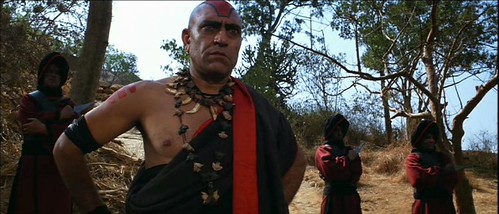
**This scene made such an impression on myself and my brother that for years any trip over a walking bridge at a park was incomplete without some reenactment (and if time permitted, a brief rendition of Three Billy Goats Gruff). It was probably disconcerting for mom that her kids were the ones always yelling 'prepare to meet Kali ... in Hell!'**
Temple truly is the black sheep of the trilogy, but that's what makes it so great. Why can't sequels like this be made anymore, where it exists as simply another episode in the series? Temple did not pick up where Raiders left off, it was another exercise in classic adventure film making by Spielberg -- merging the nickel arcade storylines of the 1940s with the production sensibilities of the 1980s. We'll never see another movie like it again.


Friday, August 10, 2007
'Gordon's alive?!?' On DVD!!
In the annals of love-it-or-hate-it comic book movies, Flash Gordon sits in a corner all its own. Not only does it inspire opposing sides of praises and pans, but even the growing community that loves the movie usually can't decide on the reason: is it camp or not? This was a point of contention at my favorite DVD review site, DVD Talk, where patriarch Glenn Erickson (aka DVD Savant) proclaims it 'relies too much on camp sensibilities.' But two days earlier, seasoned reviewer Brian Orndorf said of it 'the word "camp" is tossed around quite a bit in any discussion of "Flash Gordon," and I have to be bitterly honest here, I just don't see it.' There you have it, and I'll weigh in on this subject a bit later. With the long-anticipated (and rumored) release of Flash Gordon: Saviour of the Universe Edition this week, we can easily immerse ourselves in the world of Mongo without paying for a Region 2 DVD. It's great to finally have this on DVD, but as I'll address below it's largely a disappointment.
I think one of the problems people have with Flash Gordon is that it takes itself seriously, with virtually no attempts at self-parody. Remakes such as Scooby Doo and The Brady Bunch Movie were sold as big jokes from the beginning to capitalize on how we view those television shows now, while Flash Gordon simply wanted to be a gaudy action spectacle. Looking at the old Flash Gordon comic strips, the story and characters seem more suited for television (ahem) than film, but there's little that makes sense about why Flash Gordon ended up as such high quality entertainment. It certainly isn't due to the plot, which can be summed up in one sentence, from its IMDB page:

A football player and his friends travel to the planet Mongo and find themselves fighting the tyrant, Ming the Merciless, to save Earth.
 When talking about this movie, you have to start with the lavish production design, which resulted in perfectly-visualized characters (almost without flaw) and radical special effects. When Flash, Dale and Dr. Zarkov enter Ming's temple, director Mike Hodges gives us throw-away shots of servants, enemies and who-knows what else dressed in costumes that must have taken a great team of minds to dream up. And they're just in the background -- up front and center we have the jaw-dropping Ming the Merciless, played to perfection by Max Von Sydow. Ming is some combination of Fu Manchu, Skeletor and Donald Rumsfeld, as he's infinitely evil but also just goofy enough to act as comic relief in some scenes. Ming's line of 'Klytus I'm bored!' opens the movie as we Earth through his cross hairs and sets up his character, and the film itself, in entertaining fashion.
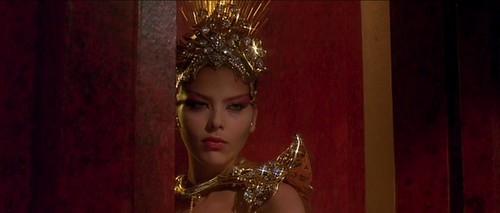
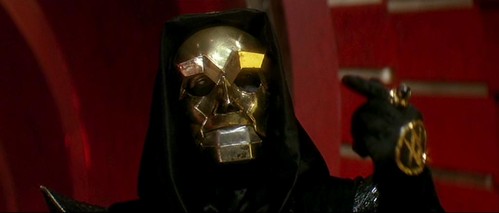 At his side is Klytus (Peter Wyngarde), the sinister toadie who hides behind a cleverly-designed face of metal. Klytus is an effective, understated contrast to Ming, and the result is a memorable pair of villains. The supporting characters really make the movie, as Brian Blessed nearly steals the show with his performance of the enthusiastic winged viking Prince Vultan. Most of the characters are simply fun to look at, such as Ornella Muti's Princess Aura, who has one of my favorite shots of the movie as she slyly peeks a glance at Flash as he enters Ming's temple.
 But it's bad news when the title character of the movie is maybe the weakest link of the whole film, and that's what we have with Sam J. Jones as Flash Gordon. We meet Flash as he's coming back from vacation (by himself?), despite the fact that his New York Jets are playing a game -- what kind of professional athlete takes a vacation during the season? I'd love to see this on the ESPN bottom line: 'Eagles QB Donovan McNabb out for Sunday's game at Giants (vacation).' I mention this because it's the only nugget we get about Flash's personality, the rest of the script is mostly him throwing henchmen around and making dunderheaded observations ('This Ming is a psycho!'). Jones himself sticks out like Dane Cook in a John Sayles film -- he just doesn't bring it, and his cause isn't helped by the fact that his deliveries are dubbed over. It's odd that the script doesn't give Flash much to work with, but perhaps that was by design once Jones' limitations as an actor were made obvious.
Flash Gordon is greatly aided by the musical talents of Queen, which provided the soundtrack. More durable than Freddy Mercury's famous 'FLASH!' yelp are the driving rhythms from Brian May, John Deacon and Roger Taylor. The latter's pulsing drums really fuel the action in a lot of scenes and the movie's final scene is pushed to another level with the band's rising beats. The bombastic music fits with the overall, late-70s style of the film -- with every location and costume giving off a golden hue. It's this aspect of the production that I think critics point their 'camp' finger at, but I just see creative and highly stylized approach to a fantasy story. You'll never mistake this for Star Wars, there are no white plastic walls or tech-talk -- it has a look all its own that never tries to be realistic, and that's a good thing. But even if parts of it can be interpreted as camp, why should its defenders take offense to that? If it stands apart from other films of its era and genre, why should that be a negative, especially when most of today's superhero and action movies look the same?
 The DVD: Since it's dubbed 'The Saviour of the Universe' edition, you would expect quite a bit from this DVD, especially since it's the Region 1 debut of the movie. Expectations are further stoked by the DVD's packaging, highlighted by Alex Ross coverart and a nifty design where the packaging opens by flipping up the cover, like a legal tablet. But the clothes still do not make the man, which is where we're left with this DVD. Beyond a great anamorphic transfer and sound, all you have is a retrospective from Ross (who was onboard anyway to design the cover, as well as an upcoming toy line), some reminiscing from screenwriter Lorenzo Semple, Jr. and the first episode of the 1936 Flash Gordon serial. The interviews with Ross and Semple would have worked well in the framing of a larger documentary (like the generous one we got with The Monster Squad recently), but on their own are not particularly useful. Ross is more than happy to gush about his favorite movie, but comes off as another fanboy, going so far as to call the ending 'the greatest in cinematic history.' Semple gives us a few anecdotes from the set, but is mostly content to give excuses about why the script wasn't better (no one read it, not even the set designer). The 1936 Flash episode is watchable for about 5 minutes, when it becomes clear that it's mostly made up of stock footage and near-actors.
But a final throw-in tells us why we should not be surprised at the neglected extras: a 10-second promo for the soon-to-premiere Flash Gordon series. If this really was the motivation to finally release Flash Gordon on DVD, then there is no excuse for the weak extras, because I would expect the producers of the new series would have lots of access to the original source material and those familiar with it. Why not a documentary on the entire Flash Gordon universe (in all its incarnations), which would do more to fuel excitement for the series than simply a 10-second promo.