Wednesday, October 31, 2007

Worst. Funeral. Ever.


I'm really thankful never to watch Phantasm as a child, because the amount of lost sleep I would have endured may have resulted in being held back a grade. Phantasm is a one-of-a-kind horror movie, seemingly springing from a brain storming session of what people are afraid of. It ends up feeling like a wax museum of horror frights, with a wide variety of spooky images that only occasionally relate to the plot. And yes, there is a plot -- run from the bad stuff. It's the kind of movie that couldn't be remade today: there's only one Tall Man, and most of the movie's charming creep-factor relies on mood..

It's a tribute to Coscarelli that it all comes together to work so well. A production light on story, heavy on special effects, yet with minimal budget. Some sleight-of-hand effects work well to mask what shortcoming Phantasm had in the cash department, and music by Fred Myrow and Malcolm Seagrave adds another uneasy element to the atmosphere. The music may be my favorite part of Phantasm, and one of the reasons it's so easy to turn on anytime -- has there ever been a more rocking horror score? What starts as eerie, slowly builds up to almost soft rock when the percussion kicks up later in the movie, providing a perfect backdrop to the Tall Man's pursuit.

From the beginning, Coscarelli gives you slight hints of what you're in for: a glimpse of a hooded dwarf scurrying behind a grave, the silent mystery of what lurks inside the mortuary and ... who is that Tall Man? Thankfully, there are few to no answers in Phantasm. It exists as a nightmare that goes in and out of actual dreams, never trying to explain whatever evil is at play in Morningside Cemetery: are there other Tall Man portals on our planet? Is it another dimension? Where does the mortuary go after it disappears? Almost every scene asks another question without an opportunity for an answer (the finger turns into a bug?), and Coscarelli keeps the scares coming so there's no reason to keep wondering.

The Tall Man has to be one of the best original monsters of the past few decades. What is it about him that works so well? He's not exactly tall or ugly -- he just has that walk and that hair, and that way of saying things: "You play a good game, boy. But the game is up -- it's time to die!" I think Phatasm is one of the few movies where I can picture a television series based on it: each week, a new hair-raising adventure for Mike and Reggie with the Tall Man. And every episode ends the same way -- with the Tall Man lunging at Mike through a mirror.

(click)

Tuesday, October 23, 2007

Initial thoughts on Kubrick box set


Well, Oct. 23 is finally here and as you can see from above -- I did not need reminding. Just a few early items about the Kubrick box set, I expect to have more comprehensive posts on the DVDs after checking out all the extras.

-- A nice surprise is the cover art, which is different (save for The Shining) from the new individual releases that also came out today (get a look at the normal art here). It's a cool extra, and I really like how the 2001 cover looks with the effect. The reverse sides are identical to the individual releases, which unlike the box set come with slip covers.

--Eyes Wide Shut is advertised on the back as "Selectable in both rated and -- for the first time in North America -- unrated versions," yet as far as I can tell the unrated version is the only one on the disc. In most DVDs with this option, you go to a menu after selecting "play" that allows you to toggle between rated or unrated, but there's nothing like that here. The second disc contains all extras. The rated version is definitely no real loss, since all you gain are those CGI censors, but it's a little curious that it's missing.

--About those CGI censors in the Eyes orgy scene: Their absence has a much more positive impact on that scene than I had anticipated. They were a distraction to begin with, but without them an already great scene is made even better. It just seems right to see all the debauchery that Bill is seeing, and the sex itself is presented with the artistry of the rest of the movie. A shot of two women having oral sex with their masks still on is an interesting choice that adds to the scene's mysterious atmosphere.

--A commentary track on Full Metal Jacket featuring Adam Baldwin, Vincent D'Onofrio, R. Lee Ermey and critic/screenwriter Jay Cocks is highly entertaining and informative. There's no dead air, and everyone has something insightful to say.

--That said, Full Metal Jacket is the only release in this set unavailable individually on regular DVD. HD and BluRay get an individual release, though that may be due to the fact that the current release of the movie on next generation formats had mastering problems.

--I'm excited to watch Vivien Kubrick's documentary The Making of the Shining, that surprisingly contains a commentary track.

--2001 has a lot of good looking extras, including a 1966 audio-only interview with Kubrick.

For $55, this is a very attractive box set.

Monday, October 22, 2007

DOUBLE BILL: 'The Terror' of 'Targets'


Note: This post is a contribution to the Double Bill Blog-a-Thon at Broken Projector.

Targets is a movie about a seemingly ordinary, well-behaved man who suddenly goes on a killing rampage in Southern California. So it's a bit odd that it starts out with Dick Miller and Boris Karloff in a castle shouting about something, with water quickly filling up the room. Credits fill up the screen, and we learn that Karloff is indeed in the movie -- but where are the guns? And why do we keep seeing that raven? And who's that ghostly woman we see before "The End" pops up on screen. Peter Bogdanovich's first major film, Targets is a unique experience for the viewer in part because it makes great use of another film, Roger Corman's The Terror, released five years earlier in 1963. For this Double Bill, we're going to screen The Terror first.

The Terror (1963)
A French cavalry guard riding on the beach. An attractive woman who may be a ghost. A castle inhabited by the strange Baron von Leppe and his assistant Stefan. A raven. These are the main characters in Corman's The Terror, and there are well-known names behind almost all of them (I don't know the name of the raven): Jack Nicholson, Dick Miller, Boris Karloff and Sandra Knight. Behind the camera at one point or another during the piecemeal production were Francis Ford Coppola, Monte Hellman, Jack Hill and even Nicholson. And the actors and collaborators aren't the only familiar pieces of the film -- Von Leppe's castle interior is also seen in the Corman pictures Tomb of Ligeia, The Haunted Palace and The Raven.

Shot in the dream-like Pathe color, The Terror is titled as horror, but is more mystery or detective story than anything. Nicholson's Lt. Andre Duvalier has been separated from his military unit, and seeks shelter in Von Leppe's castle, as well as an explanation for the beautiful woman he saw on the beach who disappeared. Von Leppe is hesitant to do either, and the fidgety Stefan seems to be hiding something. Oh, and the raven is outside cawing. A coherent story is not always on the screen, as it seems most of the movie is comprised of Duvalier following Von Leppe around the castle asking questions. Eventually, the mysterious woman appears (and disappears) again, and some elements of Von Leppe's past are revealed. The raven makes many more appearances (often cawing), there's lots of shouting at the end, Stefan and the bird get in a fight on a cliff, and the raven wins.

There's never a point in The Terror where it doesn't feel like a legendarily cheapo Corman production, and it's really not one of his better cheapos. But considering it was filmed in many fragments by several directors, it comes together pretty well, and has a fun gothic atmosphere. But these aspects combined to make The Terror a great choice for a second life in Bogdanovich's Targets -- as a run-of-the-mill drive-in movie. Bogdanovic made the movie at Corman's urging, with the conditions being that he use portions of The Terror and also utilize Karloff, who owed the producer two days of shooting from another production.

Intermission
Please enjoy this episode of Batfink


Targets (1968)
Since we're now familiar with The Terror, it's a little strange to see it on the screen again, this time with credits imposed over the film's climax. We once again see Von Leppe's discovery in the tomb, with good old raven flying next to "The End." The next shot shows us the origin of what we were watching: a studio screening for producers, director Sammy Michaels (Bogdanovich) and star Byron Orlock (Karloff). Orlock is an aging horror star who is ready for retirement, studio contract or not, and is also hesitant to participate in a hokey premiere of The Terror at a local drive-in. The next shot of Orlock is a masterful introduction to the film's other main character, Bobby, who has Orlock in his crosshairs from a gun shop across the street. Bobby has a lot of guns, and he's about to buy some more. Leaving the gun shop, Bobby opens the trunk of his Mustang to reveal a startling weapons cache. For the rest of the film, we follow Bobby and Orlock's paths until they meet in a near-perfect climax.

Bobby appears to be a young man cut right out of the My Two Sons mold, and he's more than eager to speak to his parents in "Yes, sir!" "Great!" and "Delicious" tones. But besides his gun collection, there are a few other odd aspects about Bobby: during an outing at the shooting range, he puts his father in his crosshairs briefly, and when his wife comes home from work that night, she finds him sitting in the dark smoking a cigarette. The next morning, Bobby mechanically kills everyone in the house, leaving a confession note and a warning of many more killings that day. Orlock, meanwhile, is spending the day in high spirits, content that his often disappointing career is coming to a close. He will make an appearance at the drive-in tonight, and that will be that.

Bobby's killing path will take him to a water tower overlooking a freeway, where he will pick off several cars with remarkable ease -- while eating a sandwich and drinking a Dr. Pepper. While eluding the police later in the day, Bobby finds the perfect hiding place for more mayhem: behind the screen at the drive-in. It is here where The Terror again becomes a character, with the images of Von Leppe, Duvalier and the raven filling the screen. Bogdanovich films the drive-in scenes perfectly, with dialog barely audible through the collective drone of the tiny car-mounted speakers. Bogdanovich makes great use of The Terror's B-movie quality, showing us fragments of it that make it appear even less comprehensible than in full form. Orlock arrives just as Bobby's terror begins, and as people drive out of the lot in horror, he takes it as their reaction to his movie.

The Terror and Targets come full circle as Orlock gets out of his car to find the source of all this murderous mayhem. Bobby looks up at the screen to see Von Leppe walking down a castle corridor, and then looks to his left to see Orlock walking toward him. The converging characters -- fiction and reality in one -- is too much for Bobby, as he surrenders with his hands over his eyes.

Saturday, October 20, 2007

Two new horror favorites


Following up on the post below about 31 Flicks That Give You the Willies, it's once again a great month to find out about underseen and underrated horror movies. I recently took in two of these flicks, and have nothing but good to say about both of them:

The Tomb of Ligeia (1964)

A tip of Vincent Price's top hat to Neil Sarver for this one. After reading Neil's recommendation, I saw that TCM was showing the Roger Corman classic the following day -- huzzah! The Tomb of Ligeia contains one of my new favorite openings of any horror movie. How could you turn away after hearing these opening lines:

"You cannot bury her in consecrated ground, she was un-Christian!"

"This is my ground."

"It's the Lord's ground."

"Then let the Lord refuse her."

"She will not rest with the Christian dead."

"She will not rest for she is not dead ... to me. And she will not die for she willed not to die."
The opening scene is a dark funeral procession at a crumbling English abby. Price's character, Verden, carries the body of his wife Ligeia, which has a convenient window to display her face. After she is lowered into the ground, we see her eyes pop open, which Verden attributes to a "simple reflex." A snarling black cat walks over her grave, and the pallbearers leave in horror, Verden asking if "cat got your tongue?" The film's title is displayed over the cat and Ligeia's tombstone, then we're taken through a creative credits scene of numerous gothic paintings featuring the abby and that darned cat.

It's a beautiful beginning to an entertaining movie, shot in gorgeous widescreen in England and on a familiar Corman set that was also used for The Terror, The Raven and The Haunted Palace. The last of Corman's Edgar Allen Poe-based movies, the short story Ligeia provided the basis here. Poe's 1838 story featured a narrator married to the strange title character, although he could not remember her last name or quite how they met. His wife was obsessed with the philosophy of a person's will to live, and also die, and continues through her passing. As in most Poe stories, the ending packs a punch. Corman's movie does not show us any of Ligiea's life, instead focusing on Verden and his relationship with Lady Rowena, whom he meets shortly after the opening funeral.
A dapper gentleman who is forced to wear bad-ass wraparound sunglasses due to light sensitivity, Verden is haunted by Ligiea's existence, or lack thereof. Strange things happen after her death: the date of her death is removed from her tomb (Verden probably did it, but he can't remember), a hunting party's trophy fox disappears from plain view (a fox was Ligiea's symbol) and that black cat is not exactly welcoming of Rowena. While not scary, The Tomb of Ligeia has an intoxicating atmosphere of morbid English mystery. Verden's abby is an amazing setpiece (particularly in outdoor scenes), and the story builds right up until the pure Poe ending (with a little more action added in from Corman). And as good as the opening dialog was, nothing matches this beauty from Verden, which I hope was taken straight from the Poe text:
"Christopher, not ten minutes ago I... I tried to kill a stray cat with a cabbage, and all but made love to the Lady Rowena. I succeeded in squashing the cabbage and badly frightening the lady. If only I could lay open my own brain as easily as I did that vegetable, what rot would be freed from its grey leaves?"
I Walked With a Zombie (1943)


These Val Lewton/Jaques Tourneur movies never cease to entertain, and while it's not as good a movie as Cat People, it's equally as bold and mysterious. One of the most interesting elements of this movie is the title, which seems to put it in the same league as Teenagers from Outer Space or My Stepmom's a Werewolf. I took the "walk" in the title as a courtship slang, maybe equating to I Went With a Zombie, and expected a tale of a husband or boyfriend who turned into a zombie. And when you learn that the title is literal, the choice seems strange or perhaps a bad translation ("You walked with a zombie? Big whoop, my family got eaten by them!").

While the title is a little off, the film is anything but. A reworking of Jane Eyre, I Walked With a Zombie shares the novel's concept of a husband with a wife allegedly gone mad, with a comely new woman firmly in his sights. Betsy is a nurse who has agreed to help on a Caribbean plantation, where she cares for the owner's wife Jessica. Suffering from the strange effects of a local fever, Jessica is in a near vegetable state -- a zombie. Constantly dressed in flowing white with an eerily distant stare, Jessica is the haunting mystery that is central to the film. After falling in love with husband Paul, Betsy is determined to cure Jessica, as her condition seems to defy medical logic.

The film's title refers to its most satisfying scene, when Jessica and Betsy walk through the plantation's wheat fields to a spooky voodoo gathering. With this scene, the relationship between Betsy and Jessica gathers some sapphic qualities, especially if you interpret the "walk" element the way I did. It's a beautiful scene, with the moonlight shining through Jessica's gown and the scenery allowing you to almost feel the West Indies night heat. Tourneur has a field day with the odd voodoo elements, and Darby Jones' piercing Carrefour character is the physical embodiment of the area's zombie practices, with bulging eyes and an emaciated gait. Not one of the scarier of producer Val Lewton's horror movies, but the sexual undercurrent in a creepy voodoo land appeal of I Walked With a Zombie makes it memorable.

Sunday, October 14, 2007

Welcome to Haddonfield


You know a horror movie is great when you can't pinpoint just what it is about it that scares you. It's one thing to have the villain jump out of the shadows and startle you, but it's quite another to fill the viewer with a constant sense of dread and uneasiness. Halloween does this better than almost any other horror movie, and it's due in no small part to the fact that John Carpenter was behind the camera.

Working on a tiny budget, Carpenter's horror movie would have no special effects, frightful sets or gruesome villains. For his most terrifying element, Carpenter turned to a place we've all seen: Anytown, U.S.A. Instead of having characters trapped in the dark surroundings of an unfamiliar hell, Carpenter focused on everyone's fear of their privacy being invaded. In the fictional Haddonfield, Ill., where Michael Myers "comes home," we are given a seemingly ordinary town with no shortage of peace and quiet -- and that's what makes it so scary.

Outside of a brief scene at a school and in the downtown area, our experience in Haddonfield takes place exclusively in a safe-as-can-be American neighborhood with unobstructed sidewalks, groomed gardens and not a stoplight in sight. But it's what the neighborhood lacks that creates a sense of unease and isolation.

Outside of the corps characters and a few random trick-or-treaters (who are never a focus of the lens), there are no other people on the sidewalks. If you take out the main characters, we see no other cars on the street, except for one far in the background. All of the houses are large with landscaped yards, but none of them seem to be occupied. It's Halloween, but the neighborhood is largely asleep, with no decorations outside of jack-o-lanterns. Best of all, the whole place is completely silent -- you don't hear so much as the wind howling.

With this design of the world in Halloween, Carpenter gives us a surrounding that is familiar, but also isolated. There is never any point in the movie when our characters feel like anyone else can help them, with no one else in sight, much less a passing police car. Carpenter also plays with our expectations of a horror movie, by giving us some of the biggest scares in broad daylight. You can argue that the scariest part of the whole movie is Laurie's walk home, wondering what could be lurking behind that hedge? And if we're this scared now, what could he have in store for us when the sun goes down?

Halloween as a holiday presented Carpenter with a myriad of scary possibilities, especially through the eyes of the children Laurie babysits. For children, what other time of the year are you most vulnerable to monsters? Although Halloween never directly focuses on the terror visiting Tommy and Lindsey, we can only assume what's going through their minds during a night when they took in television viewings of The Thing From Another World! and Forbidden Planet. Both movies, science fiction in genre but with a healthy dose of horror, contain an alien juggernaut pitted against scientific minds. Before their awful night is over, the children will witness a creature of seemingly infinite strength and durability crash into their house and clash with adults who are just as frightened.

Halloween helped set the stage for a decade of slasher movies, but none were able to duplicate the everyday fright of Carpenter's classic.

Tuesday, October 09, 2007

Horror by numbers


Another in a series of recent film survey lists, Ed Hardy Jr. is hosting the 31 Flicks That Give You the Willies, with readers asked to submit 31 nominees. I love this idea because it's asking not for the best or favorite, but simply the movies that scare you the most. I can do this -- because a lot of movies scare me.

I tend to write a good amount about horror movies (and that will continue this month), and that's partially due to the fact that for a few years now I've been in horror-catch-up mode, making up for all the years when I avoided horror movies. For the longest time, they weren't me, and there were quite a few I was actually afraid of seeing. Somewhere in college this changed, and I've been going through the genre at a steady pace ever since.

Some of you may not classify all of these as horror, but they all fall into the same category for me: scary.

  1. The Night of the Hunter (1955) -- One of my top 5 favorite movies of all time, and one that will always frighten me. On a personal level, it reminds me of a nightmare I had when I was three years old that I have never forgotten: my parents had left my brother and I with a babysitter who happened to be a witch, but they didn't believe me. Night of the Hunter follows this mode of terror, by putting you inside the mind of a child who can't trust adults. Being helpless is a terrible feeling, and it permeates this movie. It also helps that Rev. Harry Powell (Robert Mitchum) is one of the scariest characters ever put on film.
  2. The Leopard Man (1943) -- I've said before, this is an imperfect movie filled with terrifying scares. It's the Don Larsen of horror movies. When we see the leopard's eyes, then look back and see only darkness -- chills.
  3. The Innocents (1961) -- Hands down the scariest ghost movie ever made. Why is it that ghosts doing nothing but sitting by a pond are scarier than ghosts who jump out of shadows?
  4. Sisters (1973) -- The best case for never entering a hospital again. Or even hinting that you're mentally ill. Or having a twin sister.
  5. Halloween (1978) -- As I hope to say in a post later this month, it's the quiet scenes in this movie that do the most for me. Somehow, John Carpenter manages to make every hedge and tree limb scary.
  6. Invaders from Mars (1953) -- If only for the superb ending, a startling revelation that your worst nightmare is indeed a reality.
  7. The Descent (2005) -- No more hospitals. No more caves.
  8. The Thing (1981) -- The scares start right as we learn that the creature sitting on the operating table isn't dead yet.
  9. Invasion of the Body Snatchers (1956) -- No remake will ever measure up to this one.
  10. Ringu (1998) -- Don't even know where to start with this one.
  11. Twin Peaks: Fire Walk with Me (1992) -- I know this isn't a horror movie, but the scene where Laura Palmer enters her room and finds the man behind her dresser scared the hell out of me.
  12. Friday the 13th (1980) -- Another one in the running for scariest ending ever.
  13. Demons (1985) -- Delicious concept of being terrorized while watching a horror movie at a theater. Love it.
  14. Phantasm (1979) -- "You think you go to heaven when you die? You come to us!"
  15. The Evil Dead (1981) -- A story (and budget) stretched to the absolute extreme.
  16. Jeepers Creepers (2001) -- The first half was the only time I considered leaving a theater because of how scared I was.
  17. Candyman (1992) -- Anyone who went to a Catholic school knew the myth of Bloody Mary, and this one hit a little too close to home.
  18. The Other (1972) -- Kids do the darndest things. I mean they really do some goddamn awful things!
  19. Village of the Damned (1960) -- It's the eyes.
  20. Bride of Frankenstein (1935) -- Dr. Pretorious' miniature creations. So creepy.
  21. Gremlins (1984) -- The image of seeing Santa Claus terrorized while cops looked on haunted me for years.
  22. Cat People (1942) -- Amid a bunch of high-class scares, the best may be the subtle opening scene where Irena suddenly looks possessed after that brief encounter with another woman in the restaurant.
  23. The Birds (1963) -- It's basically Hitchcock saying "you wanna see something really scary?"
  24. Don't Look Now (1973) -- Those dark alleys. That photograph. That thing at the end.
  25. Freaks (1932) -- Utterly masterful ending, and chilling as hell.
  26. Return of the Living Dead Part III (1993) -- So much twisted mayhem, it's beautiful.
  27. The Fog (1980) -- The very beginning and ending get the most scares.
  28. Prince of Darkness (1987) -- Wait, the fate of the world is resting on a bunch of college nerds in an urban church? And Alice Cooper plays some sort of hobo witch king? And all they have for weapons are 2x4's? Did you say Victor Wong is in it?
  29. When a Stranger Calls (1979) -- Even scarier than the opening phone conversation is the bar scene where Tony Beckley apparently falls for that absolute hag.
  30. The Haunting (1963) -- I think it's overrated as far as scary movies go, but the final line gave me goosebumps.
  31. Hellraiser (1987) -- Love the mythology that exists in this film.

Sunday, October 07, 2007

'It's not the age honey, it's the mileage'


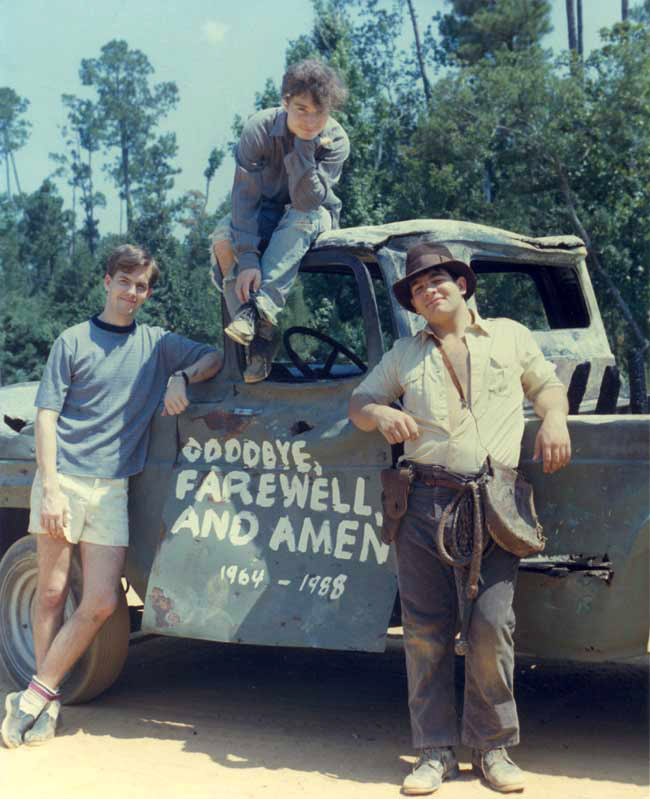
As someone who was obsessed with all things Indiana Jones growing up (including the seldom-seen arcade game that featured one button: "whip"), I was fascinated a few years ago to read about the shot-by-shot remake of Raiders of the Lost Ark that a few adolescent friends put together in Mississippi. The Vanity Fair article (PDF file) that introduced most of us to the project dove into the elements that make this story almost too good to be true: a homemade film that took 8 years to make, made by friends who put everything they had into the film's making, and a finished project that even impressed Steven Spielberg.

Raiders: The Adaptation
is also a movie that few will see, because due to licensing restrictions it will likely never be on DVD, and it's even tricky to get it into private screenings. Thanks to the Idaho International Film Festival, I was finally able to see the adaptation and learn even more about its tremendous back story. Talking to one of the festival's organizers before the movie, she said not to expect it to be like an actual movie, especially the sound recorded on a BetaMax camcorder. The film has not been touched since its final edit in 1988 (rightfully so) and is pretty raw. While it's true that it's not like an actual movie, Raiders: The Adaptation is also one of the most unique movie-watching experiences I've ever had.

The sound is so garbled that probably 80 percent of the dialog is indecipherable, so if you have never seen Raiders of the Lost Ark beforehand, you'll get a little frustrated trying to follow things. But that's where a lot of the fun comes in -- because John Williams' score is used throughout, the film takes on a hybrid-silent quality. Luckily they were dealing with a fairly simple story that relies little on dialog to drive it (we're not talking Glengarry Glen Ross here). But the raw sound does little to hamper the kids' enthusiastic acting, notably the energy of Angela Rodriguez as Marion. Eric Zala, Chris Strompolous and Jayson Lamb fill in most of the male roles (and almost every crew position), but Rodriguez is probably the strongest performer and really brings the adaptation to another level.


The main reason the adaptation took 8 years to produce was a commitment to high-quality stunts, sets and special effects, and the end result is sometimes startling (considering the circumstances). In a Q&A session afterward, Strompolous explained that most indoor scenes were shot in one of their basements -- including the pyrotechnic-laced barroom shootout. Once the movie gets going, you find yourself wondering just how they will accomplish the various memorable scenes, and they only skip past them in a few instances (such as the large scale 'Flying Wing' sequence). In all other cases, they turn to their youthful creativity -- the Ark setpiece looks nearly identical to the original's, they were able to film in a decommissioned submarine in Mobile, Ala. (after three years of haggling), a small dog is substituted for the monkey in Marrakesh, Indy gets away from the dart-shooting natives via motorboat and not airplane, and the famous map travel interludes are accomplished with stop-motion animation. Probably the most impressive scene is the famous truck chase, which is presented more or less in full, with the Nazis riding in a Volkswagen SuperBeetle instead of a Mercedes, and Indy commandeering an old Ford truck. I kept waiting for Indy's risky stunts underneath the truck to be cut, but there it was -- with a 15-year-old kid hanging on for dear life.

One of the biggest surprises was how fun it was to see the credits, where the makers went out of their way to credit each and every contributor -- meaning their own names were listed no less than 15 times. The final credit reads: "This is the end," -- The Doors.

Raiders: The Adaptation has no peers, and no genre. There are innumerable examples of this kind of tribute on YouTube, but today's kids have so much more at their disposal than simply a BetaMax camera. Strompolous talked of coordinating each friend's birthday and Christmas wish list to relate to what their production needed, and any allowance they got went straight to the movie. There were even a couple times where the boys went a couple months without talking to each other, and at one point it looked like the project was put to bed for good ... until Indiana Jones and the Last Crusade came out. The third entry in the trilogy provided all the motivation they needed. By then, all three friends were 18 and dealing with a project that had consumed their entire childhood. After working endless hours at a local television studio to finish the final edit ... it was done.

The story goes that each friend went his separate way for college, and Zala ended up at NYU where a certain student named Eli Roth watched the adaptation one night, and began spreading the word. Soon, Spielberg had seen it and the Vanity Fair article was in the works. In 2004, it was announced that a documentary of the adaptation's production was underway (still TBA). All three eventually quit high-paying jobs in the entertainment industry to focus again on their childhood film, touring around film festivals with it. Strompolous spoke of a screening last year in an Eastern Idaho town I had never heard of, so they clearly get around to every corner of the country with this thing. He also told me that while working in the DVD industry, he pitched the film to Paramount as an extra in the Indiana Jones Trilogy. They smiled and said no.

At the Boise screening, the theater was packed with families, and even kids who obviously hadn't seen the original before seemed captivated. In a way, it's the ultimate kids movie. The message here is this: if Raiders: The Adaptation comes to your town, don't miss it -- it might be your only chance.

Note: Visit TheRaider.net for an extensive history of the adaptation.

Tuesday, October 02, 2007

Why watch it when you can wear it?


My years of hard work toward finding an Internet t-shirt shop that fits my senselessly picky and narrow taste has finally paid off: presenting FoundItemClothing.com. Sitting here in my Senor Pizza t-shirt from Lover Boy, I just feel so complete that I had to spread the news. For you see, Found Item Clothing sells t-shirt designs that were worn by characters in movies.

"Wait, does that mean I can buy Cameron's Caduceus shirt from Ferris Bueller's Day Off?" Yup. "What about the 'Surf Nicaragua' shirt from Real Genius?" Yup. "Did you ever see the Get a Life episode where Chris Elliot goes to Handsome Boy Modeling School?" No, but they have.

And best of all, the company's founder shares his first name and hometown with me -- so I feel kind of obligated to point people in his direction. What scares me is that Adam's been in business for only a short time, so there's bound to be many more awesome designs coming down the pipeline (my short dream list would include Jack Burton's shirt from Big Trouble in Little China, and one with the logo of the burger place in Fast Food -- in both cases, only for their sheer obnoxiousness and obscurity).

And because I was so delighted to find Found Item Clothing, I figured I would have a few quick words with its founder:

DVD PANACHE: Reading your "about" section, you got into this initially as a way to get a Real Genius shirt for yourself, at what point did you see the potential for your own business?
FOUND ITEM CLOTHING: It was a slow process. Since there was no other way of getting my I love Toxic Waste shirt fix than to print my own, I had to do a minimum run of 25 to work with the printer I wanted. It was pretty slow for the first couple months, but I did sell enough shirts to make my money back. Then people started requesting shirts from other movies, and I started noticing a lot more shirts in movies too. I figured that if I could get to make my own shirts to wear and be able to cover my costs, that would be awesome. Then over the course of the last two years, the catalog of shirts has grown, and we've started to make a little money, but Ihaven't quit my day job yet...

DVD PANACHE: What are some other designs you're considering?
FOUND ITEM CLOTHING:
Well, the end of this week will be "Stephen King Rules" from Monster Squad. Then in a couple weeks will be Booger's "High on Stress" shirt from Revenge of the Nerds. In November, we've got stuff form Rushmore and Roadhouse, and probably one more, but I haven't decided yet.

DVD PANACHE: I'm hoping to strike up a Loverboy conversation because of my shirt, do you find many strangers recognizing where your designs are from?
FOUND ITEM CLOTHING: Sadly, not that often. Maybe a couple times a year. The kids these days just have no appreciation for culture..

DVD PANACHE: Any chance I can get a matching Senor Pizza hat and fake mustache?
FOUND ITEM CLOTHING: Hmmm...I hadn't thought about it, but that would make an awesome Halloween costume. I've already got this year's stuff together for the new costume guide, but maybe next year.

(P.S. -- for skeptical mothers out there, the shirts are top notch quality as well, it doesn't fit me like a belly shirt or a flag like many other places out there).

Saturday, September 29, 2007

Evil Dead RV


What ever happened to the good old days when it seemed every time you turned around there was a guy wearing a goat's head sacrificing a nude virgin? Well maybe it never got that bad (in most areas), but it's comforting to know that there was a time when the threat of Satanic cults was a great distress to this nation. Case in point the Satanic cult craze in Hollywood and television through the 70s and early 80s. Rosemary's Baby probably jump started the film industry's fascination, and The Exorcist did nothing to slow it down.

So the Satanic cult/Satan genre had a few good movies, but we also got a bunch of low-grade/high-fun crazy crap such as Necromancy (also known as A Life for a Life, Rosemary's Disciples, The Toy Factory and The Witching), starring a brow-furrowed Orson Welles as the devilish owner of a bad toy factory (never seen) and the leader of a Satanic cult (very much seen). But as far as Satanic cults go, it doesn't get much more fun than 1975's Race With the Devil.

Starring Peter Fonda and Warren Oates (strangely looking much older and fatter than he did in Bring Me the Head of Alfredo Garcia, made only a year earlier), Race With the Devil combines the familiar Satanic cult paranoia of Rosemary's Baby with the sensibilities of a Winnebago road trip. What starts off as a pleasant Texas to Colorado ski vacation via a new RV turns bad when Roger (Fonda) and Frank (Oates) find a secluded camping area for the men and their girlfriends, and accidentally spy an apparent Satanic sacrifice across the river. Somehow the men are spotted, and eventually high-tail their asses out of there, but not before a suspenseful river crossing (this is before people knew RVs were not off-road vehicles) and fighting off a few stowaway cult members.

Of course, the local law is little to no help (despite the usually God-fearing R.G. Armstrong playing the sheriff), but our foursome is able to steal a book on Satanism from the library. So they're in the clear, right? Unfortunately, this is not your everyday Satanic cult. The brand of cult in Race With the Devil is the kind that will fill your RV with snakes, the kind that will stare at you while you're in a swimming pool, and the kind that will take you out to dinner at a country western bar with one hand and sacrifice your little dog with the other.

Our gang soon finds out what most of us had already suspected: the entire state of Texas is one giant Satanic cult. This leads to a Winnebago death chase that may have inspired some of the delicious madness that ends The Road Warrior. There are some absolutely smashing stunts to be had in the climactic chase scene, and if you're hoping for the gang to outrun the Satanists, well -- you just don't know how Texas cults work, do ya? They always get their man.

Race With the Devil is all kinds of fun, and it's helped by the fact that the nameless Satanic cult is played as an outright MacGuffin. We never learn what their intentions are, what they plan to do with our gang, or even who it was they were sacrificing that one night. And who cares? As long as it results in a cross country chase with a Winnebago, I'm satisfied.

Note: While googling Race With the Devil, I ran into this Black Oak Arkansas album of the same name. Niiiiiice.

Monday, September 24, 2007

Wes Anderson: It's in the Details (Part II)


As I said in Part I, what I love most about Wes Anderson's movies is his attentiveness to the details. Often they don't have anything to do with the plot, or you only catch them the second time through, but they're what make Anderson's movies his. In The Life Aquatic with Steve Zissou, these details are less explicit than they were in The Royal Tenenbaums (such as a richly detailed quick flashback of Ethelline's former suitors or the infamous paintings in Eli's house). The details here are less bombastic and usually low-key, fitting in with the overall mood and story of the film.

  1. Steve Zissou's office, like that of Raleigh St. Claire in The Royal Tenenbaums, features an outrageous rotary telephone.
  2. Anne-Marie is topless when she's introduced, silently inferring that she's foreign, but she has an American accent in her later scenes.
  3. All the crew members of the Belafonte have multiple titles, except Pele, who is merely the "safety expert."
  4. Zissou's interns are from the University of North Alaska.
  5. The packed theater in the beginning is made up of French and English speakers, as half the audience starts laughing at Zissou's reply before the translator starts talking.
  6. The over-attentive assistant at the theater brings Zissou and the host an ornate crystal pitcher of water without prompt.
  7. Zissou and Alistair Hennessey (Jeff Goldblum) are both wearing a number of apparently nautical decorations on their suits at the gala, but Hennessey has more, including some sort of medal in place of a tie.
  8. Zissou's entire crew, and also Hennessey, wear a small green pin on their lapel.
  9. At the after party on the Belafonte, Zissou gives Eleanor some her game of solitaire just before the power goes out.
  10. The bar tender at the after party is one of Zissou's interns, wearing a shirt with "INTERN" boldly printed on it.
  11. The Air Kentucky uniform that Ned Plimpton (Owen Wilson) wears includes a string tie in the style of Col. Sanders.
  12. The kitchen in the Belafonte includes many racks of wine.
  13. Among the books in The Steve Zissou Companion Series: Tragedy of the Red Octopus, Arctic Night Lights and Trawlers, Junks and Dinghies (Zissou later reads the latter, trying to identify the pirates' ship).
  14. The painting of Hennessey at the Explorers' Club features him sitting on a couch on the deck of a boat, like he does later in the movie.
  15. After Zissou berates the Explorers' Club waiter for trying to give wine to Ned -- who "doesn't know anything about wine" -- he throws it down like a shot.
  16. One of the artifacts at the Explorers' Club is an old space suit from a foreign country.
  17. After landing on his island with Plimpton, Zissou takes a bottle of liquor and a shot glass out of his suit jacket.
  18. Continuing the theme of pay phones from earlier Anderson movies, the Belafonte contains a strange, foreign edition with many slots for coins. Unlike the pay phones in The Royal Tenenbaums, it is not rotary.
  19. Plimpton's official correspondence stationary describes him as "Kingsley (Ned) Zissou."
  20. Co-writer Noah Baumbach plays Oseary Drakoulias' assistant in a brief scene in his office.
  21. Zissou uses the term "teamsmanship."
  22. The studio inside the Belafonte contains a pristine electric guitar, similar to a Fender Jaguar model.
  23. Among the stunts listed on the bulletin board are: Skydiving into the Volcano (crossed out by Eleanor), bottle shooting, Zodiac speed jump over rocks and cliff jumping.
  24. Klaus makes himself a cappuccino during the raid on Hennessey's compound.
  25. Hennessey has a framed picture of Lord Mandrake on his boat, just as Zissou does.
  26. A rum cannonball (which Zissou remembers fondly from the Hotel Citroen) contains rum, gin, orange juice, strawberry soda, lemon-lime soda and pineapple juice.

Wednesday, September 19, 2007

Where no season set has gone before

I knew I was forgetting something in my last post when I talked about how busy this Christmas season would be for big DVD releases, and here it is:


If you haven't heard, to help celebrate the 40th anniversary of Star Trek, all of the original episodes have been mastered in HD, gotten enhanced special effects and are now being syndicated across the country (here's a list of air dates on local affiliates). The results have been outstanding (see old vs. new) while only occasionally inching into George Lucas touch-up territory. While the episodes are available for broadcast in HD, most areas have them on analog stations (including mine). And unless you have an XBox 360, where they are available for download in HD, you'll never be able to see William Shatner's nipples through his enterprise uniform. Which brings us to the new DVD set.

The moment I heard about the new episode treatment, I couldn't help but feel sorry for all those Star Trek fans who had plunked down $90 for the three season sets released a couple of years ago. Knowing companies are still in the business of making money, they would eventually get around to releasing these hot-rodded seasons on DVD, at an even more astronomical price. But I would have never predicted that the new seasons would arrive in an HD-DVD/DVD combo format! This news is exciting and disappointing at the same time. Exciting because you'll have the episodes in HD even if you haven't decided to upgrade your hardware yet, and disappointing because this has increased the price even more ($200 MSRP).

Still, this is a big milestone for television on DVD and a huge piece of news for the HD-DVD fight. The Star Trek seasons will be the first showcase of what the next-gen formats can do for television, specifically older television. Like many series, Star Trek was filmed on 35mm, which means there is a ton of resolution built into the master prints of it -- a picture quality no television in the 1970s, much less an ordinary DVD can replicate. So this isn't just bumping up to 720p on your upconversion player, these sets will present the genuine article with radically improved picture quality. The DVDs will also have new special features that take advantage of the new format, including the ability to completely navigate through the enterprise with your remote (watch a handy video of the feature here).

In fact, one of the reasons new special effects had to be added was that they didn't hold up in HD. With amazing clarity, the decades-old effects wouldn't be able to blend in like they could on our old Zenith set. Still, there's the price -- and from reading the comments on the Amazon page it looks like that will be a huge stumbling block even for huge Trek fans. I see it as just another reason why the consumer is winning in a big way with the HD-DVD vs. BluRay battle.

Saturday, September 15, 2007

Start saving up for Oct. 23!


October 23 is shaping up to be one of the deepest DVD release dates in some time. There's quite a few to cover, so let's start right at the top with the most anticipated release:

Warner Director's Series: Stanley Kubrick

A long time coming, Kubrick fans will finally get souped-up widescreen transfers of 2001: A Space Odyssey, A Clockwork Orange, Full Metal Jacket, The Shining and Eyes Wide Shut. The set also includes a disc containing the documentary "Stanley Kubrick: A Life in Pictures." This will be the third Kubrick box set from Warner Bros., but by far the best -- and coming in at only $55! As has been long discussed, Kubrick specified that his movies only be released in full screen and mono sound for home video, allegedly because he didn't like how letterbox effects looked. This was fairly easy to do, as almost all of his movies were shot in full frame and then cropped for theatrical distribution. Kubrick died before widescreen televisions became popular, and now we will finally have all of his movies available in their theatrical aspect ratio.

This will also be the first time American audiences will see the uncut version of Eyes Wide Shut, without the digitally-added shadowy figures in the orgy scene. All of the releases will have extra material (a first for each movie included), including commentary tracks. In addition to the box set, each included film will be available in new standalone two-disc editions, and new versions of Lolita and Barry Lyndon will go on sale that date as well (no information as of yet for those last two). Other Kubrick classics, such as Dr. Strangelove and Spartacus, are not available to Warner Bros., but have received quality DVD releases in the past. For a good explanation on Kubrick's full frame compositions and what to expect with the new widescreen cropping, check out this very informative DVD Talk thread.

The Mario Bava Collection, Volume 2

Now that Tim Lucas' long-awaited tome on the director has been released, Bava fans have more reason to celebrate with another affordable collection of his films. $35 gets you 8 Bava movies, including Bay of Blood, Lisa and the Devil and 5 Dolls for the August Moon. Volume 1 of the Bava collection contains six of the director's works, and was available on Amazon this summer for $20. My experience with Bava is admittedly meager, but I've been itching to put an end to that, and this new set may be just the cure.

The Adventures of Young Indiana Jones, Volume 1

I don't remember this series as fondly as others, but fans have been clamoring for a DVD release of it for a long time. From my perspective, only the real hard core fans will pony up $90 for this, as it only contains seven episodes (plus 38 companion documentaries) across 12 discs. The second and third volumes are expected in December and Spring 2008. Paramount was smart to give this similar packaging to the Indiana Jones Trilogy box.

The Criterion Collection: Days of Heaven, Breathless and Under the Volcano

A very solid month's offerings from Criterion. For many, Days of Heaven is the highlight as Malick films typically have very poor representation on DVD (possibly due to the director). I'm looking forward to Under the Volcano, as I had never heard of it until Criterion's announcement, and it sounds very good.

Hellraiser: 20th Anniversary Edition

Hopefully Anchor Bay will give this the same first class treatment it gave Phantasm earlier this year. I believe this will be the first time Hellraiser will be available in anamorphic widescreen.

Cutting Class (Unrated Version)

Yes, that's right Moviezzz! For the first time on DVD comes the horror movie Brad Pitt would like us to forget -- and that's not going to happen with the young actor dominating the cover art. A strangely entertaining slasher flick that seemed to inspire the most infamous shot in Eli Roth's Thanksgiving (see Moviezzz link for more explanation), Cutting Class has been rarely seen, some say due to Pitt's efforts to keep it out of the public eye (I've only seen an edited version on late-night cable). No word on extras, or what the new cut is like.

Battleship Potemkin (The Ultimate Edition)

The historic treasure gets a serious upgrade, featuring newly-translated intertitles as well as the original Russian intertitles. The highlight of this two-disc set looks to be a newly-recorded score, care of the Deutsches Filmorchestra, presented in 5.1 sound.

***************

What a week! And just a week later, we'll have the Twin Peaks: Gold Box. It's also going to be quite a Christmas season, with the Blade Runner extravaganza coming out in December.

Tuesday, September 11, 2007

Wes Anderson: It's in the Details (Part I)


Wes Anderson's career technically started with the marvelous Bottle Rocket, but the career he is currently living out began with Rushmore. It was with Rushmore that Anderson introduced a comedic style that not only featured traditional jokes, but a variety of "static" jokes disguised as background objects, names and seemingly trivial details. The montage of Max Fischer's heavy involvement in scholastic clubs was a perfect introduction to this style, as it took up little screen time but obviously contained a wealth of comedy that would be revealed further on repeat viewings. This style of Anderson's would be applied in his two subsequent films, The Royal Tenenbaums and The Life Aquatic with Steve Zissou. Even though his upcoming The Darjeeling Ltd. looks to be less zany than those last two (obligatory: "why does it have to be zany?"), I'm infinitely thrilled to see it if only for seeing what details he serves up this time.

To me, this kind of comedy reminds me of the best moments of The Simpsons, where static jokes are treated like royalty by writers. But Anderson has quietly made this technique his own, and for me it doesn't get any better than in The Royal Tenenbaums. Here, I have listed (in all the not-so-obvious details, names and background objects I have noticed after many viewings. I intend to do this for the other two Anderson movies I mentioned as well.

  1. Pagoda serves Royal Tenenbaum a martini on a silver tray, after he informed his children of their parents' divorce.
  2. The cover of Etheline Tenenbaum's A Family of Geniuses seems to be a photograph taken at the book's very release junket, possibly indicating that we are seeing a later edition of the book.
  3. The Tenenbaum family flag, an elongated pink triangle with a simple "T" crest at its base, flies on a spire at the family's Archer Avenue house as well as their summer home on Eagle's Island. This same shade of pink is frequently worn by Royal and Pagoda during the movie.
  4. In a flashback to Royal addressing Margot as his adopted daughter, they are at a party and flanked by high-ranking military members apparently from Russia, Western Europe and the Middle East, as well as an old man in an outrageous houndstooth suit.
  5. At young Eli Cash's house, in the background there is a key holder bearing Sharpie inscriptions of "Eli's Keys" and "Aunt's Keys" with respective arrows. Young Eli is later seen wearing a key on a necklace.
  6. Royal wears the same outfit in all the childhood scenes: a tan coat with sunglasses and a lit cigarette.
  7. As he is getting dressed for a press event for his new book, Old Custer, Eli is assisted by three men -- one of which holds up a platter of finger sandwiches. Eli takes one bite.
  8. When we are introduced to Henry Sherman, he is apparently inside an apartment building he owns. Behind him are plaques with reminders of when garbage is picked up and other items. Below the text is "H. Sherman. Landlord."
  9. After Royal is informed that he must leave The Lindburgh Palace Hotel, we see his masseuse packing his bags while he looks out the window and smokes.
  10. The name of the reggae band Margot got involved with is Desmond Winston Manchester XI (the name of the album is illegible on my TV, anyone?)
  11. The names of Margot's plays we see on posters in her room include and Nakedness Tonight and Erotic Transference.
  12. Raleigh St. Claire's office is filled with various outdated technology, including a bizarre multiline rotary phone and random vacuum tube switchboards.
  13. The three former suitors of Etheline are: Neville Smythe (a British Arctic explorer), Yasuo Oshima (an Asian architect) and Franklin Benedict (a John Huston-like director with an eye patch, cigarette and a set filled with an Indiana Jones lookalike, a pair of amphibious people, a space man and an obscured production chair, of which we can see the word "Galaxion").
  14. While meeting with Pagoda, Royal calls Henry a "two-bit chartered accountant."
  15. The Tenenbaum's neighborhood varies radically with each side of the house: one side is in an upscale area next door to the Thai embassy, another is in a downtrodden area and a third side is on a wooded street with a bus stop.
  16. Margot's closet still contains her leopard costume used in the play performed on her birthday.
  17. Eli is seen smoking a peace pipe.
  18. Eli's apartment features the spectacular "Aggressively Mediocre/Mentally Challenged/Fantasy Island (circle one)" paintings by Miguel Calderon.
  19. Richie is seen reading Three Plays by Margot Tenenbaum. The book can't be any longer than 150 pages, and though the names of the plays listed on the cover are illegible, none of them look to be the previously mentioned titles.
  20. Henry Sherman's desk has an urn on it, presumably containing the remains of his wife who died of stomach cancer.
  21. In addition to the previously mentioned former suitors, Henry and Etheline recall Gen. Doug Cartwright in conversation.
  22. Rotary payphones are frequently featured in shots, often in strange locations such as near the water of a public swimming pool and on the roof of a rec center.
  23. A gravestone observed by Royal and Richie reads "drowned in the Caspian Sea."
  24. During the broadcast of Richie's infamous tennis meltdown, the play-by-play man is voiced by Wes Anderson. His color analyst is named Tex Hayworth.
  25. Eli's apartment has a large table saw and a mounted bull's head with a lasso around the horns.
  26. Richie is often seen drinking a Bloody Mary.
  27. The magazine sent from Eli to Etheline has a note that reads "Dear Mrs. Tenenbaum, just in case you missed it. --Eli."
  28. Eli's cover story is titled "Where the Wild Things Are" and has a deck that reads "New work reopens genre. Adam Scher talks with the James Joyce of the West."
  29. Eli's previous novel was titled Wildcat.
  30. Royal tells a cabbie to take him to the "375th St. Y" and their destination bears that literal title.
  31. The novel The Royal Tenenbaums that the movie supposedly follows is very poorly written. When chapter headings introduce scenes, they begin with lines like "Royal is wearing his wool hat" or "they pull up in front of a building that looks like a huge castle."
  32. When Chas is chasing Eli through the house during the wedding, Pagoda stops Eli with some sort of food and says "hey man, try this it's very tasty." Eli eats it.
  33. Margot's play we see near the end, Levinsons in the Trees, appears to be based on the miniature set we see her playing with in the beginning.

Sunday, September 09, 2007

The Mind and the Metallurgy


It was 20 years ago this summer that RoboCop was released, and the occasion is celebrated by finally delivering a proper DVD of it to consumers (more on that later). I first saw RoboCop the following summer, when my mom amazingly rented it for me and my friends to watch during my seventh birthday party. It was quite a coup, since we had all spent most of the year imagining what the movie could have been like -- and wondering how many years it would be before our parents would let us see it. I think the title fooled my mom -- it sounds innocent enough -- and I'll never forget the look on my friend Ben Maddox's face when I told him what movie we would be watching that evening (he gripped my shoulders and asked me to repeat, like he had just been told his parents had been eaten by wolves). Somehow we made it through the whole movie without my parents really catching on to what we were watching. Our minds were appropriately blown, and Paul Verhoeven's trademark shock value was a frequent topic of conversation that summer.

Many might shake their fist at DVD Savant when he says in his review that RoboCop is "both the best and the most important Science Fiction film of the 1980s." It doesn't appeal to everyone, but the movie is supremely important in the realm of Sci-Fi -- using the genre as a means to explore issues in our culture to a depth that a more traditional movie could not achieve. It's also important in how RoboCop represents the decade, using landmark "analog" effects to create a world not post-apocalyptic, but one that has clearly reached its peak and is slowly crumbling.

The movie opens with a futuristic Detroit where criminals no longer fear the police, and local badge is nearing strike after a recent massacre of their own. Compounding their fears is the decision of the city to turn over police operations to a private company, OCP -- with deep pockets and radical ideas of how to eliminate crime. The OCP way is not prevention, but annihilation with the frightening E.D. 209 concept -- a monstrous, armored robot that can mow down rows of criminals without thinking twice. But E.D. 209 famously malfunctions in the boardroom, emptying a few drums of bullets into a lacky suit, shifting the company's focus to another project, the RoboCop. Needing only a "volunteer," OCP finds one in Officer Alex Murphy, who in his first day after transferring to the dangerous downtown precinct is viciously executed by a gang of criminals.

We learn almost nothing about Murphy prior to his death, only that he has a family. In one of the movie's greatest sequences, we see the mechanical transformation of Murphy through his eyes, gradually gaining consciousness as his new identity is forged. This climaxes with an epic reveal, as the ordinary police officers in the precinct hear the thunderous footsteps of their new partner, then come face to face with the eye-less machine. Beyond saying that Murphy's memory was erased as part of the RoboCop program, we're given scant details as to how human he still is -- whether his brain is still somewhat intact, or whether his face was simply transplanted onto steel. However many human elements remain, Robo slowly starts to realize there is more to him than circuits, starting with memories of a home and a family who have since moved on after his death.

RoboCop's creators hail the project as something that will "eliminate crime" in Detroit within a decade, but Verhoeven explicitly shows that the only upgrade Robo offers over regular cops is his efficiency at killing. OCP believes that with enough RoboCops or E.D. 209's, the populace will be too afraid to commit crimes, a strategy that will produce more contracts with other cities. But Verhoeven also shows the business side of crime, with crooks bemoaning their notch on the ladder ("we steal this money but we never get to spend any of it!"), and drug kingpins running their rackets like blue collar business owners.

RoboCop would not have worked without the success of its titular character, and watching the new documentaries on the DVD, it's clear a lot of credit has to go to actor Peter Weller. Working for eight months with a mime expert from Juliard, Weller developed the mechanical body movements that convinced audiences they were seeing a well-polished machine. It's Weller's movements that help keep RoboCop a serious film, with his character never veering into Tin Man territory (the sequels had that area covered). Other aspects of the production design keep it another plane of Sci-Fi as well, starting with the still-amazing look of E.D. 209. Bearing no human aspects, the machine is still full of life and terror thanks to some of the best-applied stop-motion animation ever seen and a look of menace that separated it from other giant screen robots (interviews with the designers confirmed my suspicions that its "face" was inspired by a killer whale).

While other effects-heavy films of decades ago look dated, the concept of Future Detroit still succeeds. It is a future with modest technological gains, but a multitude of new problems. The scant remaining aspects of the past are soon to be paved over for a literally new city where the failings of municipal government will be replaced by privatization. Today, Murphy's loss of identity within his cyberclothes is an easy allusion to the bevy of techno-accessories that regularly weigh us down.

The DVD: After so many incomplete editions, it was refreshing to know a definitive RoboCop DVD was in the pipeline, and here it is. The most elusive extra has always been the uncut version of the film, which was contained in the early (and long out of print) Criterion edition. A later release by MGM contained a handful of documentaries, but you had to spring for the Trilogy box set to see the full cut (with the potential for that awkward explanation to your house guest of why you own RoboCop 3). Generously, both cuts are included in this edition, with each getting a cleaned up transfer and a DTS sound mix. So how is the unrated cut? After waiting years to see it, I have to admit that there's really not much difference. The main thing you'll notice is much more blood and bullets with the E.D. 209 boardroom scene, but other than that nothing really jumped out at me.

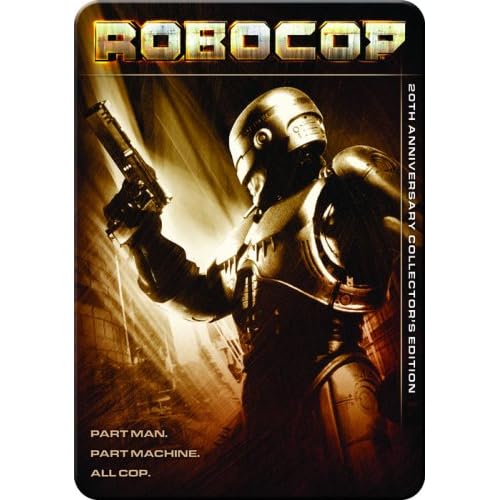
One of many new MGM releases to be housed in attractive "steelbook" packaging, RoboCop: 20th Anniversary Collector's Edition puts each version of the movie on its own disc. The first disc also contains the holdover extras from the last release (including Verhoeven's commentary), while the second disc has all new extra material. The new documentaries are quite good, with "Villains of Detroit" looking at the baddies with actors Ronny Cox, Kurtwood Smith and Ray Wise. Smith points out how his character (Clarence Boddicker) was crafted to be atypical, wearing glasses and a thin frame -- with his smarts being his most sinister weapon. "Special Effects: Then and Now" is the highpoint of the disc, with the film's creative talents providing informative insights into their processes and just how it was done. Much of this is spent on the creation of E.D. 209, including the exhaustive process of making the full-scale replica. A nice touch on this documentary is talking with the artists about today's special effects industry, particularly since their talents (matte painting, stop-motion animation) are pretty much extinct. The last documentary is "RoboCop: Creating a Legend," a nice look at everything RoboCop, such as his suit, the actor in it and even the gun (amazingly, they used an actual Beretta model which really did shoot three-round bursts).

Thursday, August 30, 2007

Saying goodbye to an old friend


In my years on the Internet, I can say that there have been probably three Web sites I have visited regularly, without interruption: ESPN.com, Amazon.com and DVDJournal.com. As of today, one of them is ceasing publication, and I think you can guess which.

Monday and Tuesday mornings have been very similar for me for the past eight years: read the Disc of the Week and see what new reviews are posted (Monday) and read about the latest DVD news (Tuesday). For its entire 9-year run, DVD Journal has kept the same basic look and adhered to the above schedule. There have been almost no changes to the excellent Web site in nearly a decade, and no one was never calling for them -- because it was that good. With a corps of about 10 West Coast-based writers, DVD Journal was impeccable at shining the spotlight on the important releases, keeping you up-to-date on the industry and never letting you down. Since it was based in my hometown of Portland, I had always felt kind of a personal connection to the site, especially since some of the writers (Dawn Taylor, D.K. Holm, Kim Morgan) were connected to other Rose City media. They were all great, but collectively they had a similar style: speaking as wordsmith film fans, but never veering from a high standard of professionalism.

Of course, there were exceptions to this rule, namely the inimitable and mysterious Alexandra DuPont. I think in my early days of reading DVD Journal, DuPont was the first film writer on the Internet I noticed who had an anti-print style to her writing -- the Internet was the only medium where it could exist. Often written in exhaustive length (and appearing sporadically on the site), DuPont's expansive reviews of The Indiana Jones Collection and The Lord of the Rings remain favorites, and her early early theatrical review of Star Wars: The Phantom Menace is that of Internet fan boy legend. Her bibliography was one of the first links I added to this blog.

DVD Journal proved that there's a place on the Net for simplicity. As stated in its About section, it's "typeset in a simple word processing program because we can't find any HTML software that doesn't piss us off." In light of this, there were never any flashy graphics, frames or even much in the way of advertising. This last bit was something that fascinated some of us: just how was it able to exist? With a great stable of writers and remarkable consistency, DVD Journal obviously wasn't out there to be a cash cow. Even though many Web sites of this ilk aren't raking in the profits, they at least try.

Great reviews are one thing, but DVD Journal was able to attract a loyal following because it payed close attention to that first word in its title. In addition to being one of the best places to find news of upcoming DVDs, the site offered an always updated Editor's Top 25, an expansive list of DVD MIA movies, a history of DIVX and even a handy guide to all those DVD terms you may not understand. With big DVD releases, the Journal always had detailed reviews of not just the movie, but also the extras (even breaking down multiple commentary tracks).

So why am I telling you all this just when DVD Journal is calling it quits? Well, it's not going to stay online forever, so go check out some of their 4,000 reviews and find out what you were missing.

Selected favorites from the DVD Journal archives:

Alien Quadrilogy by Clarence Beaks

Heavy Metal by Gregory P. Dorr

Mulholland Dr. by Damon Houx

The Searchers by D.K. Holm

Star Trek: The Motion Picture by Mark Bourne (Mark's reviews of the entire series are all exceptional)

THX 1138 by Alexandra DuPont

The Wild Bunch by Dawn Taylor

Ed Wood by Mark Bourne

Monday, August 27, 2007

French officials address explosive violence


Note: This post is part of the Bizarro Blog-a-Thon at Lazy Eye Theatre.

By Eve Roth
The Associated Press

PARIS (AP) -- Police officials from Paris, Nice and Arles gathered in the nation's capital city today to address mounting criticism stemming from a recent hurricane of violence that swept through the three cities. In its wake was untold levels of property damage, at least seven civilian deaths, countless smashed cars and the dramatic murder of figure skater Natacha Kirilova. Yet the most damning element of the whole affair was the number zero. As in the number of arrests made by police, and the number of leads about who was responsible.

"We have reason to believe that some of them are still alive, and that one could be an American," Paris Police Chief Raul Beauvais said while trying to look tough, possibly in a poor impression of John Wayne.

French media outlets have been unanimous in condemning local authorities, who they say are contributing to their nation's stereotype as a leaf in the wind when it comes to violent conflict.

"This band of thugs essentially played a game of 'Grand Theft Auto' in our country, and all we have to go on is that a few of them may have had dark hair," blasted crime columnist Frederic St. Videau of the Paris Plain Dealer. "Unless we're targeting stylish criminals as an untapped consumer, then we need to find a new police force."

The carnage began two weeks ago in Paris, when a wild shootout erupted over an apparent arms deal gone bad. After the surviving party predictably escaped, police found four dead Parisian mobsters. It may have seemed like just another Saturday night in Paris, but it was just the start of a maniacal spree of mayhem over the next week.

In Nice two days later, a fantastic barrage of shootings and explosions left residents of the sleepy tourist town stunned.

"I'm fine with guns, but do they really need grenade launchers and bazookas?" echoed longtime village sage Luc Devereaux while lazily filling his tobacco pipe. "And seriously, why do they need to target fruit stands?"

The Nice fruit stand was where the eruption started, with two gentlemen in a Mercedes opening fire on a motorcade of five sedans, with one employing a grenade launcher to great effect. After dispatching two of the cars in spectacular fashion, the party in the Mercedes chased after a Citroen, which met its fiery end through the crosshairs of a well-aimed bazooka.

"You could tell he knew how to handle that little firecracker," observed known vagrant "Sticks," while clutching a sack of carrot stems. "It blew up, then kept sliding down the road. Almost like a badger on election day."

But that was just the opening act of the day's horrible festivities. The cars continued chase, weaving in and out of Nice alleys and even forest roads, smashing into a fish market before destroying a quaint restaurant patio with an outburst of gunfire. Despite a flurry of spilled blood and innocent death, it was here that authorities nearly had their moment of triumph. The Nice SWAT team arrived, however it was only in time to witness the last of the awful visitors speed off in a huff.

"You bet our guys were there, with guns drawn and brows furrowed," grinned Nice Police spokesman Guy Garnier-Fulke, leaning precariously close to the press corps. "But then they drove off, what were our men supposed to do -- run after them?"

The one saving grace of the Nice tragedy was that further casualties were eliminated through the help of the city's "No Afternoon Drives" program, where no one is permitted in their cars past 2 p.m. Because of this, the awesome race-car driving skill of our troublers were left unimpeded -- for better or worse.

One day later, the two men seen involved in the Nice disturbance (both possibly with dark hair) arrived in the historic burg of Arles. Whether this was a tourist stop for the criminals or not, it still resulted in the deaths of two sight-seers by gunshot. Like the Nice authorities, Arles Police came close to apprehending the conspirators, only to watch them car-jack a poor soul and escape.

"We didn't plan on them having a reverse gear," lamented recently-axed Arles Police Chief Carl Peterson, who announced after the press conference that he would retire to his native land of Baraboo, Wisc.

With the knowledge of a crime spree terrorizing the country, Paris Police still decided on the questionable action of an early weekend -- leaving but three constables to patrol the whole city for a span of 96 hours. The timing couldn't have been worse, as the "Gruesome Twosome" -- as the Lichtensteinian press has dubbed them -- made their way into the French capital for a riotous chase.

Clips of this two-car chase have been among the most popular on the Belgian file sharing Web site ClipTubMan, and those who witnessed it will never forget its awesome spectacle.

"Oh my God, it was like Ayrton Senna had come back from the grave to show us mortals how real driving is done!" recalled noted Formula 1 enthusiast, and current NASCAR driver Kasey Kahne, who spied the chase from the confines of a Paris lingerie shop.

The infamous chase resulted in the wreckage of 25 cars, killed at least one driver, and shocked untold onlookers as the black BMW and blue Peugeot weaved through oncoming traffic. French Transportation Minister praised Parisian drivers on this black day, noting that many of them were not exceeding 20 kph during the chase, despite driving in a 60 kph zone.

Because of Paris' limited police force on that day, the closest authorities got to the chase was a base-pay constable who gave chase in a tunnel, only to flip his car after driving over a small traffic divider. Adding to the agency's black eye was the fact that the lead car in the chase (the black BMW) crashed over an incomplete freeway segment and even blew up -- yet no one was taken into custody.

"Even if we had our full complement of officers, how many would we have had patrolling at the base of a freeway construction site?" Beauvais asked half-sincerely while pouring the last of the press conference's complimentary wine case.

Tragically, the crime spree ended at the site of esteemed skater Kirilova's death during her famous "Go-Go-Whip" routine. The sniper in the case was never identified, nor were the "dark-haired dastardlies" -- as the Basque press has taken to calling them.

Though no crimes have been committed in days, authorities still believe the two headliners of the spree are at large, with only a disappointing description and an eerie thought by Beauvais in the police department's favor.

"If you ask me, the (suspects) kind of resemble those old disgraced samurai whose masters had died -- what'd they call them, Ronin ... Ronan ... Ronjun?" Beauvais muttered as he exited.

Associated Press reporters John Cocktoasten and John "Stumpy" Pepys also contributed to this report.