Reverent. That's the word I kept thinking while seeing Superman Returns. The reverence Bryan Singer and Co. had toward everything Superman is apparent in every element of this film, and it's that kind of thinking which has helped produced the best comic book movies, and the exact feeling which was missing in the last X-Men movie. Whereas X-Men was a slow-moving parade from one special effects sequence to another who-cares plot point, 'Superman Returns' exudes a charm that it is the best possible incarnation of a worshipped cultural icon.
The best decision Singer made with this movie was placing it somewhere in Richard Donner's Superman universe. As a pseudo sequel to Superman II, Singer didn't need to spend an hour with Supes' origin. This was the right decision not only story telling-wise, but also because it allows the first two entries in the series to be appreciated as they should be, while also enabling fans to further forget the last two Superman movies. I think this was an early stumbling block by fans, as the thinking was 'Superman' didn't need to be remade, as Donner's 1978 will always be a landmark achievement for all comic and blockbuster films.
And like Donner's film, 'Superman Returns' feels like two movies. I've always felt that the first third of 'Superman' is the high-water mark for any superhero movie, which is why some feel disappointed with the movie as a whole, because the rest is almost a letdown. 'Superman Returns' is the reverse of this, with the movie kicking into high gear after the first hour. Where 'Superman Returns' will pale in comparison to the 'Spiderman' franchise to non-comic fans is that first hour, where you'll feel kind of lost if this is the first Superman movie you've seen. But it's impossible not to smile once you see how right Brandon Routhh looks in the suit (which in my opinion, does NOT need to be fire engine red and sky blue, the straight-up colors looked hokey even in '78 and would come off worse on today's screens, I like the new pallette), how much fun Kevin Spacey is obviously having as Lex Luthor (despite what Ebert says, more on that later) and even though flying sequences are old hats nowadays, Singer manages to conceive something effortlessly startling in many scenes. This is most apparent at the end of the much-talked about airline rescue scene, I won't spoil it but when you see the notes Singer ended it on, you'll get a feeling for how much creative energy was really put into this film, I know I did.
I re-watched Superman: The Movie with my nephew the day before seeing the new one, and I recommend doing the same, just to get a handle at how connected the two are. Sure, Gene Hackman's Luthor was fun as hell and Spacey's is more evil than gregarious, but then how would expect Hackman's Luthor to act after spending five humiliating years in prison? I knew Singer was headed in the right direction when I heard he was re-using some of Brando's footage, and it turned out to be a revelation. Brando IS Jor-El, using a new actor would be all wrong, and I think my favorite scene of the new movie is at the end when Superman recites my favorite Jor-El line. But this wasn't from Jor-El talking to him through the crystals, this came right before he left Krypton, as if the father HAS become the son and vice versa. I wasn't expecting it and was just blown away when I heard it.
'Superman Returns' is nearly flawless, but there are still some parts of it that bother me. Chief among them is the decision to have a Superman Jr. in this. I can understand putting this device in a sequel, but now they HAVE to put lil Supes in the sequel, and they didn't really get much mileage out of him in this movie. Do we really want to see a coming-of-age Superman learning his powers in the next movie? I'm sure they will make it work when we see Superman again in 2011 or so, but it just seemed like an odd decision which didn't prove too fruitful. Another is that while Singer weaves the Superman world masterfully, we never really get the feel how happy Earth is to see Superman again after a five year absence. Seeing the miracles he works, don't you think the populace would really miss him, and if he came back, shouldn't there be some sort of global emotion? You see it at the end, but never really get the impression when he first arrives. Also, some minor fan boy quibbles: if this is a sequel, why does the Kryptonite Lex steals from the museum still say 'Abbas Addiba' on it? Lex already stole this piece of Kryptonite in the original and presumably used it, did someone recover it and put it back in a museum? We're never really convinced why Superman would want to return to Krypton, I mean if a planet explodes, it explodes, meaning even if there were some chunks left floating around, there wouldn't be anyone hanging out on it Little Prince style. One last note: there were a few scenes where my wife and I both thought Routhh's unusually perfect features were digitally enhanced. I know it was filmed in digital and we were seeing it at a digial theater, but watch for a few shots where Routhh comes off looking more like a Ken doll than human.
Finally, I have to say how much I disagree with Ebert's two star review. I've been reading Ebert for at least 10 years and don't think I've ever thought he was ever so wrong. The ho-hum action sequences he describes sure don't sound like the ones I watched, same goes for Spacey, who seemed to relish playing someone genuinely devil-ish. I thought Ebert would appreciate the creativity which went into 'Superman Returns,' as well as the story, which was miles ahead of X-Men 3, for which he gave a positive review.
Late review: A Prairie Home Companion
As much as I enjoyed 'Superman Returns,' my favorite movie of the year is still A Prairie Home Companion, which is the rare kind of movie that leaves you with some sort of baptismal feeling exiting the theater. Everything works. Everything. As good as the casting looked on paper, it becomes near perfection when you see Woody Harrelson and John C. Reilly in the prototypical Harrelson and Reilly roles. This is especially true for Kevin Klein, who would get an Oscar nom for this if he hadn't played this same role a few times before. It's a movie full of Best Supporting Actor nominations, but if I could pick actor who will actually get this nomination, it's actually Virginia Madsen, who's in the role of her career and literally sparkles throughout. Throw in the wonderful-as-usual Garrison Keillor writing, and you have a movie that you have to be kind of an asshole not to like.
Thursday, June 29, 2006
Unbreakable


Thursday, June 08, 2006
The That Guys
With the tragic passing of Paul Gleason last week, it is time to recognize the exclusive Hollywood club to which he belonged. Gleason was a That Guy, a term coined by Bill Simmons, but further explained in this post, which also represents the first class in the That Guy Hall of Near-Fame.
A That Guy is a recognizable, nameless actor who usually plays the same character in every film he is in. For example, when I was told that Gleason died I was clueless, until someone said he was the guy from The Breakfast Club. The name of the phrase comes from saying 'Hey, it's That Guy!' when a That Guy appears onscreen. While being a That Guy is usually not a welcome distinction, Jeremy Piven has proven that That Guys can move into leading roles. However, there are other That Guys who have made a nice career out of it, these are the pioneers, the original That Guys. The inaugural class inducted into the That Guy Hall of Near-Fame begins with the genre's foremost figure.
Dick Miller
Destined to play: Take-no-shit, witty old guy; next victim in buffet line for monster/killer
I have written about the wonders of Dick Miller before, both here and here, and it is essential for him to headline this list. Miller has been a That Guy for a whopping 162 movies and he's still going even though he's pushing 80. Miller was lucky enough to befriend directors such as Roger Corman and Joe Dante who began casting him (sometimes with his character having the same name in multiple movies) in all of their projects. You might know him as the gunstore owner in The Terminator or that one guy in Gremlins (with a substantially larger role in the sequel).
Danny Trejo
Destined to play: Thug, sometimes with a heart of gold
There was a run of movies in the late 80s/early 90s where it seemed that SAG passed a new bylaw which required any action movie involved Danny Trejo in some way. Since 1985 he has starred in an unbelievable 126 movies, including a whopping 22 in 2006 or 2007! Trejo has the coveted That Guy statistic of having more roles than lines (unofficial number). He has had a few breakthrough moments: his role in Heat (character name: Trejo!) was memorable, as was his turn in Desperado (1995 was a good year for him).
Al Leong
Destined to play: Thug/goon
While Trejo has had some roles to speak of, I can't even think of a single line of dialogue uttered by an Al Leong character. Never heard of him? Think of the thug with the butcher knife in Big Trouble in Little China or the Asian thug in Die Hard, or basically any Asian character you've seen who sported a fumanchu. While not having as many credits to his name as some on this list (only 53), Leong undoubtedly is the acting president of the Ninja/Gunman division of the Asian Actors Guild.
Woody Strode
Destined to play: Grateful sidekicks
The other posthumas entry in the list, you could argue that Woodrow Wilson Strode's career was more than a That Guy, and that may be true, but he played That Guy so well that he needs to be on here. Lurking in the background of so many great Westerns, Strode was a favorite of John Ford but earned his shining moment as the dynamite arrow-shooting Jake Sharp in the 1966 masterpiece The Professionals.
Paul Gleason
Destined to play: Hard-ass authority types
Known to a generation as the Breakfast Club principal, Gleason made a career out of playing detectives, deans and doctors. So anonymous was Gleason that his IMDB page contains the line 'reportedly owned a restaurant.' (NOTE: There were better pictures of Gleason available, but I had to include this one because of his quote 'I fantasize all the time' on the cover.)
Tuesday, May 30, 2006
Your basic X-Men rant
We all know the problems X-Men: The Last Stand faced even before anyone saw it: rushed production schedule, underfunded (for a summer special effects behemoth), questionable story (Dark Phoenix as Plot B?) and leagues of fans ready to pounce on it for any irregularities between comic pages and film. After seeing that, all of the above helped contribute to a sub-par movie, but I'm not ready to jump on the bandwagon saying it could have been a great movie.
Some potential existed, but I'm convinced more than ever that a 'Spiderman'-caliber X-Men movie cannot be made. The biggest challenge is that the X-Men universe has become so bloated over the decades -- with a ridiculous infusion of characters, villains, philosophies, etc. -- that it is near impossible to make a quality, focused film. What makes movies based on the likes of Superman, Spiderman and Batman so epic is that the formula is fairly cut and dry because their origins are a part of pop culture and the villains and dynamics are pretty well-known. In the case of X-Men, there is no great origin and the problems that face a superhero team are much different (and you could say less interesting) than those which confront an individual.
My great hope from the beginning for the X-Men franchise was that it would eventually adopt one of the epic storylines for a movie. I've always felt that the Days of Future Past saga was made for Hollywood (kind of a Terminator-meets-12 Monkeys story), sure it would have been a daunting production, but it would have been the kind of plot that would appeal to a large mass beyond the comic fans. Of course the other most well-known X-Men storyline is the sprawling Dark Phoenix saga, which was alluded to in X2 but then pushed away as a side story in X3, solidifying its stature as a rush job with little creative energy.
Making Dark Phoenix the primary plot would have no doubt increased the budget quite a bit, and it seems 20th Century Fox was unwilling to break the bank with X3. To deal with this, it seems the filmmakers decided to give viewers as many X-Men characters as possible, increasing the 'Hey!' ratio but lowering the overall product with flimsy special effects and a who-cares story. But even with the inclusion of a horde of X-Men past and present (who the hell was the antler guy?), there were many questionable no-shows. Chief among these was Gambit, who -- along with Wolverine -- seemed like the most obvious choice for an X-Men movie character from the beginning: he's a sarcastic charmer with a screen-friendly power, and has built-in connections to Rogue.
On the villain side, there was the strange choice to make Pyro (a perennial non-descript background character) as Magneto's No. 2. In order to set up a predictable battle with Iceman, they changed his character to an apparently young American (he's always been an adult Australian). To the surprise as no one, the Iceman-Pyro fight was a dud.
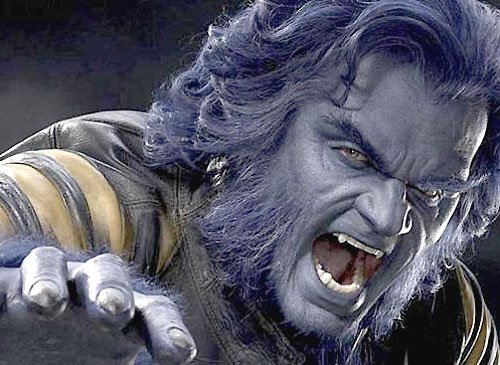
But there were some nice surprises in X3, I don't think anyone ever expected Juggernaut and Beast to be portrayed so accurately on screen as they were. I wasn't expecting Juggernaut's near-invincibility to be translate well, but it was one of the few successful effects in the movie (Super-Annoying Comic Geek Swipe: One scene that irked me was how Juggernaut was eventually overcome at the end, with his 'mutant' powers temporarily removed -- actually Juggernaut is one of the few X-Men characters who is not a mutant, his powers come from a magical gem inside his armor, which is why he is virtually unstoppable. And even if he was a mutant, wouldn't his mutant ability -- being unstoppable and invincible -- be something the government would want to harness or at least research?). Beast seemed like a character who would never look good on screen, but putting him in a suit and playing up his intelligence and diplomacy was perfect -- as was his graceful fighting at the end.
Unfortunately the excellent treatment of Beast and Juggernaut was overshadowed by several mis-steps, most notably -- and surprisingly -- with Wolverine. Whereas the first two films sometimes came close to showing Wolvie's true nature, X3 portrayed him as a mild-mannered uncle-figure, constantly trying to offer advice and generally just walking around the mansion playing it cool. What has made the real Wolverine one of Marvel's most popular characters is that he is a near-unlikable ferocious fiend who can rarely contain his anger. What happened to him? There have been rumblings of a Wolverine movie which will hopefully show us the true side of him.
Final swipe: The low budget of X3 was at times embarrassingly obvious, with the low mark coming at the beginning. Wolverine and Co. are battling a Sentinel (yes!) -- offscreen (no!!!) and all we see of this fantastic, towering character are a pair of glowing eyes and its head after Wolvie cuts it off. If there was ever a stage production of X-Men, this is how it would be done. Truly pitiful.
Tuesday, May 23, 2006
Overstaing the Underrated

The easiest list to make is the one with 'The Worst' in the title, a notch below that is 'Most Overrated,' since all that is required is to find a way to pick apart a consensus opinion. The only list harder to make than 'The Best' is 'Most Underrated,' because the idea of being underrated is having little or no discussion or buzz going on about said underrated item, hence a little more digging is required. There have been other underrated lists, and there will be more, but I'd like to think of mine as somewhat original, because I didn't take any ideas for mine from other lists, making mine even more underrated than your underrated . . . I think. Keep in mind that my idea of an underrated movie is one that is either still waiting for the acclaim it deserves or one which received unfair treatment either upon or after its release (multiple horrible sequels, slipping public opinion of its makers/stars). I didn't bother to rank these . . . that's overrated.
Neighbors
Despite being the last movie John Belushi made, Neighbors is never mentioned as one of the comic's best moments. Paired with Dan Aykroyd, and playing the 'straight man' character for the only time in his career, 'Neighbors' starts out as a typical comedy but quickly ascends into absurd levels of absurdity. 'Neighbors' sometimes has the feel of a Neil Simon comedy, since Belushi's character is eventually being assaulted from every possible angle of his life. It also features a 21-year-old Cathy Moriarty, fresh off her debut in 'Raging Bull.'
Robocop
The stature of Paul Verhoeven's action/satire of technology and the media has slipped considerably over the years. This could be traced in part to its two subpar sequels, but also to the fact that when someone today sees Robocop, they just see a robot suit which screams 1987. I've always seen 'Robocop' as the high-water mark for Verhoeven, whose rare ability to fill any scene (be it comedy or action) with a feeling of menace and impending pain is put to great effect here. Like he would with Starship Troopers and Total Recall, 'Robocop' is consistently mean-spirited, but never without its tongue slightly in cheek. 'Robocop' is unfarily seen today as just another late-80s action scifi sendup, which doesn't take into account its clever skewering of the media and corporate ethics.
Obsession
Like Verhoeven, Brian De Palma seems to have as many detractors as fans. The most common insult hurled his way is how he's a hack, since his most famous works were either remakes or reworkings (or in the case of Carrie, based on a famous book). While the above is true, it shouldn't be held against him, because by and large De Palma has actually taken the basic idea of a previous movie and turned it into something ultimately his. The best example of this is 1976's Obsession, which creatively twists Vertigo's themes of love, obsession and identity into a beautiful and unique film. Set in New Orleans with liberal doses of exaggerated natural light, 'Obsession' (like 'Vertigo') constantly has the feel of a dream, and you are constantly questioning what parts of it take place in reality. This little gem came on the cusp of De Palma's breakout with 'Carrie,' and is usually left out when discussing the director.
Kickboxer/Hard Target
Since Jean Claude Van Damme has crossed into that territory inhabited by Sylvester Stallone and since vacated by John Travolta, whereby all of their movies are cleared from our collective memory until they either die or make some sort of career changing film (i.e. Pulp Fiction). Van Damme's inclusion in this territory is certainly warranted (see: repeated straight-to-video roles, endless cocaine habit, all around joke), but that shouldn't stop his two best movies from being enjoyed. As I covered in my comparison of Van Damme and Steven Seagal, Kickboxer was a perfect vehicle for Van Damme, because it didn't try to hide the fact that he was a bad actor. This leads to several intended moments of hilarity and also some damn good fighting. In Hard Target, Van Damme was finally paired with a competent director who actually intended on using a story behind his many jump kicks in tight jeans. John Woo not only gave Van Damme some fun devices (being cajun, biting the rattler off a rattlesnake) but also took the leash off Lance Henriksen and let him wield a supremo bad ass single shot pistol. Both movies have aged terribly, but they remain just as entertaining and shouldn't be dismissed as they are.
The Burbs
Now that Tom Hanks has a free pass for any movie, no matter how stale (Davinci Code) or contrived (Terminal) his performance may be, his comedy career seems to have been forgotten. Even at the time of its release, The Burbs didn't get nearly enough attention as it deserved. Just a glance at who was behind this movie is cause for a raised eyebrow: Directed by Joe Dante and also starring Corey Feldman (!), Bruce Dern (!!), Henry Gibson (!!?!!) and since this is Dante, you know that the immortal Dick Miller is in it. This was also the brief star turn for Rick Ducommun, who was a popular comedian at the time and had two HBO specials under his belt (he would never be heard from again). 'The Burbs' has the usual Dante levels of absurdity and everything that comes out of Dern's mouth is gold ('Go paint your goddamned house!'). This movie has a burgeoning cult following and maybe some day it will get a decent DVD release.
The Getaway (1972)
When discussing the best of Steve McQueen and Sam Peckinpah, The Getaway rarely comes up. Peckinpah made many other great movies, but 'The Getaway' was his biggest hit. McQueen is often associated with his other blockbusters, such as The Great Escape or Bullitt. Compounding matters, when most people hear 'The Getaway' they think about the completely unnecessary and subpar 1994 remake. It's a shame, because 'The Getaway' is an enthralling, gritty and completely masterful on-the-run action epic. McQueen is perfect for Doc McCoy, who is dead set about not going back to prison, but will go to the grave in the pursuit of getting away with a bank robbery. There's an unbelievable scene in the beginning when Peckinpah shows the endless boredom and routine of prison: McCoy is shown delicately putting together a crude model of a bridge, but as he puts the last piece of it on, repeated shots of his daily routine are spliced together with him slowly crushing his just-completed craft. Although it is a big budget Hollywood blockbuster, there are Peckinpah touches everywhere, such as when McCoy realizes he's been spotted at an electronics store, he casually goes next door, steals a shotgun and prepares for the impending bloodshed. Watch for a young Sally Struthers in a nice role.
'You wanna get out of here? You talk to me'

2006 marks the 25th anniversary of one of the greatest sequels and certainly one of the best action movies of its era: The Road Warrior. Perfect in almost every respect, 'The Road Warrior' manages to maintain a torrid pace while never straying from a simple plot and mostly minimalist script.
Director George Miller and writer/producer Byron Kennedy had an interesting dilemma when conceiving a sequel to Mad Max. Their 1979 movie was a smash hit all over the globe -- except the United States -- where a version dubbed with American voices didn't make much of an impact. Warner Bros. of course wanted a big hit in America with the sequel, but how should they go about making the next chapter to a movie few in the States saw? The answer was a solution today's Hollywood should take a look at more often. Instead of a traditional sequel, Miller and Kennedy made a movie which could stand on its own, hence the unique U.S. title instead of the worldwide 'Mad Max 2.'
Apart from the excellent expository introduction and Max himself, the only aspect of 'The Road Warrior' that links to 'Mad Max' is Max's reaction to being asked if he's ever lost any family. Whereas 'Mad Max' was a classic tale of revenge, 'The Road Warrior' would be a cross between a Saturday morning cartoon and Leone's Spaghetti Westerns, with Max playing the role as The Man With No Name. Though 'Mad Max' was made with an extremely small budget (until 'Blair Witch' it held the film record for cost:profit ratio), it made its mark with its shockingly raw action scenes (you could argue that it contains two of the most brutal car collisions ever seen on the screen), and 'The Road Warrior' would aim to up the ante at every hairpin turn.
At the opening of 'The Road Warrior,' we find Max exactly where we left him before: in his car driving away from the pain that transformed him into the 'shell of a man' he now inhabits. What has helped make this such a legendary movie is the way Max is handled: given almost no lines of dialogue and with the absolute minimum of emotions. When Max cracks a half-smile at the end, it's not a reach to say it's his first genuinely enjoyable moment since his family was killed.
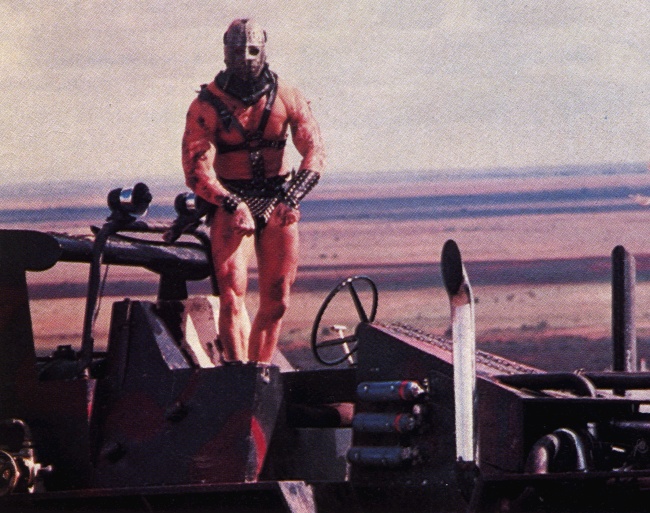
A spartan script by design, 'The Road Warrior' is still filled with odd characters and overflowing with lavishly creative production design. In the hands of American filmmakers, the gangs would be driving Mustangs with machine guns mounted to them. In 'The Road Warrior' world of the Australian Outback, the only real recognizable car is an old Ford F150, with Max at the helm of a heavily modified Australian-version Ford Falcon and Humongous' gang manning function-first monstrosities. Then there are the costumes. The friendlies at the refinery seem to have found their wardrobe by raiding a high school football locker room, while Humongous and Co. have taken the opportunity in the post-apocalpytic world to break out their cod pieces and assless chaps. It's the attention to detail such as the above which makes the movie work so well.
And the violence. Miller/Kennedy seem bent on one-upping themselves with each opportunity. When the boomerang blade smashes through the tranny's skull, you feel it. When the unlucky pair who are fastened to the front of a Humongous machine get an up-close view of the back of a tanker, it hurts. 'The Road Warrior' keeps going further and further up the meter of brutally fun action until Humongous and his machine meet their profoundly beautiful end.
There was a point in my life where I watched 'The Road Warrior' almost daily, and one aspect I grew to appreciate was the score by Brian May (no, not the one from Queen), who continued his work with Miller/Kennedy from 'Mad Max.' Since there's little dialogue, May's score is often at centerstage to carry some of the scenes, and it delivers every time.
It's a shame that on the 25th anniversary of 'The Road Warrior,' there is still no suitable DVD release, save for the bare-ass bones release around seven years ago. 'Mad Max' has a very nice two-disc Special Edition and there's even been talk of it getting the Superbit treatment (though I can't imagine why). Warner even saw fit to release a Special Edition VHS of 'The Road Warrior' shortly before the advent of DVD, but still no proper treatment for it on DVD (though there have been rumors of a Christmas release).
Also, it's strange to see how limited Miller's work as a director has been since his coming out party with 'Mad Max' and 'The Road Warrior.' Outside of those two movies he has directed just five, including 'Beyond Thunderdome' and the wonderful 'Babe: Pig in the City.' Perhaps he is content to sit on the royalties he gets from 'The Road Warrior' and 'Beyond Thunderdome,' which he was awarded the rights to from Warner in exchange for stepping out of the director's chair for 'Contact.'
Wednesday, May 17, 2006
Keep Watching the Shelves!
There seems to be an unhealthy amount of over-the-top DVD releases coming out this summer. With releases like these, it's easy to say to yourself "hey, I can wait two years to upgrade to HD-DVD!" A couple of these discs were once thought to be in permanent residence in the film graveyard, but with their coming out party now give hope to those still residing six feet under (more on that later). In addition to the forthcoming Ultimate Western Fanboy Box Set (which recently had its perfect coverart revealed), these are the releases I've been salivating over for weeks.
Grand Prix (July 11)
I have written before on the injustice of not having John Frankenheimer's ground-breaking Grand Prix available on DVD. Thanks in part to a vigilant online petition, the stunning film will now get a two-disc 40th anniversary release. This news was nothing short of shocking to fans of the movie, who were told for years by Warner Bros. that there was little interest in a DVD release, and would have been happy with just as happy with a bare bones anamorphic disc. On DVD, 'Grand Prix' will be fully enjoyed for the first time since its theatrical run, where its Super Panavision 70mm 2.20:1 aspect ratio was fully exploited. For those who have never experienced it, prepare to be blown away in Dolby Digital 5.1 by the opening credits, which creates a one-of-a-kind symphony using engine notes and the sounds of a raceway. The only shame about this release is that it will not contain the views of the commentary-friendly Frankenheimer, who died suddenly in 2002.
Beyond the Valley of the Dolls (June 13)
Russ Meyer's big budget, girl band vixen murder ride easily made my Top WTF!?! Movies list, but that doesn't mean I won't be picking up this long-overdue release. Beyond the Valley of the Dolls has been available in Region 2 for a few years, but will now hit shelves on the same day as the movie that inspired it, Valley of the Dolls. Truthfully, I probably wouldn't pick this one up if not for its signature extra: a commentary track by the movie's co-writer, a one Roger Ebert (yes -- that Roger). Ebert's commentaries are always excellent, and it will be interesting to hear his thoughts on his own work. Okay, I would have bought it, but just to shock my friends with the 'I am Supergirl!' decapitation scene.
Amazing Stories, Season 1 (July 18)
This series deserved to be rediscovered on DVD, as many have forgotten about it. Created by Steven Spielberg, who got his start on a similar series, Night Gallery. Amazing Stories is quite different than 'Night Gallery' or even 'Twilight Zone,' since it is generally geared toward a younger audience -- like many of Spielberg's movies. Being Spielberg, he was able to recruit some of the best actors and directors around to be involved with the series. Like any series of this genre, it is hit and miss, but there are some real gems in the first season, such as Mummy, Daddy about an actor who has an eventful night with a real-life version of the character he's playing. Perhaps the best-known episode from season 1 is Hell Toupee, directed by Irvin 'I fucking directed The Empire Strikes Back!' Kershner, it's about a man who gets a hair transplant from a convicted murderer.
Dazed and Confused: The Criterion Collection (June 6)
For the big fans of Dazed and Confused, this release could represent a triple dip, as it replaces the respectable Flashback Edition which was released last year, which replaced a very early bare bones disc. It's an easy sell for me just because of the cover art (if you can't tell, that's an outer jacket, with 'peepholes' inside to the inner disc cover, ala Led Zeppelin III), but being Criterion, it has a load of extras as well. Richard Linklater is of course on board for a commentary (and also has his name prominently on the cover now), a new 50-minute documentary, an expectedly exhaustive and entertaining booklet that only Criterion can do, and even a poster.
The Simpsons, season 8 (August 15)
As someone who has fiendishly purchased every Simpsons season shortly after it was released, I have long told myself that this will be the final season in my collection. Season 8 marks the last truly great Simpsons season, before it started its slow decline the following year. Generally, all the episdodes in this set are great (with some true classics such as Homer vs. the 18th Amendment and Bart After Dark), but it also has a couple duds, which forecast the decline on the horizon (notably, Mountain of Madness and Brother From Another Series). Fox will continue its ridiculous head-design, but will hopefully offer a traditional box design like they did for Season 7.
Graveyard tenants: Monster Squad/Night of the Creeps
Both of these Frank Dekker cult classics are still unavailable on DVD, and there is no release in sight. Aint-It-Cool recently held a reunion screening in Austin, and their recap details how the rights to both movies have bounced around lately, and who to write your letter to about how shitty this is. This is one of the rare cases where a pair of contemporary movies are almost unwatchable just because there is nowhere to find them. The only way you can see either is to buy an old VHS or a bootlegged DVD off eBay. I have actually never seen Night of the Creeps, but it sounds fun enough, if it's anything like Monster Squad, which was one of my favorite movies growing up. Hope seems slim for a DVD release for these 80s horror/comedies, but if Grand Prix can be released, anything is possible.
NOTE: DVD Panache was recently on hiatus due to a relocation to better quarters and a corporate outing to Cabo San Lucas. Rest assured, we are still going strong and look for some regular posting starting this week.
Monday, April 24, 2006
'This laser gun can melt anything -- except you, honey'
 The above is a direct quote from Danger: Diabolik, a movie that put a smile on my face that is only now starting to subside. Don't be swayed by its absurdly low rating at IMDB, 'Diabolik' is in a category all its own. That's partly to blame because it's a French-Italian production set in England, combining equal parts Batman and James Bond, drenched with the sharp style only the tail-end of the mod era could dare dream of.
There are movies based on comic books made every year, but 'Diabolik' is one of the few movies that feels like it is a comic book, and looking at it on paper, many would have suggested 'Diabolik' be produced on a paper medium. Here is our story: the lead character is anti-hero/criminal/playboy/terrorist Diabolik (John Phillip Law, who amazingly is of no relation to Jude Law), who confounds authorities with heists while dressed in his traditional leather catsuit and eluding them in various Jaguar XKE's to his underground lair (identical to the Batcave -- if it was designed by Ferrari) where he can cavort with Eva (imagine Goldie Hawn, but sexier, and Italian). Before the movie's over, Diabolik will have stolen $10 million in cash, a priceless emerald necklace and England's gold reserve. He will also demolish England's federal finance buildings -- seemingly out of spite and reduce a government press conference to hysterics using 'exhilirating gas.'
I was intrigued at the possibilities of 'Diabolik' after seeing that DVD Savant named it the most impressive DVD of 2005, but never imagined it would be this much fun. In addition to the aforementioned zany plot, you get high-speed chases on winding Italian roads, lots of maniacal cackles and the quirkiest Ennio Morricone score you've ever heard. The script is littered with clever, rhythmic word plays ('I was expecting you, Inspector') and the lavish sets are crammed with fun details (as he drives into his gargantuan lair in the beginning, try and spot a whole floor of spare Jags).
It's rare you find movies this good that have the 'bad guy' essentially as the main character, one who is not looking for any sympathy, just a lot of money for he and his femme fatale to roll around in. 'Diabolik' isn't trying to say anything, but it's one helluva snap shot from a creative time when movies like this could be made without trying to be too silly.
So why is 'Diabolik' so lightly regarded? By 1968, you couldn't make a movie like this with a straight face in the U.S., and it was still a gamble in Europe. The last good Connery 007 came out in '67 (You Only Live Twice) and the first of the spy spoofs was released in '66 (Our Man Flint, and even it sequel In Like Flint in '67), so at the time there wasn't exactly a salivating audience for something as wild as 'Diabolik.' It probably didn't help how obvious it was that 'Diabolik' was trying to cash in on the 'Batman' TV series which debuted in '66.
But with such a great DVD release, 'Diabolik' deserves to be recognized now. On the cheap ($12.99) disc, you get a commentary from Law and director Mario Bava's biographer and a couple of featurettes. The best extra shows how 'Diabolik' has established some sort of legacy: the Beastie Boys' video for 'Body Movin' (click here to watch the video) which uses footage from the movie and inserts the rappers in their own scenes. The video is on the disc, as well as commentary from the Beasties.
Friday, April 21, 2006
Suspended suspension of disbelief
It's the reason you don't bat an eye when Superman reverses the Earth's axis to go back in time a few minutes; it's why you accept the idea in The Abyss that a person can breathe water if they really want to; it's how you got that idea in your head that if you find yourself being chased on a rooftop, it would be a good idea to jump to that next building. The suspension of disbelief is central to any performing art, but this does not mean that your audience will buy whatever far-fetched device you throw at them. This is why I present to you my favorite 'you have got to be fucking kidding me' moments, which failed due to either sub-par direction and effects, or simply dumb thinking, and ended up being unintentionally hilarious.
Robocop 3
If you've seen Robocop 3, you probably know where I'm going with this. With the decision to make a PG-13 Robocop, certain sacrifices had to be made. There would be no more of Robocop shooting a would-be sniper through his scope or an acid-drenched thug being turned to mush by a speeding car. Instead we would have scenes like the beginning, which seems designed to provide a James Bond-style intro. We find Robo's partner (Nancy Allen, who at this point was probably wondering how a career that started out with being a regular collaborator with a young Brian DePalma could have degraded to this) in trouble again, but help is on the way. However, instead of just coming to her aid, Robocop decides to give the baddies some shock-value by driving to the top of a nearby parking structure and plunging over the edge. The intentions are semi-good, but here's where it spirals out of control: after driving off a 15-story building, Robocop's car lands on all four wheels, looking a lot like it was dropped from a crane 10-feet off the ground. Robocop then uses his new machine-gun hand to cut a hole in the ceiling of the car so he can have a big entrance. It's a fitting intro to a movie full of 'doh!'s.
Speed
An obvious choice for sure, but it's notable because way back in 1994 there was no need to question what it looked like for a bus to jump over a gap in a freeway. It had never been done before, so we just accepted how it looked. Now, buses jumping over freeway gaps is old news, so when we see the signature scene from Speed, we say 'hey, why does the front of the bus shoot 15 feet in the air right as it goes over the edge? And how is it able to land on its back wheels?' I had thoughts similar to these when I saw 'Speed,' but decided to give it the benefit of the doubt because movie-goers had been waiting a lifetime to see a bus jump. What makes this even more frustrating for me is that it would have been better if the bus hadn't made the jump. It would have been a much better stunt if the bus had fallen short and landed on the roadway below, desperately trying to keep the speed above 70 (or was it 60?) as it careens out of control. (Perhaps more embarrassing than the jump is Keanu Reeves' last line, which should go down as one of the worst 'I just killed the bad guy line,' when he proudly utters: 'Yeah, but I'm taller!' after decapitating Dennis Hopper).
To Live and Die in L.A.
This entry refers not to the actual movie of To Live and Die in L.A., but rather the alternate ending included in the DVD, which would have been a disaster of epic proportions if it had been tacked on to the theatrical release. In this alternate ending, our hero William Petersen is killed just like in the original, but instead of showing his partner taking over his beat we flash to an FBI outpost in Alaska, with Petersen's character very much alive and wearing a sheepish grin as we pan out from Alaska into the credits. What?! 'Oh I get it, you see he took a point-blank shotgun blast to the chest, but he actually secretly survived and then got transferred to Alaska so he would be safe from the gangs.' Just awful. This is comparable to having a new ending in Citizen Kane, where we instead see Kane in disguise in the Andes sledding on Rosebud as he winks at the camera.
Alien: Resurrection
This is not about any individual horrible scene in a completely horrible movie, but rather its entire horrible plot. The makers of Alien: Resurrection would like us to believe that in the future they find out that DNA, in addition to containing all of our genes, also conveniently stores all of our memories and life experiences. This explains how Ripley could be incinerated in Alien 3, but as a clone of herself in Resurrection, she is able to recall how to kill the aliens and how the creatures tormented her in three previous movies. Resurrection is an even worse sequel reach than Escape From the Planet of the Apes ('Okay, they destroyed Earth in the second one, but what if two apes had found a way to go -- back in time!').
Live and Let Die
Bond movies naturally fit into this list, but in Live and Let Die, they truly set an astronomical standard which would never be topped. One of the weapons of at Bond disposal is some kind of anti-shark pellet that causes inflation to Macy's Parade levels of hilarity. Of course in the final battle, we know that Bond will use this on the villain, which he does, but the filmmakers run into a problem here: in 1973 it was completely impossible to show a person inflate and explode on film. They go around this problem by inserting a balloon which may or may not resemble the villain, we never know because the film conveniently turns very grainy and the shot is so quick we must use circumstantial evidence to decipher just what happened.
Friday, April 14, 2006
Zombies down under and Spielberg's folly
For a short time, I had an Australian rooommate in college. He delighted me with some beyond-Paul Hogan-and-Yahoo Serious Aussie knowledge, such as how Volkswagen Buses are called 'combies,' aboriginees are called 'abbies' and the folk from the rural northwest are their version of rednecks. He neglected to reinforce my confidence in what Australian filmmakers can do with a measly budget and some inspired ideas: a rare opportunity for them to show us Yanks up. Over 25 years ago this fact was brought to life with Mad Max (which has a long overdue post coming up . . . hopefully) and forever stamped with Rabbit-Proof Fence. But who knew that those Tropic of Capricorn-straddlers (I ran out of synonyms, sorry) could come up with a zombie movie so original and fun -- and without the aid of Bruce Campbell?
I speak of Undead, which I finally saw yesterday. Funded without any studio aid, 'Undead' has a story -- and even a look-- that feels like a video game, and I mean that in the best possible way. For such a funds-strapped project, 'Undead' is filled with clever SciFi channel-grade CGI effects which never detract from its bold story, but give it a more fun atmosphere. The Spierig Brothers took an approach to 'Undead' that should be a prerequisite of any zombie movie: come original and don't apologize. Instead of putting its characters in a series of backed-into-the-corner surrounded by zombies moments, 'Undead' uses zombie battle scenes sparingly -- because it actually has a story to tell. Instead of a chemical truck overturning and awaking the dead, you get a superb interstellar mystery that twists believeably around and back until the final shot.
What originally drew me to this movie a couple years ago was a description of its hero: Marion is your average Aussie loner, but he carries three shotguns fashioned together to allow for easy tri-shotgun shooting and reloading. Neat. 'Undead' also carries my new favorite zombie-slaying scene, ever: our other hero is trying in vain to fight off zombies with a broom handle in a hardware store, when the end of itself accidentally attached through the hole of a buzz saw blade. With the blade at a slight angle, our femme fatale embarks on an artistic zombie butchering, climaxing with an Australian flag floating to the floor behind her.
'1941'
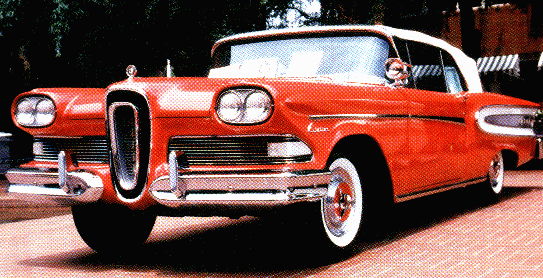
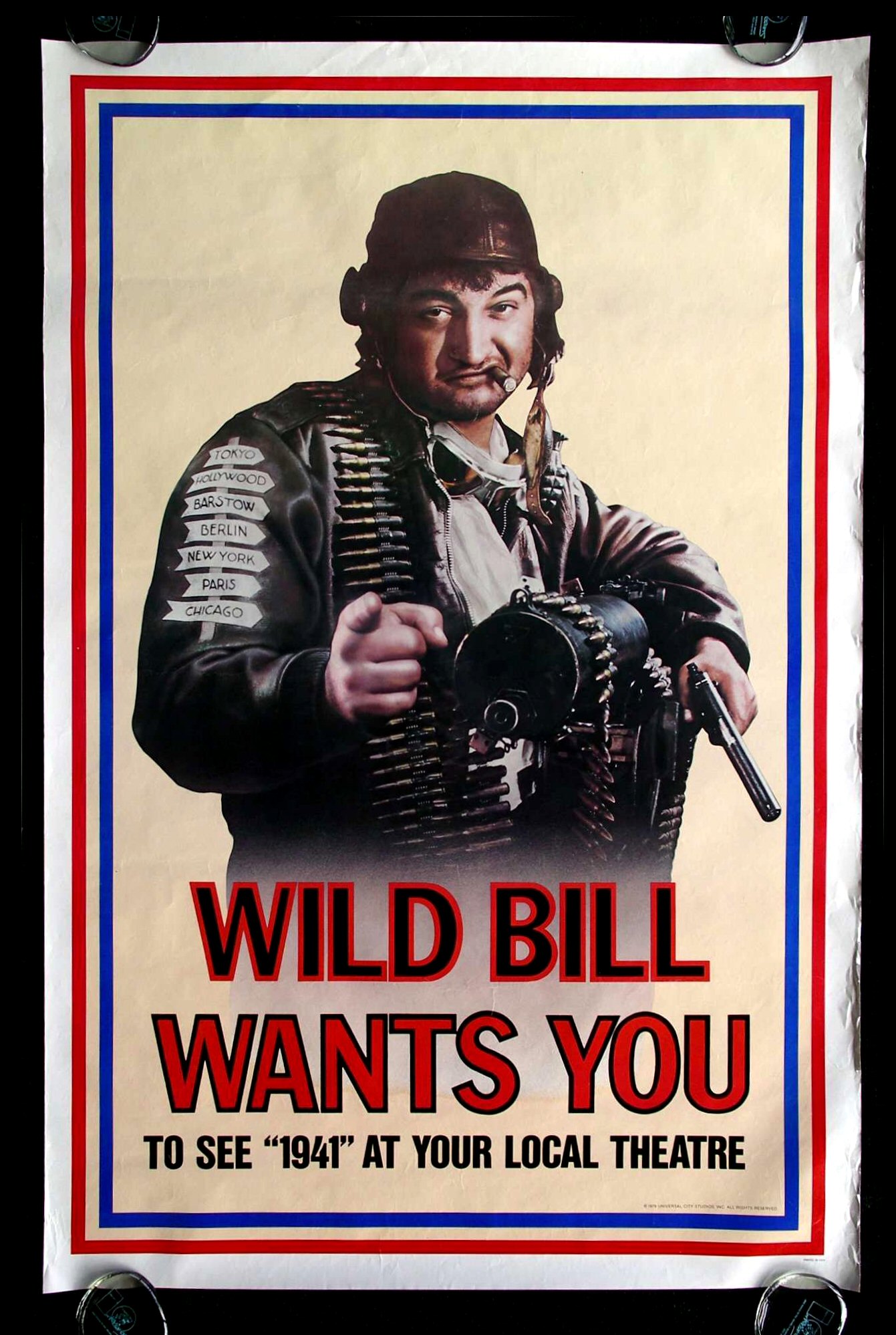
I was excited to see 1941 because it seems to have risen -- in some circles at least -- to the exclusive club of elite failures inhabited only by the likes of Heaven's Gate, Cleopatra and the Edsel. At this point in Steven Spielberg's career -- having just made two super hits both critically and commerically in Close Encounters of the Third Kind and Jaws -- he entered the rare realm of being able to do any project he damn well wishes, a luxury he would enjoy for the rest of his career. With this power, Spielberg unleashed an overweight and wrought lead zeppelin of a would-be comedy/historical epic.
Just watching '1941,' it's obvious that it was one of the red-headed stepchildren of the late 70s, Star Wars-era Hollywood, when studios were gradually growing eager to throw around previously-unheard of budgets. This is one of the main problems with '1941,' its stubborn intent on using as many big-name actors in scene after scene of overflowing sets and over-the-top mayhem. The latter can be used for great effect (see 'The Blues Brothers'), but here it just becomes tiresome. For example, in one completely needless scene, Dan Aykroyd's character observes that an air raid is about to commence in Los Angeles, but the lights are still on, so he and others opt to destroy all the neon lights and street lamps in downtown L.A. This is neither funny, nor interesting, and it probably cost about $5,000,000 of shooting time and effects.
'1941' decides from the opening shot that it's going to be a zany, outrageous comedy filled with many people running into things which later explode. The intentions are sometimes good -- such as Robert Stack's general announcing to a crowd at an air base that there will be no bombing on American soil, only to have a stray B-52 bomb roll into his podium -- but even that joke takes so much time to setup that it leaves you literally waiting for the predictable punchline, and when it arrives, it doesn't even matter. Spielberg fills the movie with about 10 too many characters and 4 too many storylines. Aykroyd and John Candy have promising roles, but never have enough screentime to do anything interesting. John Belushi's character is funny and is plenty of scenes, but is pretty much giving us the same joke every time. Even my man Warren Oates, has a fun role, but we only see him for two scenes. Hell, I wouldn't have even known Christopher Lee was in the movie if I hadn't seen the credits because his character is always seen in darkness and all we can really make out is his chin.
Maybe Spielberg needed to get this one out of his system, he would never again attempt a straight comedy in his career.

Wednesday, April 12, 2006
Cinematic snackfare
There are countless unwritten rules in film: Blood must be the color of raspberry syrup; Christopher Walken must be cast in the role of Christopher Walken; every Nic Cage movie must have a 'Nic Cage Freakout Scene'; any movie that uses the intro to Norman Greenbaum's 'Spirit in the Sky' as music in its preview will suck and . . . the film must be at least 90 minutes long. Like the first two rules listed, it was not always this way (and in those cases, it needn't be either: blood is rarely that dark and Walken was once capable of playing a straight character). There was a time when movies regularly ran below 90 minutes, sometimes waaaaay below.
These days, a film that clocks in at 60 or even 70 minutes would be labeled a short, but as the movies I'm about to detail will show, it is possible to make a feature film without going to far past an hour. When watching one of these wonderfully brief movies, you don't find yourself looking at your watch wondering when it will end, rather you gaze at your watch and wonder just how they're going to wrap up everything in the next 10 minutes. Here are my picks for the best of the brief:
The Unknown (1927, 63 minutes)
Tod Browning was the Tim Burton or David Cronenberg of the early years of film. Freaks was made over 70 years ago and is still unnerving. The Unknown is a perfect title for a movie that is quite unlike anything else. In an era that oddly saw many movies made about clowns (see He Who Gets Slapped, Laugh Clown Laugh -- also with Lon Chaney), this is the most bizarre -- following an 'armless' performer (Chaney) who uses his feet to throw knives and sees an opportunity in fellow performer Joan Crawford, who just happens to fear being touched by men. But the macabre truth is that Chaney's character is actually a murderer on the run who has disguised himself in the circus and definitely does have arms -- but in an attempt to show his love for Crawford -- has them amputated. As with the best silent movies, 'The Unknown' has a perpetual dream-like quality to it
6000 Enemies (1939, 62 minutes)
Yes, this flawed-but-entertaining Walter Pidgeon movie checks in at a scant 62 minutes, which was very short in the talkie era. 6000 Enemies takes on a familiar plot, which had been told many times at the time in Hollywood and perfected in James Cagney's Each Dawn I Die: the tale of the wrong guy in prison. In the case of 'Each Dawn I Die,' Cagney plays a railroaded journalist, while Pidgeon portrays a D.A. What made '6000 Enemies' an average movie in its day makes it all the more watchable today. Made during the 'production code' era of Hollywood when studios -- particularly MGM -- went out of their way to make 'clean' movies. For example, Pidgeon's character is sent to prison and surrounded by thousands of criminals he sent there, but the worst they can think up to get back at him is yelling insults like 'the jury rests!' and sometimes shooting him rude stares. What's more, after the D.A. proves his mettle in a prison boxing match, the cons are more than happy to accept him as a friend. This could have easily been a very poor 2-hour movie, but as a 60-minute blazer it's nearly comical watching a 20-minute climactic courtroom scene shoved into a 20-second montage, or how the primary villain is seen in only two brief scenes.
The Public Enemy (1931, 83 minutes)
Though it is the longest by far in this crop, The Public Enemy makes the cut simply because it packs an overflowing plot (the life and death of a criminal) into such a tidy package. This is what made James Cagney, the pint-sized big mouth tough guy (i.e. the first Joe Pesci), a legitimate star. 'The Public Enemy' is best known as 'the grapefruit movie,' because of a scene when Cagney's character grows ever frustrated with his dame, so he grabs the nearest object -- a grapefruit -- and shoves it in her face (and yes, this was also parodied by The Simpsons, in Brother From the Same Planet). Cagney plays a young hood who grows to be a bootlegging baron, which clashes with his straight-laced brother -- especially when he serves his family a keg on the dinner table. 'The Public Enemy' would not really be classified as a mob movie today, rather it is closer to gangsploitation movies like Menace II Society, following a good kid who goes bad.
The Narrow Margin (1952, 71 minutes)
I saved this for last, because The Narrow Margin is a true filet mignon film (i.e. not a damn ounce of fat on it). This unforgettable noir thriller sets a torrid pace from the start and doesn't let up. Detective Walter Brown (the lantern-jawed, gravel-throated Charles McGraw) has problems: his mission is to transport a key mob witness crosscountry on a train, but his partner was just murdered, his cargo is an anxious and thankless dame, and in between fighting off an inquisitive tike, a mysterious fat man and his own nerves, he has to somehow make it through the trip while a mob hitman is onboard wanting blood. Watching this again, I could not help myself from singing 'Train Kept a Rollin' in my head (the Aerosmith version of course), but Steven Tyler never had lines in his song such as 'nobody likes a fatman except his grocer and his tailer' or 'this case is headed straight for the cemetery.' It seems impossible that 'The Narrow Margin' could jam this many shady characters and switcheroos into 71 minutes. Whenever I hear someone say they don't like any black and white movies, this is the one I pop in.

Sunday, April 02, 2006
Submitted for your approval
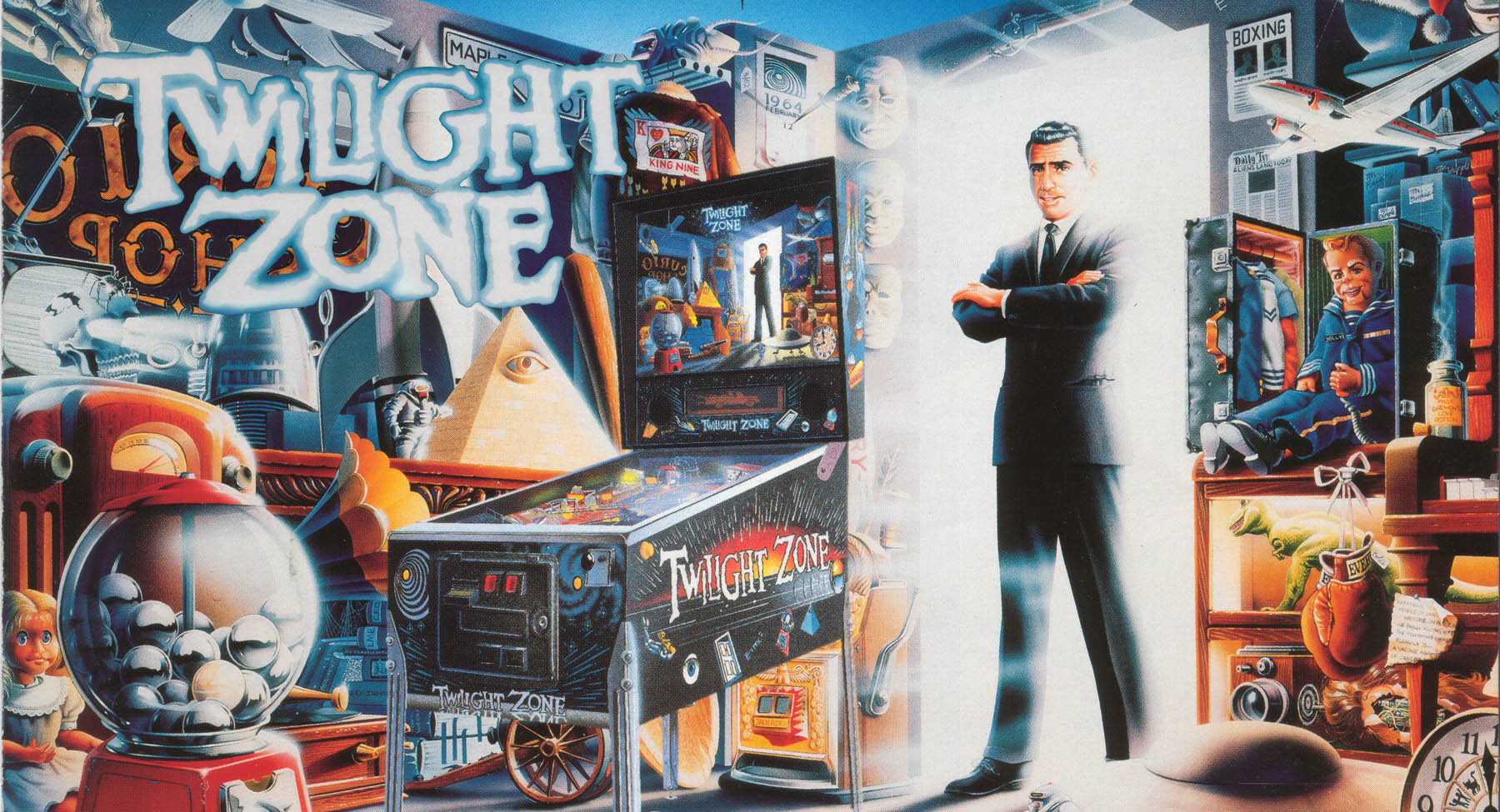
On the surface, it may seem like a dream for Twilight Zone fans that every season of the legendary show is now available in new definitive editions. But even a die-hard fan like myself has to admit that these overpriced ($120 msrp!?!) monstrosities should only appeal to completists. It's not that the sets are not put together well (they include a lengthy list of extras and one of the seasons even includes the spectacular 'Twilight Zone Companion' book), but it's the fact that TZ, taken in as seasons, is overloaded with absolute clunker episodes.
Having seen almost every TZ episode, I've estimated that only about 30 percent of them are worthy of your time and there is a fairly large percentage of episodes that barely pass as watchable. When TZ was at its best it presented original stories featuring great acting, directing and maybe even a score by Bernard Herrman or Jerry Goldsmith. But far too many of the episodes feature recycled stories or -- as is the case with many bad TZ eps -- terrible acting and directing. One of my favorite episodes, A Piano in the House, has a fairly unengaging story but is made entertaining by the the actors and the choices made by the director in filming a luxurious, crowded party of the elite.
If you've never seen a truly horrid TZ episode, here's an example of just how bad it can get: the episode Four O'Clock is about a man with a parrot who believes he has the ability to shrink all his enemies to the height of two feet, and all of this will occur at four o'clock, as he tells us many times. But when the time arrives, it is he that shrinks, as his parrot tells him that his feathered friend was the one with the power all along. Ho ho! There are few episodes this bad, but many linger at around this level of quality, which is why you don't need to shell out over $100 for a season set, especially when you can buy the previously released DVDs comprised of four episodes, which now retail for about $6. And I am here with a helpful guide on how to build your TZ collection with only the best episodes, for less than a quarter the price of one of the season sets.
The Twilight Zone, Volume 11
Notable episodes: The Dummy, Living Doll, The After Hours
Pound for pound, this is probably the best $6 TZ disc out there. The After Hours is one of the few truly terrifying episodes out there, about a store's mannequin who has lost her way. The Dummy and Living Doll are scary in their own right, with both also having influenced everything from Child's Play to Treehouse of Horror III.
The Twilight Zone, Volume 8
Notable episodes: Third From the Sun, To Serve Man, The Shelter
To Serve Man is probably the best TZ episode, though not necessarily my favorite, and its 'punchline' was famously skewered by The Simpsons in the original Treehouse of Horror. To Serve Man is helped by easily the best-ever TZ score (Herrman, of course) and also the acting by Richard 'Jaws' Kiel and Lloyd Bochner (one of Lee Marvin's many kills in the wonderful 'Point Blank'). But it's the story that makes To Serve Man so riveting even today (be sure and watch for Russia's representative at the U.N., why is he the only rep who takes out a sandwich to eat while an intelligent alien is addressing the room?). Third From the Sun is a fun and well-directed bit with a nice ending and The Shelter is enjoyable enough, especially since it was wonderfully parodied by The Simpsons in Bart's Comet (noticing a trend here?).
The Twilight Zone, Volume 7
Notable episodes: Shadow Play, The Hitch-Hiker, Perchance to Dream
My favorite of the $6 discs, with Shadow Play being one of my most-loved episodes. It's a gripping, original tale wrought with philosophical questions, a great performance by the late Dennis Weaver and one of the best TZ endings. The Hitch-Hiker also has a great ending and Perchance to Dream stands as one of the more original and unforgettable TZ works (certainly the best of the 'dream' episodes).
More Treasures of the Twilight Zone
Notable episodes: The Masks, Eye of the Beholder, The Howling Man
There were two 'Treasures' discs released in the original lot of TZ DVDs, and this one is not to be missed, although it does still retail for about $15. It's worth it though, as it contains my all-time favorite episode, The Howling Man, one of the series' most famous moments in Eye of the Beholder (the pig people plastic surgery one) and an underrated little masterpiece in The Masks. The Howling Man is worth the price of admission alone, as it's a timeless horror tale about a traveler in Europe who unwittingly releases Satan himself from the clutches of a monestary. It's quite unlike any other TZ episode, perfectly written and directed with a brilliant, 'fuck yeah!' ending. 'Eye of the Beholder' is the much-copied story about a beautiful woman who is viewed as a freak by a society where ugly is the norm. The Masks is underrated as good TZ episodes go, with a truly twisted plot and unforgettable setpieces (where can I buy masks like that??).
Thursday, March 23, 2006
Requiem for a lazy blogger
Yup, I'm still yet to be cured of this slacker blogging syndrome. I was trying to pin down the reason this week and thought that it might be the fact that I've seen way too many disappointments this month, films that aren't exactly inspiring me to write. That doesn't mean I haven't seen some good ones, but the stud:dud ratio was clearly at an all-time low in February-March, so come with me as I take you on a tour of the hits and misses I've seen lately.
Biggest Dud: 'Creepshow 2'
My God this one was bad, and I actually had some modest expectations for it. I remember seeing the previews for it as a kid and always was intrigued by the potential of the vignette The Raft, which is the main reason I finally watched it. Based on three of Stephen King's short stories, Creepshow 2 also included George A. Romero as director. So there's definitely some potential here, which is subsequently ruined by the curious directing decision to play the whole movie slightly sarcastically, with a half-smirk to inject some element of comedy into all three stories. While it might have looked good on paper, the laughs are never there and subsequently, neither is the horror.
Making matters worse is the awful animated segments that preclude each of the stories. We begin as some sort of Cryptkeeper dude drops of the latest issue of Creepshow at a comic book store, where it is picked up by some slimey kid. Through the magic of animation that reaches previously unheard of lows, we see the kid's adventures with the comic in between readings and are introduced to the Cryptkeeper's generic castle as he introduces each story. Before the previously mentioned Raft story, we get a worthless vignette called 'Chief Wood'nhead' about a wooden indian who sits in front of George Kennedy's store, until one night when some hoods rob the place and he goes on a killing spree. It is devoid of any fright, comedy or entertainment value. Luckily after it was finally over I got to see the reason I even popped in this atrocity (which regularly sells for $5, wonder why): The Raft.
The story is vintage King: three teens on a raft haunted by a strange creature in the water that slowly kills them. The thing in the lake resembles a floating oil spot and can reach up through the cracks in the raft and kill them. This is a good premise, but the whole segment is ruined by more awful direction. When the first teen is sucked in and horribly killed, her friends react more like she dropped a glass of milk. It could have been played out like Cujo, which has a similar plot, but instead plays out like a bad Amazing Stories episode. In the end, 'Creepshow 2' was so disappointing I couldn't even bear to watch the final vignette (some trash about a woman and a zombie hitch hiker).
Biggest Hit: 'Elephant'
After watching Gus Van Sant's masterful Elephant, I couldn't believe there isn't more hype about it. 'Elephant' is one of the most original and unique movies I've ever seen. Most will dismiss it when they hear it's about a Columbine-style high school massacre, but it's more of an experimental film about life than anything. Using a voyeuristic lens and toying with the chronology of a day at a generic high school, Van Sant leads us through characters we get to know deeply, while never succumbing to overly expository dialogue. One of the characters, Carrie, has extensive screen time, but maybe two lines. Finally, she is given a quick and emotionless death just like the others, showing what little concern the teen killers had for their victims as they probably knew her just as we did: a face in the hallway.
Van Sant uses extremely long shots from a lens that routinely drifts away from characters and into other conversations like it was some ghost wandering through the school. The chronology Van Sant uses is creative, as in one scene we see three characters pass by each other in the hall and eventually see through each of their paths how they got to that intersection. At no point until that deja vu shot was it apparent that we were watching a flashback. The killers themselves are not portrayed as hell-bent Satanic kids, but as a couple of punks who anyone would know. Both know they are going to die and that they will kill many of their classmates, but never seem overly excited about their prospects. The only real emotion any of them show is when one is walking the halls and is frustrated that most of the students have already fled the building.
Van Sant makes it a point to show that he has no answers, just like anyone else, for the ghastly phenomenon of high school shootings. Using a controversial and unsexy topic, Van Sant created a very simple movie that creates a powerful message by being just that.
Biggest surprise: 'High Anxiety'
I was surprised by Mel Brooks' tribute to Alfred Hitchcock not in how much I liked it, but just as how it is not your typical Brooks comedy. He's at his always-zany, but it's not exactly overflowing with jokes like Blazing Saddles or Young Frankenstein or as daring as Silent Movie. And most of all, it's not really a parody, but as the opening prologue says: a tribute. If you're not familiar with Hitchcock, this might not be for you, as you won't catch the note-perfect takes on his scenes, or jokes like Brooks' character checking into a hotel as Mr. McGuffin. It's not the funniest Brooks comedy, but it just feels so right, such as the setup for the best joke in the movie: Brooks repeatedly asks for a newspaper from a bellhop, who finally enters Brooks' room while he's taking a shower and 'stabs' him with the newspaper, leading to the exact shot from 'Psycho' where we see black ink (the same color the blood in Hitchcock's black and white movie was) swirling down the drain.
Other misses:
Rio Grande
As the closing movie in John Ford's 'Cavalry Trilogy,' I really wanted to like Rio Grande, but it never seemed to capture the lively spirit that Fort Apache and She Wore a Yellow Ribbon did so well. Sure, John Wayne and Maureen O'Hara are in it and Victor McClaglen plays Victor McClaglen again, but the pieces never seem to come together as well as they did in the other two. Hurting its cause is that Lt. Col. Yorke isn't the best kind of character for Wayne. It's essentially the same character Henry Fonda played so well in 'Fort Apache,' whereas Wayne was always at his best when playing men with a slightly lighter and synical side, not a stone cold disciplinarian as Yorke is.
The Devil's Rejects
This wasn't so much a disappointment, as it was entertaining, but it seemed like it should have been better. The sequel to Rob Zombie's tremendous House of 1000 Corpses (which will be even better when a director's cut is finally released), The Devil's Rejects seems more like made-for-TV spinoff of a once-popular series. We get the best characters from 'House' back and go with them on more of their adventures, but it always seems like it's a 109-minute movie made with a 45-minute story. There are subplots and inflated scenes everywhere that seemingly do nothing to better the movie than to up the running time. And in that running time we never really get that good a glimpse at Captain Spaulding & Co. We're with them the whole time but never get the sense that we know them, or find out much more about them than we did in the original.
The Haunting (1963)
Again, a good movie but it never once lived up to its hype as a genuinely scary film. I watched it at night and never found it even remotely creepy. I wouldn't sayI'm immune to scares, as I am quick to give a movie credit for having genuine chills, but it may be a case of simply becoming desensitized to the 'what's that sound' kind of scare that this movie apparently makes its living on. That's not to say 'The Haunting' is not entertaining, as its use of brilliant setpieces (the towering spiral staircase -- wow!) and lighting make for plenty of eye candy, but the lack of scares makes this movie truly drag at times.

Wednesday, March 08, 2006
Another end-all box set
Us Western fans are getting spoiled again. If you were floored by the long-overdue Peckinpah set, feast your eyes on this. On June 6, Warner is set to release the John Ford-John Wayne Collection. The ten disc (!) set is headlined by two heavyweights: an Ultimate Collector's Edition of The Searchers (2006 representing the film's 50th anniversary) and a two-disc set of Stagecoach. 'The Searchers' alone will retail for $35 since it will contain a load of goodies including a 36-page booklet, a reproduction of the original comic book, behind the scenes photos and even a mail-in one-sheet poster. In addition to these two blockbusters, the set will come with Fort Apache, The Wings of Eagles, The Long Voyage Home, She Wore a Yellow Ribbon, They Were Expendable and 3 Godfathers. How much for this treasure chest? How does $80 sound?!?
The new discs of 'The Searchers' and 'Stagecoach' will retail for near $50 alone, and for another $30 you can six more classics, with nary a dud among them? Too good to be true. Actually my only quibble is that it does not contain Rio Grande, the finale to Ford's 'Cavalry Trilogy' that also includes 'Fort Apache' and 'She Wore a Yellow Ribbon.'
To understand what a great release this is, compare it to Universal's recent Alfred Hitchcock set, which contains 14 films at a bargain price, but gives us discs of movies many of us already had, in many cases hardly improving upon the original. The Ford-Wayne set presents two exhaustive special editions and the best examples of the featured genre (no 'Torn Curtain,' 'Topaz' or 'Frenzy' which bogged down the Hitchcock set). Also, keep in mind that $80 is the MSRP for the set, which means Amazon will probably sell it for $65 or $70!
Though 'Stagecoach' and 'The Searchers' are what will really sell this set, I can't wait to finally have 'Fort Apache' on my shelf, which is my favorite Ford-Wayne film. A meaningful and original tale of military ethics with a cast featuring Henry Fonda, Shirley Temple (with one of the best character names ever -- Philadelphia Thursday), Ward Bond and even a 'hell yeah!' role by the one and only Victor McLaglen help push 'Fort Apache' into the cinematic stratosphere. The most memorable scene in the movie is Wayne's closing monologue, which is regarded by some as his finest moment.
So now that Western fans can check Peckinpah and now Ford off their DVD wish lists, when can we finally get special editions of Leone's For a Few Dollars More, A Fistful of Dollars and Duck, You Sucker that we have long been promised?

Thursday, March 02, 2006
Your basic Oscar prediction post
Yeah, I've been slacking off lately in terms of posting, but that's neither here nor over there because the Oscars are coming up this Sunday. You won't find all the categories here (does anyone have a preference for 'Best Sound Mixing'?), but you will find plenty of second-guessing and semi-informed opinions.
Actress in a supporting role
Nominees: Amy Adams, Junebug; Catherine Keener, Capote; Frances McDormand, North Country; Rachel Weisz, The Constant Gardener; Michelle Williams, Brokeback Mountain
This is probably the least glamorous of all the major categories this year. Nobody saw 'Junebug,' there's little remaining buzz over 'North Country' and Philip Seymour Hoffman is who everyone remembers from 'The Constant Gardener.' I see it as a two-person race between Weisz and Williams. Both are also in the I-Can't-Believe-Charlize Theron-Is-Actually-Nominated! category, since the two actresses have had a fairly dubious career up until this point (Weisz in both 'Mummy' movies; Williams was in 'Dick' and even starred as Wilson's girlfriend in an episode of 'Home Improvement'). But Williams was the main reason 'Brokeback Mountain' was pushed from a pretty good movie into a favorite for Best Picture.
Who I want to win: Williams
Who will win: Williams
Actor in a supporting role
Nominees: George Clooney, Syriana; Matt Dillon, Crash; Paul Giamatti, Cinderella Man; Jake Gyllenhall, Brokeback Mountain; William Hurt, A History of Violence
Wow, what a lineup. Can't remember the last time this category was so packed with stars. A few quibbles: how did Gyllenhall find his way onto this list when his role in 'Brokeback' was at least equal to Heath Ledger's, who is nominated for Best Actor? And Hurt was good in 'A History of Violence,' but he was only in one scene and had maybe 15 minutes of screen time, how does he get the nod over someone like Mickey Rourke in 'Sin City'? I think this is Dillon's to lose, since 'Crash' has all the hype and he is the lone acting nominee from it, but it wouldn't surprise me at all to see Giamatti come away with it since many felt he was robbed for not winning for 'Sideways.' I won't be let down with any of these choices, but will root for Hurt as an underdog that will give attention to a film that should have been nominated for Best Picture.
Who I want to win: Hurt
Who will win: Dillon
Actress in a leading role:
Nominees: Judi Dench, Mrs. Henderson Presents; Felicity Huffman, Transamerica; Keira Knightley, Pride & Prejudice; Charlize Theron, North Country; Reese Witherspoon, Walk the Line
I'm going to throw out Theron and Knightley immediately, since the memory of Theron winning the award is still fresh and classic roles (like Knightley's) rarely win. I can see Dench winning, as she is an easy person to vote for, but I don't see her or Huffman overcoming the momentum that Witherspoon still has with Walk the Line. The first thing people talked about with the movie was Witherspoon's performance, which was much more complicated and driving than Joaquin Phoenix's. It will help her that there's really no other homeruns in this group. Witherspoon plum deserves the award, as even taking on the role of June Carter-Cash was a brave move for her, since she had never had a role like that before.
Who I want to win: Witherspoon
Who will win: Witherspoon
Actor in a leading role
Nominees: Philip Seymour Hoffman, Capote; Terrence Howard, Hustle & Flow; Heath Ledger, Brokeback Mountain; Joaquin Phoenix, Walk the Line; David Strathain, Good Night, and Good Luck
For anyone who has seen 'Hustle & Flow,' you know that Terrence Howard absolutely deserves this award, and you will also know that he will not win it. The movie itself has so little buzz, and it was nominated for no other awards, that it's a given, and a shame, that Howard will not win. And it's too bad, because Howard perfected a completely original and complicated character who carried an inspired movie from beginning to end. I see this as another two-person race between Hoffman and Ledger, as Phoenix's performance was somewhat overrated and nobody knows who the hell Strathain is. While Ledger's performance is easily second-best to Howard this year in my book, Hoffman is an actor who many people will vote for partly because of his many great past roles.
Who I want to win: Howard
Who will win: Hoffman
Director/Best Picture
Nominees: Brokeback Mountain, Capote, Crash, Good Night, and Good luck, Munich
This is one of the few years recently where the Best Director nominees are identical to those in Best Picture, so I combined them. I have two thoughts here: Ang Lee should win for Best Director and 'Crash' is the weakest link of the Best Picture noms. Watching 'Brokeback,' it's clear how tenuous a picture this was, how if it was mishandled in any way, its significance would be lost. The subject of Gay Cowboys in Love seems like it would walk the line between satire and fetish, but instead it's one of the best interpretations of forbidden love. Whereas 'Brokeback' is original and of rare quality, the hype 'Crash' has enjoyed is mostly because it has dared to touch on racism. It is a commendable subject, but it's another thing to present it in the most heavy-handed and predictable way possible. The Matt Dillon rescue scene and the ending between Ludacris and Terrence Howard are the most egregious offenders, as both scenes come off as completely unbelievable. We've also seen the Sandra Bullock character before in tons of movies, a person (usually a woman) who stereotypes a class/race, but by the end must change her views. I wasn't impressed at all, and I saw it when it first came out before all the hype. Of all these candidates, I thought 'Brokeback' was the best, but feel that 'Capote' will win because I have the feeling that the voters will give this award back to an artsy, small-budget film, unlike past years.
Who I want to win: Brokeback Mountain
Who will win: Capote

Wednesday, February 08, 2006
Does the world really need 14 Superman discs?
In the latest chapter of the ongoing trend of releasing big DVD sets to promote new movies, Warner Bros. will apparently sell a Superman box set to end all box sets, weighing in at a mammoth 14 discs. Overkill? Probably. Most of the hype surrounding this set will focus on the 'Richard Donner Cut' of Superman II, and you can read about what might be in that version in this exhaustive article about the upcoming set. Here's the long and mostly short of it: the main reason Superman: The Movie took nearly two years to complete is that the plan was for Donner to shoot the movie and its sequel simultaneously. Finally, after Donner had shot about 75 percent of the sequel, producers told him to wrap it up and they would finish shooting on the sequel after Superman had raked in the dough.
That all seemed fine and dandy, but Donner ended up parting ways with the franchise after shooting the original Superman, so Richard Lester was brought in to finish up the sequel, and also Superman III. Lester was best known as the director of most of The Beatles' movies and also two different Three Musketeers films (he would direct a third, The Return of the Musketeers, in 1989, starring who else but C. Thomas Howell as Raul). Doesn't this sound like the guy you want at the helm of a major special effects franchise?
Anyway, even though Donner had shot a lot of footage for the sequel, most of it was junked, including all the scenes involving Marlon Brando as Superman's father Jor-El. This new version will hopefully include those scenes, as well as an infamous scene previously only seen in the television cut. I am one of the few people to attempt to watch Superman II on television and still have fond memories of this disturbing scene, here's a synopsis:
After the three baddies escape from the Phantom Zone, you would expect them to terrorize the world, but their first stop is a small town in Texas. After humiliating the local law enforcement, a young boy jumps on a horse and rides away for help. The female baddy, Ursa, grabs a siren off a police car, hurls it some 400 yards and kills the boy, setting up this exchange between Ursa and the boy's mother:
'But he was just a boy!'
'Who will never become a man'
Wowie!
Well back to the lecture at hand, this is a completely needless attempt by Warner to convince the public that the Superman series was actually memorable. Even with Donner's new footage, the sequel will still only be an average movie. If you don't believe me, here's an example of the consistently horrid dialogue:
After the three baddys kill some astronauts on the moon . . . one astronaut said 'It's a girl,' leading to this awesome exchange at mission control:
SCIENTIST1: What's a 'curl'?
SCIENTIST2: Isn't that what the old Canaveral guys used to call a comet with an East-West trajectory?
SCIENTIST1: How should I know? I was back in high school in those days.
Hoho!
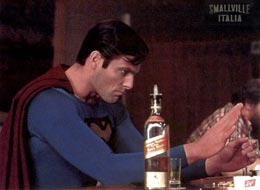
Superman III is literally one of the worst movies you will ever see. Not only does it NOT star Gene Hackman, but we finally get to see what happens when Superman faces off against an equally supercomputer designed by Richard Pryor. 'Superman III' is at least entertaining in how bad it is. When Pryor and gang try and kill the Man of Steel with kryptonite laced with tobacco, he is turned into Bad Superman, who wastes no time in getting drunk (leading to an epic scene on him in a bar where he starts breaking things by flicking peanuts, much to the dismay of onlookers) and straightening the Leaning Tower of Pisa. We also get a scene of Pryor skiing down the side of a building (we told you he's CRAZY!).
Superman IV: The Quest for Peace is a minor upgrade, if only because we get Lex Luthor back and a new villain (Nuclear Man -- what else?). Sidney J. Furie was a natural choice for director, I mean he had just overseen Iron Eagle. Among many questionable scenes in this movie is the one where Superman unveils his previously unused 'brick action' power. After Nuclear Man destroys the Great Wall of China, Superman stares intently at the ruins and magically rebuilds it in a few seconds. Did Jor-El tell him about the 'brick action' power during his trip to Earth? ('This is another little thing you can do, if a brick house or church is knocked down and you don't have time to rebuild it on your own . . . ')
So enough about the movies, what exactly are they going to find to fill 14 discs? One rumor is that Warner will include the unimaginable horror that is Supergirl. Okay, but that's still only five movies. Assuming Warner can dig up enough trash extras to warrant two discs for each movie, we're still four short. Another question is how much will this very bad boy cost? A comparable set, the Alien Quadrilogy retails for $80 for only eigh discs. It's possible that the Superman set could get into the $150 range.
Finally, it appears that this mammoth set will be bested by the upcoming Planet of the Apes: Ultimate DVD Collection set. Also coming in at 14 discs, this completely unwanted set will contain all five movies, the entire television series, the entire animated series and a new two-disc set of Tim Burton's Planet of the Apes.