The above is a direct quote from Danger: Diabolik, a movie that put a smile on my face that is only now starting to subside. Don't be swayed by its absurdly low rating at IMDB, 'Diabolik' is in a category all its own. That's partly to blame because it's a French-Italian production set in England, combining equal parts Batman and James Bond, drenched with the sharp style only the tail-end of the mod era could dare dream of.
There are movies based on comic books made every year, but 'Diabolik' is one of the few movies that feels like it is a comic book, and looking at it on paper, many would have suggested 'Diabolik' be produced on a paper medium. Here is our story: the lead character is anti-hero/criminal/playboy/terrorist Diabolik (John Phillip Law, who amazingly is of no relation to Jude Law), who confounds authorities with heists while dressed in his traditional leather catsuit and eluding them in various Jaguar XKE's to his underground lair (identical to the Batcave -- if it was designed by Ferrari) where he can cavort with Eva (imagine Goldie Hawn, but sexier, and Italian). Before the movie's over, Diabolik will have stolen $10 million in cash, a priceless emerald necklace and England's gold reserve. He will also demolish England's federal finance buildings -- seemingly out of spite and reduce a government press conference to hysterics using 'exhilirating gas.'
I was intrigued at the possibilities of 'Diabolik' after seeing that DVD Savant named it the most impressive DVD of 2005, but never imagined it would be this much fun. In addition to the aforementioned zany plot, you get high-speed chases on winding Italian roads, lots of maniacal cackles and the quirkiest Ennio Morricone score you've ever heard. The script is littered with clever, rhythmic word plays ('I was expecting you, Inspector') and the lavish sets are crammed with fun details (as he drives into his gargantuan lair in the beginning, try and spot a whole floor of spare Jags).
It's rare you find movies this good that have the 'bad guy' essentially as the main character, one who is not looking for any sympathy, just a lot of money for he and his femme fatale to roll around in. 'Diabolik' isn't trying to say anything, but it's one helluva snap shot from a creative time when movies like this could be made without trying to be too silly.
So why is 'Diabolik' so lightly regarded? By 1968, you couldn't make a movie like this with a straight face in the U.S., and it was still a gamble in Europe. The last good Connery 007 came out in '67 (You Only Live Twice) and the first of the spy spoofs was released in '66 (Our Man Flint, and even it sequel In Like Flint in '67), so at the time there wasn't exactly a salivating audience for something as wild as 'Diabolik.' It probably didn't help how obvious it was that 'Diabolik' was trying to cash in on the 'Batman' TV series which debuted in '66.
But with such a great DVD release, 'Diabolik' deserves to be recognized now. On the cheap ($12.99) disc, you get a commentary from Law and director Mario Bava's biographer and a couple of featurettes. The best extra shows how 'Diabolik' has established some sort of legacy: the Beastie Boys' video for 'Body Movin' (click here to watch the video) which uses footage from the movie and inserts the rappers in their own scenes. The video is on the disc, as well as commentary from the Beasties.
Monday, April 24, 2006
'This laser gun can melt anything -- except you, honey'

Friday, April 21, 2006
Suspended suspension of disbelief
It's the reason you don't bat an eye when Superman reverses the Earth's axis to go back in time a few minutes; it's why you accept the idea in The Abyss that a person can breathe water if they really want to; it's how you got that idea in your head that if you find yourself being chased on a rooftop, it would be a good idea to jump to that next building. The suspension of disbelief is central to any performing art, but this does not mean that your audience will buy whatever far-fetched device you throw at them. This is why I present to you my favorite 'you have got to be fucking kidding me' moments, which failed due to either sub-par direction and effects, or simply dumb thinking, and ended up being unintentionally hilarious.
Robocop 3
If you've seen Robocop 3, you probably know where I'm going with this. With the decision to make a PG-13 Robocop, certain sacrifices had to be made. There would be no more of Robocop shooting a would-be sniper through his scope or an acid-drenched thug being turned to mush by a speeding car. Instead we would have scenes like the beginning, which seems designed to provide a James Bond-style intro. We find Robo's partner (Nancy Allen, who at this point was probably wondering how a career that started out with being a regular collaborator with a young Brian DePalma could have degraded to this) in trouble again, but help is on the way. However, instead of just coming to her aid, Robocop decides to give the baddies some shock-value by driving to the top of a nearby parking structure and plunging over the edge. The intentions are semi-good, but here's where it spirals out of control: after driving off a 15-story building, Robocop's car lands on all four wheels, looking a lot like it was dropped from a crane 10-feet off the ground. Robocop then uses his new machine-gun hand to cut a hole in the ceiling of the car so he can have a big entrance. It's a fitting intro to a movie full of 'doh!'s.
Speed
An obvious choice for sure, but it's notable because way back in 1994 there was no need to question what it looked like for a bus to jump over a gap in a freeway. It had never been done before, so we just accepted how it looked. Now, buses jumping over freeway gaps is old news, so when we see the signature scene from Speed, we say 'hey, why does the front of the bus shoot 15 feet in the air right as it goes over the edge? And how is it able to land on its back wheels?' I had thoughts similar to these when I saw 'Speed,' but decided to give it the benefit of the doubt because movie-goers had been waiting a lifetime to see a bus jump. What makes this even more frustrating for me is that it would have been better if the bus hadn't made the jump. It would have been a much better stunt if the bus had fallen short and landed on the roadway below, desperately trying to keep the speed above 70 (or was it 60?) as it careens out of control. (Perhaps more embarrassing than the jump is Keanu Reeves' last line, which should go down as one of the worst 'I just killed the bad guy line,' when he proudly utters: 'Yeah, but I'm taller!' after decapitating Dennis Hopper).
To Live and Die in L.A.
This entry refers not to the actual movie of To Live and Die in L.A., but rather the alternate ending included in the DVD, which would have been a disaster of epic proportions if it had been tacked on to the theatrical release. In this alternate ending, our hero William Petersen is killed just like in the original, but instead of showing his partner taking over his beat we flash to an FBI outpost in Alaska, with Petersen's character very much alive and wearing a sheepish grin as we pan out from Alaska into the credits. What?! 'Oh I get it, you see he took a point-blank shotgun blast to the chest, but he actually secretly survived and then got transferred to Alaska so he would be safe from the gangs.' Just awful. This is comparable to having a new ending in Citizen Kane, where we instead see Kane in disguise in the Andes sledding on Rosebud as he winks at the camera.
Alien: Resurrection
This is not about any individual horrible scene in a completely horrible movie, but rather its entire horrible plot. The makers of Alien: Resurrection would like us to believe that in the future they find out that DNA, in addition to containing all of our genes, also conveniently stores all of our memories and life experiences. This explains how Ripley could be incinerated in Alien 3, but as a clone of herself in Resurrection, she is able to recall how to kill the aliens and how the creatures tormented her in three previous movies. Resurrection is an even worse sequel reach than Escape From the Planet of the Apes ('Okay, they destroyed Earth in the second one, but what if two apes had found a way to go -- back in time!').
Live and Let Die
Bond movies naturally fit into this list, but in Live and Let Die, they truly set an astronomical standard which would never be topped. One of the weapons of at Bond disposal is some kind of anti-shark pellet that causes inflation to Macy's Parade levels of hilarity. Of course in the final battle, we know that Bond will use this on the villain, which he does, but the filmmakers run into a problem here: in 1973 it was completely impossible to show a person inflate and explode on film. They go around this problem by inserting a balloon which may or may not resemble the villain, we never know because the film conveniently turns very grainy and the shot is so quick we must use circumstantial evidence to decipher just what happened.
Friday, April 14, 2006
Zombies down under and Spielberg's folly
For a short time, I had an Australian rooommate in college. He delighted me with some beyond-Paul Hogan-and-Yahoo Serious Aussie knowledge, such as how Volkswagen Buses are called 'combies,' aboriginees are called 'abbies' and the folk from the rural northwest are their version of rednecks. He neglected to reinforce my confidence in what Australian filmmakers can do with a measly budget and some inspired ideas: a rare opportunity for them to show us Yanks up. Over 25 years ago this fact was brought to life with Mad Max (which has a long overdue post coming up . . . hopefully) and forever stamped with Rabbit-Proof Fence. But who knew that those Tropic of Capricorn-straddlers (I ran out of synonyms, sorry) could come up with a zombie movie so original and fun -- and without the aid of Bruce Campbell?
I speak of Undead, which I finally saw yesterday. Funded without any studio aid, 'Undead' has a story -- and even a look-- that feels like a video game, and I mean that in the best possible way. For such a funds-strapped project, 'Undead' is filled with clever SciFi channel-grade CGI effects which never detract from its bold story, but give it a more fun atmosphere. The Spierig Brothers took an approach to 'Undead' that should be a prerequisite of any zombie movie: come original and don't apologize. Instead of putting its characters in a series of backed-into-the-corner surrounded by zombies moments, 'Undead' uses zombie battle scenes sparingly -- because it actually has a story to tell. Instead of a chemical truck overturning and awaking the dead, you get a superb interstellar mystery that twists believeably around and back until the final shot.
What originally drew me to this movie a couple years ago was a description of its hero: Marion is your average Aussie loner, but he carries three shotguns fashioned together to allow for easy tri-shotgun shooting and reloading. Neat. 'Undead' also carries my new favorite zombie-slaying scene, ever: our other hero is trying in vain to fight off zombies with a broom handle in a hardware store, when the end of itself accidentally attached through the hole of a buzz saw blade. With the blade at a slight angle, our femme fatale embarks on an artistic zombie butchering, climaxing with an Australian flag floating to the floor behind her.
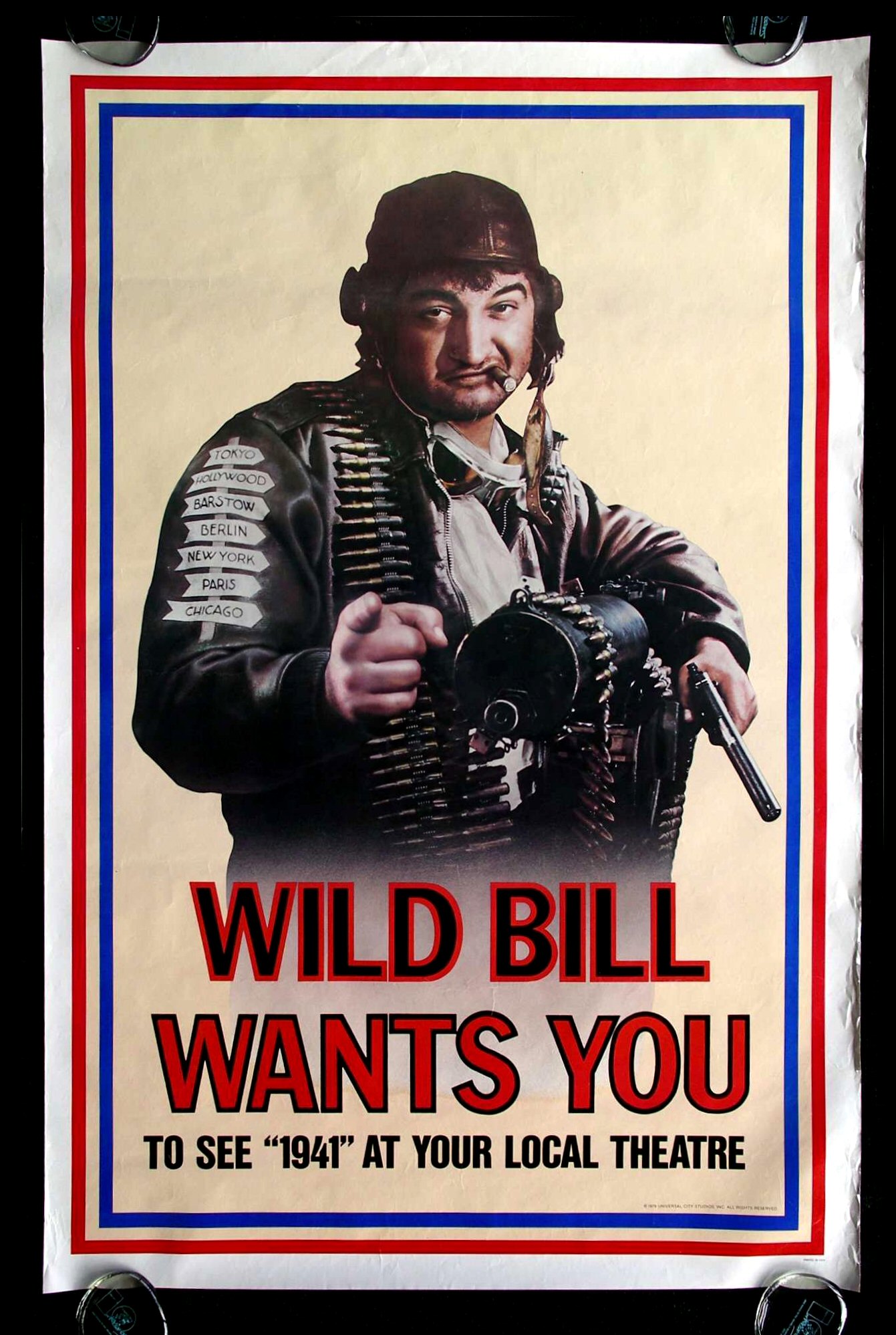
'1941'
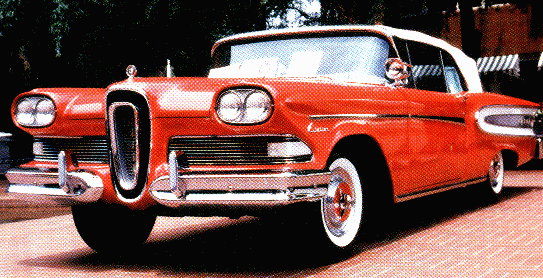
I was excited to see 1941 because it seems to have risen -- in some circles at least -- to the exclusive club of elite failures inhabited only by the likes of Heaven's Gate, Cleopatra and the Edsel. At this point in Steven Spielberg's career -- having just made two super hits both critically and commerically in Close Encounters of the Third Kind and Jaws -- he entered the rare realm of being able to do any project he damn well wishes, a luxury he would enjoy for the rest of his career. With this power, Spielberg unleashed an overweight and wrought lead zeppelin of a would-be comedy/historical epic.
Just watching '1941,' it's obvious that it was one of the red-headed stepchildren of the late 70s, Star Wars-era Hollywood, when studios were gradually growing eager to throw around previously-unheard of budgets. This is one of the main problems with '1941,' its stubborn intent on using as many big-name actors in scene after scene of overflowing sets and over-the-top mayhem. The latter can be used for great effect (see 'The Blues Brothers'), but here it just becomes tiresome. For example, in one completely needless scene, Dan Aykroyd's character observes that an air raid is about to commence in Los Angeles, but the lights are still on, so he and others opt to destroy all the neon lights and street lamps in downtown L.A. This is neither funny, nor interesting, and it probably cost about $5,000,000 of shooting time and effects.
'1941' decides from the opening shot that it's going to be a zany, outrageous comedy filled with many people running into things which later explode. The intentions are sometimes good -- such as Robert Stack's general announcing to a crowd at an air base that there will be no bombing on American soil, only to have a stray B-52 bomb roll into his podium -- but even that joke takes so much time to setup that it leaves you literally waiting for the predictable punchline, and when it arrives, it doesn't even matter. Spielberg fills the movie with about 10 too many characters and 4 too many storylines. Aykroyd and John Candy have promising roles, but never have enough screentime to do anything interesting. John Belushi's character is funny and is plenty of scenes, but is pretty much giving us the same joke every time. Even my man Warren Oates, has a fun role, but we only see him for two scenes. Hell, I wouldn't have even known Christopher Lee was in the movie if I hadn't seen the credits because his character is always seen in darkness and all we can really make out is his chin.
Maybe Spielberg needed to get this one out of his system, he would never again attempt a straight comedy in his career.

Wednesday, April 12, 2006
Cinematic snackfare
There are countless unwritten rules in film: Blood must be the color of raspberry syrup; Christopher Walken must be cast in the role of Christopher Walken; every Nic Cage movie must have a 'Nic Cage Freakout Scene'; any movie that uses the intro to Norman Greenbaum's 'Spirit in the Sky' as music in its preview will suck and . . . the film must be at least 90 minutes long. Like the first two rules listed, it was not always this way (and in those cases, it needn't be either: blood is rarely that dark and Walken was once capable of playing a straight character). There was a time when movies regularly ran below 90 minutes, sometimes waaaaay below.
These days, a film that clocks in at 60 or even 70 minutes would be labeled a short, but as the movies I'm about to detail will show, it is possible to make a feature film without going to far past an hour. When watching one of these wonderfully brief movies, you don't find yourself looking at your watch wondering when it will end, rather you gaze at your watch and wonder just how they're going to wrap up everything in the next 10 minutes. Here are my picks for the best of the brief:
The Unknown (1927, 63 minutes)
Tod Browning was the Tim Burton or David Cronenberg of the early years of film. Freaks was made over 70 years ago and is still unnerving. The Unknown is a perfect title for a movie that is quite unlike anything else. In an era that oddly saw many movies made about clowns (see He Who Gets Slapped, Laugh Clown Laugh -- also with Lon Chaney), this is the most bizarre -- following an 'armless' performer (Chaney) who uses his feet to throw knives and sees an opportunity in fellow performer Joan Crawford, who just happens to fear being touched by men. But the macabre truth is that Chaney's character is actually a murderer on the run who has disguised himself in the circus and definitely does have arms -- but in an attempt to show his love for Crawford -- has them amputated. As with the best silent movies, 'The Unknown' has a perpetual dream-like quality to it
6000 Enemies (1939, 62 minutes)
Yes, this flawed-but-entertaining Walter Pidgeon movie checks in at a scant 62 minutes, which was very short in the talkie era. 6000 Enemies takes on a familiar plot, which had been told many times at the time in Hollywood and perfected in James Cagney's Each Dawn I Die: the tale of the wrong guy in prison. In the case of 'Each Dawn I Die,' Cagney plays a railroaded journalist, while Pidgeon portrays a D.A. What made '6000 Enemies' an average movie in its day makes it all the more watchable today. Made during the 'production code' era of Hollywood when studios -- particularly MGM -- went out of their way to make 'clean' movies. For example, Pidgeon's character is sent to prison and surrounded by thousands of criminals he sent there, but the worst they can think up to get back at him is yelling insults like 'the jury rests!' and sometimes shooting him rude stares. What's more, after the D.A. proves his mettle in a prison boxing match, the cons are more than happy to accept him as a friend. This could have easily been a very poor 2-hour movie, but as a 60-minute blazer it's nearly comical watching a 20-minute climactic courtroom scene shoved into a 20-second montage, or how the primary villain is seen in only two brief scenes.
The Public Enemy (1931, 83 minutes)
Though it is the longest by far in this crop, The Public Enemy makes the cut simply because it packs an overflowing plot (the life and death of a criminal) into such a tidy package. This is what made James Cagney, the pint-sized big mouth tough guy (i.e. the first Joe Pesci), a legitimate star. 'The Public Enemy' is best known as 'the grapefruit movie,' because of a scene when Cagney's character grows ever frustrated with his dame, so he grabs the nearest object -- a grapefruit -- and shoves it in her face (and yes, this was also parodied by The Simpsons, in Brother From the Same Planet). Cagney plays a young hood who grows to be a bootlegging baron, which clashes with his straight-laced brother -- especially when he serves his family a keg on the dinner table. 'The Public Enemy' would not really be classified as a mob movie today, rather it is closer to gangsploitation movies like Menace II Society, following a good kid who goes bad.
The Narrow Margin (1952, 71 minutes)
I saved this for last, because The Narrow Margin is a true filet mignon film (i.e. not a damn ounce of fat on it). This unforgettable noir thriller sets a torrid pace from the start and doesn't let up. Detective Walter Brown (the lantern-jawed, gravel-throated Charles McGraw) has problems: his mission is to transport a key mob witness crosscountry on a train, but his partner was just murdered, his cargo is an anxious and thankless dame, and in between fighting off an inquisitive tike, a mysterious fat man and his own nerves, he has to somehow make it through the trip while a mob hitman is onboard wanting blood. Watching this again, I could not help myself from singing 'Train Kept a Rollin' in my head (the Aerosmith version of course), but Steven Tyler never had lines in his song such as 'nobody likes a fatman except his grocer and his tailer' or 'this case is headed straight for the cemetery.' It seems impossible that 'The Narrow Margin' could jam this many shady characters and switcheroos into 71 minutes. Whenever I hear someone say they don't like any black and white movies, this is the one I pop in.

Sunday, April 02, 2006
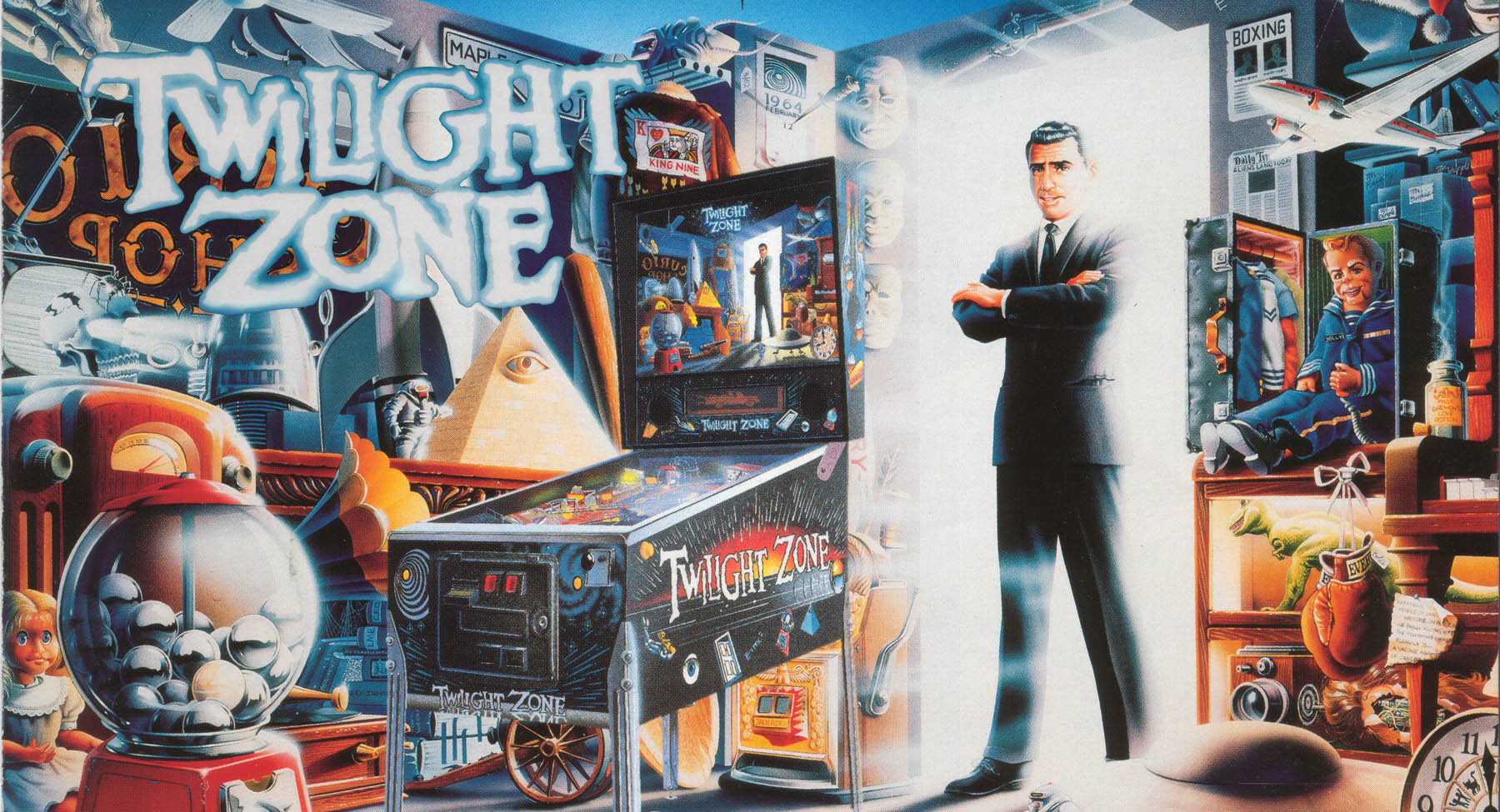
Submitted for your approval
On the surface, it may seem like a dream for Twilight Zone fans that every season of the legendary show is now available in new definitive editions. But even a die-hard fan like myself has to admit that these overpriced ($120 msrp!?!) monstrosities should only appeal to completists. It's not that the sets are not put together well (they include a lengthy list of extras and one of the seasons even includes the spectacular 'Twilight Zone Companion' book), but it's the fact that TZ, taken in as seasons, is overloaded with absolute clunker episodes.
Having seen almost every TZ episode, I've estimated that only about 30 percent of them are worthy of your time and there is a fairly large percentage of episodes that barely pass as watchable. When TZ was at its best it presented original stories featuring great acting, directing and maybe even a score by Bernard Herrman or Jerry Goldsmith. But far too many of the episodes feature recycled stories or -- as is the case with many bad TZ eps -- terrible acting and directing. One of my favorite episodes, A Piano in the House, has a fairly unengaging story but is made entertaining by the the actors and the choices made by the director in filming a luxurious, crowded party of the elite.
If you've never seen a truly horrid TZ episode, here's an example of just how bad it can get: the episode Four O'Clock is about a man with a parrot who believes he has the ability to shrink all his enemies to the height of two feet, and all of this will occur at four o'clock, as he tells us many times. But when the time arrives, it is he that shrinks, as his parrot tells him that his feathered friend was the one with the power all along. Ho ho! There are few episodes this bad, but many linger at around this level of quality, which is why you don't need to shell out over $100 for a season set, especially when you can buy the previously released DVDs comprised of four episodes, which now retail for about $6. And I am here with a helpful guide on how to build your TZ collection with only the best episodes, for less than a quarter the price of one of the season sets.
The Twilight Zone, Volume 11
Notable episodes: The Dummy, Living Doll, The After Hours
Pound for pound, this is probably the best $6 TZ disc out there. The After Hours is one of the few truly terrifying episodes out there, about a store's mannequin who has lost her way. The Dummy and Living Doll are scary in their own right, with both also having influenced everything from Child's Play to Treehouse of Horror III.
The Twilight Zone, Volume 8
Notable episodes: Third From the Sun, To Serve Man, The Shelter
To Serve Man is probably the best TZ episode, though not necessarily my favorite, and its 'punchline' was famously skewered by The Simpsons in the original Treehouse of Horror. To Serve Man is helped by easily the best-ever TZ score (Herrman, of course) and also the acting by Richard 'Jaws' Kiel and Lloyd Bochner (one of Lee Marvin's many kills in the wonderful 'Point Blank'). But it's the story that makes To Serve Man so riveting even today (be sure and watch for Russia's representative at the U.N., why is he the only rep who takes out a sandwich to eat while an intelligent alien is addressing the room?). Third From the Sun is a fun and well-directed bit with a nice ending and The Shelter is enjoyable enough, especially since it was wonderfully parodied by The Simpsons in Bart's Comet (noticing a trend here?).
The Twilight Zone, Volume 7
Notable episodes: Shadow Play, The Hitch-Hiker, Perchance to Dream
My favorite of the $6 discs, with Shadow Play being one of my most-loved episodes. It's a gripping, original tale wrought with philosophical questions, a great performance by the late Dennis Weaver and one of the best TZ endings. The Hitch-Hiker also has a great ending and Perchance to Dream stands as one of the more original and unforgettable TZ works (certainly the best of the 'dream' episodes).
More Treasures of the Twilight Zone
Notable episodes: The Masks, Eye of the Beholder, The Howling Man
There were two 'Treasures' discs released in the original lot of TZ DVDs, and this one is not to be missed, although it does still retail for about $15. It's worth it though, as it contains my all-time favorite episode, The Howling Man, one of the series' most famous moments in Eye of the Beholder (the pig people plastic surgery one) and an underrated little masterpiece in The Masks. The Howling Man is worth the price of admission alone, as it's a timeless horror tale about a traveler in Europe who unwittingly releases Satan himself from the clutches of a monestary. It's quite unlike any other TZ episode, perfectly written and directed with a brilliant, 'fuck yeah!' ending. 'Eye of the Beholder' is the much-copied story about a beautiful woman who is viewed as a freak by a society where ugly is the norm. The Masks is underrated as good TZ episodes go, with a truly twisted plot and unforgettable setpieces (where can I buy masks like that??).
Thursday, March 23, 2006
Requiem for a lazy blogger
Yup, I'm still yet to be cured of this slacker blogging syndrome. I was trying to pin down the reason this week and thought that it might be the fact that I've seen way too many disappointments this month, films that aren't exactly inspiring me to write. That doesn't mean I haven't seen some good ones, but the stud:dud ratio was clearly at an all-time low in February-March, so come with me as I take you on a tour of the hits and misses I've seen lately.
Biggest Dud: 'Creepshow 2'
My God this one was bad, and I actually had some modest expectations for it. I remember seeing the previews for it as a kid and always was intrigued by the potential of the vignette The Raft, which is the main reason I finally watched it. Based on three of Stephen King's short stories, Creepshow 2 also included George A. Romero as director. So there's definitely some potential here, which is subsequently ruined by the curious directing decision to play the whole movie slightly sarcastically, with a half-smirk to inject some element of comedy into all three stories. While it might have looked good on paper, the laughs are never there and subsequently, neither is the horror.
Making matters worse is the awful animated segments that preclude each of the stories. We begin as some sort of Cryptkeeper dude drops of the latest issue of Creepshow at a comic book store, where it is picked up by some slimey kid. Through the magic of animation that reaches previously unheard of lows, we see the kid's adventures with the comic in between readings and are introduced to the Cryptkeeper's generic castle as he introduces each story. Before the previously mentioned Raft story, we get a worthless vignette called 'Chief Wood'nhead' about a wooden indian who sits in front of George Kennedy's store, until one night when some hoods rob the place and he goes on a killing spree. It is devoid of any fright, comedy or entertainment value. Luckily after it was finally over I got to see the reason I even popped in this atrocity (which regularly sells for $5, wonder why): The Raft.
The story is vintage King: three teens on a raft haunted by a strange creature in the water that slowly kills them. The thing in the lake resembles a floating oil spot and can reach up through the cracks in the raft and kill them. This is a good premise, but the whole segment is ruined by more awful direction. When the first teen is sucked in and horribly killed, her friends react more like she dropped a glass of milk. It could have been played out like Cujo, which has a similar plot, but instead plays out like a bad Amazing Stories episode. In the end, 'Creepshow 2' was so disappointing I couldn't even bear to watch the final vignette (some trash about a woman and a zombie hitch hiker).
Biggest Hit: 'Elephant'
After watching Gus Van Sant's masterful Elephant, I couldn't believe there isn't more hype about it. 'Elephant' is one of the most original and unique movies I've ever seen. Most will dismiss it when they hear it's about a Columbine-style high school massacre, but it's more of an experimental film about life than anything. Using a voyeuristic lens and toying with the chronology of a day at a generic high school, Van Sant leads us through characters we get to know deeply, while never succumbing to overly expository dialogue. One of the characters, Carrie, has extensive screen time, but maybe two lines. Finally, she is given a quick and emotionless death just like the others, showing what little concern the teen killers had for their victims as they probably knew her just as we did: a face in the hallway.
Van Sant uses extremely long shots from a lens that routinely drifts away from characters and into other conversations like it was some ghost wandering through the school. The chronology Van Sant uses is creative, as in one scene we see three characters pass by each other in the hall and eventually see through each of their paths how they got to that intersection. At no point until that deja vu shot was it apparent that we were watching a flashback. The killers themselves are not portrayed as hell-bent Satanic kids, but as a couple of punks who anyone would know. Both know they are going to die and that they will kill many of their classmates, but never seem overly excited about their prospects. The only real emotion any of them show is when one is walking the halls and is frustrated that most of the students have already fled the building.
Van Sant makes it a point to show that he has no answers, just like anyone else, for the ghastly phenomenon of high school shootings. Using a controversial and unsexy topic, Van Sant created a very simple movie that creates a powerful message by being just that.
Biggest surprise: 'High Anxiety'
I was surprised by Mel Brooks' tribute to Alfred Hitchcock not in how much I liked it, but just as how it is not your typical Brooks comedy. He's at his always-zany, but it's not exactly overflowing with jokes like Blazing Saddles or Young Frankenstein or as daring as Silent Movie. And most of all, it's not really a parody, but as the opening prologue says: a tribute. If you're not familiar with Hitchcock, this might not be for you, as you won't catch the note-perfect takes on his scenes, or jokes like Brooks' character checking into a hotel as Mr. McGuffin. It's not the funniest Brooks comedy, but it just feels so right, such as the setup for the best joke in the movie: Brooks repeatedly asks for a newspaper from a bellhop, who finally enters Brooks' room while he's taking a shower and 'stabs' him with the newspaper, leading to the exact shot from 'Psycho' where we see black ink (the same color the blood in Hitchcock's black and white movie was) swirling down the drain.
Other misses:
Rio Grande
As the closing movie in John Ford's 'Cavalry Trilogy,' I really wanted to like Rio Grande, but it never seemed to capture the lively spirit that Fort Apache and She Wore a Yellow Ribbon did so well. Sure, John Wayne and Maureen O'Hara are in it and Victor McClaglen plays Victor McClaglen again, but the pieces never seem to come together as well as they did in the other two. Hurting its cause is that Lt. Col. Yorke isn't the best kind of character for Wayne. It's essentially the same character Henry Fonda played so well in 'Fort Apache,' whereas Wayne was always at his best when playing men with a slightly lighter and synical side, not a stone cold disciplinarian as Yorke is.
The Devil's Rejects
This wasn't so much a disappointment, as it was entertaining, but it seemed like it should have been better. The sequel to Rob Zombie's tremendous House of 1000 Corpses (which will be even better when a director's cut is finally released), The Devil's Rejects seems more like made-for-TV spinoff of a once-popular series. We get the best characters from 'House' back and go with them on more of their adventures, but it always seems like it's a 109-minute movie made with a 45-minute story. There are subplots and inflated scenes everywhere that seemingly do nothing to better the movie than to up the running time. And in that running time we never really get that good a glimpse at Captain Spaulding & Co. We're with them the whole time but never get the sense that we know them, or find out much more about them than we did in the original.
The Haunting (1963)
Again, a good movie but it never once lived up to its hype as a genuinely scary film. I watched it at night and never found it even remotely creepy. I wouldn't sayI'm immune to scares, as I am quick to give a movie credit for having genuine chills, but it may be a case of simply becoming desensitized to the 'what's that sound' kind of scare that this movie apparently makes its living on. That's not to say 'The Haunting' is not entertaining, as its use of brilliant setpieces (the towering spiral staircase -- wow!) and lighting make for plenty of eye candy, but the lack of scares makes this movie truly drag at times.

Wednesday, March 08, 2006
Another end-all box set
Us Western fans are getting spoiled again. If you were floored by the long-overdue Peckinpah set, feast your eyes on this. On June 6, Warner is set to release the John Ford-John Wayne Collection. The ten disc (!) set is headlined by two heavyweights: an Ultimate Collector's Edition of The Searchers (2006 representing the film's 50th anniversary) and a two-disc set of Stagecoach. 'The Searchers' alone will retail for $35 since it will contain a load of goodies including a 36-page booklet, a reproduction of the original comic book, behind the scenes photos and even a mail-in one-sheet poster. In addition to these two blockbusters, the set will come with Fort Apache, The Wings of Eagles, The Long Voyage Home, She Wore a Yellow Ribbon, They Were Expendable and 3 Godfathers. How much for this treasure chest? How does $80 sound?!?
The new discs of 'The Searchers' and 'Stagecoach' will retail for near $50 alone, and for another $30 you can six more classics, with nary a dud among them? Too good to be true. Actually my only quibble is that it does not contain Rio Grande, the finale to Ford's 'Cavalry Trilogy' that also includes 'Fort Apache' and 'She Wore a Yellow Ribbon.'
To understand what a great release this is, compare it to Universal's recent Alfred Hitchcock set, which contains 14 films at a bargain price, but gives us discs of movies many of us already had, in many cases hardly improving upon the original. The Ford-Wayne set presents two exhaustive special editions and the best examples of the featured genre (no 'Torn Curtain,' 'Topaz' or 'Frenzy' which bogged down the Hitchcock set). Also, keep in mind that $80 is the MSRP for the set, which means Amazon will probably sell it for $65 or $70!
Though 'Stagecoach' and 'The Searchers' are what will really sell this set, I can't wait to finally have 'Fort Apache' on my shelf, which is my favorite Ford-Wayne film. A meaningful and original tale of military ethics with a cast featuring Henry Fonda, Shirley Temple (with one of the best character names ever -- Philadelphia Thursday), Ward Bond and even a 'hell yeah!' role by the one and only Victor McLaglen help push 'Fort Apache' into the cinematic stratosphere. The most memorable scene in the movie is Wayne's closing monologue, which is regarded by some as his finest moment.
So now that Western fans can check Peckinpah and now Ford off their DVD wish lists, when can we finally get special editions of Leone's For a Few Dollars More, A Fistful of Dollars and Duck, You Sucker that we have long been promised?

Thursday, March 02, 2006
Your basic Oscar prediction post
Yeah, I've been slacking off lately in terms of posting, but that's neither here nor over there because the Oscars are coming up this Sunday. You won't find all the categories here (does anyone have a preference for 'Best Sound Mixing'?), but you will find plenty of second-guessing and semi-informed opinions.
Actress in a supporting role
Nominees: Amy Adams, Junebug; Catherine Keener, Capote; Frances McDormand, North Country; Rachel Weisz, The Constant Gardener; Michelle Williams, Brokeback Mountain
This is probably the least glamorous of all the major categories this year. Nobody saw 'Junebug,' there's little remaining buzz over 'North Country' and Philip Seymour Hoffman is who everyone remembers from 'The Constant Gardener.' I see it as a two-person race between Weisz and Williams. Both are also in the I-Can't-Believe-Charlize Theron-Is-Actually-Nominated! category, since the two actresses have had a fairly dubious career up until this point (Weisz in both 'Mummy' movies; Williams was in 'Dick' and even starred as Wilson's girlfriend in an episode of 'Home Improvement'). But Williams was the main reason 'Brokeback Mountain' was pushed from a pretty good movie into a favorite for Best Picture.
Who I want to win: Williams
Who will win: Williams
Actor in a supporting role
Nominees: George Clooney, Syriana; Matt Dillon, Crash; Paul Giamatti, Cinderella Man; Jake Gyllenhall, Brokeback Mountain; William Hurt, A History of Violence
Wow, what a lineup. Can't remember the last time this category was so packed with stars. A few quibbles: how did Gyllenhall find his way onto this list when his role in 'Brokeback' was at least equal to Heath Ledger's, who is nominated for Best Actor? And Hurt was good in 'A History of Violence,' but he was only in one scene and had maybe 15 minutes of screen time, how does he get the nod over someone like Mickey Rourke in 'Sin City'? I think this is Dillon's to lose, since 'Crash' has all the hype and he is the lone acting nominee from it, but it wouldn't surprise me at all to see Giamatti come away with it since many felt he was robbed for not winning for 'Sideways.' I won't be let down with any of these choices, but will root for Hurt as an underdog that will give attention to a film that should have been nominated for Best Picture.
Who I want to win: Hurt
Who will win: Dillon
Actress in a leading role:
Nominees: Judi Dench, Mrs. Henderson Presents; Felicity Huffman, Transamerica; Keira Knightley, Pride & Prejudice; Charlize Theron, North Country; Reese Witherspoon, Walk the Line
I'm going to throw out Theron and Knightley immediately, since the memory of Theron winning the award is still fresh and classic roles (like Knightley's) rarely win. I can see Dench winning, as she is an easy person to vote for, but I don't see her or Huffman overcoming the momentum that Witherspoon still has with Walk the Line. The first thing people talked about with the movie was Witherspoon's performance, which was much more complicated and driving than Joaquin Phoenix's. It will help her that there's really no other homeruns in this group. Witherspoon plum deserves the award, as even taking on the role of June Carter-Cash was a brave move for her, since she had never had a role like that before.
Who I want to win: Witherspoon
Who will win: Witherspoon
Actor in a leading role
Nominees: Philip Seymour Hoffman, Capote; Terrence Howard, Hustle & Flow; Heath Ledger, Brokeback Mountain; Joaquin Phoenix, Walk the Line; David Strathain, Good Night, and Good Luck
For anyone who has seen 'Hustle & Flow,' you know that Terrence Howard absolutely deserves this award, and you will also know that he will not win it. The movie itself has so little buzz, and it was nominated for no other awards, that it's a given, and a shame, that Howard will not win. And it's too bad, because Howard perfected a completely original and complicated character who carried an inspired movie from beginning to end. I see this as another two-person race between Hoffman and Ledger, as Phoenix's performance was somewhat overrated and nobody knows who the hell Strathain is. While Ledger's performance is easily second-best to Howard this year in my book, Hoffman is an actor who many people will vote for partly because of his many great past roles.
Who I want to win: Howard
Who will win: Hoffman
Director/Best Picture
Nominees: Brokeback Mountain, Capote, Crash, Good Night, and Good luck, Munich
This is one of the few years recently where the Best Director nominees are identical to those in Best Picture, so I combined them. I have two thoughts here: Ang Lee should win for Best Director and 'Crash' is the weakest link of the Best Picture noms. Watching 'Brokeback,' it's clear how tenuous a picture this was, how if it was mishandled in any way, its significance would be lost. The subject of Gay Cowboys in Love seems like it would walk the line between satire and fetish, but instead it's one of the best interpretations of forbidden love. Whereas 'Brokeback' is original and of rare quality, the hype 'Crash' has enjoyed is mostly because it has dared to touch on racism. It is a commendable subject, but it's another thing to present it in the most heavy-handed and predictable way possible. The Matt Dillon rescue scene and the ending between Ludacris and Terrence Howard are the most egregious offenders, as both scenes come off as completely unbelievable. We've also seen the Sandra Bullock character before in tons of movies, a person (usually a woman) who stereotypes a class/race, but by the end must change her views. I wasn't impressed at all, and I saw it when it first came out before all the hype. Of all these candidates, I thought 'Brokeback' was the best, but feel that 'Capote' will win because I have the feeling that the voters will give this award back to an artsy, small-budget film, unlike past years.
Who I want to win: Brokeback Mountain
Who will win: Capote

Wednesday, February 08, 2006
Does the world really need 14 Superman discs?
In the latest chapter of the ongoing trend of releasing big DVD sets to promote new movies, Warner Bros. will apparently sell a Superman box set to end all box sets, weighing in at a mammoth 14 discs. Overkill? Probably. Most of the hype surrounding this set will focus on the 'Richard Donner Cut' of Superman II, and you can read about what might be in that version in this exhaustive article about the upcoming set. Here's the long and mostly short of it: the main reason Superman: The Movie took nearly two years to complete is that the plan was for Donner to shoot the movie and its sequel simultaneously. Finally, after Donner had shot about 75 percent of the sequel, producers told him to wrap it up and they would finish shooting on the sequel after Superman had raked in the dough.
That all seemed fine and dandy, but Donner ended up parting ways with the franchise after shooting the original Superman, so Richard Lester was brought in to finish up the sequel, and also Superman III. Lester was best known as the director of most of The Beatles' movies and also two different Three Musketeers films (he would direct a third, The Return of the Musketeers, in 1989, starring who else but C. Thomas Howell as Raul). Doesn't this sound like the guy you want at the helm of a major special effects franchise?
Anyway, even though Donner had shot a lot of footage for the sequel, most of it was junked, including all the scenes involving Marlon Brando as Superman's father Jor-El. This new version will hopefully include those scenes, as well as an infamous scene previously only seen in the television cut. I am one of the few people to attempt to watch Superman II on television and still have fond memories of this disturbing scene, here's a synopsis:
After the three baddies escape from the Phantom Zone, you would expect them to terrorize the world, but their first stop is a small town in Texas. After humiliating the local law enforcement, a young boy jumps on a horse and rides away for help. The female baddy, Ursa, grabs a siren off a police car, hurls it some 400 yards and kills the boy, setting up this exchange between Ursa and the boy's mother:
'But he was just a boy!'
'Who will never become a man'
Wowie!
Well back to the lecture at hand, this is a completely needless attempt by Warner to convince the public that the Superman series was actually memorable. Even with Donner's new footage, the sequel will still only be an average movie. If you don't believe me, here's an example of the consistently horrid dialogue:
After the three baddys kill some astronauts on the moon . . . one astronaut said 'It's a girl,' leading to this awesome exchange at mission control:
SCIENTIST1: What's a 'curl'?
SCIENTIST2: Isn't that what the old Canaveral guys used to call a comet with an East-West trajectory?
SCIENTIST1: How should I know? I was back in high school in those days.
Hoho!
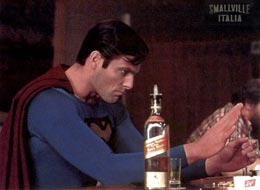
Superman III is literally one of the worst movies you will ever see. Not only does it NOT star Gene Hackman, but we finally get to see what happens when Superman faces off against an equally supercomputer designed by Richard Pryor. 'Superman III' is at least entertaining in how bad it is. When Pryor and gang try and kill the Man of Steel with kryptonite laced with tobacco, he is turned into Bad Superman, who wastes no time in getting drunk (leading to an epic scene on him in a bar where he starts breaking things by flicking peanuts, much to the dismay of onlookers) and straightening the Leaning Tower of Pisa. We also get a scene of Pryor skiing down the side of a building (we told you he's CRAZY!).
Superman IV: The Quest for Peace is a minor upgrade, if only because we get Lex Luthor back and a new villain (Nuclear Man -- what else?). Sidney J. Furie was a natural choice for director, I mean he had just overseen Iron Eagle. Among many questionable scenes in this movie is the one where Superman unveils his previously unused 'brick action' power. After Nuclear Man destroys the Great Wall of China, Superman stares intently at the ruins and magically rebuilds it in a few seconds. Did Jor-El tell him about the 'brick action' power during his trip to Earth? ('This is another little thing you can do, if a brick house or church is knocked down and you don't have time to rebuild it on your own . . . ')
So enough about the movies, what exactly are they going to find to fill 14 discs? One rumor is that Warner will include the unimaginable horror that is Supergirl. Okay, but that's still only five movies. Assuming Warner can dig up enough trash extras to warrant two discs for each movie, we're still four short. Another question is how much will this very bad boy cost? A comparable set, the Alien Quadrilogy retails for $80 for only eigh discs. It's possible that the Superman set could get into the $150 range.
Finally, it appears that this mammoth set will be bested by the upcoming Planet of the Apes: Ultimate DVD Collection set. Also coming in at 14 discs, this completely unwanted set will contain all five movies, the entire television series, the entire animated series and a new two-disc set of Tim Burton's Planet of the Apes.


Thursday, February 02, 2006
Seven Days of Sam Peckinpah, Part 2
'Am I still gonna get paid?'
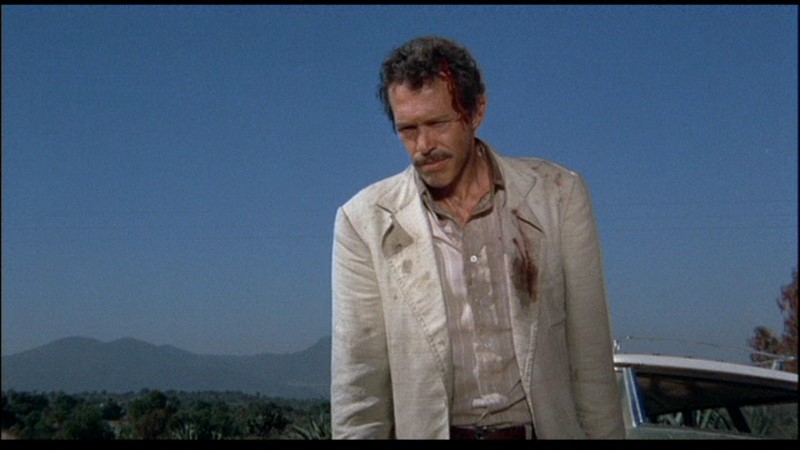
Day 4: 'Bring Me the Head of Alfredo Garcia'
This movie is often described as Peckinpah's most personal film, so it comes as no surprise that Bring Me the Head of Alfredo Garcia is a grating, unforgettable trip through the deepest depths of desperation and false hope. 'Alfredo Garcia' was the lone 'controversial' film by Peckinpah that had no studio interference, and it was also the director's last great film. After 'Alfredo Garcia' he would essentially become a director-for-hire, taking on projects such as Convoy and The Osterman Weekend before his death in 1984.
So as the last great Peckinpah film, it is so fitting that 'Alfredo Garcia' is also the first starring role for Warren Oates, who made a career out of small, but entertaining roles, primarily in Westerns. Oates was a perfect cast, because his character of Bennie is a person who was always in the background, but who has one chance (however minute) to pull himself out of a lifetime rut. Bennie, an American banished to Mexico, is spending another night as a worthless piano player in a bar where no one bats an eye when a hooker is punched to the floor. But on this fateful night, he hears news that a Mexican general is offering a sizeable bounty for the head of one Alfredo Garcia. Bennie takes interest in this because he knows Garcia is already dead.
To get the bounty, Bennie will have to enlist the help of his hooker girlfriend (who was once involved with Garcia) and journey into the darkest locations of Mexico before digging up a corpse and coming away with its head. It is a risky and unsettling proposition, but also one Bennie knows he can't turn down, because this is his one chance to come out on top. Oates is marvelous playing a character who will reach the pinnacle of hope and experience love for the first time in his life, before jarringly plunging into the lowest possible depth and emerging with nothing save for a craving for his own death.
With 'Alfredo Garcia,' Peckinpah gives us an emotional punch to the gut. The movie turns so unexpectedly from an underdog story into a what-could-possibly-come-next descent into the absolute worst of ourselves. The characters are so perfectly established, that when Bennie wakes up next to Garcia's grave to find out the only thing in the world he cared about more than that awful head was taken away from him, the anger and grief feels almost too real.
Peckinpah again uses his familiar technique of demoralizing male characters by showing their companion taken by another man. But in 'Alfredo Garcia' it is used in the most heartbreaking fashion, when the biker played by Kris Kristofferson essentially says he's going to rape Bennie's girlfriend, our hero tries to intervene only to be told to go away because she's 'been here before.' This leads to Bennie killing both bikers, as he begins to realize the violence he is capable of and what he is willing to do to reach his goal.
By the end, the prize is in sight for Bennie, but he has lost everything else and knows it does not matter a bit. When he looks into the eyes of the person who started this backbreaking fall for him, Bennie realizes he has fallen so far that the only way out is through the barrel of a gun, which is the last visual before the credits rise.
Best scene: Bennie gets a little help from his friends (and their machine gun) when the going gets iffy on the road.
Best line: 'I've been no place I wanna go back to, that's for sure' --Bennie
Best Peckinpah moment: El Jefe's daughter telling Bennie to kill him.
'It feels like ... times have changed'
Day 5: 'Pat Garrett & Billy the Kid'
With Pat Garrett & Billy the Kid, Peckinpah was presented for the first time in his career with material that had been done before. Hollywood had produced numerous tales of the former lawless friends who were now at odds with each other, and many of them focused on the infamous Billy the Kid. If Peckinpah was going to make a film on a familiar story, then you know he was going to do it different, and his way. Peckinpah's vision of the old Western tale is told more from the angle of Garrett, and is ultimately light on story but heavy on all the elements that make his movies great.
As the movie opens, we are introduced to Billy and Garrett and quickly learn that they are old friends. Garrett informs Billy that he has short time to get out of town, since Garrett will soon be the area's sheriff. Weeks later, after arresting his friend, Billy escapes from jail and leads Garrett on a long chase through Mexico that takes up the rest of the movie. Where this movie loses most viewers is after Billy escapes from jail, as there is little narrative as Billy eludes his friend. Garrett doesn't seem all that rushed to capture his fugitive and Billy doesn't seem to be trying to hard to escape the law. The plot is weak compared to other Peckinpah greats, but it is still an entertaining show, as it is helped by one of the greatest casts for any Western.
What keeps 'Billy' going is the casting of Kris Kristofferson and James Coburn in the title roles. Peckinpah portrays Billy as an anti-authority free spirit capable of harsh violence, Kristofferson fits this role perfectly, looking the part of a 19th century hippy. Coburn is able to be his hard-ass self in the role of Garrett, who at heart is still every bit the bandit as Billy. Both actors have two of the most memorable voices in cinema, and their rare conversations create some sort of testosterone-twanged harmony. The casting of Bob Dylan is questionable, but he does well with what little material he has and of course contributed the outstanding soundtrack.
Dylan's music is the driving force behind one of the movie's best scenes. As Garrett hunts down some of Billy's comrades with a newly deputized old friend and his wife, the opening chords of 'Knocking on Heaven's Door' begins playing softly. This happens just as Baker, the lawman accompanying Garrett, is shot in the gut and realizes he's about to die. Baker slowly starts walking toward a river when his wife notices and runs after him. Just as his wife sees his wound, Dylan sings the iconic first line of the song, 'Mama take this badge from me . . .' A scene earlier, Baker asked 'Mama' for his badge so they could help Garrett. It's a small, but heartbreaking and just plain perfect scene.
The new DVD of 'Billy' offers two versions, the 'preview version' which is the longer cut, and a new cut of the film from 2005 done by those who worked with Peckinpah and were familiar with what he wanted. The new version is tighter and moves a couple of scenes around as well as other differences (i.e. in the preview version, we never hear Dylan's lyrics in the above scene). That the newer version is able to present a more fluid movie by rearranging scenes illustrates the frustration many have with this movie. It has little structure and we appear to follow the title characters from one isolated scene to another. As the film progresses, its pretension increases, climaxing with an unfulfililng ending that tries to be overly relevant. 'Billy' is an entertaining Western spectacle, but lacks the deeper meaning of Peckinpah's other greats.
Best scene: Billy's jail escape is raw, brutal and wild fun.
Best line: 'Won't some of you people get him up off the ground and into it?' --Garrett
Best Peckinpah moment: Billy convinces his friend during a shootout that since he already has mortal wounds, why not help us out and go out shooting?
'If you have trouble [spelling] "Cable," wait until you get to "Hogue"'
Day 6: 'The Ballad of Cable Hogue'
The Ballad of Cable Hogue is unlike any other Peckinpah movie, which pretty much makes it unlike any other movie, period. This does not mean it is a truly great film, but it is wonderfully quirky and unique, with a typically excellent Peckinpah cast. 'Cable Hogue' is a simple revenge tale sprinkled in with romance and some occasional goofball comedy. Most of this movie has aged very poorly, as you will likely groan when scenes have characters running away in double time, Benny Hill-style.
A soft-hearted drifter double-crossed and left for dead by his 'friends,' Cable is in the desert with no horse, water and presumably -- hope. That's until his unlikely discovery of a spring not too far from the road. With the help of a girl-crazy preacher who comes along the road, Hogue fixes up a glorified roadhouse that serves the occasional passerby. While in town securing the few acres he needs, Hogue takes a fancy to a prostitute named Hildy, but doesn't bother to pay for her services. Before being chased out of town, Hogue convinces a stage company to take a chance on him and give him funds for his roadhouse. Soon, Hogue is a fairly reputable businessman, and it's not too long before Hildy starts to warm up to him again.
What keeps 'Cable Hogue' going is the electric performance from Jason Robards as the title character. In keeping with Peckinpah's usual themes, Hogue is a good guy nearing the end of his life before realizing what he is capable of. While he softens up a bit as he succeeds as a businessman, Hogue knows that someday his former friends will be coming along that road and he has some payback for them.
There is little violence, and the comedy rarely works, so what makes this a good movie? Like all Peckinpah films, the characters are believable and rarely fail to entertain. The interaction between Hogue, Hildy and their preacher friend Josh is where the film is at its best. 'Cable Hogue' starts going downhill at the end, when Peckinpah tries to cram more meaning into the movie than it really needs. His familiar theme of the end of the West comes out at the end, and it seems unneeded. 'Cable Hogue' is still a fun movie, but has less relevance and has aged worse than any of Peckinpah's other Westerns.
Best scene: Hogue scares the wits out of his enemies by baiting them into a hole where they find snakes thrown on them.
Best line: 'Since I cannot rouse Heaven, I intend to raise Hell' -- Josh
Best Peckinpah moment: Hogue sharing a bottle of whiskey with the drivers of the stagecoach, ala 'The Wild Bunch.'
'The day of the 49er is gone'
Day 7: 'Ride the High Country'
I conclude this Peckinpah marathon with his first real movie, which showed Hollywood what he could do even with the most modest of budgets and expectations. Shot in only 26 days and with two of the genres foremost stalwarts, Ride the High Country is a timeless tale of morals, friendship and aging, which would go on to be popular themes in all of Peckinpah's greats.
Longtime friends Steve Judd and Gil Westrum find themselves on opposite ends of the tracks now. Gil is an entertainer, masquerading as a sharp shooter named 'The Oregon Kid,' while Steve was once a U.S. Marshal, but is now trying to prove he can still cut as a lawman even as he grows old. Together, they take on a job of transporting a gold shipment through dangerous territory. Gil brings with him his young protege Heck and they even pick up a young woman who is going their way to be married.
'Ride the High Country' was greenlighted as another simple Western, but Peckinpah made it something much more, and it is still regarded as one of the genre's best. All of Peckinpah's Westerns show the end of the cowboy days, and this is the most literal use of that theme, as stars Joel McCrea and Randolph Scott were both veteran Western actors looking to end their acting days on a high note.
On their way to the gold town, Gil and Steve prove to their young companions that they can more than handle their own on the dangerous trail. And when it is clear that Elsa is in over her head with her marriage, the two take it upon themselves to set things right. Little did Elsa know that by marrying one of the infamous Hammond brothers, she was in essence marrying the whole gang. Essentially raped on her wedding night, Gil and Steve take things into their own hands, even though they don't have to.
Before they get back home, they will take on the Hammond brothers gang and Gil will be forced to make a choice of going forward with his plan (stealing the gold for himself and Heck) or being loyal to his friend. By the end, we are left with one of the most touching death scenes of all time and a glimpse into the early successes of a filmmaker who would use this film as his jumping-off point. The values touched on in 'Ride the High Country' are summed up in the best line of the film, and perhaps any Peckinpah movie:
Heck: My father says there's only right and wrong - good and evil. Nothing in between. It isn't that simple, is it?
Steve: No, it isn't. It should be, but it isn't
Best scene: The raucus gold community celebrates Elsa's wedding the only way they can
Best line: See above
Best Peckinpah moment: In a shootout with the Hammond brothers, Gil and Steve show they haven't missed a beat.
Closing thoughts: The idea for this marathon came from the new Peckinpah box set, and it does not disappoint. All four movies (as well as other Peckinpah DVDs, such as 'Straw Dogs,' 'Alfredo Garcia' and 'Junior Bonner') have excellent commentaries from four men who knew the director best. The new version of 'Pat Garrett & Billy the Kid' actually improves on the original movie and 'The Wild Bunch' is loaded with extras (not that I would know, my second disc is defective and I'll have to send the whole set back to get a replacement disc). What got me excited to write these two posts is that Peckinpah is not only one of my favorite directors but also one of the most interesting persons in all of cinema. He was a tortured soul and was able to make several great movies before his death. Even though a few of the films touched on here ('Major Dundee,' 'The Ballad of Cable Hogue') do not measure up to the others, they are still entertaining and worthy of seeing.
Wednesday, January 25, 2006
Seven Days of Sam Peckinpah, Part 1

Well I now know it's true because I got the box set in the mail last week, along with Peckinpah necessities Bring Me the Head of Alfredo Garcia and Junior Bonner. This coincided with me finally getting the new extended version of Major Dundee from Blockbuster Online, thus setting the stage for Seven Days of Sam Peckinpah: a one week, two post event wherein I would finally get around to reviewing some of my all-time favorites.
'If they move ... kill 'em'
Day 1: The Wild Bunch
It's rare that you find a movie whose opening scene has so much tension or sheer 'you are in for one hell of a movie' bravado as 'The Wild Bunch.' The opening is just perfect, from Peckinpah's trademark freezeframe credits to the uneasy calm before the robbery turns into a bloodbath. It's a fitting introduction to a film which goes so outside the boundary of what a typical Western was and packs so much plot, characters and thrilling violence into its running time.
It's easy to see how 'The Wild Bunch' still has an influence over today's films. It was one of the first movies to use slow-motion photography in action scenes, as well as one of the first to utilize the more liberal censors of that era by painting each shootout with gratuitous amounts of blood. It would also set the stage for many more movies where pretty much all the characters are criminals, leading to calls that Hollywood is glorifying crime and violence.
But the gunfire and gore isn't what made 'The Wild Bunch' such a classic, this is a movie with a multi-layered plot and many well-developed characters. For me, 'Wild Bunch' starts to hit its groove when we see the first Pike Bishop-Deac Thornton flashback. We learn so much about both men in that short flashback, Bishop's quiet regrets of leaving Thornton in the lurch and Thornton's searing revenge for getting arrested while Bishop continued living the life of a criminal. The idea of former friends now on opposite sides of the law is one of the many themes repeated in Peckinpah's movies, as it was featured prominently in 'Ride the High Country,' 'Major Dundee' and of course 'Pat Garrett and Billy the Kid.'
All of Peckinpah's films feature the theme of growing old, but staying smart and strong. 'The Wild Bunch' is perhaps the most famous example of this, and I would say his best use of it, since all of the characters carry an air of desperation with them, as they know their time is running out. 'The Wild Bunch' was the first Peckinpah film to use a cuckold element as a device to show power. Angel is absolutely destroyed by watching his former flame ignore him and throw herself at Gen. Mapache, seemingly reveling in his feelings of shock and betrayal. Peckinpah would use scenes of women openly cheating on their partners later in 'Pat Garrett and Billy the Kid' and most prominently in The Getaway.
What helped undoubtedly helped 'The Wild Bunch' become such an undisputed classic was the underrated score by Jerry Fielding. The bristling, varied themes composed by Fielding pop up at just the right time and add extra punch and tension to scenes such as those preceding the final shootout
Best scene: Has to be the opening shootout, its controlled chaos rivals that of the movie's climax.
Best line: 'What I like and what I need are two different things!' -Thornton
Best Peckinpah moment: Thornton constantly abusing the thugs that are supposed to assist him. He's out of prison, but trying to catch Bishop and Co. is almost as bad when he's stuck with these 'gutter trash, chicken-stealing sons of bitches.'
'Tell him Junior sent ya'
Day 2: Junior Bonner
If your nickname is 'Bloody,' you can shed that image as a filmmaker real quick by making a rodeo movie. Yes, it is a rodeo movie set in modern times, but Peckinpah makes sure no one mistakes it for anything but a Western. 'Junior Bonner' doesn't have any shootouts and has few tense moments, but still manages to be a very entertaining film.
Like most of his films, Peckinpah surrounds his star (Steve McQueen) with his own troupe of well-known Western mainstays (though in this case, the Peckinpah Troupe is sparsely represented, with only Dub Taylor and Ben Johnson on hand). 'Junior Bonner' has a small, but well-rounded cast, and that seems to help the movie, since you know who everybody is. One thing that has always amused me is how McQueen is pretty much upstaged in the movie by Johnson, who plays his affable and flamboyant father.
Ace Bonner is a key figure in the movie, since Junior is as much awed by him as he is scared, because he can see himself becoming the mirror-image of him. At one point in time, the elder Bonner was a self-described rodeo celebrity, but is now barely known in his own town (which is quickly becoming unrecognizable, thanks to his other son, Curley). This sense of becoming forgotten is illustrated beautifully in two short moments (at Curley's new development and outside the rodeo) when Junior asks if someone has seen his father and both times he is answered with 'who?'
Junior doesn't much care about being a celebrity, but he does want to show his hometown what he can do at the rodeo before traveling to another small town who-cares competition. The most important thing in Junior's life is doing things his way, whether it's right (getting a second chance at the bull who beat him before) or wrong (punching out his brother in front of his family). Junior comes back to Preston, Ariz. finding his family's old house being razed to make way for a mobile home park built by his brother, his dad's in the hospital after driving drunk, his mom is happy to see him, but she (like everyone) want him to settle down and do something practical with his life.
The ending is predictable, but along the way we get amazing scenes, such as father and son riding off on the same horse in the middle of a beautiful parade to share a bottle of booze, the chaotic milk-a-cow competition and of course the barfight scene, which I wrote about before. In the end, 'Junior Bonner' has simplest of all Peckinpah stories, and you get the sense he wanted it that way, so as to avoid the studio meddling that plagued most of his efforts.
Best scene: Junior tricks an old friend into starting a bar fight so he can escape for a few minutes with his trophy girlfriend.
Best line: 'I'm working on my first million, you're still working on 8 seconds' -Curley
Best Peckinpah moment: Children watching in awe as Junior and other rodeo guys get pummeled in the dirt (violence amusing the young is seen in almost every Peckinpah film).
One last thing: Scarecrow Video, the biggest and best video store on the planet, put out an excellent book two years ago, at least I thought it was excellent until I read their synopsis of 'Junior Bonner:' 'His old friends welcome him immediately and press him to ride in the upcoming rodeo. His children are slower to accept him, and after dogged perseverance by Bonner, his wife comes around.'
Uh, what? First of all, the first thing he does when he gets into Preston is join the rodeo, no one had to convince him. But Junior definitely has no children or wife, at least not in the movie I saw. The only explanation I can think of is Scarecrow must have confused his two nephews and sister-in-law Ruth as his children and wife.
'Until the Apache is taken or destroyed'
Day 3: Major Dundee
All that I knew about 'Major Dundee' prior to this week were from reading DVD Savant's extremely indepth article regarding the trials Peckinpah faced in filming it. The story of how 'Major Dundee' was made is perhaps more famous than the movie itself, here's a quick synopsis: In 1964, Peckinpah's only major experience directing a mainstream studio film was 'Ride the High Country,' but he was nonetheless recruited for 'Major Dundee,' which Columbia had eyed as a historic, patriotic movie. Peckinpah had grander plans of a 160-minute epic, which Columbia did not want but Peckinpah went ahead with it, blowing his budget on filming in exotic Mexican locales. This led to Peckinpah being banned from the Columbia lot, where his movie was chopped down to under 2 hours. No one has ever seen the full version Peckinpah intended, until this year when an extended edition DVD was released with 12 additional minutes and re-cut scenes. It also had an entirely new score, replacing the amateurish, abrasive original music.
As a result of being chopped down so much, 'Major Dundee' was released in 1965 as a movie with a grand story and an all-star cast, but also a film that was very hard to follow . . . or enjoy. As such, it often gets the studio interference 'free pass' that other mangled epics such as Welles' The Magnificent Ambersons is afforded (you will note that 'Ambersons' is rated an '8' by IMDB users, a rating I think is about three points too high, but that's for another post).
Savant noted that Peckinpah's overly grand plans for 'Major Dundee' were probably due to his inexperience with dealing with studios and his desire to put himself on the same level as filmmakers such as David Lean and Howard Hawks, whose resumes were filled with such epics. What 'Major Dundee' ultimately became was a movie filled with the small details and memorable characters that made Peckinpah such a popular director, but these characters were caught in an abbreviated story with nothing all that interesting or significant to do.
'Major Dundee' is the story of the title character (Charlton Heston), a civil war union general relegated to overseeing a jail full of confederates. But when a band of Apaches slaughter troops and kidnap children, he takes their vengeance upon himself, even if he has to lead an army composed of mostly of confederate prisoners. It's a wonderful beginning, but the movie never really takes off, and there are only a couple of memorable scenes that stick out (the best being the climax, in which the remains of Dundee's army square off with a large French contingent in the Rio Grande, turning the river red with blood). One curious aspect that really bogs down 'Major Dundee' is that many of the key scenes are filmed (poorly) at night, leading to squinted eyes and the hopes that one of these troops brought a lantern or two.
It's interesting to imagine what 'Major Dundee' could have been in its full form, but it already seems too long at the restored 139 minutes. Another way to look at it its significance is how it changed Peckinpah as a director, would we have gotten 'The Wild Bunch' or 'Bring Me the Head of Alfredo Garcia' without 'Major Dundee'?
Best scene: The aforementioned Rio Grande scene, which allegedly was even more drawn out and action packed in the full version.
Best line: 'I am *not* your uncle, you redneck peckerwood. And if you say one more word, you'll spend the rest of this campaign in chains.' -Dundee
Best Peckinpah moment: Capt. Tyreen (Richard Harris) shoots Hadley in the back before the Yanks can put him before a firing squad.
Stay tuned for Seven Days of Sam Peckinpah, Part 2!


Wednesday, January 18, 2006
New Arrivals at the DVD Panache Library
(EDITOR'S NOTE: Some of you may have wondered why there was no post last week, and frankly we're still searching for that answer too. Not to fear, in an effort to win back readers who are still on the fence, this week begins the DVD Panache Seven Days of Sam Peckinpah Marathon. This will be the basis of the next two weeks' posts, so bear with me because it is sure to be a semi-wild ride.)
The bags of letters (some not even written by me!) I have received since Christmas have had a consistent theme: did you blow all your hard-earned Christmas on DVDs or what? The answer to that is a firm yes, and if you shift your gaze to the right, you will notice that I have finally updated The DVD Panache Library to reflect these recent purchases.
The DVD I was most looking forward to for the past few months would have to be Sin City: Recut, Extended, Unrated, and I am pleased to report that this is everything you could ever hope for (and more!) in a Robert Rodriguez DVD. Rodriguez packs every possible goody in this two-disc pack, and even adds a few features you've never seen anywhere before. One of these creative features is a chance to watch the movie (albeit sped up about 800%) in its raw form, that is without any of the cool black and white backgrounds and effects added. It's amazing to see that this big of a movie could be filmed in such a small space.
Fans of the original graphic novels will be pleased to see that the only way to watch the new cut of Sin City is to watch each story on its own. This works especially well with That Yellow Bastard, which was bookended around The Big Fat Kill and The Hard Goodbye in the theatrical cut. Even better, Yellow Bastard gets the most new scenes of the three stories, so it's a drastically different experience than the one you saw in theaters. The best of the Yellow Bastard new scenes is that we finally get to see Aileen, Hardigan's wife, and why she left him. Unfortunately, the other two stories hardly get any new scenes. The Hard Goodbye gives us a scene with Marv's mom, but I think that was it. The Big Fat Kill only has one new scene, but thankfully it's the best of the bunch. Let's just say that if you're a Miho fan, skip right to the last scene.
And since it is a Rodriguez disc, you get another installment of his cooking school (breakfast tacos) and another session of his 10-minute film school. The latter is extremely informative and makes you wonder why no one thought of this filmmaking technique before, or for that matter how much it will be used in the future.
Finally, one of the first things you will notice about this set is just how handsome its packaging is. It looks awesome on your shelf, especially if it's right next to the previous Sin City DVD (I couldn't wait either).
But if the new Sin City DVD is my favorite new disc, the King Kong set can't be too far behind. The best part about the Kong set is the exhausting seven-part documentary, with a running time of over 120 minutes, which is a dream for any fan of the movie. This docu gives you everything from clips of the early adventure movies made by Merrian C. Cooper and Earnest Schoedsack to the few surviving clips of Creation, the almost-movie that was the primary inspiration behind Kong. But the very best and most heralded part of this documentary is the work of Peter Jackson and friends to restore the lost Spider Pit sequence, which was excised from the original cut and has never been found. Pretty much just for shits and giggles, Jackson and Co. spent weeks recreating this sequence with the same kind of technology that was available in 1933. The end result is expectedly hokey, but also genuinely terrifying in some parts.
The most surprising DVD I got was the Back to the Future Trilogy, which you can get at Amazon for $18. For that money, this three-pack is stuffed to the gills with extras, including excellent commentary tracks by two of its producers and all kinds of documentaries and interviews. Also, I had not ever watched the whole trilogy in sequence before, and you can really see how both of the sequels lack that youthful energy of the first one. The third one regains some of this, but the second movie remains a disappointment to me.
Finally, due in the mail today or tomorrow is, among others, The Wizard of Oz Three Disc Collector's Edition. It's good to see this classic get the epic treatment it deserves, as it appears this set is on par with The Lord of the Rings Extended Editions for how many extras are included. I'll post a review of the whole set if I ever get through it. This article gives a good idea of what all is included in it.
QUICK REVIEW: Watched the original Scarface last night, and I have to say it is a must-see for any movie fan, but particularly fans of the Pacino version. Going into it, I knew from reading articles about the movie that I should watch for the myriad of 'X's peppered throughout from director Howard Hawks, a reference to the title character's trademark scar. They were easy to spot, and some were pretty blatant (when he goes to kill an old friend, his room number is 'X' and he has a giant 'X' shadow on him), but there was one instance of it that was complete genius, which I had not read about. When Tony and his gang go to kill a rival Irish gangleader at a bowling alley, we see the Irishman shot just as he releases his ball, which results in a strike (for non-bowlers: that results in an 'X'). Thankfully, Hawks didn't have anyone write an 'X' on his scorecard or anything, he just left it at him bowling a strike. There are many parallels between this version and the re-make, most noticably the 'The World is Yours' sign, which is a key setpiece in both films. But the most memorable aspect of Scarface is the man himself, Paul Muni, a bad ass in every sense of the word and one of the original stereotypical gangsters of film.

Thursday, January 05, 2006
Batman Began
One of the DVDs I got for Christmas was the excellent new 'Batman' disc. I already owned the regular release of it, but wanted the new one for two main reasons: the new transfer with a DTS track (the previous one looked horrible) and that they miraculously included all three of the videos Prince did for his Batman soundtrack songs. The latter reason would have warranted a DVD purchase on its own, two of the videos ('Batdance' and 'Partyman) have to be mentioned among the worst videos of all time. The song 'Batdance' is pretty much soundbites from the movie played over dance beats, the video isn't much better, with Prince dressed as half Batman/half Joker, surrounded by women dressed as Batman, Joker and Vickie Vale, it ends with Batman/Joker forced to pick up a shotgun that was lying on an electric chair, at which point he explodes. Make your own conclusions. The only noteworthy part of the 'Partyman' video (this is the song played as Joker and his goons mess up the museum) is at the beginning when Prince, again dressed as Batman/Joker, enters a party to the introduction of: 'There's a new king in town ... Partyman!'
Horrible 80s videos aside, the point of this post is to take a look at the first modern retelling of Batman, which was a major cultural event when it first came out. Batman was one of the first movies to feature an ends-all marketing campaign, complete with all kinds of product promotions and previews broadcasting all day and night. Of course, like many movies carrying such hype, 'Batman' disappointed most viewers, but not before making tons of money for Warner Bros. Yet for an impressionable 2nd grader, 'Batman' was a watershed moment. After I walked out of Lloyd Cinemas that fateful day, I began measuring my life from that day forward.
I loved the movie, had never seen anything like it, but couldn't believe how little my parents cared for it, as well as most critics. It was only until about five years ago when I first started seeing through my own prejudices to see why 'Batman' was such a failure.
I think the problem a lot of people had with 'Batman' in 1989 was that it was a wasted opportunity, because the Batman story is very film-friendly. His origin is dramatic and well-known, and there are built-in 'hey, cool' props such as the Bat Cave and Batmobile. Tim Burton succeeded on these points, but ultimately fell flat when trying to make the plot as modern as possible, throwing all the typical comic book storylines out the window.
Burton's attempt to portray the Joker as a maniacal artist trying to spread terror and erase vanity by poisoning beauty products doesn't just sound like a bad idea, it falls flat on screen, leading to the point near the climax where you go 'so what?' Maybe it was Burton's intention to go away from a 'can Batman save the world?' type story, but the way he goes about his watered-down plot never infuses any sense of danger, always vital to a comic book story.
Even without the flawed story, there are the scenes that bog down the movie just when it needs to get going. The absolute worst of these is the encounter between Bruce Wayne and Joker at Vickie Vale's apartment. On paper, I'm sure it was supposed to show Wayne as conflicted about his identity, since he wants to defend Vale but cannot reveal who he is. But what it amounts to is a very awkward scene with no real meaning, with lines such as 'You wanna get nuts, come on, let's get nuts!' Does that sound like something Bruce Wayne would say, much less while wielding a fireplace poker? The only memorable part of this awful scene is Kim Basinger's attempt at fainting in the very last shot.
Okay, so the story and some of the direction sucks, but you might be asking yourself at this point: 'Didn't this shlump just say he has TWO DVDs of this movie?' That's right, I do! I see more flaws with 'Batman' every time I see it, but that doesn't mean I don't enjoy it, just that I'm finally coming to terms with why it was so universally trashed in 1989. Danny Elfman's epic score is undoubtedly one of the biggest stars of the movie, same goes for Burton's images of Gotham City, which is just as stone cold and soul-less as Wayne is portrayed.
Christopher Nolan's sequel to Batman Begins is rumored to include the Joker, so it will be interesting to see how he updates the classic villain, compared to Burton's vision of him. Likely, the sequel to 'Begins' will push the 'original' modern retellings of Batman closer and closer to Whocaresville.