Well I now know it's true because I got the box set in the mail last week, along with Peckinpah necessities Bring Me the Head of Alfredo Garcia and Junior Bonner. This coincided with me finally getting the new extended version of Major Dundee from Blockbuster Online, thus setting the stage for Seven Days of Sam Peckinpah: a one week, two post event wherein I would finally get around to reviewing some of my all-time favorites.
'If they move ... kill 'em'
Day 1: The Wild Bunch
It's rare that you find a movie whose opening scene has so much tension or sheer 'you are in for one hell of a movie' bravado as 'The Wild Bunch.' The opening is just perfect, from Peckinpah's trademark freezeframe credits to the uneasy calm before the robbery turns into a bloodbath. It's a fitting introduction to a film which goes so outside the boundary of what a typical Western was and packs so much plot, characters and thrilling violence into its running time.
It's easy to see how 'The Wild Bunch' still has an influence over today's films. It was one of the first movies to use slow-motion photography in action scenes, as well as one of the first to utilize the more liberal censors of that era by painting each shootout with gratuitous amounts of blood. It would also set the stage for many more movies where pretty much all the characters are criminals, leading to calls that Hollywood is glorifying crime and violence.
But the gunfire and gore isn't what made 'The Wild Bunch' such a classic, this is a movie with a multi-layered plot and many well-developed characters. For me, 'Wild Bunch' starts to hit its groove when we see the first Pike Bishop-Deac Thornton flashback. We learn so much about both men in that short flashback, Bishop's quiet regrets of leaving Thornton in the lurch and Thornton's searing revenge for getting arrested while Bishop continued living the life of a criminal. The idea of former friends now on opposite sides of the law is one of the many themes repeated in Peckinpah's movies, as it was featured prominently in 'Ride the High Country,' 'Major Dundee' and of course 'Pat Garrett and Billy the Kid.'
All of Peckinpah's films feature the theme of growing old, but staying smart and strong. 'The Wild Bunch' is perhaps the most famous example of this, and I would say his best use of it, since all of the characters carry an air of desperation with them, as they know their time is running out. 'The Wild Bunch' was the first Peckinpah film to use a cuckold element as a device to show power. Angel is absolutely destroyed by watching his former flame ignore him and throw herself at Gen. Mapache, seemingly reveling in his feelings of shock and betrayal. Peckinpah would use scenes of women openly cheating on their partners later in 'Pat Garrett and Billy the Kid' and most prominently in The Getaway.
What helped undoubtedly helped 'The Wild Bunch' become such an undisputed classic was the underrated score by Jerry Fielding. The bristling, varied themes composed by Fielding pop up at just the right time and add extra punch and tension to scenes such as those preceding the final shootout
Best scene: Has to be the opening shootout, its controlled chaos rivals that of the movie's climax.
Best line: 'What I like and what I need are two different things!' -Thornton
Best Peckinpah moment: Thornton constantly abusing the thugs that are supposed to assist him. He's out of prison, but trying to catch Bishop and Co. is almost as bad when he's stuck with these 'gutter trash, chicken-stealing sons of bitches.'
'Tell him Junior sent ya'
Day 2: Junior Bonner
If your nickname is 'Bloody,' you can shed that image as a filmmaker real quick by making a rodeo movie. Yes, it is a rodeo movie set in modern times, but Peckinpah makes sure no one mistakes it for anything but a Western. 'Junior Bonner' doesn't have any shootouts and has few tense moments, but still manages to be a very entertaining film.
Like most of his films, Peckinpah surrounds his star (Steve McQueen) with his own troupe of well-known Western mainstays (though in this case, the Peckinpah Troupe is sparsely represented, with only Dub Taylor and Ben Johnson on hand). 'Junior Bonner' has a small, but well-rounded cast, and that seems to help the movie, since you know who everybody is. One thing that has always amused me is how McQueen is pretty much upstaged in the movie by Johnson, who plays his affable and flamboyant father.
Ace Bonner is a key figure in the movie, since Junior is as much awed by him as he is scared, because he can see himself becoming the mirror-image of him. At one point in time, the elder Bonner was a self-described rodeo celebrity, but is now barely known in his own town (which is quickly becoming unrecognizable, thanks to his other son, Curley). This sense of becoming forgotten is illustrated beautifully in two short moments (at Curley's new development and outside the rodeo) when Junior asks if someone has seen his father and both times he is answered with 'who?'
Junior doesn't much care about being a celebrity, but he does want to show his hometown what he can do at the rodeo before traveling to another small town who-cares competition. The most important thing in Junior's life is doing things his way, whether it's right (getting a second chance at the bull who beat him before) or wrong (punching out his brother in front of his family). Junior comes back to Preston, Ariz. finding his family's old house being razed to make way for a mobile home park built by his brother, his dad's in the hospital after driving drunk, his mom is happy to see him, but she (like everyone) want him to settle down and do something practical with his life.
The ending is predictable, but along the way we get amazing scenes, such as father and son riding off on the same horse in the middle of a beautiful parade to share a bottle of booze, the chaotic milk-a-cow competition and of course the barfight scene, which I wrote about before. In the end, 'Junior Bonner' has simplest of all Peckinpah stories, and you get the sense he wanted it that way, so as to avoid the studio meddling that plagued most of his efforts.
Best scene: Junior tricks an old friend into starting a bar fight so he can escape for a few minutes with his trophy girlfriend.
Best line: 'I'm working on my first million, you're still working on 8 seconds' -Curley
Best Peckinpah moment: Children watching in awe as Junior and other rodeo guys get pummeled in the dirt (violence amusing the young is seen in almost every Peckinpah film).
One last thing: Scarecrow Video, the biggest and best video store on the planet, put out an excellent book two years ago, at least I thought it was excellent until I read their synopsis of 'Junior Bonner:' 'His old friends welcome him immediately and press him to ride in the upcoming rodeo. His children are slower to accept him, and after dogged perseverance by Bonner, his wife comes around.'
Uh, what? First of all, the first thing he does when he gets into Preston is join the rodeo, no one had to convince him. But Junior definitely has no children or wife, at least not in the movie I saw. The only explanation I can think of is Scarecrow must have confused his two nephews and sister-in-law Ruth as his children and wife.
'Until the Apache is taken or destroyed'
Day 3: Major Dundee
All that I knew about 'Major Dundee' prior to this week were from reading DVD Savant's extremely indepth article regarding the trials Peckinpah faced in filming it. The story of how 'Major Dundee' was made is perhaps more famous than the movie itself, here's a quick synopsis: In 1964, Peckinpah's only major experience directing a mainstream studio film was 'Ride the High Country,' but he was nonetheless recruited for 'Major Dundee,' which Columbia had eyed as a historic, patriotic movie. Peckinpah had grander plans of a 160-minute epic, which Columbia did not want but Peckinpah went ahead with it, blowing his budget on filming in exotic Mexican locales. This led to Peckinpah being banned from the Columbia lot, where his movie was chopped down to under 2 hours. No one has ever seen the full version Peckinpah intended, until this year when an extended edition DVD was released with 12 additional minutes and re-cut scenes. It also had an entirely new score, replacing the amateurish, abrasive original music.
As a result of being chopped down so much, 'Major Dundee' was released in 1965 as a movie with a grand story and an all-star cast, but also a film that was very hard to follow . . . or enjoy. As such, it often gets the studio interference 'free pass' that other mangled epics such as Welles' The Magnificent Ambersons is afforded (you will note that 'Ambersons' is rated an '8' by IMDB users, a rating I think is about three points too high, but that's for another post).
Savant noted that Peckinpah's overly grand plans for 'Major Dundee' were probably due to his inexperience with dealing with studios and his desire to put himself on the same level as filmmakers such as David Lean and Howard Hawks, whose resumes were filled with such epics. What 'Major Dundee' ultimately became was a movie filled with the small details and memorable characters that made Peckinpah such a popular director, but these characters were caught in an abbreviated story with nothing all that interesting or significant to do.
'Major Dundee' is the story of the title character (Charlton Heston), a civil war union general relegated to overseeing a jail full of confederates. But when a band of Apaches slaughter troops and kidnap children, he takes their vengeance upon himself, even if he has to lead an army composed of mostly of confederate prisoners. It's a wonderful beginning, but the movie never really takes off, and there are only a couple of memorable scenes that stick out (the best being the climax, in which the remains of Dundee's army square off with a large French contingent in the Rio Grande, turning the river red with blood). One curious aspect that really bogs down 'Major Dundee' is that many of the key scenes are filmed (poorly) at night, leading to squinted eyes and the hopes that one of these troops brought a lantern or two.
It's interesting to imagine what 'Major Dundee' could have been in its full form, but it already seems too long at the restored 139 minutes. Another way to look at it its significance is how it changed Peckinpah as a director, would we have gotten 'The Wild Bunch' or 'Bring Me the Head of Alfredo Garcia' without 'Major Dundee'?
Best scene: The aforementioned Rio Grande scene, which allegedly was even more drawn out and action packed in the full version.
Best line: 'I am *not* your uncle, you redneck peckerwood. And if you say one more word, you'll spend the rest of this campaign in chains.' -Dundee
Best Peckinpah moment: Capt. Tyreen (Richard Harris) shoots Hadley in the back before the Yanks can put him before a firing squad.
Stay tuned for Seven Days of Sam Peckinpah, Part 2!
Wednesday, January 25, 2006
Seven Days of Sam Peckinpah, Part 1


Wednesday, January 18, 2006
New Arrivals at the DVD Panache Library
(EDITOR'S NOTE: Some of you may have wondered why there was no post last week, and frankly we're still searching for that answer too. Not to fear, in an effort to win back readers who are still on the fence, this week begins the DVD Panache Seven Days of Sam Peckinpah Marathon. This will be the basis of the next two weeks' posts, so bear with me because it is sure to be a semi-wild ride.)
The bags of letters (some not even written by me!) I have received since Christmas have had a consistent theme: did you blow all your hard-earned Christmas on DVDs or what? The answer to that is a firm yes, and if you shift your gaze to the right, you will notice that I have finally updated The DVD Panache Library to reflect these recent purchases.
The DVD I was most looking forward to for the past few months would have to be Sin City: Recut, Extended, Unrated, and I am pleased to report that this is everything you could ever hope for (and more!) in a Robert Rodriguez DVD. Rodriguez packs every possible goody in this two-disc pack, and even adds a few features you've never seen anywhere before. One of these creative features is a chance to watch the movie (albeit sped up about 800%) in its raw form, that is without any of the cool black and white backgrounds and effects added. It's amazing to see that this big of a movie could be filmed in such a small space.
Fans of the original graphic novels will be pleased to see that the only way to watch the new cut of Sin City is to watch each story on its own. This works especially well with That Yellow Bastard, which was bookended around The Big Fat Kill and The Hard Goodbye in the theatrical cut. Even better, Yellow Bastard gets the most new scenes of the three stories, so it's a drastically different experience than the one you saw in theaters. The best of the Yellow Bastard new scenes is that we finally get to see Aileen, Hardigan's wife, and why she left him. Unfortunately, the other two stories hardly get any new scenes. The Hard Goodbye gives us a scene with Marv's mom, but I think that was it. The Big Fat Kill only has one new scene, but thankfully it's the best of the bunch. Let's just say that if you're a Miho fan, skip right to the last scene.
And since it is a Rodriguez disc, you get another installment of his cooking school (breakfast tacos) and another session of his 10-minute film school. The latter is extremely informative and makes you wonder why no one thought of this filmmaking technique before, or for that matter how much it will be used in the future.
Finally, one of the first things you will notice about this set is just how handsome its packaging is. It looks awesome on your shelf, especially if it's right next to the previous Sin City DVD (I couldn't wait either).
But if the new Sin City DVD is my favorite new disc, the King Kong set can't be too far behind. The best part about the Kong set is the exhausting seven-part documentary, with a running time of over 120 minutes, which is a dream for any fan of the movie. This docu gives you everything from clips of the early adventure movies made by Merrian C. Cooper and Earnest Schoedsack to the few surviving clips of Creation, the almost-movie that was the primary inspiration behind Kong. But the very best and most heralded part of this documentary is the work of Peter Jackson and friends to restore the lost Spider Pit sequence, which was excised from the original cut and has never been found. Pretty much just for shits and giggles, Jackson and Co. spent weeks recreating this sequence with the same kind of technology that was available in 1933. The end result is expectedly hokey, but also genuinely terrifying in some parts.
The most surprising DVD I got was the Back to the Future Trilogy, which you can get at Amazon for $18. For that money, this three-pack is stuffed to the gills with extras, including excellent commentary tracks by two of its producers and all kinds of documentaries and interviews. Also, I had not ever watched the whole trilogy in sequence before, and you can really see how both of the sequels lack that youthful energy of the first one. The third one regains some of this, but the second movie remains a disappointment to me.
Finally, due in the mail today or tomorrow is, among others, The Wizard of Oz Three Disc Collector's Edition. It's good to see this classic get the epic treatment it deserves, as it appears this set is on par with The Lord of the Rings Extended Editions for how many extras are included. I'll post a review of the whole set if I ever get through it. This article gives a good idea of what all is included in it.
QUICK REVIEW: Watched the original Scarface last night, and I have to say it is a must-see for any movie fan, but particularly fans of the Pacino version. Going into it, I knew from reading articles about the movie that I should watch for the myriad of 'X's peppered throughout from director Howard Hawks, a reference to the title character's trademark scar. They were easy to spot, and some were pretty blatant (when he goes to kill an old friend, his room number is 'X' and he has a giant 'X' shadow on him), but there was one instance of it that was complete genius, which I had not read about. When Tony and his gang go to kill a rival Irish gangleader at a bowling alley, we see the Irishman shot just as he releases his ball, which results in a strike (for non-bowlers: that results in an 'X'). Thankfully, Hawks didn't have anyone write an 'X' on his scorecard or anything, he just left it at him bowling a strike. There are many parallels between this version and the re-make, most noticably the 'The World is Yours' sign, which is a key setpiece in both films. But the most memorable aspect of Scarface is the man himself, Paul Muni, a bad ass in every sense of the word and one of the original stereotypical gangsters of film.

Thursday, January 05, 2006
Batman Began
One of the DVDs I got for Christmas was the excellent new 'Batman' disc. I already owned the regular release of it, but wanted the new one for two main reasons: the new transfer with a DTS track (the previous one looked horrible) and that they miraculously included all three of the videos Prince did for his Batman soundtrack songs. The latter reason would have warranted a DVD purchase on its own, two of the videos ('Batdance' and 'Partyman) have to be mentioned among the worst videos of all time. The song 'Batdance' is pretty much soundbites from the movie played over dance beats, the video isn't much better, with Prince dressed as half Batman/half Joker, surrounded by women dressed as Batman, Joker and Vickie Vale, it ends with Batman/Joker forced to pick up a shotgun that was lying on an electric chair, at which point he explodes. Make your own conclusions. The only noteworthy part of the 'Partyman' video (this is the song played as Joker and his goons mess up the museum) is at the beginning when Prince, again dressed as Batman/Joker, enters a party to the introduction of: 'There's a new king in town ... Partyman!'
Horrible 80s videos aside, the point of this post is to take a look at the first modern retelling of Batman, which was a major cultural event when it first came out. Batman was one of the first movies to feature an ends-all marketing campaign, complete with all kinds of product promotions and previews broadcasting all day and night. Of course, like many movies carrying such hype, 'Batman' disappointed most viewers, but not before making tons of money for Warner Bros. Yet for an impressionable 2nd grader, 'Batman' was a watershed moment. After I walked out of Lloyd Cinemas that fateful day, I began measuring my life from that day forward.
I loved the movie, had never seen anything like it, but couldn't believe how little my parents cared for it, as well as most critics. It was only until about five years ago when I first started seeing through my own prejudices to see why 'Batman' was such a failure.
I think the problem a lot of people had with 'Batman' in 1989 was that it was a wasted opportunity, because the Batman story is very film-friendly. His origin is dramatic and well-known, and there are built-in 'hey, cool' props such as the Bat Cave and Batmobile. Tim Burton succeeded on these points, but ultimately fell flat when trying to make the plot as modern as possible, throwing all the typical comic book storylines out the window.
Burton's attempt to portray the Joker as a maniacal artist trying to spread terror and erase vanity by poisoning beauty products doesn't just sound like a bad idea, it falls flat on screen, leading to the point near the climax where you go 'so what?' Maybe it was Burton's intention to go away from a 'can Batman save the world?' type story, but the way he goes about his watered-down plot never infuses any sense of danger, always vital to a comic book story.
Even without the flawed story, there are the scenes that bog down the movie just when it needs to get going. The absolute worst of these is the encounter between Bruce Wayne and Joker at Vickie Vale's apartment. On paper, I'm sure it was supposed to show Wayne as conflicted about his identity, since he wants to defend Vale but cannot reveal who he is. But what it amounts to is a very awkward scene with no real meaning, with lines such as 'You wanna get nuts, come on, let's get nuts!' Does that sound like something Bruce Wayne would say, much less while wielding a fireplace poker? The only memorable part of this awful scene is Kim Basinger's attempt at fainting in the very last shot.
Okay, so the story and some of the direction sucks, but you might be asking yourself at this point: 'Didn't this shlump just say he has TWO DVDs of this movie?' That's right, I do! I see more flaws with 'Batman' every time I see it, but that doesn't mean I don't enjoy it, just that I'm finally coming to terms with why it was so universally trashed in 1989. Danny Elfman's epic score is undoubtedly one of the biggest stars of the movie, same goes for Burton's images of Gotham City, which is just as stone cold and soul-less as Wayne is portrayed.
Christopher Nolan's sequel to Batman Begins is rumored to include the Joker, so it will be interesting to see how he updates the classic villain, compared to Burton's vision of him. Likely, the sequel to 'Begins' will push the 'original' modern retellings of Batman closer and closer to Whocaresville.

Monday, December 19, 2005
Thoughts on King Kong

I loved it, but five years from now when I'm flipping through channels and Kiwi Pete's Kong is on TNT and the original Kong is on Turner Classic, I think I would choose the latter. The main reason I prefer the original is how Jackson has tried to make the relationship between Kong and Ann more mutual. In the original, the movie is mainly about Kong being a very lonesome beast who finds some kind of happiness in this strange flax-haired beauty who doesn't run away from him. We never see too much emotion (or anything other than screams) from Ann toward Kong, she's pretty much along for the ride. Jackson tries vainly to show that Ann cares for Kong, with unfortunate results most of the time.
Two scenes in particular illustrate this. As they're escaping the island, Ann tries to stop Denham and Co. from hurting or capturing the ape. Um, a few hours ago you were hanging from the lip of a T-Rex and were nearly eaten by a half dozen jungle creatures, are you really worrying what's going to happen to Kong at this point? Then at the end as the biplanes attack Kong on the Empire State Building, Ann tries to wave off the attackers. Why? What do you plan to do with Kong once they let him live in peace? Jackson never really sells the audience on why Ann would care so much for a 25-foot ape and as a result she often comes off as comically deranged. We can easily see why the beast would love the beauty, but why does the beauty want anything to do with her beast?
What impressed me the most was how much homage Jackson pays to the original Kong. Many scenes are recreated note for note, most surprising of which is the T-Rex battle, which uses the original's climax nearly verbatum. A few others, such as Jack's rescue of Ann and the entire Kong on Broadway sequence, are similarly recreated. In the hands of any other filmmaker, Kong would be throwing the T-Rex into a volcano, but it's a tip of the hat to Jackson who can use the original foundation to create scenes that still mezmerize.
And he is able to mezmerize the audience with the best special effects ever seen on screen. If you think you've been CGI'd to death after seeing any of the Star Wars prequels or even Jackson's Lord of the Ring trilogy, where you never forget you're looking at something digital, Kong will blow you away. Even upclose (which many of the shots are), there's no reason to believe you're not seeing a live 30-foot tall ape. Jackson and Co. must have done exhaustive primate research to make Kong move and act so lifelike. His lips and fur look like you could reach out and touch them, you never get that feeling with the aforementioned movies.
Is it too long? It comes in at 3 hours 7 mins, but I can only think of a few scenes he could have cut. Jackson essentially follows the same structure of the original, but obviously fleshed out the potential of Skull Island with more horrors. Skull Island is a truly terrifying place in 2005. The original natives wore coconut bras, now they're almost as scary as the creatures outside their walls. Jackson's Skull Island also has a welcomed mythical quality, with Mayan-style ruins peppering the landscape (complete with steps leading to Kong's perch). The only part of Skull Island where Jackson may reach too far is the bug pit, which has a scene in it that I think crosses the line and will cause many audience members to look away.
It cost over $200 million, but 'King Kong' lives up to the hype and would have conquered any summer challengers had it been released then. Universal has a license to print money with this film and it should earn Academny nominations for visual effects and sound editing. What I'm looking forward to now is what the DVD will be like, since the LOTR sets were appropriately over the top.
NOTE: The DVD Panache offices will be closed for Christmas vacation next week, but will re-open for business in January
Wednesday, December 14, 2005
A Kubrick Christmas
Some people watch It's a Wonderful Life or A Christmas Story during the holidays, I watch Eyes Wide Shut. Stanley Kubrick's last cinema offering before his death, 'Eyes Wide Shut' remains an enigma for film fans, with some hailing it a masterpiece while others condemn it as an uneven disappointment. But no matter what you think of the movie, you have to agree that it is a mysterious visual journey through the most difficult emotion in relationships: jealousy.
I get a dull look most of the times I tell people that this is one of my favorite movies. Like most Kubrick films, it warrants multiple viewings to understand the various themes and visual tricks the master filmmaker is trying to get across. Due to strange circumstances, I saw 'Eyes' on the big screen on three consecutive nights, so I had some time to digest it. I think the biggest problem for 'Eyes' detractors is that although it is set in New York, it is not structured, paced or written like most American films. Kubrick is famously anti-Hollywood and goes against its conventions whenever possible, 'Eyes' is a perfect example. Its structure is both frustrating and fascinating because even at the two hour mark, you really don't have a good idea of what direction it's going: does it turn into a straight mystery with Bill's experience at the mansion or was his two-night odyssey all a dream? Ultimately the most important plot devices happen at the very beginning and end, an atypical structure that can turn off many viewers.
In the beginning, our focus is on Bill (Tom Cruise), but our eyes should instead be turned to Alice (Nicole Kidman), whose character's revealing scene is taking place with her Hungarian suitor at the Christmas party. Alice lets him dance and shmooze with her through several songs, all the time quietly keeping up his hopes that he might have a chance at an affair with her. This is best illustrated when Alice is asked if she would like to go upstairs and see the art collection, to which she responds: 'Maaaaybeeee ...... nottt .... juuuuuusssst ...... yet.' It becomes clear that she is just toying with the emotions of her dance partner, keeping him on the edge of her finger until finally pushing him away. Upon first viewing, this scene may seem trivial, but it is absolutely vital to understanding Kidman's character (more on that later).
Meanwhile, husband Bill is face to face with a conked out hooker shortly after rebuffing the advances of two European models. Both Bill and Alice had the invitation to be unfaithful presented to them on a silver platter, with Alice seemingly energized by the experience while Bill treated it like an everyday occurrence. Alice's encounter with the Hungarian seems to be her motivation for instigating the bedroom battle of the sexes in the next scene. Alice is shocked at Bill's admittance that he is never jealous of her, which leads to Alice's disclosure of her near affair years earlier. This confession destroys Bill's stereotypical view of how women think, and the very idea that his wife could have been unfaithful lights a fire in him.
After Bill leaves the bedroom, he begins a journey to a destination he is unsure of, perhaps with the intentions of testing his own faithfulness. Along the way, every person he meets interacts with him sexually and in most cases stops short of throwing themselves at his feet. While Bill does not accept any of these offers, he comes tantalizingly close (especially with the hooker Domino and later her roommate), and in the end his 'only' crime is lying, which is treated by Kubrick as just as wrong as cheating.
These scenes all set up the final conversation, when we get the idea that Alice's sailor confession may not have been true (and we're unclear if Bill's adventures actually happened), but get the idea that Alice's plan to make her husband jealous and change his stereotypical view of women and sex may have worked too well. In the toy store, Alice experiences the same shocking emotions as Bill did in the bedroom, learning that their whole marriage could have been thrown away in seconds. They resolve to be 'awake' now, since the source of their troubles was mostly their respective imaginations.
What makes 'Eyes' truly a classic for me is the numerous 'winks' Kubrick throws at the viewer both with his lens and in the story. There are a couple of coincidences in 'Eyes' that still puzzle me, intended or not. The first is during Bill's early encounter with the models, they tell him they're going to take him 'where the rainbow ends,' and later Bill ends up at Rainbow Fashions to rent a costume. The second is at Domino's apartment, she refers to Alice on the phone as 'Mrs. Dr. Bill' and later at Victor's house he says that Nick is probably 'at home, banging Mrs. Nick.' I'm not sure what Kubrick is trying to say with these, but it seems like there's more there than just coincidence.
There are numerous visual tricks that Kubrick employs, the most paramount is his lighting. Kubrick was always known as a perfectionist with his lighting, and his lights in 'Eyes' probably deserve a credit alongside Cruse and Kidman. All the light sources in 'Eyes' seem just a little too bright, creating a unique style that reaches a peak at the early Christmas party scene when Cruise and Chris Isaak walk up a flight of stairs flanked by a wall of christmas lights that creates a wondrous contrast with their tuxedos. I can't imagine trying to watch this scene on VHS, or even how much more spectacular it will look in the next generation of DVD. Kubrick continues this over the top lighting technique throughout the running time, paying particular attention to having colored Christmas lights (and Christmas trees) in almost every scene.
The other visual trick Kubrick uses is the blue light that permeates through every window at night. This is first made apparent in the early bedroom fight, when Alice is in the doorway to another room, which is entirely bathed in blue light. This blue light could probably be explained in the city scenes, but where does it come from at the mansion? Kubrick could be trying to use blue (typically a color associated with sex) to illustrate the sins that await Bill and Alice outside their bedroom.
But I couldn't talk about 'Eyes' without discussing my favorite scene in it, which ranks among my favorite scenes of all-time. When Bill is at the mansion party, he is summoned downstairs, for a few seconds we see only see Bill staring at what awaits him on the main floor. Even before we are allowed to see what has startled him, the viewer is startled by a single piano note, which is the first note of the film's score played thus far (and this is roughly an hour and a half into the movie). The abrasive piano theme perfectly echoes the horrific scene Bill is seeing: the entire masked party waiting for him to be unmasked. Our first glimpse of the gathering of masked party guests staring at Bill (as well as the subsequent montage of masks) is a startling shot that conveys the fear Bill is feeling.
NOTES: At the 1:21:14 mark, a masked party guest walks into the room where Bill is with a girl at his side, the next shot shows her walking up to talk to Bill but if you look closely you can see that this is a different actress than the previous shot; it's been said before that the reason Bill was busted at the party was because he was wearing a blue cloak instead of a black one, I don't buy it: when he enters into the inner circle after being called out, you can see that it's more of an effect of the blue light hitting Bill's cloak because some of the guests behind him also appear to be wearing blue; Clues that Bill's nights could have been dreams: both nights he greets Alice just as she is waking up and the aforementioned coincidences (especially the rainbow reference) could be Bill dreaming about things that were said to him earlier.


Wednesday, December 07, 2005
The View From the Cheap Seats
So I don't get out to see new movies probably as much as I should, but on Saturday I was able to ingest two of this year's best that have long-overdue viewings for me: all for only $6. Yup, I went to the cheap theater to see A History of Violence, then as I walked out to my car, I realized that for another mere $3, I could see Wallace and Gromit in the Curse of the Were-Rabbit. Yes, you've probably already read reviews of these two long ago, but if you stick through my takes on them, I might even throw in a couple bonus reviews.
A History of Violence
The title of this wonderful film could easily apply to its director, David Cronenberg, whose work usually features grosser than you'd expect gore and frequently contains visions of flesh being transformed and manipulated to show what a person is truly made of (see Videodrome, eXistenZ, The Fly). But while those movies deal with excruciating changes and transformations, it's a little refreshing that the central theme of A History of Violence is that people do not change, no matter how hard they try.
Cronenberg isn't trying to say much with 'Violence,' which is why it may feel a little too simple and inconsequential to some. I think its perfect that way, Cronenberg takes an old fashioned approach to his movie, using a pacing and story typically found in 1940s detective noirs (Out of the Past is the most obvious parrallel).
'Violence' introduces us to Tom Stall (Viggo Mortensen), who has been trying his best for the past 20 years to be an ordinary guy, to forget his violent past. He owns a diner in a sleepy Indiana town and loves his wife and kids. But one night changes everything when his diner is held up by a couple of thugs. One of them utters a line that foreshadows an upcoming shot, when he shouts: 'Show them we mean business!' Before one of the thugs can assault a female employee, Tom quickly shoots and kills both of them. Before we leave the diner scene, we get a quick and biting shot of the thug Tom shot in the head, we see his fractured skull and how he's struggling through his last few breaths. It's a startling shot, but to me this is Cronenberg showing the audience 'he means business.'
Tom is soon visited by three men he pretends not to know, they are from his old gang in Philadelphia, they insist on calling him 'Joey' and ask why he hasn't talked to his brother for so long. The three (led by a brilliant Ed Harris) pester Tom's family before finally threatening to hurt them lest Tom returns to Philly. Tom can't keep up the charade any longer, and eventually heads to Philadelphia to confront his past.
Cronenberg never lets the audience doubt that Joey was once a very real, and violent criminal, but it's also realistic that Tom wants to leave Joey behind forever, no matter how many people he has to kill. I loved how Tom's killings in this movie are unflinchingly brutal and masterful. Joey may have changed his name to Tom and moved to the country, but he never forgot how to kill people.
Wallace and Gromit in the Curse of the Were-Rabbit
June 1997, I'm in the middle of a way too long Aer Lingus flight to Ireland, sitting in the very middle of the claustrophobic middle aisle of a 747. The only thing that saved me from pulling the 'eject' button on my seat was a mid-flight showing of some shorts featuring these curious characters named Wallace and Gromit. The shorts (especially The Wrong Trousers) had some of the best animated action scenes I had ever seen, the fact that it was in claymation made it even more amazing.
W&G has been popular in the U.S. for a number of years, but it would take a movie like this to really unleash it on the masses. Years in devleopment, Curse of the Were-Rabbit not only one-ups itself in the action department, but also contains enough puns to make Carrot Top keel over (wishful thinking). I think it's one of the top 5 movies of the year and one of the best family movies in years, so why didn't it 'only' gross $55 million domestically? I really think it was a mistake to release it at Halloween, because it's pretty far from a scary or even a monster movie, and Halloween releases typically don't make much. W&G should have been released a week before Thanksgiving, put head-to-head with the other family movies that fight for audiences during the holiday.
It's really that good. I was in a theater full of kids and found myself probably laughing more than any of the tikes I was surrounded by. What enhances its value is that kids today are so spoiled on the Pixar-type animated movies that its a treat to see pantheon-level clay work. Steve Park and Nick Box could have easily used CGI for some of the scenes, but thankfully didn't (it's used tactfully in one scene, but you can barely notice).
Bonus review: Rio Bravo
I had heard alot about this epic Howard Hawks-John Wayne collaboration, specifically how it was one of the best siege movies, in the same league in the genre as Zulu and The 300 Spartans. So because of this, I had the mindset going in that it was going to be non-stop action like those two, and it most certainly is not. I wouldn't even classify Rio Bravo as a siege movie, even in the Western siege subgenre that includes High Noon, rather I'd just call it my favorite traditional western (which excludes the likes of Peckinpah and Leone) period.
'Rio Bravo' is one of the few movies I've found myself liking more and more as I continue to look back on it. This could be due to its deliberate-as-mollasses pace, which will turn off anyone looking for quick action. Though it is slow going for most of the movie, 'Rio Bravo' is very hard not to like. You have Wayne being The Duke, Dean Martin being a (what else?) drunk gunfighter and of course Walter Brennan having free-rein to be the sass-mouth rube deputy with half a leg that only he can play.
The trio of Wayne, Martin and Brennan is pure gold, and they're a small Texas town's only hope to keep a rich rancher and his henchmen from tearing the place apart to spring his brother from jail. It's been said before, but Hawks went about to make an anti-High Noon and bloody well succeeded. Whereas Gary Cooper goes looking for help in every tavern and church to brace for the arrival of Frank, Wayne refuses to enlist help from the town and makes do with what he has (for the most part). From its infamous dialogue-free opening to shootout ending, 'Rio Bravo' is a relic of a western masterpiece that deserves patience and praise.
Super Quick Bonus Review: Family Guy Presents Stewie Griffin: The Untold Story
Finally saw this one and was very impressed. As big a fan as I am of 'Family Guy,' the one problem I have with it is its inconsistency, the jokes are either fall on the floor funny or a shake your head miss. I thought this would be exacerbated in the movie, but that is not the case, as it has some of the best writing of the whole series.
Though it doesn't have the feel of a full-length movie (it's pretty much three episodes, and it even has writing credits for three 'parts'), 'Stewie' will probably exceed any 'Family Guy' fan's expectations, and the 'Ferris Bueller' parody at the end is worth the price of admission alone.


Wednesday, November 30, 2005
Before 'Kong' There Was ... 'Kong'
The soon-to-be-released King Kong has been No. 1 on my anticipated movie list since I heard Peter Jackson would be directing it. No one else I can think of has the fearless approach to filmmaking needed to turn 'King Kong' into a the powerful and meaningful movie it deserves to be. Forget the 1976 albatross of a remake, I knew Kiwi Pete would dive into this project beard-first, treating the story with the same weight as his Lord of the Rings movies. The other aspect I knew would work in the favor of a new 'Kong' was that, unlike many remakes, most audiences (especially younger ones) have not seen the original. Well, I have, and I'm here to tell you that it's more than just a giant ape which has inspired the biggest movie of the season.
Despite its startling special effects, the original 'King Kong' was made on a budget that was small even for 1933, about $600,000, and much of that was obviously devoted to the effects. As such, the first third of the film is almost maddeningly simple and ordinary, but the early scenes have a certain charm to them, because they lull you to sleep a little bit before 'Kong' turns on the afterburners for the rest of the movie. Though most of today's generation has not seen the movie, plenty know the story: director Carl Denham is off on a ship to find his next action picture, and all he needs is a dame crazy enough to be his leading lady, dame is offered to Kong, Kong likes dame, Kong taken to New York, escapes, finds dame and is killed from machine gun fire from bi-planes.
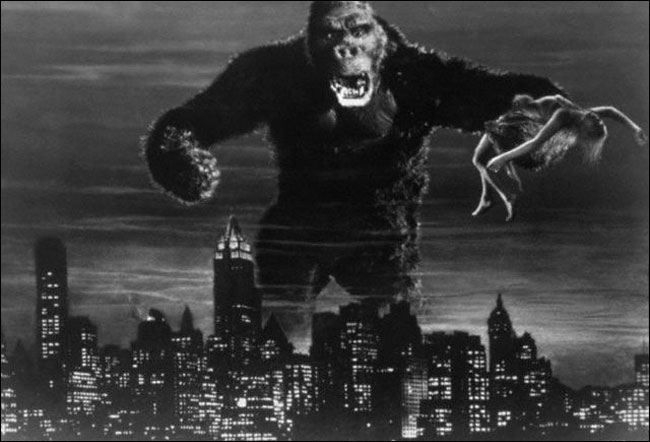
It's a simple enough story, but in my opinion what has made 'Kong' such a classic is what else happens on Skull Island. After Kong grabs his lady and heads back into the jungle, Denham and his crew follow and the audience finds much more than just a giant gorilla. The men ward off a stegosaurus, Kong has a brutal fight with a T-Rex, barely survives an encounter with a giant snake and even has to shoo away a pterodactyl who had eyes for his woman. It is in these scenes that the unflinching action and still-effective special effects come alive. When Kong fights the T-Rex, it is absolutely brutal, the action not the effects. The two beasts throw each other to the ground and the battle lasts a bit longer than you would think, with Kong triumphing after stretching the dinosaur's jaw until blood oozes out, leading to a wonderful shot of Kong playfully opening and closing his foe's jaws to see if it is really dead.
These effects were accomplished in 1933 and create a much different (and sometimes more effective) experience than many of today's effects. No matter how much money is spent on CGI effects, an audience always knows what they are looking at is fake. But the Kong effects can get away with more because the film is black and white and subsequently take on a much more physical quality, especially since Kong's fur constantly seems to be rippling (an unintended but highly successful byproduct of the animators' fingers constantly disturbing the rabbit fur that covered the miniature Kong).
The facial design of Kong is vital to the story, as the animators are able to present him with a playful, adolescent look moments after looking truly menacing. It's this youthful face that makes one scene truly memorable. Cut out of the original theatrical release at the request of censors, after Kong has scaled his mountain with his damsel, he delicately holds her and strips away a few layers of her dress, curiously examining each piece of this fabric he has never felt. As Kong peacefully strokes the curiosity in his hand, you genuinely believe that this 18-inch miniature ape model loves this woman, an emotion that is difficult to evoke even with today's CGI advances.
The best example of how CGI has 'ruined' some effects is one of my favorite action scenes of all time. In the classic King Solomon's Mines, there is a scene where our characters are trapped in a giant stampede, with literally hundreds and hundreds of all kinds of African creatures racing past them. There is a true sense of danger, because we know the animals are real. If this scene was ever attempted again, the animals would be born on computers and this sense of danger (which is sorely lacking in many of today's movies) would never exist. This same sense of realism is one reason why Kong has remained timeless.
The scenes of Kong escaping from the theater and scaling the Empire State Building are well-parodied and firmly entrenched in our subconscious, but many of the shots are truly striking. One in particular is when we first see Kong climbing the Empire State Building: instead of a closeup, director Merian C. Cooper wisely pulls far away from the action, showing us the surprisingly small silhouette of Kong inching his way up the building and in the background we see the terrifying shadows on the clouds of a fleet of attack planes heading for Kong. We know the ape's death is certain, but for a few seconds he gets to relive those minutes of bliss on his mountain when he sits undisturbed on the Empire State Building with his companion.
Initially it looks like Kong may be able to fend off the planes, but as their attacks become more precise, he looks at the blood pouring out of his chest and realizes he will not survive, until he finally tumbles off the side of the building. The genius of Kong's animation is that it is able to project these feelings of fear and love so that when he meets his doom, it becomes one of the very few monster movies where the audience is quietly saddened by the creature's demise.
It's easy to dismiss the original 'King Kong' as just another monster movie, but it is the scenes I mentioned above that I believe will be heightened emotionally and visually in Peter Jackson's version.
NOTES: One of the funniest parts of 'Kong' are some scenes that aren't included. After Kong is subdued with a smoke bomb and lays on the beach, Denham announces that they will put him on a raft and take him back to the ship. The next scene we see is 'King Kong: The Eighth Wonder of the World' on Broadway. Ummm, how exactly did you get this 20-foot tall monstrosity into and out of a ship and then into the heart of Manhattan? The filmmakers probably had no idea themselves, and it's almost comical how they 'skip' those scenes.


Tuesday, November 22, 2005
Have You Seen ...
The Wicker Man
Must see!
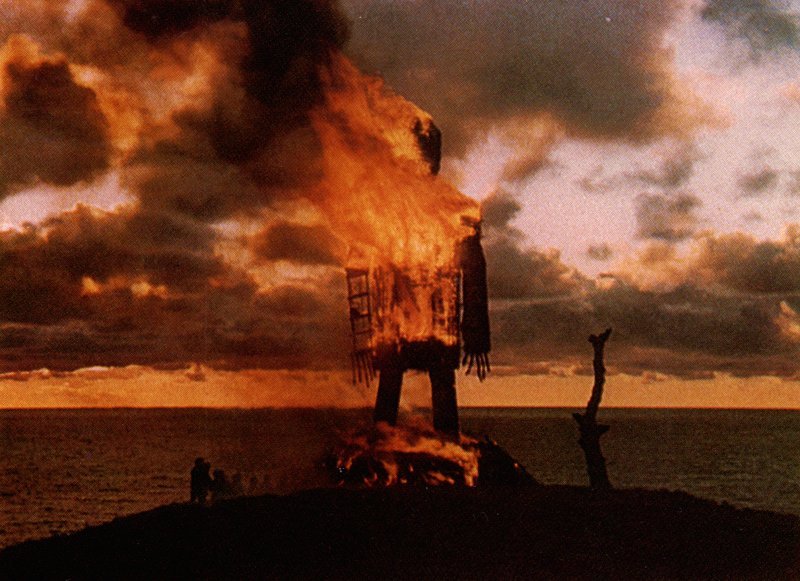
One of the few cult movies that deserves more acclaim than it already garnishes, The Wicker Man is a deep, mysterious, smart and truly terrifying tale of religious tolerance that will stay with you long after the credits roll. The true beauty of 'The Wicker Man' is that its rich message and difficult themes are not smashed into the audience's face, rather they are gradually coaxed from the orange coals of curiosity and horror until it is literally a towering fire of macabre controversy during the final minutes.
'The Wicker Man' opens with Sergeant Howie arriving from the mainland of Scotland to the isolated island community of Summerisle. He is investigating a case of a missing girl, but he soon learns that this will be anything but a typical case. The alleged mother of the missing girl has no recollection of her and introduces Howie to her only child. Things continue to go south when Howie checks into his inn, as he observes a public orgie in the twilight and is seduced by a hypnotic spell from the inn's daughter.
Howie's by-the-book demeanor and God-fearing spirit is put to the test when he hears an adolescent class of girls being taught about how fallic symbols are everywhere, learns that the town is a giant Pagan contingent who worship the "old Gods," and when he meets Lord Summerisle himself, played by (who else?) Christopher Lee. Summerisle does not hide the fact that the missing girl is in fact dead, and he has his blessing to continue with the investigation, but warns him that he may not enjoy their traditional May Day celebration. Growing more and more suspicious and bewildered, Howie sneaks his way into the festival, when the true intentions of the populace (and the crime he is investigated) are revealed.
The theme of religious tolerance emerges early, as the Christian Howie is mortified at the practices in Summerisle. All of the island's inhabitants are clearly happy with their way of life, but Howie's staunch British values force him to question why they follow such a faith. This is why 'The Wicker Man' is still relavent, as all cultures will continue to ponder what is the 'right' religion to be a part of. But this advanced plot does nothing to take away from the horror-feel of this film, which reaches a stirring peak with its end that will leave you speechless.
Prime Cut
Must see if you like dark/violent comedies
Starting in the mid 60s, the film industry became more and more liberal with its tabboos, with filmmakers continuing pushing the limits of what was acceptable on the screen. Prime Cut is a perfect example of how fast the industry changed. Made in 1972, just eight years earlier, it would not have been possible to make such a movie, especially in America. 'Prime Cut' was one of the first dark/violent comedies, which means it's not exactly packed with jokes, but the characters, situations and action make it funny in a disturbing/quirky kind of way. This genre today includes the likes of Pulp Fiction, Snatch, Kill Bill, Sin City and Layer Cake. 'Prime Cut' is just as violently zany and amusingly strange and kinky as the latter movies with a twist of midwestern hospitality and a smashing cast.
The opening scene of 'Prime Cut' sets the tone for the rest of the film, as we see a meat processing plant as the opening credits roll. By the end of this sequence it becomes apparent that the meat being transformed into sausage form is that of a very unlucky person. These sausages are sent from the Kansas City plant to the gang in Chicago who sent said unlucky person to retrieve their money. No, they are not joking. So the gang sends its resident hardass Nick Devlin (Lee Marvin, yes!) and some of his flunkies out of the city and into the country to get the money owed to them by cattle baron/mobster/asshole Mary Ann (Gene Hackman). His name really is Mary Ann, and best of all there's no attempt at an explanation of it either, the other characters don't even bat an eye when referring to this very scary man as Mary Ann.
But ole' Mary doesn't just sell cattle -- he sells flesh, as in human, as in prostitutes, as in slaves. Nick gets into Mary Ann's flesh auctions because the two go back a ways, and Nick takes a liking to one particular piece of flesh -- an unbelievably young and cute Sissy Spacek, in her first starring role. Spacek and Marvin make a good team, and they might just take down Mary Ann's whole operation, but not before feeding a limousene to a thresher, driving a semi-truck through a nursery, watching Gene Hackman nosh on tripe and setting more than a few orphans free.
May
Must see if you aren't afraid to be entertained and completely disgusted
The first shot in May is only about 0.8 seconds long, but it is 100% perfect and I don't think I've ever seen anything else like it. You don't really know what you've seen, but it sets up a terrifying scene at the end, so that you somehow know inside you what's coming next. It's the only possible way the ending could by any more horrifying. It also makes you wonder (around the one hour mark), just how the movie is going to get back to that first 0.8 seconds.
That's because 'May' is only a horror movie for the last 20 minutes or so, much like Carrie, which many will compare 'May' to. And the two are very similar. Both title characters carry the evil passed on to them from their mothers, and want oh-so-much just to be a normal girl with friends, even if that means spilling blood by the gallons.
You see, May is not your average girl. Her closest friend is a mildly disturbing doll made by her mother after May could not find any friends at school. It's housed in glass, and seems to control May from behind it at times. As May sinks further and further from reality, we hear the glass beginning to break, as the true side of May wants to get out.
It wasn't always bad, though. May met a guy at the laundromat (Jeremy Sisto), who professes that he 'likes weird.' Perfect. Eh, no you don't pal, not this kind of weird. After May shares with him some stories from her animal clinic workplace over lunch one day, he starts to think, 'maybe I'll give normal a try.' Sisto's character distances himself from May and soon she decides to give her mother's philosophy of 'making' a friend for herself a go. This has horrific consequences, as she adds a equal parts Frankenstein and Ed Gein to this troubling mix. Director Lucky McKee takes a bold gamble with the final shot, one most directors would never dream of with a serious movie like this. Does it work? If it had been more subtle, it would be perfect, but as it is it's a fitting ending to this outside-the-box horror tale.
{{{spoiler warning}}}
One thought about the 'eye scene' that degraded it for me: YOU CANNOT CUT YOUR OWN EYEBALL OUT, at least not to the degree May did. The ocular bone protects the eyeball very well, that's why you don't hear about people's eyes falling out. It would be like trying to push a golf ball through a hole meant for a large marble, just wouldn't work. Sorry, my limited anatomical knowledge ruined that scene's shock value for me.


Tuesday, November 15, 2005
The Anti-Thanksgiving Movies
Think back to that paper you wrote about Thanksgiving in fourth grade, it probably went something like this: 'Thanksgiving is a time when we give thanks for all we're thankful for, and I'm thankful that I can give thanks for the things I'm thankful for.' Yes, Thanksgiving is about everything that's good in life, but unfortunately, these movies are not. These are the films you walk out of in a dark mood, wanting nothing more than to sink your head into a jello mold and watch the final minutes of your life slip by in a gelatin reflection. Below are the ten movies best representatives from the genre you will not be giving thanks for, simply because thinking about them may cause you to start sobbing in your cranberry sauce.
10. The Bicycle Thief
This was a slow-burn movie for me. It wasn't until later that night that The Bicycle Thief really sank in and I had to explain to my future wife why I had spontaneously started crying. It's one of the better stomach-punch movies because it sneaks up on you, it lulls you into thinking this tale of a father and son searching for a bicycle that was stolen, a machine that will provide precious employment in post-war Italy, is nothing more than an entertaining example of neo-realism. But when the father reaches the end of his rope and steals someone else's bicycle, while his son watches him get hauled away, the tears start flowing grease drips off pizza.
9. Glengarry Glen Ross
After Alec Baldwin's ball-busting speech that opens Glengarry Glen Ross, David Mamet's script takes us into the filthy, smarmy, mean, back-stabbing and greedy world of desperate salesmen. In one of Jack Lemmon's all-time best performance's, he plays Shelly (known to some of you as 'Gill' on 'The Simpsons') who is the guy that calls you at 8 a.m. on a Sunday trying to get you to invest in some piece of property you're allegedly interested in. Shelly used to close sales, now he just sees closed doors. He's willing to do anything to get back in the game. He's worse than any used car salesman, he's your worst friend ... he's an asshole. And when he finds out his big sale is a sham, you'll find yourself quietly laughing.
8. Bully
You know when you're watching a Larry Clark movie, it's not going to be something that'll exactly perk your spirits about. Like Clark's Kids, Bully shows the viewer just how dangerous bored, naive teens can be. 'Bully' gives us end-all-asshole Bobby (a young and imposing Nick Stahl), who constantly torments his childhood friend Marty, ultimately to the point that Marty and Co. decide it's best to put him out of his misery. Their 'perfect crime' comes undone so easily and by the time they're all in court in-fighting while each of their long prison sentences are handed down, you find yourself covering your mouth much like the court audience in the movie. Most depressing part? It's based on a true story.
7. The Ox-Bow Incident
On the surface this is a dark western, but The Ox-Bow Incident is at its core an extremely liberal (for the time) indignation of lynching, which was still prevalent. When a small Nevada town gets word that a popular rancher was murdered and his cattle herd rustled, a band of 'justice' seekers set out to catch the band. They find three worthy-enough suspects in the mountains and convict them in the court of mob justice before stringing them up, just minutes before the sheriff rides up and informs them that they're all murderers. Damn! As Henry Fonda reads the letter a suspect wrote to his wife minutes before being executed, you find yourself wondering why you had to be born human.
6. Bring Me the Head of Alfredo Garcia
Almost any Sam Peckinpah movie could be included here, but I chose Alfredo Garcia is his most dark entry (probably because it was the only one without any studio interference). When a Mexican general puts a hefty bounty for the head of the man that knocked up his daughter, Bennie (Peckinpah stalwart Warren Oates, who else?) wises up, because he knows Alfredo is dead and he knows his hooker girlfriend will help him find the body. Lots of gut-wrenching moments here, like when Bennie and gal's romantic outdoor dinner is interrupted by bikers (one being Kris Kristofferson) who want to rape her, Bennie tries to be the hero for her, but is turned away because she's "been here before." Yikes. Did I mention for the last third of the movie, our hero totes around a fly-infested bag containing ole' Al's head?
5. Native Son
Few have seen this Oprah movie from 1986, fewer should have to. Native Son is the warming tale of Bigger Thomas, a do-good black teen from the slums of 1940s Chicago who tries to care for his family by getting a job as a chauffer for a wealthy family. He drives the daughter around a lot, one night she gets drunk and Bigger tries to keep her quiet in the house so her father doesn't scold her, but there's one problem: he inadvertantly suffocates her in the process. Whoops. Time to save his hide so he dumps her body in the house's incinerator. Of course the authorities wise up and find her bones, and young Bigger is sent to the chair while mother Oprah looks on. Ain't life grand?
4. Requiem for a Dream
I'm convinced that most heroin addicts aren't big movie or music buffs. Because if they had seen any good smack movies (The Basketball Diaries anyone?), or heard any of the seemingly hundreds of rock 'n roll songs about the horrors of the drug (Black Sabbath's Hand of Doom is a good one) I think they would be scared straight. But if I'm ever some kind of teacher, when it comes to drug education, I would just show them Requiem for a Dream, which depicts the thrills of hard core drug use in such a way that you're pretty much numb to the multi-pronged 'you can't unsee this' ending.
3. Last House on the Left
This doesn't make the list just because it tried to shock audiences with graphic depictions of violence (mostly against women), rather because once the completely ridiculous ending is finally over, you find yourself wondering why you just spent 90 mins of your life on such a terrible movie. No, Wes Craven's early effort is not one of the best horror movies of the 70s, it is just a very bad movie. Why does all the dialogue sound like something a 7th grader would write on their skateboard (yes, we realize she's a young woman, we don't need 5 lines in the opening 10 mins about her breasts), why does the supposed realism devolve into antics that would make Leslie Neilsen's eyes bleed (oh you're hooking that up to the doorknob so he'll get shocked, yes we all saw that on Tom and Jerry). You've been warned.
2. Mask
Let's be quite clear on something, only two movies have made me cry: The Bicycle Thief and the No.1 movie on this list. But only one movie has made me cry twice (also the number of times I've seen it), and that is Mask. Frankly, if you don't at least fake some tears at the end of this one, you're kind of an asshole. Come on people, sure he has a deformed head, but he's still a nice guy! Damn the only person outside of mom Cher's biker gang who treats him normally is a blind Laura Dern, and then her parents won't let her even talk to him! And come on mom, all he wanted to do was travel a little, couldn't you drop the loser boyfriends for a weekend before he dies! Oh, yeah he dies at the end, as if you didn't see that coming! Excuse me, it's getting dusty in here ...
1. Grave of the Fireflies
Now while Mask is a tearjerker, it is also a very good movie. The makers of Grave of the Fireflies appeared to have an agenda: to make the most sickeningly depressing movie ever. By the end you can barely see the credits through your tears, but you feel as if the filmmakers had you in a full nelson throughout the movie, hoping it will get tears out of you. And I realize Roger Ebert has given this his great movie treatment, but there was no enjoyment in this movie for me. This anime tale gives us two WWII orphans in Japan, who just watched their mother die from firebomb burns, and have to live with cruel relatives. They take their money and chastise the son for not working, even though he's like 7. So they move out and live in a cave, surviving on what big bro can steal. If you don't know by now what will happen at the end, I'll give you a hint: people (especially young children) need to eat.

Tuesday, November 08, 2005
In Defense of 'Indiana Jones and the Temple of Doom'
I'll admit it: I'm an apologist. When people wanted Dennis Miller off Monday Night Football, I said his humor was misunderstood. When the new BMW 5-series came out, I was one of the few people who said 'it's still a BMW.' I only honk the horn on my car unless it's absolutely necessary. But when people say 'Indiana Jones and the Temple of Doom' is terrible and the worst of the series, I say 'WAIT ONE GODDAMN MINUTE!'
Before you repeat the same line to your screen whilst reading this post, another allowance: I view 'Temple of Doom' different than most people. I've been passionate about this movie since I first saw it at the age of 5 and was literally the first real movie I had ever seen. I remember the night vividly: my parents trying to hook up the VCR they had RENTED, the opening Paramount logo, and the gradual realization that not all movies were like Lady and the Tramp or The Song of the South (the latter a grave understatement). So I started out worshipping this movie, but I still believe that it does not deserve all the negativity that is consistently heaped on it.
But before we get to Apologist Frank's defense of one of his favorite adventure movies, let's look at what is working against 'Temple of Doom,' what makes it an easy target for criticism.
It's not 'Raiders of the Lost Ark'
Oh man, it is about as far from 'Raiders' as you can get. 'Raiders' is truly one of the greatest films of its era, with timeless stunts, memorable characters and an engaging and engrossing story. There was no way 'Temple' was going to top it, because the only greater treasure Indy could hunt for would be the Holy Grail (and who would want to make a movie about that?)
He's not saving the world
No, this is the only entry in the trilogy that does not include Nazis, nor does it have any enormous consequences if Indy does not succeed (sure it's talked about, but you never really feel any danger).
Kate Capshaw is in it
This is probably complaint No. 1 among 'Temple' bashers: Kate Capshaw is not funny, Kate Capshaw is annoying, Kate Capshaw cannot act. All three are popular battle cries when denouncing her role in 'Temple.'
OKAY FRANK, SO WHY DOESN'T IT SUCK?
Since you asked, I would be so kind as to point you to the above three bullets. It is these very three main complaints about the movie that make it one of my favorites.
WHAT? YOU LIKE KATE CAPSHAW?
Not exactly, but I understand why she's in the movie and who Lucas and Spielberg were thinking about when they wrote her part: Deborah Kerr in King Solomon's Mines. 'Temple' is at its core a tribute to the best moments in 'King Solomon's Mines,' using culture shock and an expedition through fabulous locales as a backdrop to the adventure tale. Willie Scott is Kerr's character in 'Mines,' the high society vixen comedically trying to cope with the outrageous elements around her. The most obvious nod to 'Mines' in fact is the give and take between Willie and Indy, which is nearly identical to the I-hate-you-no-I-love-you antics that Stewart Granger goes through with Kerr. But while Kerr wasn't exactly a dunce in 'Mines,' the popularity of dumb blonde characters in the 80s made it a no-brainer.
And while 'Temple' naturally must be compared (and subsequently knocked down a few pegs) to 'Raiders,' I welcome the drastic change in direction. Let's not forget that The Last Crusade is an obvious attempt to recreate the glory of 'Raiders' by using a similar story (complete with religious themes), thus making 'Temple' the true black sheep of the Indy family. But to me, that's what makes it so special. In the Indiana Jones world, his adventures with the Ark and the Holy Grail would be what he was known for, but his little adventure in India would be a story he would relay with a fellow archaeologist at a bar. Or maybe he wouldn't talk about it at all: he didn't have anything to show for it, and no one else was there besides Short Round a lounge singer from Missouri.
YEAH, THE KID FROM 'THE GOONIES' IS EVEN WORSE!
And yes, there are those misguided souls in this world who don't appreciate Short Round, which I will never understand. Sure his lines may be groan-inducing early on (but 'You call him Docta Jones, doll!' always gets a laugh out of me), but by the end, Short Round (or 'Mr. Round') is a perfect complement to Indy's physical comedy, especially in the mine scene when they are both fighting off adversaries (a wonderful shot where their punches are in synch) before Indy yells at him to 'quit playing around with that kid!' Also, Short Round's theme is second only to the main overture, it's a great melody that suits his character perfectly.
The aforementioned mine scene has to go down as one of the all-time best action set pieces of all time. Lucas and Spielberg cram every kind of stunt and effect into the last half hour of the film (including some of the best live-action miniature work ever seen with the mine chase), culminating in the signature scene of the movie.
You know what scene I'm talking about, in fact I've already written about it. But what I didn't mention in that post was the how the terrifying performance from Amrish Puri, who played Mola (or 'the heart-ripper-outter'). Puri, who died last year, was a giant in Indian cinema, known as Bollywood's Al Pacino. It's easy to see how he could have well over 200 roles to his credit when he shouts 'Stones will be found Doctor Jones ... You won't!'
OKAY, BUT YOU HAVE TO ADMIT IT'S AT LEAST THE WORST OF THE SERIES
Well it's certainly not better than 'Raiders,' but there's no way you can put 'Last Crusade' above it. 'Temple' does have its problems, but nothing like the at-times plodding pace of 'Last Crusade,' the near absence of any kind of villain (face it, nobody's afraid of Julian Glover) and the sometimes ridiculous lengths it goes for comedy (the Hitler bit is the most aggregious offender).
CAN YOU JUST GET IN ONE JAB AT THE 'TEMPLE' DIALOGUE?
It's not the best, and it does have one 'I know kung fu'-level quote: At the very end, when Indy returns the sacred rock to the village, its leader says 'Now you see the magic of the rock!' Harrison Ford then does his best cheesy smile and squinted eyes to show some kind of emotion and replies: 'Yes, I understand its power now.'


Tuesday, November 01, 2005
The Infernal Question
You can ask me about my favorite food (eggs benedict), beer (Widmer), car (1997 Porsche 911 Turbo S, black), bad 80s song (St. Elmo's Fire), Simpsons episode (Homer the Vigilante), military aircraft (A-10 Thunderbolt), Henrik Ibsen play (A Doll's House), Madonna era (short hair, circa 'Cherish') or pre-war Heisman Trophy winner (Nile Kinnick), but I don't know how many more times I can hear 'what's your favorite movie?' without someone (possibly myself) getting hurt.
If not for one of my weaker moments in fourth grade when I responded to this question with RoboCop 2 (which offers a look into just how feelbe-minded I was at that point: putting RoboCop 2 above RoboCop), I cannot think of an instance when I could provide a singular answer to this query. It seems to be a prequisite for being a movie snob (hmm, good idea, more on that in a later post) that you have to list multiple movies in regards to this question. Why is it so easy to have just one favorite of the above categories, yet so sickenly far from one with movies?
It's also essential to note that this question refers to "favorite" movies, and not what I think is the "best" movie, of which I can easily say Citizen Kane. Yes, not the most original answer, but as you may have read, I qualify as a Kane Snob. With my favorite movies, I've never even been able to rank them, preferring rather to keep them to a listing of the 10 most essential movies to me. These films I can pop in at any time and watch, or sometimes need to pop them in, depending on my mood. I am incapable of putting one over another, as my affection for them usually runs in cycles (I always forget just how much I love Jaws). I am always afraid of some snob like me calling my essentials list 'predictable,' only because it would be semi-justified. There are some no-brainers on here, but also a few picks that might surprise some people. Now, in the interest of limiting this post to under 2,000 words, I will not go into full essay mode with these selections. I already have given this treatment to a couple of them, and more may be in the works.
Adam's Essential Ten (in no order):
The Third Man
Some of you may recall a small blurb I wrote about The Third Man in the wake of Hurricane Katrina, as I immediately thought of the movie while watching images of the storm's aftermath. This thinking still holds true, as 'The Third Man' is all about the way people react to destruction around them: some continue to live their lives, some crumble like the buildings around them and a few take advantage of the situation. All three of these types collide head on in this 'they don't make 'em like that anymore' thriller/mystery/romance on the streets of post-war Vienna.
This is Spinal Tap
It's rare that you can still laugh at a comedy during the 44th viewing of it, and even rarer that you laugh harder on said viewing than the 43rd viewing. This is Spinal Tap is just this movie for me. I can never make it through Marty DeBergi saying 'they are treading water in a sea of retarded sexuality and bad poetry' without busting up, same goes for 'what's wrong with being sexy?' Then there are the little visual touches that garner even more laughs, such as the few shots in the background of the early interview that show that Tap's castle is probably little more than a set from a high school Hamlet production. I'll never tire of watching this.
The Last of the Mohicans
I touched on my favorite scene in 'Mohicans' in an earlier post, and it's a great example of director Michael Mann's range. He may have been accused of over-using the downtown setpieces he has made famous over the years, and certainly quashed that theory by going back to one of the classics. Mann's unique lens just makes this ageless tale look and sound unlike anything else. He utilizes extended closeups Leone-style to great effect and uses the wilderness setting as almost another character (which he does masterfully with his L.A. movies as well). The last 20 minutes still floor me. Nearly perfect.
The Bridge on the River Kwai
Even with the big budgets and endless CGI shots of today's Hollywood, a better adventure film will never be made. The Great Escape is usually handed this title, but nothing in that film can match the pace, boldness, ferocity and suspense of The Bridge on the River Kwai, whose plot is a dizzying tower of equal parts loyalty, revenge and courage raised to levels that approach stupidity. Through flawless timing and execution, 'Bridge' builds (pun intended) the most suspenseful climax of any movie, ending with one of the most emotional and entertaining payoffs possible.
Vertigo
Alfred Hitchcock was of course known for producing scares, but his best skill was portraying the emotions produced by entrapment and desperation, two of the most common themes in his films. Vertigo is the best example of both, as Hitchcock produces a love story equally twisted as it is tantalizing. The story is so rich I won't even begin to describe it, but what I can gush about is the still wondrous visuals Hitchcock creates, which have a luminescent quality usually reserved for dreams and are graced by Bernard Herrman's most haunting and timeless score. 'Vertigo' draws me in every time, I can't leave it off the list.
Dark City
I just touched on this (not gonna link it, just scroll down dummy) and Dark City is one flick that I find myself liking more every time I pop it in. One note to add to my previous post about it is the brilliant 'Shell Beach' theme, which acts as the beacon that keeps the city's inhabitants going about their daily 'lives.' Somehow, some way they'll get to Shell Beach. The people in the city are able to live like they once did because there was a Shell Beach for them at one time, and they're still trying to find out how to get there.
The Night of the Hunter
I'll always stand by the fact that Robert Mitchum's Harry Powell is the most terrifying character ever put upon audiences. With 'LOVE' and 'HATE' tattooed across his knuckles, Powell is able to slither into people's trust through the guise of a do-good preacher. Yet he also believes that God is standing by all his killings, doing the Lord's work for him. It's Mitchum's performance that creates an air of madness in The Night of the Hunter, ratcheting up the suspense with every passing minute. 'Hunter' also contains a number of haunting scenes that you'll never forget, and one that may be my all-time favorite (watch for the fish hook).
Citizen Kane
Yes, the easy choice, but I can't leave it off. Citizen Kane, outside of its mountain of accolades, remains one of the best combinations of every kind of film genre. It literally has it all, including visuals and editing techniques that forever changed Hollywood. It's still easy for me to put 'Kane' on any time and watch it through. I talked about one of my favorite moments in 'Kane' in a previous posting.
Jaws
I still feel Jaws is a very under-valued film. Before its release, the fear of sharks that everyone has today was almost non-existant. You can only imagine how scarier 'Jaws' was to audiences in 1975 who had little knowledge of the dangers of sharks. But the suspense still holds up today: the underwater scene with the head (maybe the top 'jump' scare of all time), a swimmer's detached leg gracefully descending to the ocean floor, the way the Orca fills with water so fast and starts to sink. I can't watch the Orca scenes (nearly a separate movie) without feeling like a complete wuss, and I love every minute of it.
Sin City
The newest addition to the list. When I went back and saw it for a second time the day after it came out, I knew it had to be included. While it's definitely not for everyone, it is for me. The cast is simply perfect (Rutger Hauer!?!), the visuals are ground-breaking and the violence is suitably out of this world. Part of the reason I appreciate Sin City so much is how absurdly difficult I know it should have been to port the comic books to the big screen. Take a look at some of Frank Miller's work and you'll see why he's listed as co-director, because the film is literally a shot-by-shot remake. Can't do without it, and cannot wait for the sequels.