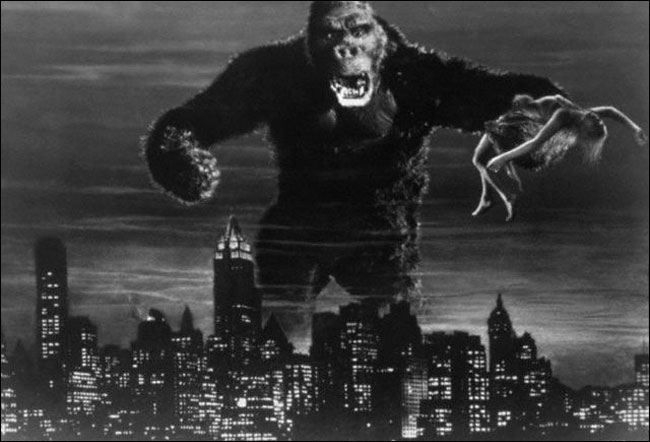
The soon-to-be-released King Kong has been No. 1 on my anticipated movie list since I heard Peter Jackson would be directing it. No one else I can think of has the fearless approach to filmmaking needed to turn 'King Kong' into a the powerful and meaningful movie it deserves to be. Forget the 1976 albatross of a remake, I knew Kiwi Pete would dive into this project beard-first, treating the story with the same weight as his Lord of the Rings movies. The other aspect I knew would work in the favor of a new 'Kong' was that, unlike many remakes, most audiences (especially younger ones) have not seen the original. Well, I have, and I'm here to tell you that it's more than just a giant ape which has inspired the biggest movie of the season.
Despite its startling special effects, the original 'King Kong' was made on a budget that was small even for 1933, about $600,000, and much of that was obviously devoted to the effects. As such, the first third of the film is almost maddeningly simple and ordinary, but the early scenes have a certain charm to them, because they lull you to sleep a little bit before 'Kong' turns on the afterburners for the rest of the movie. Though most of today's generation has not seen the movie, plenty know the story: director Carl Denham is off on a ship to find his next action picture, and all he needs is a dame crazy enough to be his leading lady, dame is offered to Kong, Kong likes dame, Kong taken to New York, escapes, finds dame and is killed from machine gun fire from bi-planes.
It's a simple enough story, but in my opinion what has made 'Kong' such a classic is what else happens on Skull Island. After Kong grabs his lady and heads back into the jungle, Denham and his crew follow and the audience finds much more than just a giant gorilla. The men ward off a stegosaurus, Kong has a brutal fight with a T-Rex, barely survives an encounter with a giant snake and even has to shoo away a pterodactyl who had eyes for his woman. It is in these scenes that the unflinching action and still-effective special effects come alive. When Kong fights the T-Rex, it is absolutely brutal, the action not the effects. The two beasts throw each other to the ground and the battle lasts a bit longer than you would think, with Kong triumphing after stretching the dinosaur's jaw until blood oozes out, leading to a wonderful shot of Kong playfully opening and closing his foe's jaws to see if it is really dead.
These effects were accomplished in 1933 and create a much different (and sometimes more effective) experience than many of today's effects. No matter how much money is spent on CGI effects, an audience always knows what they are looking at is fake. But the Kong effects can get away with more because the film is black and white and subsequently take on a much more physical quality, especially since Kong's fur constantly seems to be rippling (an unintended but highly successful byproduct of the animators' fingers constantly disturbing the rabbit fur that covered the miniature Kong).
The facial design of Kong is vital to the story, as the animators are able to present him with a playful, adolescent look moments after looking truly menacing. It's this youthful face that makes one scene truly memorable. Cut out of the original theatrical release at the request of censors, after Kong has scaled his mountain with his damsel, he delicately holds her and strips away a few layers of her dress, curiously examining each piece of this fabric he has never felt. As Kong peacefully strokes the curiosity in his hand, you genuinely believe that this 18-inch miniature ape model loves this woman, an emotion that is difficult to evoke even with today's CGI advances.
The best example of how CGI has 'ruined' some effects is one of my favorite action scenes of all time. In the classic King Solomon's Mines, there is a scene where our characters are trapped in a giant stampede, with literally hundreds and hundreds of all kinds of African creatures racing past them. There is a true sense of danger, because we know the animals are real. If this scene was ever attempted again, the animals would be born on computers and this sense of danger (which is sorely lacking in many of today's movies) would never exist. This same sense of realism is one reason why Kong has remained timeless.
The scenes of Kong escaping from the theater and scaling the Empire State Building are well-parodied and firmly entrenched in our subconscious, but many of the shots are truly striking. One in particular is when we first see Kong climbing the Empire State Building: instead of a closeup, director Merian C. Cooper wisely pulls far away from the action, showing us the surprisingly small silhouette of Kong inching his way up the building and in the background we see the terrifying shadows on the clouds of a fleet of attack planes heading for Kong. We know the ape's death is certain, but for a few seconds he gets to relive those minutes of bliss on his mountain when he sits undisturbed on the Empire State Building with his companion.
Initially it looks like Kong may be able to fend off the planes, but as their attacks become more precise, he looks at the blood pouring out of his chest and realizes he will not survive, until he finally tumbles off the side of the building. The genius of Kong's animation is that it is able to project these feelings of fear and love so that when he meets his doom, it becomes one of the very few monster movies where the audience is quietly saddened by the creature's demise.
It's easy to dismiss the original 'King Kong' as just another monster movie, but it is the scenes I mentioned above that I believe will be heightened emotionally and visually in Peter Jackson's version.
NOTES: One of the funniest parts of 'Kong' are some scenes that aren't included. After Kong is subdued with a smoke bomb and lays on the beach, Denham announces that they will put him on a raft and take him back to the ship. The next scene we see is 'King Kong: The Eighth Wonder of the World' on Broadway. Ummm, how exactly did you get this 20-foot tall monstrosity into and out of a ship and then into the heart of Manhattan? The filmmakers probably had no idea themselves, and it's almost comical how they 'skip' those scenes.
Wednesday, November 30, 2005
Before 'Kong' There Was ... 'Kong'


Tuesday, November 22, 2005
Have You Seen ...
The Wicker Man
Must see!
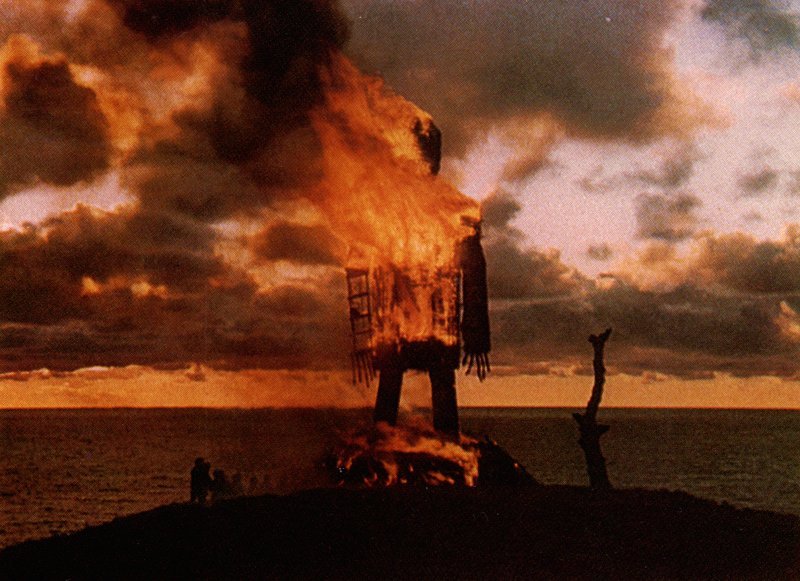
One of the few cult movies that deserves more acclaim than it already garnishes, The Wicker Man is a deep, mysterious, smart and truly terrifying tale of religious tolerance that will stay with you long after the credits roll. The true beauty of 'The Wicker Man' is that its rich message and difficult themes are not smashed into the audience's face, rather they are gradually coaxed from the orange coals of curiosity and horror until it is literally a towering fire of macabre controversy during the final minutes.
'The Wicker Man' opens with Sergeant Howie arriving from the mainland of Scotland to the isolated island community of Summerisle. He is investigating a case of a missing girl, but he soon learns that this will be anything but a typical case. The alleged mother of the missing girl has no recollection of her and introduces Howie to her only child. Things continue to go south when Howie checks into his inn, as he observes a public orgie in the twilight and is seduced by a hypnotic spell from the inn's daughter.
Howie's by-the-book demeanor and God-fearing spirit is put to the test when he hears an adolescent class of girls being taught about how fallic symbols are everywhere, learns that the town is a giant Pagan contingent who worship the "old Gods," and when he meets Lord Summerisle himself, played by (who else?) Christopher Lee. Summerisle does not hide the fact that the missing girl is in fact dead, and he has his blessing to continue with the investigation, but warns him that he may not enjoy their traditional May Day celebration. Growing more and more suspicious and bewildered, Howie sneaks his way into the festival, when the true intentions of the populace (and the crime he is investigated) are revealed.
The theme of religious tolerance emerges early, as the Christian Howie is mortified at the practices in Summerisle. All of the island's inhabitants are clearly happy with their way of life, but Howie's staunch British values force him to question why they follow such a faith. This is why 'The Wicker Man' is still relavent, as all cultures will continue to ponder what is the 'right' religion to be a part of. But this advanced plot does nothing to take away from the horror-feel of this film, which reaches a stirring peak with its end that will leave you speechless.
Prime Cut
Must see if you like dark/violent comedies
Starting in the mid 60s, the film industry became more and more liberal with its tabboos, with filmmakers continuing pushing the limits of what was acceptable on the screen. Prime Cut is a perfect example of how fast the industry changed. Made in 1972, just eight years earlier, it would not have been possible to make such a movie, especially in America. 'Prime Cut' was one of the first dark/violent comedies, which means it's not exactly packed with jokes, but the characters, situations and action make it funny in a disturbing/quirky kind of way. This genre today includes the likes of Pulp Fiction, Snatch, Kill Bill, Sin City and Layer Cake. 'Prime Cut' is just as violently zany and amusingly strange and kinky as the latter movies with a twist of midwestern hospitality and a smashing cast.
The opening scene of 'Prime Cut' sets the tone for the rest of the film, as we see a meat processing plant as the opening credits roll. By the end of this sequence it becomes apparent that the meat being transformed into sausage form is that of a very unlucky person. These sausages are sent from the Kansas City plant to the gang in Chicago who sent said unlucky person to retrieve their money. No, they are not joking. So the gang sends its resident hardass Nick Devlin (Lee Marvin, yes!) and some of his flunkies out of the city and into the country to get the money owed to them by cattle baron/mobster/asshole Mary Ann (Gene Hackman). His name really is Mary Ann, and best of all there's no attempt at an explanation of it either, the other characters don't even bat an eye when referring to this very scary man as Mary Ann.
But ole' Mary doesn't just sell cattle -- he sells flesh, as in human, as in prostitutes, as in slaves. Nick gets into Mary Ann's flesh auctions because the two go back a ways, and Nick takes a liking to one particular piece of flesh -- an unbelievably young and cute Sissy Spacek, in her first starring role. Spacek and Marvin make a good team, and they might just take down Mary Ann's whole operation, but not before feeding a limousene to a thresher, driving a semi-truck through a nursery, watching Gene Hackman nosh on tripe and setting more than a few orphans free.
May
Must see if you aren't afraid to be entertained and completely disgusted
The first shot in May is only about 0.8 seconds long, but it is 100% perfect and I don't think I've ever seen anything else like it. You don't really know what you've seen, but it sets up a terrifying scene at the end, so that you somehow know inside you what's coming next. It's the only possible way the ending could by any more horrifying. It also makes you wonder (around the one hour mark), just how the movie is going to get back to that first 0.8 seconds.
That's because 'May' is only a horror movie for the last 20 minutes or so, much like Carrie, which many will compare 'May' to. And the two are very similar. Both title characters carry the evil passed on to them from their mothers, and want oh-so-much just to be a normal girl with friends, even if that means spilling blood by the gallons.
You see, May is not your average girl. Her closest friend is a mildly disturbing doll made by her mother after May could not find any friends at school. It's housed in glass, and seems to control May from behind it at times. As May sinks further and further from reality, we hear the glass beginning to break, as the true side of May wants to get out.
It wasn't always bad, though. May met a guy at the laundromat (Jeremy Sisto), who professes that he 'likes weird.' Perfect. Eh, no you don't pal, not this kind of weird. After May shares with him some stories from her animal clinic workplace over lunch one day, he starts to think, 'maybe I'll give normal a try.' Sisto's character distances himself from May and soon she decides to give her mother's philosophy of 'making' a friend for herself a go. This has horrific consequences, as she adds a equal parts Frankenstein and Ed Gein to this troubling mix. Director Lucky McKee takes a bold gamble with the final shot, one most directors would never dream of with a serious movie like this. Does it work? If it had been more subtle, it would be perfect, but as it is it's a fitting ending to this outside-the-box horror tale.
{{{spoiler warning}}}
One thought about the 'eye scene' that degraded it for me: YOU CANNOT CUT YOUR OWN EYEBALL OUT, at least not to the degree May did. The ocular bone protects the eyeball very well, that's why you don't hear about people's eyes falling out. It would be like trying to push a golf ball through a hole meant for a large marble, just wouldn't work. Sorry, my limited anatomical knowledge ruined that scene's shock value for me.


Tuesday, November 15, 2005
The Anti-Thanksgiving Movies
Think back to that paper you wrote about Thanksgiving in fourth grade, it probably went something like this: 'Thanksgiving is a time when we give thanks for all we're thankful for, and I'm thankful that I can give thanks for the things I'm thankful for.' Yes, Thanksgiving is about everything that's good in life, but unfortunately, these movies are not. These are the films you walk out of in a dark mood, wanting nothing more than to sink your head into a jello mold and watch the final minutes of your life slip by in a gelatin reflection. Below are the ten movies best representatives from the genre you will not be giving thanks for, simply because thinking about them may cause you to start sobbing in your cranberry sauce.
10. The Bicycle Thief
This was a slow-burn movie for me. It wasn't until later that night that The Bicycle Thief really sank in and I had to explain to my future wife why I had spontaneously started crying. It's one of the better stomach-punch movies because it sneaks up on you, it lulls you into thinking this tale of a father and son searching for a bicycle that was stolen, a machine that will provide precious employment in post-war Italy, is nothing more than an entertaining example of neo-realism. But when the father reaches the end of his rope and steals someone else's bicycle, while his son watches him get hauled away, the tears start flowing grease drips off pizza.
9. Glengarry Glen Ross
After Alec Baldwin's ball-busting speech that opens Glengarry Glen Ross, David Mamet's script takes us into the filthy, smarmy, mean, back-stabbing and greedy world of desperate salesmen. In one of Jack Lemmon's all-time best performance's, he plays Shelly (known to some of you as 'Gill' on 'The Simpsons') who is the guy that calls you at 8 a.m. on a Sunday trying to get you to invest in some piece of property you're allegedly interested in. Shelly used to close sales, now he just sees closed doors. He's willing to do anything to get back in the game. He's worse than any used car salesman, he's your worst friend ... he's an asshole. And when he finds out his big sale is a sham, you'll find yourself quietly laughing.
8. Bully
You know when you're watching a Larry Clark movie, it's not going to be something that'll exactly perk your spirits about. Like Clark's Kids, Bully shows the viewer just how dangerous bored, naive teens can be. 'Bully' gives us end-all-asshole Bobby (a young and imposing Nick Stahl), who constantly torments his childhood friend Marty, ultimately to the point that Marty and Co. decide it's best to put him out of his misery. Their 'perfect crime' comes undone so easily and by the time they're all in court in-fighting while each of their long prison sentences are handed down, you find yourself covering your mouth much like the court audience in the movie. Most depressing part? It's based on a true story.
7. The Ox-Bow Incident
On the surface this is a dark western, but The Ox-Bow Incident is at its core an extremely liberal (for the time) indignation of lynching, which was still prevalent. When a small Nevada town gets word that a popular rancher was murdered and his cattle herd rustled, a band of 'justice' seekers set out to catch the band. They find three worthy-enough suspects in the mountains and convict them in the court of mob justice before stringing them up, just minutes before the sheriff rides up and informs them that they're all murderers. Damn! As Henry Fonda reads the letter a suspect wrote to his wife minutes before being executed, you find yourself wondering why you had to be born human.
6. Bring Me the Head of Alfredo Garcia
Almost any Sam Peckinpah movie could be included here, but I chose Alfredo Garcia is his most dark entry (probably because it was the only one without any studio interference). When a Mexican general puts a hefty bounty for the head of the man that knocked up his daughter, Bennie (Peckinpah stalwart Warren Oates, who else?) wises up, because he knows Alfredo is dead and he knows his hooker girlfriend will help him find the body. Lots of gut-wrenching moments here, like when Bennie and gal's romantic outdoor dinner is interrupted by bikers (one being Kris Kristofferson) who want to rape her, Bennie tries to be the hero for her, but is turned away because she's "been here before." Yikes. Did I mention for the last third of the movie, our hero totes around a fly-infested bag containing ole' Al's head?
5. Native Son
Few have seen this Oprah movie from 1986, fewer should have to. Native Son is the warming tale of Bigger Thomas, a do-good black teen from the slums of 1940s Chicago who tries to care for his family by getting a job as a chauffer for a wealthy family. He drives the daughter around a lot, one night she gets drunk and Bigger tries to keep her quiet in the house so her father doesn't scold her, but there's one problem: he inadvertantly suffocates her in the process. Whoops. Time to save his hide so he dumps her body in the house's incinerator. Of course the authorities wise up and find her bones, and young Bigger is sent to the chair while mother Oprah looks on. Ain't life grand?
4. Requiem for a Dream
I'm convinced that most heroin addicts aren't big movie or music buffs. Because if they had seen any good smack movies (The Basketball Diaries anyone?), or heard any of the seemingly hundreds of rock 'n roll songs about the horrors of the drug (Black Sabbath's Hand of Doom is a good one) I think they would be scared straight. But if I'm ever some kind of teacher, when it comes to drug education, I would just show them Requiem for a Dream, which depicts the thrills of hard core drug use in such a way that you're pretty much numb to the multi-pronged 'you can't unsee this' ending.
3. Last House on the Left
This doesn't make the list just because it tried to shock audiences with graphic depictions of violence (mostly against women), rather because once the completely ridiculous ending is finally over, you find yourself wondering why you just spent 90 mins of your life on such a terrible movie. No, Wes Craven's early effort is not one of the best horror movies of the 70s, it is just a very bad movie. Why does all the dialogue sound like something a 7th grader would write on their skateboard (yes, we realize she's a young woman, we don't need 5 lines in the opening 10 mins about her breasts), why does the supposed realism devolve into antics that would make Leslie Neilsen's eyes bleed (oh you're hooking that up to the doorknob so he'll get shocked, yes we all saw that on Tom and Jerry). You've been warned.
2. Mask
Let's be quite clear on something, only two movies have made me cry: The Bicycle Thief and the No.1 movie on this list. But only one movie has made me cry twice (also the number of times I've seen it), and that is Mask. Frankly, if you don't at least fake some tears at the end of this one, you're kind of an asshole. Come on people, sure he has a deformed head, but he's still a nice guy! Damn the only person outside of mom Cher's biker gang who treats him normally is a blind Laura Dern, and then her parents won't let her even talk to him! And come on mom, all he wanted to do was travel a little, couldn't you drop the loser boyfriends for a weekend before he dies! Oh, yeah he dies at the end, as if you didn't see that coming! Excuse me, it's getting dusty in here ...
1. Grave of the Fireflies
Now while Mask is a tearjerker, it is also a very good movie. The makers of Grave of the Fireflies appeared to have an agenda: to make the most sickeningly depressing movie ever. By the end you can barely see the credits through your tears, but you feel as if the filmmakers had you in a full nelson throughout the movie, hoping it will get tears out of you. And I realize Roger Ebert has given this his great movie treatment, but there was no enjoyment in this movie for me. This anime tale gives us two WWII orphans in Japan, who just watched their mother die from firebomb burns, and have to live with cruel relatives. They take their money and chastise the son for not working, even though he's like 7. So they move out and live in a cave, surviving on what big bro can steal. If you don't know by now what will happen at the end, I'll give you a hint: people (especially young children) need to eat.

Tuesday, November 08, 2005
In Defense of 'Indiana Jones and the Temple of Doom'
I'll admit it: I'm an apologist. When people wanted Dennis Miller off Monday Night Football, I said his humor was misunderstood. When the new BMW 5-series came out, I was one of the few people who said 'it's still a BMW.' I only honk the horn on my car unless it's absolutely necessary. But when people say 'Indiana Jones and the Temple of Doom' is terrible and the worst of the series, I say 'WAIT ONE GODDAMN MINUTE!'
Before you repeat the same line to your screen whilst reading this post, another allowance: I view 'Temple of Doom' different than most people. I've been passionate about this movie since I first saw it at the age of 5 and was literally the first real movie I had ever seen. I remember the night vividly: my parents trying to hook up the VCR they had RENTED, the opening Paramount logo, and the gradual realization that not all movies were like Lady and the Tramp or The Song of the South (the latter a grave understatement). So I started out worshipping this movie, but I still believe that it does not deserve all the negativity that is consistently heaped on it.
But before we get to Apologist Frank's defense of one of his favorite adventure movies, let's look at what is working against 'Temple of Doom,' what makes it an easy target for criticism.
It's not 'Raiders of the Lost Ark'
Oh man, it is about as far from 'Raiders' as you can get. 'Raiders' is truly one of the greatest films of its era, with timeless stunts, memorable characters and an engaging and engrossing story. There was no way 'Temple' was going to top it, because the only greater treasure Indy could hunt for would be the Holy Grail (and who would want to make a movie about that?)
He's not saving the world
No, this is the only entry in the trilogy that does not include Nazis, nor does it have any enormous consequences if Indy does not succeed (sure it's talked about, but you never really feel any danger).
Kate Capshaw is in it
This is probably complaint No. 1 among 'Temple' bashers: Kate Capshaw is not funny, Kate Capshaw is annoying, Kate Capshaw cannot act. All three are popular battle cries when denouncing her role in 'Temple.'
OKAY FRANK, SO WHY DOESN'T IT SUCK?
Since you asked, I would be so kind as to point you to the above three bullets. It is these very three main complaints about the movie that make it one of my favorites.
WHAT? YOU LIKE KATE CAPSHAW?
Not exactly, but I understand why she's in the movie and who Lucas and Spielberg were thinking about when they wrote her part: Deborah Kerr in King Solomon's Mines. 'Temple' is at its core a tribute to the best moments in 'King Solomon's Mines,' using culture shock and an expedition through fabulous locales as a backdrop to the adventure tale. Willie Scott is Kerr's character in 'Mines,' the high society vixen comedically trying to cope with the outrageous elements around her. The most obvious nod to 'Mines' in fact is the give and take between Willie and Indy, which is nearly identical to the I-hate-you-no-I-love-you antics that Stewart Granger goes through with Kerr. But while Kerr wasn't exactly a dunce in 'Mines,' the popularity of dumb blonde characters in the 80s made it a no-brainer.
And while 'Temple' naturally must be compared (and subsequently knocked down a few pegs) to 'Raiders,' I welcome the drastic change in direction. Let's not forget that The Last Crusade is an obvious attempt to recreate the glory of 'Raiders' by using a similar story (complete with religious themes), thus making 'Temple' the true black sheep of the Indy family. But to me, that's what makes it so special. In the Indiana Jones world, his adventures with the Ark and the Holy Grail would be what he was known for, but his little adventure in India would be a story he would relay with a fellow archaeologist at a bar. Or maybe he wouldn't talk about it at all: he didn't have anything to show for it, and no one else was there besides Short Round a lounge singer from Missouri.
YEAH, THE KID FROM 'THE GOONIES' IS EVEN WORSE!
And yes, there are those misguided souls in this world who don't appreciate Short Round, which I will never understand. Sure his lines may be groan-inducing early on (but 'You call him Docta Jones, doll!' always gets a laugh out of me), but by the end, Short Round (or 'Mr. Round') is a perfect complement to Indy's physical comedy, especially in the mine scene when they are both fighting off adversaries (a wonderful shot where their punches are in synch) before Indy yells at him to 'quit playing around with that kid!' Also, Short Round's theme is second only to the main overture, it's a great melody that suits his character perfectly.
The aforementioned mine scene has to go down as one of the all-time best action set pieces of all time. Lucas and Spielberg cram every kind of stunt and effect into the last half hour of the film (including some of the best live-action miniature work ever seen with the mine chase), culminating in the signature scene of the movie.
You know what scene I'm talking about, in fact I've already written about it. But what I didn't mention in that post was the how the terrifying performance from Amrish Puri, who played Mola (or 'the heart-ripper-outter'). Puri, who died last year, was a giant in Indian cinema, known as Bollywood's Al Pacino. It's easy to see how he could have well over 200 roles to his credit when he shouts 'Stones will be found Doctor Jones ... You won't!'
OKAY, BUT YOU HAVE TO ADMIT IT'S AT LEAST THE WORST OF THE SERIES
Well it's certainly not better than 'Raiders,' but there's no way you can put 'Last Crusade' above it. 'Temple' does have its problems, but nothing like the at-times plodding pace of 'Last Crusade,' the near absence of any kind of villain (face it, nobody's afraid of Julian Glover) and the sometimes ridiculous lengths it goes for comedy (the Hitler bit is the most aggregious offender).
CAN YOU JUST GET IN ONE JAB AT THE 'TEMPLE' DIALOGUE?
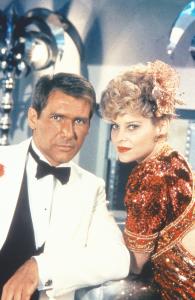
It's not the best, and it does have one 'I know kung fu'-level quote: At the very end, when Indy returns the sacred rock to the village, its leader says 'Now you see the magic of the rock!' Harrison Ford then does his best cheesy smile and squinted eyes to show some kind of emotion and replies: 'Yes, I understand its power now.'


Tuesday, November 01, 2005
The Infernal Question
You can ask me about my favorite food (eggs benedict), beer (Widmer), car (1997 Porsche 911 Turbo S, black), bad 80s song (St. Elmo's Fire), Simpsons episode (Homer the Vigilante), military aircraft (A-10 Thunderbolt), Henrik Ibsen play (A Doll's House), Madonna era (short hair, circa 'Cherish') or pre-war Heisman Trophy winner (Nile Kinnick), but I don't know how many more times I can hear 'what's your favorite movie?' without someone (possibly myself) getting hurt.
If not for one of my weaker moments in fourth grade when I responded to this question with RoboCop 2 (which offers a look into just how feelbe-minded I was at that point: putting RoboCop 2 above RoboCop), I cannot think of an instance when I could provide a singular answer to this query. It seems to be a prequisite for being a movie snob (hmm, good idea, more on that in a later post) that you have to list multiple movies in regards to this question. Why is it so easy to have just one favorite of the above categories, yet so sickenly far from one with movies?
It's also essential to note that this question refers to "favorite" movies, and not what I think is the "best" movie, of which I can easily say Citizen Kane. Yes, not the most original answer, but as you may have read, I qualify as a Kane Snob. With my favorite movies, I've never even been able to rank them, preferring rather to keep them to a listing of the 10 most essential movies to me. These films I can pop in at any time and watch, or sometimes need to pop them in, depending on my mood. I am incapable of putting one over another, as my affection for them usually runs in cycles (I always forget just how much I love Jaws). I am always afraid of some snob like me calling my essentials list 'predictable,' only because it would be semi-justified. There are some no-brainers on here, but also a few picks that might surprise some people. Now, in the interest of limiting this post to under 2,000 words, I will not go into full essay mode with these selections. I already have given this treatment to a couple of them, and more may be in the works.
Adam's Essential Ten (in no order):
The Third Man
Some of you may recall a small blurb I wrote about The Third Man in the wake of Hurricane Katrina, as I immediately thought of the movie while watching images of the storm's aftermath. This thinking still holds true, as 'The Third Man' is all about the way people react to destruction around them: some continue to live their lives, some crumble like the buildings around them and a few take advantage of the situation. All three of these types collide head on in this 'they don't make 'em like that anymore' thriller/mystery/romance on the streets of post-war Vienna.
This is Spinal Tap
It's rare that you can still laugh at a comedy during the 44th viewing of it, and even rarer that you laugh harder on said viewing than the 43rd viewing. This is Spinal Tap is just this movie for me. I can never make it through Marty DeBergi saying 'they are treading water in a sea of retarded sexuality and bad poetry' without busting up, same goes for 'what's wrong with being sexy?' Then there are the little visual touches that garner even more laughs, such as the few shots in the background of the early interview that show that Tap's castle is probably little more than a set from a high school Hamlet production. I'll never tire of watching this.
The Last of the Mohicans
I touched on my favorite scene in 'Mohicans' in an earlier post, and it's a great example of director Michael Mann's range. He may have been accused of over-using the downtown setpieces he has made famous over the years, and certainly quashed that theory by going back to one of the classics. Mann's unique lens just makes this ageless tale look and sound unlike anything else. He utilizes extended closeups Leone-style to great effect and uses the wilderness setting as almost another character (which he does masterfully with his L.A. movies as well). The last 20 minutes still floor me. Nearly perfect.
The Bridge on the River Kwai
Even with the big budgets and endless CGI shots of today's Hollywood, a better adventure film will never be made. The Great Escape is usually handed this title, but nothing in that film can match the pace, boldness, ferocity and suspense of The Bridge on the River Kwai, whose plot is a dizzying tower of equal parts loyalty, revenge and courage raised to levels that approach stupidity. Through flawless timing and execution, 'Bridge' builds (pun intended) the most suspenseful climax of any movie, ending with one of the most emotional and entertaining payoffs possible.
Vertigo
Alfred Hitchcock was of course known for producing scares, but his best skill was portraying the emotions produced by entrapment and desperation, two of the most common themes in his films. Vertigo is the best example of both, as Hitchcock produces a love story equally twisted as it is tantalizing. The story is so rich I won't even begin to describe it, but what I can gush about is the still wondrous visuals Hitchcock creates, which have a luminescent quality usually reserved for dreams and are graced by Bernard Herrman's most haunting and timeless score. 'Vertigo' draws me in every time, I can't leave it off the list.
Dark City
I just touched on this (not gonna link it, just scroll down dummy) and Dark City is one flick that I find myself liking more every time I pop it in. One note to add to my previous post about it is the brilliant 'Shell Beach' theme, which acts as the beacon that keeps the city's inhabitants going about their daily 'lives.' Somehow, some way they'll get to Shell Beach. The people in the city are able to live like they once did because there was a Shell Beach for them at one time, and they're still trying to find out how to get there.
The Night of the Hunter
I'll always stand by the fact that Robert Mitchum's Harry Powell is the most terrifying character ever put upon audiences. With 'LOVE' and 'HATE' tattooed across his knuckles, Powell is able to slither into people's trust through the guise of a do-good preacher. Yet he also believes that God is standing by all his killings, doing the Lord's work for him. It's Mitchum's performance that creates an air of madness in The Night of the Hunter, ratcheting up the suspense with every passing minute. 'Hunter' also contains a number of haunting scenes that you'll never forget, and one that may be my all-time favorite (watch for the fish hook).
Citizen Kane
Yes, the easy choice, but I can't leave it off. Citizen Kane, outside of its mountain of accolades, remains one of the best combinations of every kind of film genre. It literally has it all, including visuals and editing techniques that forever changed Hollywood. It's still easy for me to put 'Kane' on any time and watch it through. I talked about one of my favorite moments in 'Kane' in a previous posting.
Jaws
I still feel Jaws is a very under-valued film. Before its release, the fear of sharks that everyone has today was almost non-existant. You can only imagine how scarier 'Jaws' was to audiences in 1975 who had little knowledge of the dangers of sharks. But the suspense still holds up today: the underwater scene with the head (maybe the top 'jump' scare of all time), a swimmer's detached leg gracefully descending to the ocean floor, the way the Orca fills with water so fast and starts to sink. I can't watch the Orca scenes (nearly a separate movie) without feeling like a complete wuss, and I love every minute of it.
Sin City
The newest addition to the list. When I went back and saw it for a second time the day after it came out, I knew it had to be included. While it's definitely not for everyone, it is for me. The cast is simply perfect (Rutger Hauer!?!), the visuals are ground-breaking and the violence is suitably out of this world. Part of the reason I appreciate Sin City so much is how absurdly difficult I know it should have been to port the comic books to the big screen. Take a look at some of Frank Miller's work and you'll see why he's listed as co-director, because the film is literally a shot-by-shot remake. Can't do without it, and cannot wait for the sequels.
Monday, October 31, 2005
Visit Beautiful Dark City

Dark City has enjoyed a poor-man's version of The Shawhsank Redemption's afterlife. What? That is to say that both movies performed relatively poorly in theaters, only to receive its true due as a DVD. But while 'Shawshank' has so much post-theater popularity and buzz that it has skyrocketed to No. 2 on IMDB's Top 250, 'Dark City' (unranked, below such pantheon achievements as 'Pirates of the Caribbean' and 'Serenity') is confined to that small but coveted niche of 'if you know, then you'll know' cult status. It's not for everyone, but for those who can make it through the first act usually come to find one of the best films of the '90s.
'Dark City' actually received critical acclaim upon its release, with Roger Ebert going as far as saying it was the best movie of 1998. Others agreed, but few saw it. Part of it may be due with how it was marketed, I remember seeing the trailer and thinking it was a horror movie, which it clearly is not. Then there's the name, most of the population will pass on a title like 'Dark City,' especially when something like Beloved is also playing at the theater. I didn't see 'Dark City' until a few years later, buying it blindly, based mostly on Ebert's acclaims.
What I found was a film that is frustrating on first viewing, especially if there are other people in the room who keep asking just what the hell is going on, no this is a disc you need to watch alone. And if you're reading this wondering just what the hell I'm talking about, here's a quick introduction to 'Dark City':
A man wakes up in a bathtub with no knowledge of where, or who, he is. He soon finds out he is John Murdoch, wanted for a series of gruesome murders in this strange city where the sun never rises and everything stops at midnight. Oh it's a swell time at midnight, everyone goes to sleep and the whole landscape of the city shifts, people even seem to change identities. But not John, he's the only one unaffected. There's also the matter of these strange ghost-white men who are after him, and the curiousity of John being able to alter the physical reality around him by merely thinking about it. Somewhere in this city there's an answer for John, but he may not like what he finds.
'Dark City' is one of the few movies that is confusing by design. The audience is dropped into this world just as John is and we learn information at the same pace as him, which at the beginning can be very slow. Director Alex Proyas has deliberately sharp and jarring cuts early on, with the viewer having little time to observe this strange world before we are taken to a new location or character.
One of the first things you will notice about 'Dark City' is how goddamn beautiful it looks. Proyas uses natural light in every shot, that is to say that if a light is hitting a character, it is emanating from a source within the shot, such as a streetlamp or lightbulb. There is no 'moon spotlight' here, where there is a curious amount of light even when characters are in a forest at night. This allows Proyas to play with shadows and enhance the claustrophobic feel of the world he has created. There never seems to be any way out of 'Dark City' or anywhere that is safe because you can rarely see the end of an alley.
Ebert talks about this in his wonderful commentary, and I couldn't agree with it more: 'Dark City' is one of the few shining examples of sci-fi noir. There have been many attempts to merge these two genres, from Naked Lunch to Gattaca, but 'Dark City' succeeds because it isn't 'trying' to be noir, rather it seems it is a science fiction story elevated to noir through its unorthodox characters and pace. The prototype noir film has characters that are impossible to trust, regardless of whose side they are on and a consistent pace, one that never really slows down or speeds up much, often told out of sequence or in flashback. The best examples of this in 'Dark City' is Kiefer Sutherland's Dr. Schrieber, who seems to want to help John, but seems to revel in the pain and displeasure of others.
Of course, it doesn't hurt that Proyas creates a new standard for what a modern noir should look like. While his city is dark and black, it also bristles with color and jarring bright lights. The contrasts he creates with this are sometimes startling, such as when John wanders into the Automat, which is stark white and features bright colors sprinkled in (a plate of wiggling green jello never looked so good).
Yet the main reason 'Dark City' has gained such a devout following is its frighteningly original sci-fi story. It's interesting that The Matrix came out a year after 'Dark City,' because the stories are so similar. Both deal with a person born into a new reality, questioning what world we really live in and overthrowing the puppet masters of our supposed reality. 'Dark City' does it better, of course, because it doesn't need three movies to wrap up its plot, which is ultimately more satisfying. Proyas is wise to leave much to the viewers' imagination, since we are told little about The Strangers, or what they really thought they could gain from their experiments, nor are we really given an answer on why John developed his ability to tune.
There are small moments and characters that help elevate 'Dark City' onto a higher plateau: just about everything Mr. Hand says ('So we ... must become ... like him,' 'It lit up like a floating birthday cake'), the genuine sadness of Emma Murdoch and the brilliant special effects, which put substance over style (they are relatively spartan, using simple but striking morphing techniques).
The legacy of 'Dark City' is hard to predict, as its director hardly has a well-known body of work (ranging from The Crow to I, Robot). It may never achieve the popularity that it richly deserves, but that may be for the best, die-hard fans like myself will have to get by writing long-winded letters of appreciation like the one you just read.


Tuesday, October 25, 2005
A DVD Panache Halloween
Just like Christmas, there are movies that get waaaay overplayed during Halloween. It's true that you need a scary movie on while waiting for trick-or-treaters to arrive at your house, it is false that said movie needs to be Halloween, Friday the 13th or A Nightmare on Elm Street. This Halloween, surprise your guests or trick-or-treaters by having one of the following on your tube:
The Thing From Another World
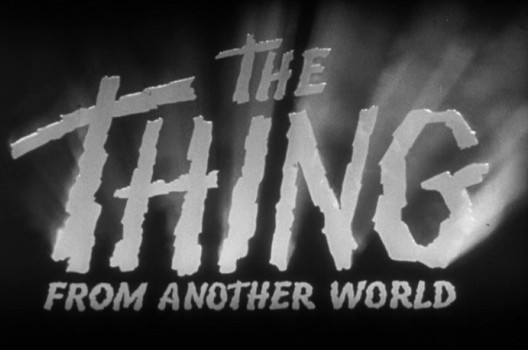
This movie gets top-billing in part because it's what the kids are watching in 'Halloween' while Jamie Lee Curtis' friends are getting killed. It's an excellent sci-fi/horror title that was remade later by John Carpenter as The Thing. While this version does not have Kurt Russell or grisly creature effects, it does have Howard Hawks behind the camera (as an uncredited co-director and screenwriter) and two scenes that will melt your fun-size Snickers: the scientists who join hands to form the shape of the UFO they found under the ice (seen in 'Halloween'), and the first time you see the monster. The lavish title sequence is also unforgettable and can also be seen in 'Halloween.'
Tales From the Crypt Presents: Demon Knight
My God, have you seen this movie? Apparently, neither have many religious groups, as they would use this movie to show that religion is actually pretty kick-ass. Did you know kids that the blood of Christ, when applied on a window or door will prevent any demons from entering? Or that there are demons lurking in the world who look like Billy Zane, and the only way to combat them is to shoot them in the eyes (apparently, pretty easy to do) or wield some divine blood? It has been said before, but this movie is much better than it should be, and is one of the most fun horror movies ever made. Zane is The Collector, a ferociously over-the-top salesman for Satan who lures people into giving away their souls. But there's something he wants even more than souls: a talisman held by a drifter that contains some of Christ's blood spilled at his crucifiction. The sparks, and blood, flies as the residents of a lonely motel are under siege by Zane and his demons. Did I mention Dick Miller, Thomas Haden Church and Jada Pinkett are in this as well, and it was directed by the same guy who made Surviving the Game?
The Monster Squad
Sadly, this gem is not yet available on DVD, and I doubt Blockbuster still stocks it. Anyone who watched HBO much in the late 80s had to have seen this about 10 times. When Dracula gets the grand idea to rule the world, he'll need the help of the Mummy, Frankenstein, the Creature and a Werewolf. Naturally, all the hijinks occur in Anytown, USA like many 80s movies and the only people on to their scheme are a gang of pre-teen cutups. 'Monster Squad' is actually a very entertaining lil' flick, with great nods to all sorts of horror movies and some very good special effects. It also contains two of the best lines the 80s had to offer: 'Wolfman's got nards!' and 'My name [cocks shotgun] is Horace!' Look for Jason Hervey (Kevin's brother in 'The Wonder Years') and the best Mummy-killing ever caught on film (why didn't anyone ever think of that?)
Transylvania 6-5000
Like The Monster Squad, this is another monster spoof movie from the 80s, with one difference: Transylvania 6-5000 is verrrrry stupid. Jeff Goldblum and Ed Belgley, Jr. play dumb reporters who are investigating sightings of Frankenstein, the Wolfman and vampires in a small Transylvanian town. Things aren't all they seem as the wolfman is very sensitive, Frankenstein just wants to play cards and the female vampire just wants sex (that's her in the picture, played by Geena Davis!). It's really just a setup for a bunch of physical comedy (mostly good, like the brilliant Dr. Jekyll/Mr. Hyde sequence) and Michael Richards moments. A movie like this would never be made again and it's hard to believe that it was made when it was. One more warning: it is verrrrry stupid.
John Carpenter's The Fog
Yes, the original and yes I really do like it. This was John Carpenter's attempt to follow up Halloween with another ground-breaking horror movie. Of course it didn't live up to 'Halloween's' standards, but what could? Nonetheless, this is a very spooky movie with excellent special effects for the era and an awesome location. The beginning is one of my favorite scenes, as a crusty old man tells campers a 'ghost story' of what actually happened to a ship of lepers at the harbor where they live. It's 100 years after that terrible incident and weird stuff starts happening, like car windows exploding and stuff falling off shelves (yikes!). But the weirdest thing is this glowing fog that starts drifting into town and killing people. There are some great 'Carpenter' moments here, like the great use of a lighthouse and the showstopping final scene (when the priest is killed) that makes the movie for me.


Thursday, October 20, 2005
If I Ran the Zoo: Making a Good 'Doom' Movie
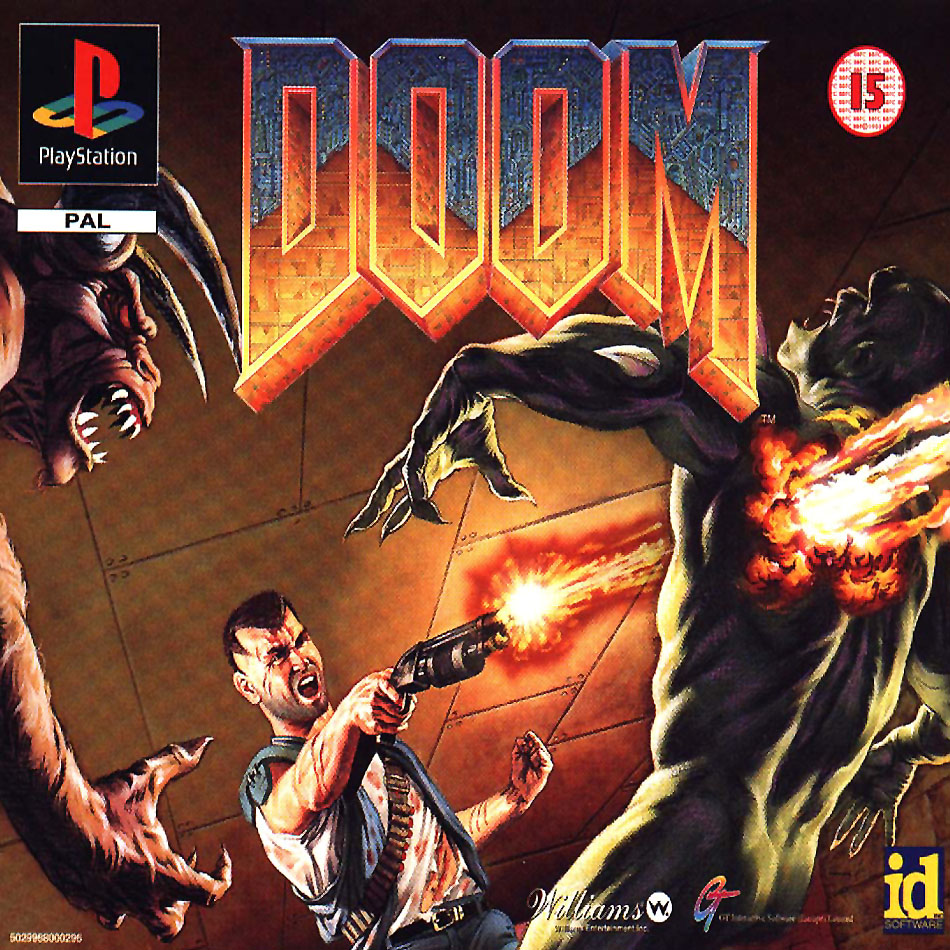
It can be done, believe me. Ever since I first played Doom, on my 100 mhz Gateway with no sound effects, I knew it could be done. After reading a couple early reviews of 'Doom,' it's clear that it missed out on its enormous potential. And I really believe there is potential here, starting with the fact that 'Doom' is the ultimate McGuffin for blowing everything up and killing lots and lots of monsters. It's a good time for a Doom movie, because the zombie resurgence is coming to a close, and 'Doom' would offer everything people like in a zombie movie (lots of shooting, hordes of monsters), only with more variety in the monsters, a more exotic location (Mars) and none of the 'drunk zombie' syndrome that happens at the end of zombie movies wherein our heroes simply start running past their pursuers. I'm pretty optimistic my game plan for a Doom movie would go over much better than what you could see in theaters now.
My reason for optimism is the ending that I've had in mind since about 1995. After you beat the first 'episode' of the game Doom, your character essentially enters Hell. To me, Hell has always been an underutilized locale for movies. There's really no right or wrong way to portray it, and if you have a guy with a chainsaw and shotgun in there blasting hooves and horns off demons, then it's all the more merrier. So here's my ending: after our hero dispenses a legion of demons and zombies on Mars, and is the only marine left, he finds the portal to Hell where all this crap has been emanating from. And what does he do? He grabs a few more guns, lights a cigarette and jumps in. The End.
To me that's the only way you can end this movie and a damn fine way if you ask me. So we have the ending, now let's work backwards, starting with the cast. The Rock is an excellent choice for the main character because he has a surplus of the credibility and camp needed to convince audiences that he can shoot his way through thousands of demons. The Rock is a good start, but we need a few people around him to make 'Doom' more appealing. We need a couple of stars who will make people say 'He's in it?' and the perfect fit for that phrase is Nick Lachey. Since he and Jessica have split up he's in the market for a career, and some fast cash, so he's in as the pretty-boy Marine who's a bit slow with the trigger and pays for it bigtime. The third tier star in 'Doom' (not a good title to own) will be Donny Wahlberg, who also needs work and will amiably fill the role of the God-fearing-explosives-expert-who-quotes-Genesis-as-he's-setting-a-bomb.
So there's our cast, now how about a story. If you don't know anything about the game of Doom, here's a refresher: guy all alone on Mars vs. zombies and demons, here's a chainsaw, good luck! This actually works in favor of the movie 'Doom' because there are no essential characters or plot points to include, which leads to my idea about the plot: very, very simple. Think 'Aliens' without any side story about Newt or exposition about what happened in the original. Most of the Marines will be killed early, followed by a Donny Wahlberg setting off a big bomb as he says 'Amen!' giving the survivors enough time to barricade the doors and listen to a few cheesy lines from The Rock. Demons pour in, they find bigger guns, a Zombie Marine attacks Nick Lachey, he hesitates to shoot him because they were childhood friends and loses his face as a result.
There will be a couple more scenes like that, including one where the mandatory Asian Marine saves The Rock's life, but his smile quickly turns to fright as he sees a huge monster creep up behind Asian Marine and eat him. The Rock somehow escapes and trips over The BFG 9000, which he uses to clear out a whole room of demons, setting up our soon-to-be-famous ending.
Would it work? I'm pretty sure it would be better than the current 'Doom' attempt. It would gain steam from word-of-mouth, especially with Lachey in it and eventually earn around $30 million before settling into semi-cult classic status on DVD. It may be a stretch, but 'Frank's Doom' would also gain notoriety for its running time of 68 minutes and unintentionally hilarious bits of dialogue from The Rock.

Monday, October 17, 2005
Top Ten 'WTF?' Movies
You know 'em. You're watching a movie with a crowd of people and cannot for the life of you figure out what the hell is going on. You want to ask someone, but wisely choose against it in fear of them pointing out your ignorance. There are some movies so rediculously hard to follow that you eventually just stop trying ('The Big Sleep'), others that are clearly not supposed to make sense ('Beyond the Valley of the Dolls') and some that are just so damn weird and inconsequential you don't even know where to start ('Orlando'). Here's ten of my favorite 'WTF?' movies, but only one of them is actually a bad movie (you'll see).
10. Miller's Crossing
This is perhaps the only movie I've seen where I loved every minute of it, yet I only understood about three of said minutes. Miller's Crossing drops you right in the middle of a complex mob prohibition plot. It feels like you wandered into a party where you only know one person, and they're discussing thermo dynamics in Mandarin Chinese. None of the characters are really introduced and while you're trying to dicypher just who the hell everybody is and what their relationships are, people are getting double-crossed and killed. But boy is this one hell of a movie. The Cohen Brothers put together a visual fiest soaked in Irish whisky (which is either being poured or drunk in every shot). At the end I was smiling but had so many questions: What exactly was Gabriel Byrne's job? Was it supposed to be tongue-in-cheek? If not then how could Albert Finney blow up a car 100 yards away from him with a Tommy gun?
9. Blow Up
Gorgeous depiction of the mod scene in 1966 London, Blow Up is full of camera tricks and lots of did-you-really-see-that? questions. When he's not photographing models and rolling around on the floor with naked teeny boppers, Thomas takes pictures of random people and generally acts like a rich, British jackass. No matter, one day he takes pictures of a couple dancing at the park, or were they? Upon closer inspection, there was a dead body in the background. Or was it? He gets a visit from the woman in the picture (or was she?) who wants the pictures back, or does she? It goes round and round as Ratt once sang until finally Thomas goes back to the park, watches some mimes play tennis and then literally disappears (WTF??!!) It does contain one of my favorite scenes, when Thomas goes into a club where the Yardbirds (complete with Jimmy Page and Jeff Beck) are playing a reworked version of 'Train Kept a Rollin' while an audience full of young hipsters are observing without emotion or any movement.
8. Dark City
One of my favorite movies, but Dark City makes the list because, like 'Miller's Crossing,' it does its best to confuse its audience in the early going. The brilliant ploy is to make the viewer just as confused as the main character, who knows nothing about the environment he was just born into. We learn about what's happening at the same rate as John Murdoch does. It's easy to get frustrated with this movie, it's also possible to see different aspects of it even after 20+ viewings, like me. But there can still be parts of it that are confusing even after so many viewings: How did Walenski 'wake up,' and why did his character not change every night? Why exactly did Murdoch get the ability to tune?
7. Beyond the Valley of the Dolls
Go into your kitchen, fill a bowl with peanut butter, vodka, cloves and cumin, beat on high for two minutes, dump it on a lawnmower then unload a few hundred rounds from a Browning Machine Gun on it. This is the closest physical representation you can get of how random, weird and maddening Beyond the Valley of the Dolls is. One of the first regular budget films Russ Meyers made, 'BVD' concerns a group of models who compose the band The Carrie Nations and their subsequent trip to Hollywood in search of riches. While there they find themselves corrupted by the weird hipsters they party with and end up in a mess of heads rolling on the floor, a murderous tranny who wishes to be called 'Supergirl' and a narrator who seems very out of place. Even stranger than the story is the style of Meyers, who seems to cut each shot about two frames before he should, which ends up looking more bouncy than some of the movie's characters.
6. Blade Runner (Director's Cut)
Not to brag, but I am one of the seemingly few who 'got' the new ending of Blade Runner. No, the oragami was not in the shape of a unicorn by accident. Yes, this new ending does kick ass. For those of you who already knew this, congrats, but I have watched this movie with enough people who had no freaking clue what the oragami meant to warrant its inclusion in this list. For directors wishing to have a 'gotcha' ending without ramming it down the audience's throat (I'm looking at you, M. Night Shyamalan), take note.
5. Orlando
This is a movie that either makes you seriously question your intelligence or simply question your imagination of how incoherent a seemingly good movie could be. Here's a cliffnotes version of Orlando: Girly-looking boy Orlando is told by Queen Elizabeth I to stay forever young and he takes those words a little close to heart. Somehow this young man does not age, but one day something even weirder happens: he wakes up and discovers that he has become a woman. She, still named Orlando mind you, goes through time experiencing all the trials of a woman (such as hearing 18th century aristocrats talk about how women aren't that smart) until finally she gives birth to a daughter in the 20th century then looks up in the sky and sees an angel that looks like herself. Credits roll. Yup, that's it. Somehow I managed not to throw my shoe at the screen.
4. Blue Velvet
Luckily, I limited this list to just one movie each from weird-masters David Lynch and David Cronenberg, otherwise this list would be entitled 'Top Ten Lynch and Cronenberg Movies,' they only make 'WTF?' movies with very little exception. Blue Velvet is my choice for Lynch. Sure, Eraserhead would have been a good pick too, but I like 'Blue Velvet' as Lynch's top 'WTF?' movie because it lures you into thinking it is actually a semi-normal movie. It starts out with a young Kyle McLachlan trying to find the owner of an ear he found in a field (we've all been there), before the plot quickly devolves into a nice blend of sadomasochism, kidnapping, Pabst Blue Ribbon, Candy Coated Clown and some affection for blue velvet. You don't think it could get any weirder after seeing Dean Stockwell do karaoke for a tearful Dennis Hopper, then you Dennis Hopper after a few hits of gas, then gain a new understanding for what a 'love letter' is before finally wondering what happened to that nice story about a boy searching for the owner of an ear.
3. Naked Lunch
There's a great 'Simpsons' gag where Bart and his friends gain fake IDs and promptly go to see Naked Lunch thinking it's a T&A flick, when they leave, Nelson remarks 'I can think of at least two things wrong with that title.' For anyone who has seen 'Naked Lunch,' this is probably the funniest line ever uttered. 'Naked Lunch' is the simple story of Bill Lee (Peter Weller) who is an average exterminator, except his wife is addicted to sniffing his roach powder, giant bugs start talking to him, he kills his wife in an attempted William Tell game, heads to Inter Zone, types reports on a typewriter that is also a large bug that talks to him, dabbles in the centipede drug trade, watches his bug typewriter eat a rival bug typewriter, chases a dominatrix maid to South America only to discover that she is really his doctor who is running an alien goo drug racket before finding his wife alive and then promptly killing her again. I mean, 'Naked Lunch' is just chock full of Hollywood cliches you see in almost every movie. 'Naked Lunch' is probably a pretty fine movie if you know anything about William Burroughs (which I do not) or if you like bugs alot (which I do not).
2. 12 Monkeys
I know, you completely understand 12 Monkeys, I thought I did too, until I tried to read this analysis of the temporal anomalies contained in the movie. Just try comprehending the seven different timelines outlined in that article before feeling dumber than your average Blockbuster employee.
1. The Big Sleep
There are many movies stranger and weirder than The Big Sleep, but there may be no movie with a less confusing and complicated plot. Although it is a truly great movie, you will dump your tub of popcorn on a loved one trying to figure out just who Sean Regan is, why (or if) he was killed, why the chauffer was killed, why the villains seem to keep switching sides and what for the love of god is Lauren Bacall's character really up to? It is nearly impossible to keep up on first viewing because the main character (Regan) is never seen and many of the biggest moments in the plot also happen off-screen. Nevertheless, there is an easy to follow love story between Bogart and Bacall that keeps this train rollin, along with some of the best Bogart dialogue you'll ever hear ('She tried to sit on my lap while I was standing up'). If you haven't seen it, just accept the fact that the plot has befuddled millions and you'll be the next.


Wednesday, October 12, 2005
Recent Viewings
Thought I'd give some updates on some of the recent movies I've seen, which have shuffled through the "Last 5 watched" list on the right.
'The Osterman Weekend'
I was interested to see this as it is Sam Peckinpah's final movie. Probably my favorite director, Peckinpah's films all had the same theme of characters who were pushed to the edge by double-crosses and back-stabbing until finally they said 'screw it, I'm doing it my way.'
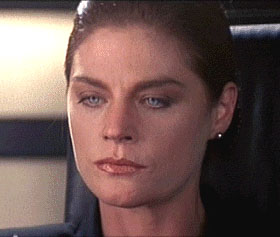
'Osterman' is no different in this respect and has a great cast of a young Rutger Hauer (a rare non-psycho role for him), Craig T. Nelson, Dennis Hopper and Burt Lancaster. You even get to see Meg Foster, who is best-known as one of the main characters in They Live, as well as having the freakiest eyes you'll ever see.
'Osterman' centers around John Tanner (Hauer), an investigative journalist who thinks he may have landed the story of his life when CIA agent Fassett approaches him and tells him of three suspected Soviet spies living in the U.S. Just one catch: they're three of John's friends who are coming over for the weekend. In exchange for Fassett coming on his show, Tanner must help turn his friends over to our side. What follows is a tense, emotional couple of days where the true intentions of Fassett are revealed.
'Osterman' holds up well because a large part of the plot is how television can manipulate the truth. Hauer and Nelson are fantastic, but I thought the movie was too short to really flesh out the overly-thick plot (adapted from the Robert Ludlum novel), which gets very confusing.
'Targets'
This movie also falls in the class of an older film that would resonate more with audiences today than when it was originally released. Peter Bagdonovich's first real turn as a director, 1968's Targets blew the doors off conservative America with a story that seems a little too realistic today.
Bobby is a clean-cut young man who, along with his wife, live at home with his parents. His existence is pure starched collar and TV dinner: he calls his dad 'sir,' is told by his mom not to stay up too late and lives in a house with nary a crumb on the floor. But Bobby also has a cache of guns in the trunk of his Mustang convertible and a brooding anger that just won't go away. One day, Bobby kills his wife and family, then heads to a water tower so he can pick people off on the freeway. His night won't be over until he heads to a packed drive-in and continues his marksmanship from behind the screen.
The other story in 'Targets' concerns the character Byron Orlock, a fictional horror actor played by Boris Karloff. Orlock is attending the drive-in that night as the premiere for his final movie and he will have a great deal to say in how Bobby's night ends.
What I liked most about 'Targets' was that there was no attempt to explain Bobby's actions. I read a synopsis that said he was a Vietnam vet but saw no evidence in the film. When he is hauled away by police, the only thing he can say is 'I barely missed!' Bagdonovich takes great care to show that Bobby appears as a wholesome person (he even packs himself a sandwich and Dr. Pepper to have on the water tower). Audiences in 1968 were probably by such a frank depiction of random violence, but viewers today would see it as reality, since such violence is depicted regularly in the media.
'Billy Jack'
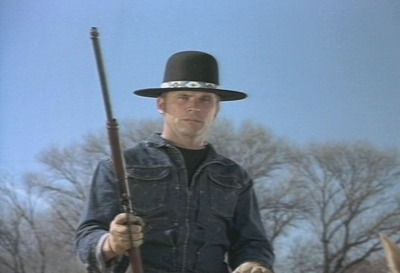
This was a nice surprise for me. I had little experience with anti-authority, pro-pacifist hippie movies, but this has to be one of the best. Billy Jack tells the story of its title character, a half white, half Indian ex-Green Beret who protects an Indian reservation and a liberal school located on it. The townies aren't too fond of the Indians, and when they try and push them out of their ice cream shops, Billy Jack is there to unleash some kung fu justice on them.
While there's plenty of action in it, 'Billy Jack' is still a hardy anti-violence movie because the Indians do not fight back as they know they cannot win and while Billy kicks his share of ass, he quickly discovers that it is a fruitless fight.
The uneasy tensions in this Arizona town come to a head when a hard-ass policeman's daughter runs away to the school on the reservation and falls in love with an Indian boy. Bad news. While trying to protect their newest student, the Indian school also tries to be accepted by the square townies, who view them as long-haired hippies.
The Indian school specializes in dramatics and actually much of the film was filmed via improvisation, giving it an even more realistic feel. Look for a young, shaggy Howard Hesseman as one of the school's performers.
'The Bank Dick'
Another nice surprise, as it was tragically my first W.C. Fields movie. It's amazing to think that Fields died two years after this was made, in 1942, because he seems so vibrant and lively in The Bank Dick. .
Watching Fields, it's easy to see the comics that have been inspired by him. The most obvious is Stephen Root's character Jimmy James on the much-loved sitcom 'News Radio,' it's almost a carbon copy of Fields' trademark bumbling annoying ways.

Monday, October 03, 2005
'Not Until the Point of Dying'

You know a movie is intensely personal to you when you feel the need to defend it whenever possible. That happens to me a lot with Once Upon a Time in the West, which is often mislabeled as slow, confusing or inferior to The Good, The Bad and The Ugly. Those descriptions could easily be true to many people, but for me 'OUTW' is a Western opera if there ever was one, a movie that should not exactly be compared with 'GBU' but rather paired with it, as they parallel each other and could be described as pseudo-sequels. When scanning through The DVD Panache Library, my eyes always stop at 'OUTW,' as watching it is such a rewarding experience no matter how many times I've seen it.
After Sergio Leone made the international smash hit 'GBU,' he naturally had to make a follow-up, and this time his ultimate vision of a Western would be put on film. His cast would be comprised of both well-known American actors (Henry Fonda, Charles Bronson, Jason Robards) as well as actors from his native Italy (Claudia Cardinale, Gabriele Ferzetti), the drawn out closeups from 'GBU' would in even fuller force this time around and the biggest leap forward from 'GBU': it would be filmed on location in America.

'OUTW,' like 'GBU' and also Once Upon a Time in America, is a tribute to the American West. Even though he was Italian, Leone saw the potential for epic filmmaking by setting stories against the background of events such as the Civil War, the Westward expansion and the early 20th century. Beneath its adventurous story, 'GBU' has a commentary on the paradoxes of war while 'OUTW' looks at how the railroad pushed aside the Old West canons that Leone cherished in his early movies.
The opening of the movie is perhaps its best known scene. It's amazing to think that a nearly silent scene of three bandits waiting for a train could be this entertaining. The creak of a windmill and the rhythm of dripping water create the opening score, while the audience gets extended introductions to the criminals who are living out the last minutes of their lives. What I love about this scene is how ugly the train station looks. There is no freshly-laid timber here like in other Westerns, rather it is old, weather-beaten and seemingly on the verge of collapse.
The story concerns a quiet stranger who comes into town on a train and how he destroys the perfectly laid plans of two dastardly barons. As in 'GBU,' there are no 'good guys' in this movie, rather a couple are a few notches less 'bad' than the others. For every character in the movie, none of their visions of grandeur takes shape, except for Bronson's character who merely wanted one man to feel the pain of all of his victims.

Cardinale's Jill arrives on a train to wed a soon-to-be-rich family man who sees the potential of the approaching railroad. Though his land is in the middle of nowhere, it has the only water source for miles, in the exact spot where the train is coming through. But Jill never sees the McBain family again, because they are brutally killed by Frank (Fonda) and his gang as they are setting up a picnic for her arrival. Frank, together with the railroad baron Morton (Ferzetti) planned to strongarm the family estate away, but they didn't count on Jill having legal ownership of the plot since she and Brett were secretly married in New Orleans before she made the trip out west.
Matters are further complicated when Bronson's mysterious character arrives. Known only as "Harmonica" because of his musical instrument of choice, Harmonica comes to town seeking vengeance on Frank for all of his victims in his earlier years.
The last side in this twisted triangle is Cheyenne (Robards), a bandit who just escaped his captors and is looking to benefit in some way from all the double-crossing that is sure to go on.
It is an intricate and at times confusing plot that is wrapped up in cinematography and a score (believe it) that rival GBU. Yes, I said the score is better than the legendary GBU 'wahh wahh wahh.' While Ennio Morricone's classic riffs for GBU are more widely recognized, I prefer the more diverse themes in OUTW, which are more varied and seem to fit their respective characters perfectly. Leone thought so much of Morricone's score that at times he 'set' the movie to his notes. There is a scene of Cheyenne riding off and his horse's steps are right on cue with his theme's tempo. George Lucas famously used this technique in The Empire Strikes Back when the Milennium Falcon is leaving Cloud City (the laser blasts are set to the score).

The cinematography takes on a life of its own not only because it was filmed in the famous Monument Valley in Utah where John Ford shot many of his films, but also because of the perfect sets. Leone's Wests are rough, decaying visions and OUTW does not disappoint in that department. The roadhouse where Jill meets Cheyenne is no saloon, rather it's closer to a barn than anything. Brett McBain's estate is imposing but certainly no mansion and Frank's gang's hideout is literally a cave.
There isn't too much dialogue in OUTW by design, Leone always wanted his characters' faces to do the talking, and they have a lot to say. This is the reason for the shockingly high amount of closeups, especially of Bronson and Fonda. Many viewers are turned off by this technique, but to me the eyes of these two actors say more than their mouths ever could. Fonda's baby blues were always the picture of wholesome America before Leone got ahold of him and filled them with unrelenting evil. Bronson's steely green eyes show a broken, driven man who will only be satisfied with the death of Frank.
But the most vital character in OUTW doesn't even get a credit: the railroad. In every scene we see Morton's locomotive there is a distinct steam engine sound that sounds like it is breathing. Leone used this to convey the animal nature of the railroad at the time, how it was gobbling up the previously untamed west and moving at a breakneck speed.
It's hard for me to pick a favorite scene in OUTW, but it has to be a small series of scenes beginning immediately after the McBain auction. Frank finally has a chance to sit down with Harmonica and try to figure out just who the hell he is. Instead, Harmonica frustrates him even more by repeating more names of his victims and showing that he will not be bought off. This sets up the blockbuster scene that follows, with Harmonica hanging out in Jill's hotel room (as she sits in a bubble bath), he watches Frank leave the saloon and walk into an ambush by his own men. Rather than watch him die, Harmonica subtlely gives off their hiding places to Frank and actually saves his life. Why? Harmonica didn't travel this far to see someone else knock off Frank.